Axios Cities

October 09, 2019
Welcome back!
- Was this newsletter forwarded to you? Sign up here.
- I'd love your tips and feedback. Just hit reply or find me on Twitter — @khart.
- “Axios on HBO” Season 2 returns 6 pm ET/PT Sunday, October 20th on all HBO platforms. Tune in: Oct. 20 & 27 + Nov. 3 & 10.
Today's newsletter is 1,775 words, about a 7-minute read.
1 big thing: Rent control redux
Illustration: Sarah Grillo/Axios
California Gov. Gavin Newsom yesterday signed legislation capping annual rent increases at 5% a year plus inflation for the next decade.
Why it matters: California is the third state this year to pass major renter protections in response to sky-high housing costs, a surge of homelessness in major cities and an outcry from residents who feel they are at the mercy of greedy landlords.
- New York State lawmakers increased rent controls in New York City just before they expired, and also allowed other towns to do the same.
- Oregon made big news in March when it became the first state to impose a statewide permanent rent cap of 7% a year plus inflation.
- In California, Newsom also signed legislation Tuesday that prohibits landlords from rejecting prospective tenants because they have Section 8 housing vouchers.
San Francisco and Los Angeles — where buying a house is increasingly out of reach and residents feel priced out of many rental properties as well — have become embodiments of a national housing crisis.
- President Trump has repeatedly ripped into San Francisco for the rapid rise of homelessness, last week referring to it as a "tent city."
- Nationwide, more than 21 million households (about half of American renters) spend more than 30% of income on housing — a threshold that HUD determines to be a high-cost burden.
- Newsom said rent caps are an important first step in addressing the high cost of housing, but more needs to be done. “We need to build more damn housing,” he said.
The other side: Most economists and property investors loathe rent control, arguing that it stops new construction and discourages landlords from maintaining their properties, causing an already tight supply to deteriorate.
- "The bill represents the implementation of a failed policy that does nothing to increase the supply of housing affordable to all income levels," said National Apartment Association CEO Robert Pinnegar.
- "It is no coincidence that three of the nation’s most expensive places to live, including San Francisco, New York and D.C., continue to grapple with housing affordability despite their long-standing rent control ordinances," he continued.
Between the lines: Plenty of academic research over the past three decades shows long-term problems associated with rent control, and local leaders tend to avoid interfering with private property issues.
- But ridiculous rents mean unhappy constituents. Valuable workers flee to cheaper cities. People end up living on the streets. Rent control is a relatively quick way for lawmakers to take action as tensions rise.
Go deeper: Curbed LA has more details about the new law, including its exemptions.
Bonus: The states with rent control


California makes two states with statewide caps on rent increases. About half of the states preempt rent control measures.
2. Mayors announce Global New Green Deal

Jamie Margolin, founder of Zero Hour, Eric Garcetti, mayor of Los Angeles and Anne Hidalgo, mayor of Paris, attend a press conference at the Copenhagen City Hall in conjunction with the C40 Mayors Summit on October 9, 2019. Photo: Liselotte Sabroe/Ritzau Scanpix/AFP via Getty Images)
Mayors from 94 cities committed to cutting emissions from the sectors that most contribute to climate change (transportation, buildings, industry and waste) to keep global temperatures below the 1.5-degree Celsius goal of the Paris Agreement.
The big picture: The Global New Green Deal was announced today at the C40 Mayors Summit in Copenhagen. Despite the U.S. federal government pulling out of the Paris Climate Agreement, cities have committed to meeting greenhouse gas reduction goals.
"As mayors, our primary responsibility is to protect the lives and livelihoods of our citizens. Climate change now represents the greatest threat to their security, public health and prosperity," said Frank Jensen, Lord Mayor of Copenhagen, in a press conference.
- He added that Copenhagen wants to be the first carbon-neutral capital city by 2025, and carbon emissions are down 40% since 2005.
What's next: Cutting global emissions in half by 2030 is necessary to void the worst impacts of the climate crisis, experts say. That means setting strict building codes, replacing fossil fuel energy sources with clean alternatives and dramatically reducing waste.
- Los Angeles Mayor Eric Garcetti said we are entering a "make-or-break decade."
- "Far from being in conflict, working on the ecology and economy go hand in hand. These two things are inextricably linked. In fact, we can build a more sustainable city at the same time we protect workers and create new careers," Garcetti said.
3. The striking upward mobility gap between black and white men


The fastest-growing cities in the U.S. may be adding lots of jobs for well-off people, but many have low rates of upward mobility for lower-income kids growing up there.
- And it's especially bleak for black males, according to Raj Chetty, Harvard economics professor and director of Opportunity Insights, a research and policy organization.
Why it matters: The extent of racial disparities and economic mobility "is so extreme in the U.S. that it's almost like they're two Americas," Chetty said about the maps above.
- The places that have the very highest rates of mobility for black men, like Boston, actually have lower rates of upward mobility than the very worst places of upward mobility for white men, like Charlotte.
- Chetty's research showed that job growth and investment happening in Charlotte and Atlanta, for example, aren't creating opportunities evenly, and black male youths are disproportionately being left behind.
What they did: The researchers analyzed outcomes of about 4 million families that moved across neighborhoods and tracked the outcomes of children of low-income parents over 30 years.
What they found: Childhood environments are stronger indicators of upward mobility than where individuals go to college or move as young adults.
- Moving to a better neighborhood at a very young age correlated with much stronger upward mobility as adults. In fact, every extra year of exposure to better childhood environments improved outcomes.
Downward mobility is also critical. White men from affluent families are likely to stay affluent as adults. But black men from affluent backgrounds are nearly just as likely to end up in the bottom tier of the income distribution than the top tier.
"If you think of achieving the American dream as climbing an income ladder for white Americans, it’s more like being on a treadmill for black Americans. Even after you've made the climb up in one generation, there are tremendous structural forces that tend to push you back down in the next generation and you have to make the climb again."— Chetty, speaking at the Results for America Summit in Washington, D.C.
And the disparities are likely to worsen over the next decade.
- By 2030, African American workers stand to lose hundreds of thousands of jobs as a result of increased automation, widening the racial wealth gap and weighing down overall U.S. growth, according to a report from McKinsey & Co.
The bottom line: A strong national economy only goes so far. The most important factor in determining upward mobility is the conditions in the half-mile radius around where you live, Chetty said.
- "While we often think of the decline of the American dream as a national problem — a challenge we’d like to solve through federal policy solutions — I really think the roots of these issues are at the very local level."
Go deeper:
- Explore the map (Opportunity Insights)
- Automation to hit African Americans disproportionately (Axios)
- The punishing reach of racism for black boys (NYT)
4. Airports embrace renewable energy to cut air travel emissions

Illustration: Sarah Grillo/Axios
Airports in the U.S. are attempting to reduce emissions by replacing equipment with electric- and solar-powered technology, Christine Weydig writes for Axios Expert Voices.
Why it matters: Air travel accounts for 2% of global emissions, and cities and public agencies are uniquely positioned to use their relationships with airlines and terminal operators to impact emissions reduction practices at the airports themselves.
What’s happening:
- Airport operators in New York City, Washington State, Chicago and Boston are partnering with airlines including JetBlue and United, and making use of federal funding including a Federal Aviation Administration grant and an EPA grant to deploy electric-powered ground service equipment and charging infrastructure.
- The major New York City-area airports, JFK, LaGuardia, and Newark, plan to convert to 100% electric shuttle bus fleets in the next year.
- Airports in Chattanooga and Indianapolis have built solar farms to displace conventional electrical grid supply. JFK is developing solar generation for both on-site consumption and to supply clean energy to surrounding communities.
What to watch: Achieving carbon neutrality is the next big milestone for airports to reach in reducing emissions.
- But, but, but: The achievement of carbon neutral status at airports is controversial because it is virtually impossible to attain without the purchase of carbon offsets.
- The Airport Carbon Accreditation program has awarded just two airports in the U.S, Dallas-Fort Worth and San Diego, with complete neutrality.
Christine Weydig is the director of environmental and energy programs at the Port Authority of New York and New Jersey.
5. States add to Big Tech's headaches
Illustration: Sarah Grillo/Axios
Already facing antitrust and privacy enforcement actions from governments around the globe, major tech companies are now grappling with a slew of new potential threats from individual states.
Why it matters: Local governments are more nimble and have higher levels of public trust than Congress, so they have more latitude to get laws passed quickly.
- That's a problem for tech companies that are trying to shore up public trust while also fighting back an array of regulatory assaults.
- "From a reputation perspective, you'd hate to have local officials who are generally more trusted gunning for you," says Washington lobbyist Bruce Mehlman.
The big picture: State attorneys general have been particularly active under the Trump administration, acting unilaterally to go their own way in some cases, and uniting to fight Washington in others.
At the state level, populist movements on the right and the left may converge on some tech-related issues, such as perceived partisan bias and business market dominance.
- Cities and states are also showing an appetite for intervening in the gig economy, which is expected to have ripple effects far beyond firms like Uber, Lyft and DoorDash.
The bottom line: Many people don't feel protected from the rapid pace of technological change, and have also lost trust in the establishment, Mehlman said. "So you have a rise of permission-less players who no longer think Washington should be the locus of global leadership."
Go deeper:
6. Urban files


Fanning California's climate change flames☝️(Axios)
America's hottest cities for urban planners (CityLab)
Why this ex-con mayor is running away from reporters (NY Times)
Tracking the 2019 mayoral elections and the candidates' platforms (Smart Cities Dive)
U.S. foreign-born gains are smallest in a decade, except in Trump states (Brookings)
Limited broadband hurts economic mobility in poorest states (Axios Expert Voices)
Quoted:
"We need to divert resources away from things that are destroying our planet toward those things — job creation, infrastructure, adaptive technologies — that will enable those most affected and most vulnerable."— Yvonne Aki-Sawyerr, mayor of Freetown, Sierra Leone, speaking in Copenhagen
7. 1 sad thing: Climate change ravages Montana forests
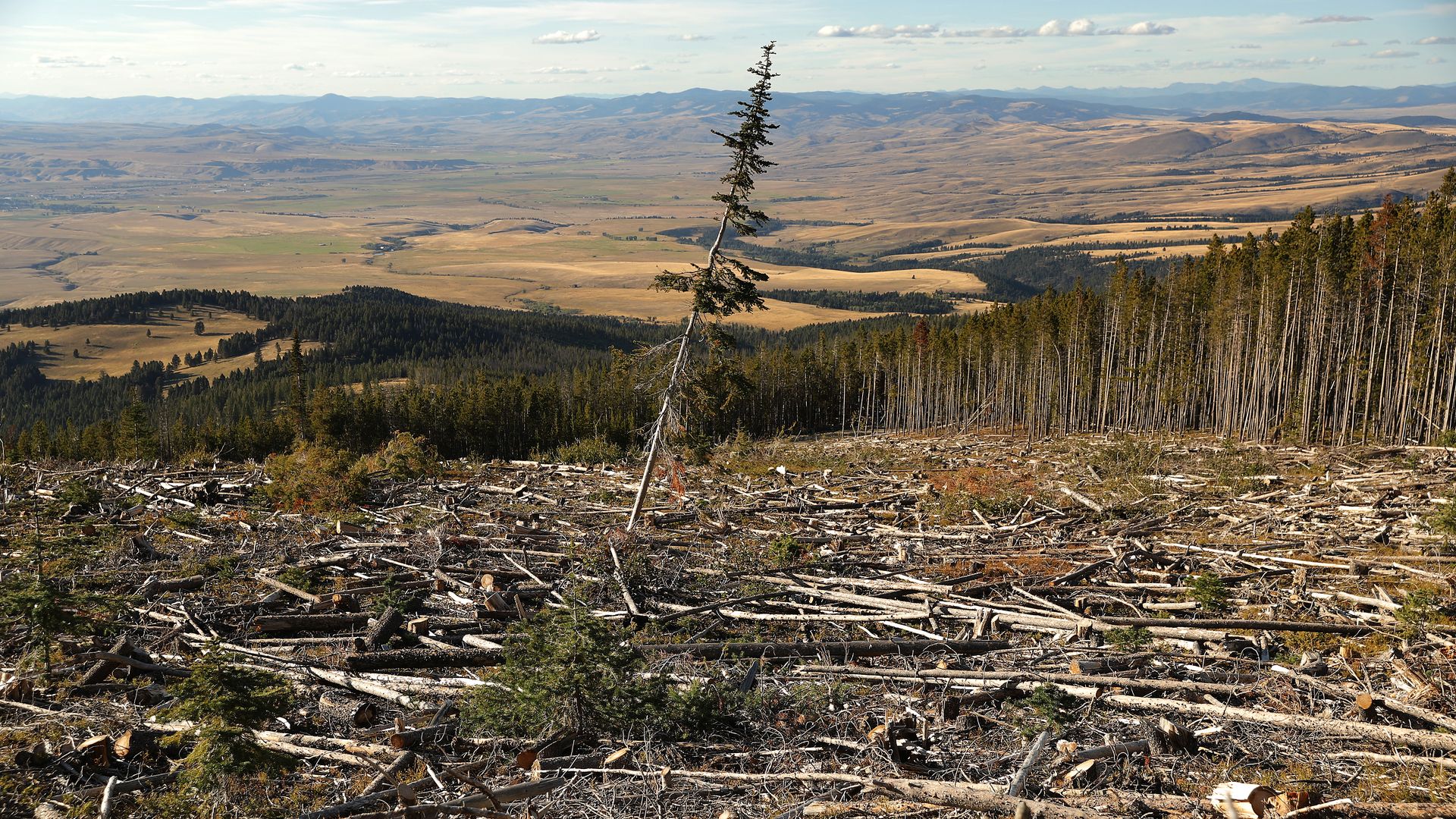
A lone lodgepole pine stands in an area that was logged after an infestation of the mountain pine beetle killed most of the trees in the stand in Beaverhead-Deerlodge National Forest near Deer Lodge, Montana. Photo: Chip Somodevilla/Getty Images
The annual average temperature in Montana has increased 2.5 degrees Fahrenheit since 1950 and is expected to increase by about 3 to 7 degrees by the middle of this century, according to the 2017 Montana Climate Assessment.
The impact: Hotter, drier summers in the Northern Rockies are raising threats of wildfires and insect infestations, including the mountain pine beetle outbreak that peaked in 2012. The bugs have killed more than 6 million acres of forest in Montana since 2000.
Go deeper: National Geographic made this short film on the beetle outbreak.
Sign up for Axios Cities

Explore the technology and market forces shaping our cities