Axios China

November 29, 2022

Welcome back to Axios China. Today I'm looking at how netizens are fighting China's online censorship of the COVID protests plus how a Tiananmen leader sees the current protests, Chinese laborers abroad, and lots more.
- Forward this newsletter to friends and colleagues who are interested in China. They can subscribe to receive Axios China every Tuesday.
Today's newsletter is 1,638 words, a 6-minute read.
1 big thing: The fight against China's protest censorship
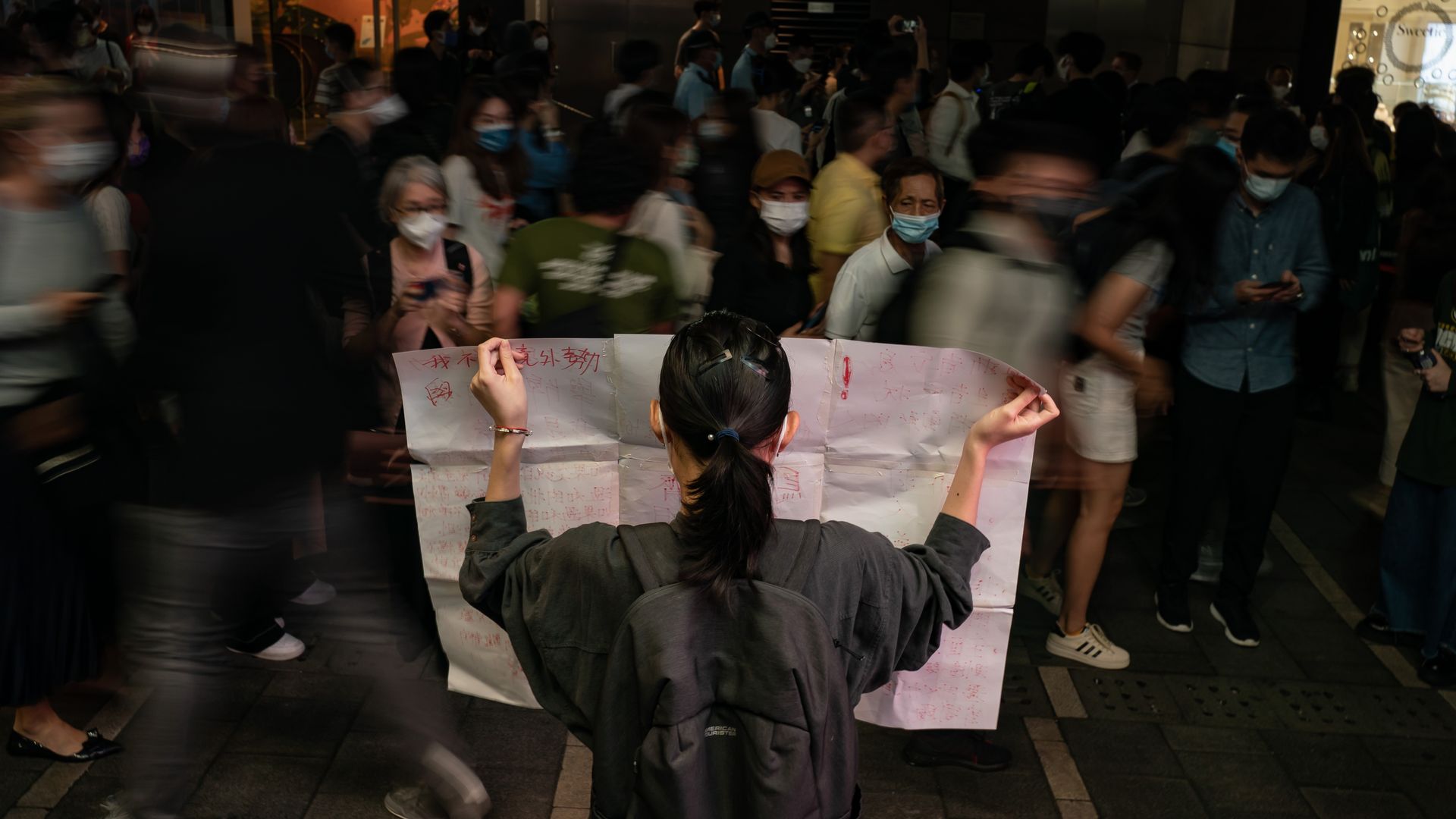
A resident holds a sign in protest of COVID restrictions on the mainland during a vigil on Nov. 28 in the central district in Hong Kong. Photo: Anthony Kwan/Getty Images
Amid an unprecedented swell of public anger against the Chinese government, internet users in China are racing to screenshot and repost content related to the COVID protests as censors try to scrub social media spaces of dissent.
Why it matters: Videos and photos posted to social media are one of the only ways to get information about the protests, as information is tightly controlled in China and journalism in the country is heavily restricted.
Driving the news: These protests — the largest since the Tiananmen pro-democracy movement in 1989 — have been spreading across China in response to pandemic policies that have seen people locked into their apartments for weeks or even months at a time, damaged the economy, and made daily life uncertain for hundreds of millions of people.
- When asked at a press briefing on Monday if China would end the zero-COVID policy due to the protests, Chinese Foreign Ministry spokesperson Zhao Lijian said, "What you mentioned does not reflect what actually happened."
- He added that China would continue to adjust its policies in line with its stated pandemic prevention measures.
State of play: On Monday, Chinese authorities flooded previous protest areas in Beijing, Shanghai and Hong Kong with police vans and security forces to preempt further demonstrations.
- Some universities, also the site of numerous protests, announced they would close early for Lunar New Year so students would return home.
- The measures seemed to have an effect, as protesters in Beijing and Shanghai did not return to previous demonstration sites on Monday night.
- Online censors deleted social media posts and articles about the protests, while official media did not cover them. On Twitter, which is not accessible in China, a deluge of spam posts appeared under hashtags related to the protests, making it more difficult to use Twitter to track what was happening, per the Washington Post.
What's happening: One former Shanghai resident surnamed Wang told Axios she has been staying up late every night since Friday grabbing screenshots of articles and social media posts about the protests, posting them on WeChat, and sending them to friends so the posts can still be viewed in China.
- "None of this is organized. There’s no group chat of us saying we should screenshot this before it’s deleted," said Wang, who moved to Taipei a few months ago and asked to withhold her full name in order to protect family and friends in China.
- Over the weekend, countless Chinese social media users posted and reposted messages intended to convey clear dissent but circumvent censors, such as lines of black squares in place of words or including speeches by Chinese officials.
The big picture: "While the Chinese people haven’t had a choice, they have had a system that they basically trust," Wang said. Many surveys find Chinese people have high trust in their government but other data describes a diversity of views.
- Wang lived through the two-month-long Shanghai lockdown earlier and described the experience as "collective trauma," with no end in sight.
- "To have a government that you trust betray you to this degree, and to betray your compliance to the system, why are we surprised that people are angry?"
What to watch: Chinese authorities relaxed some COVID restrictions on Monday but show no signs yet of abandoning the policy completely.
- "If the protests result in the end of the zero-COVID policy but not the end of authoritarianism in China, the protests have still succeeded because they improved the people’s lives," Wang told Axios.
Go deeper: How a blank piece of paper became the symbol of China's protests
2. "So much hope:" A Tiananmen leader on China's COVID protests
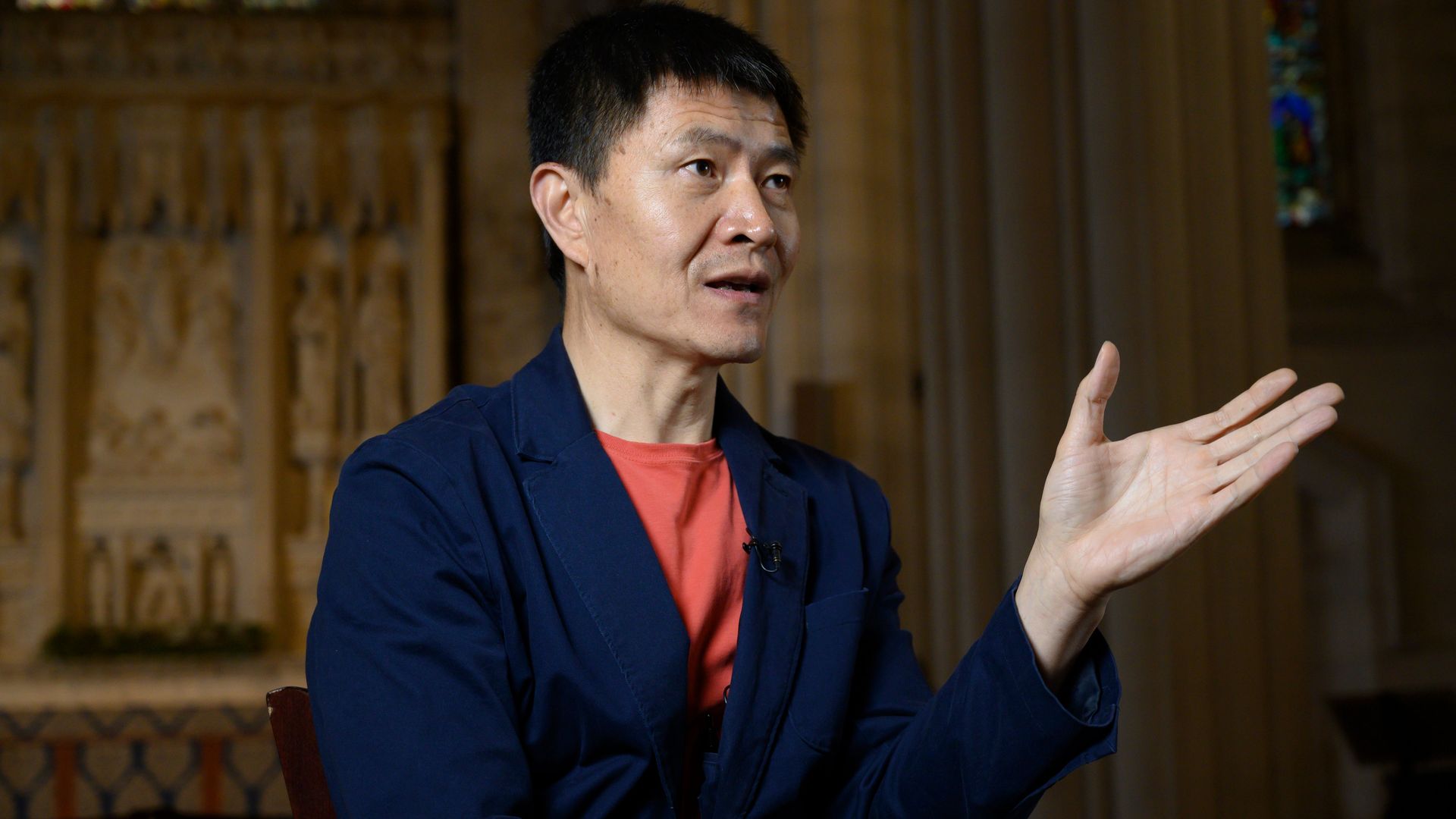
Zhou Fengsuo answers questions during an interview on May 7, 2019, in New York. Photo: Don Emmert/AFP via Getty Images
Zhou Fengsuo, a student leader during the 1989 pro-democracy movement, told Axios he was moved to tears by the historic protests in China over the weekend.
The big picture: The last time large-scale demonstrations rocked China was 33 years ago, during the nationwide mass protests that ended when the Chinese government sent tanks to Tiananmen Square, killing hundreds of young pro-democracy activists.
What he's saying: "I was in tears so many times the last few days. It's just so amazing," said Zhou, who now lives in the United States where he runs the nonprofit Humanitarian China.
- The COVID protesters are going through a similar emotional journey as those in 1989, Zhou said.
- It starts with "struggling with fear, but feeling this urge to do something," Zhou said. "And then you step out, and you realize there are more people like you, and that's very energizing."
On whether or not the protests will damage Chinese leader Xi Jinping's standing within the party:
- "I don't think it matters because he has absolute control," Zhou said.
- "This shows the advantage of a democracy. If we have bad leaders, there's a way to correct. ... Whereas in China, ... who is there to challenge him?"
What to watch: It's still early stages and thus impossible to know what the future of the current protests will be, but Zhou said people are already worrying about how the party will react.
- "This is a regime that has no regard for human life," he said. "There's no rule to guess what they would do."
3. Catch up quick
1. The Federal Communications Commission announced it adopted new rules banning U.S. sales and imports of new Huawei and ZTE telecommunications devices out of national security concerns. Go deeper.
2. Canada unveiled its long-awaited Indo-Pacific strategy, which vows to combat China's foreign interference and opposes unilateral changes to Taiwan's status quo, CTV News reports.
3. The U.K. banned Chinese-made surveillance technology from government buildings and other sensitive sites, Politico reports.
- The ban follows a national security review that found Chinese companies making surveillance cameras are subject to China's national security law, which requires Chinese entities to hand over data and assist with national security investigations upon government request.
4. The Hong Kong government has asked Beijing to intervene after a court ruled that a British lawyer could represent media tycoon Jimmy Lai in his national security trial, the Wall Street Journal reports.
- Analysts say Beijing's intervention would jeopardize the court's independence.
5. The Vatican said China has violated a secret bilateral agreement regarding the appointment of bishops, Reuters reports.
4. Report: Chinese workers overseas trapped in state-backed projects
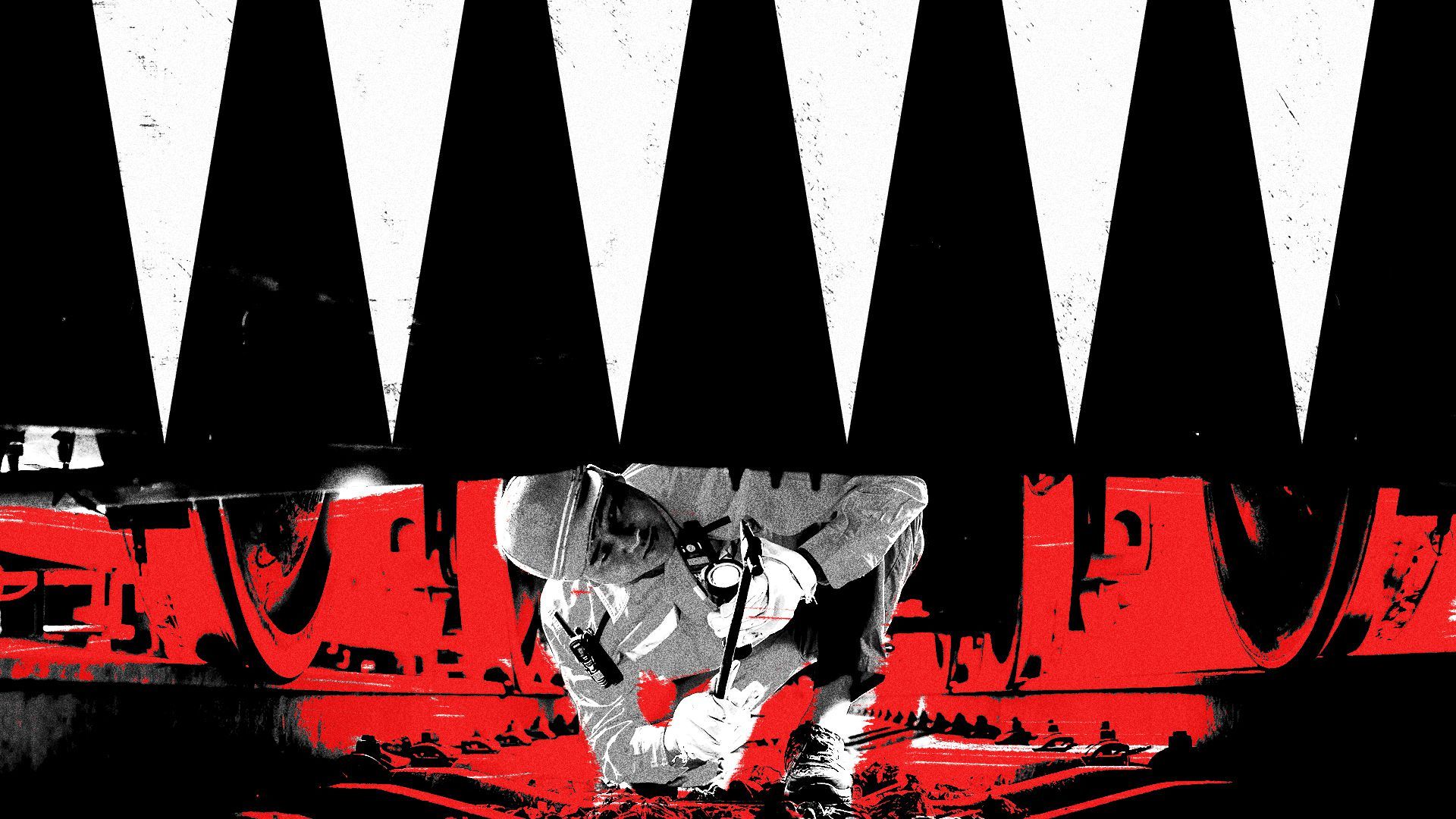
Photo illustration: Shoshana Gordon/Axios. Photo: Wang Guansen/Xinhua via Getty Images
The Chinese government and international labor laws have failed to protect Chinese laborers working in state-backed infrastructure projects overseas, according to a new report.
Why it matters: Overseas workers can be caught in a no man's land between China's labor laws and those of host countries, putting thousands of workers at risk of exploitation, Axios' Han Chen writes.
What's happening: Chinese laborers working on Chinese state-funded infrastructure projects abroad may be subject to deceptive job ads, passport retention, wage withholding, physical violence and lack of contracts, according to the report by U.S.-based nonprofit China Labor Watch.
- Such experiences indicate forced labor, according to the UN's International Labor Organization. The agency declined to comment for this story.
What they're saying: "The Chinese government bears the primary responsibility for the forced labor and abuses among its overseas workers," Li Qiang, founder and executive director of China Labor Watch, told Axios, adding that a goal of the report is to influence China's labor policies.
- "Beijing seems to have shifted the blame to individual companies, but it's very important to note that these BRI projects are backed by the state," he added.
Details: China Labor Watch contacted more than 2,000 workers in eight BRI countries for this report, including Algeria, Serbia and Indonesia.
- In a survey of more than 300 Chinese workers employed at several companies in Indonesia, the group found a clear pattern of labor abuse. About half of the workers reported no income at the time, and nearly 60% of them were working illegally on business, tourist or investment visas, the report said. The Indonesian Ministry of Manpower didn't respond to requests for comment.
- Many workers told China Labor Watch that they tried to file complaints with the Chinese consulates in their host countries, but they were told to negotiate with employers themselves, the report noted.
- Chinese workers at a copper mine in Serbia told local media BIRN last year they worked 12 hours per day and were otherwise confined to their living quarters. They also said they were forced to hand over their passports.
What’s next: The report called on the U.S. to pause or prohibit the import of goods provided by companies suspected of using forced labor or human trafficking as part of the BRI.
5. What I'm reading
Big brother in the Balkans: Serbia's legal tug of war over Chinese surveillance technology (Radio Free Europe/Radio Liberty)
- In the photos and videos from protests in Serbia in 2021, "what appeared to be plainclothes police can be seen filming crowds of protesters with a device that Serbian authorities later said was a Huawei EP 821 trunking terminal — equipment increasingly used by Chinese security forces that Serbian police bought from China as part of a security-cooperation agreement."
- "The appearance of the Huawei device in the hands of alleged law enforcement officers triggered accusations that officials had begun using facial-recognition technology to identify protesters, despite there currently being no law that allows its use."
6. 1 Taiwan thing: A new Chiang in Taipei
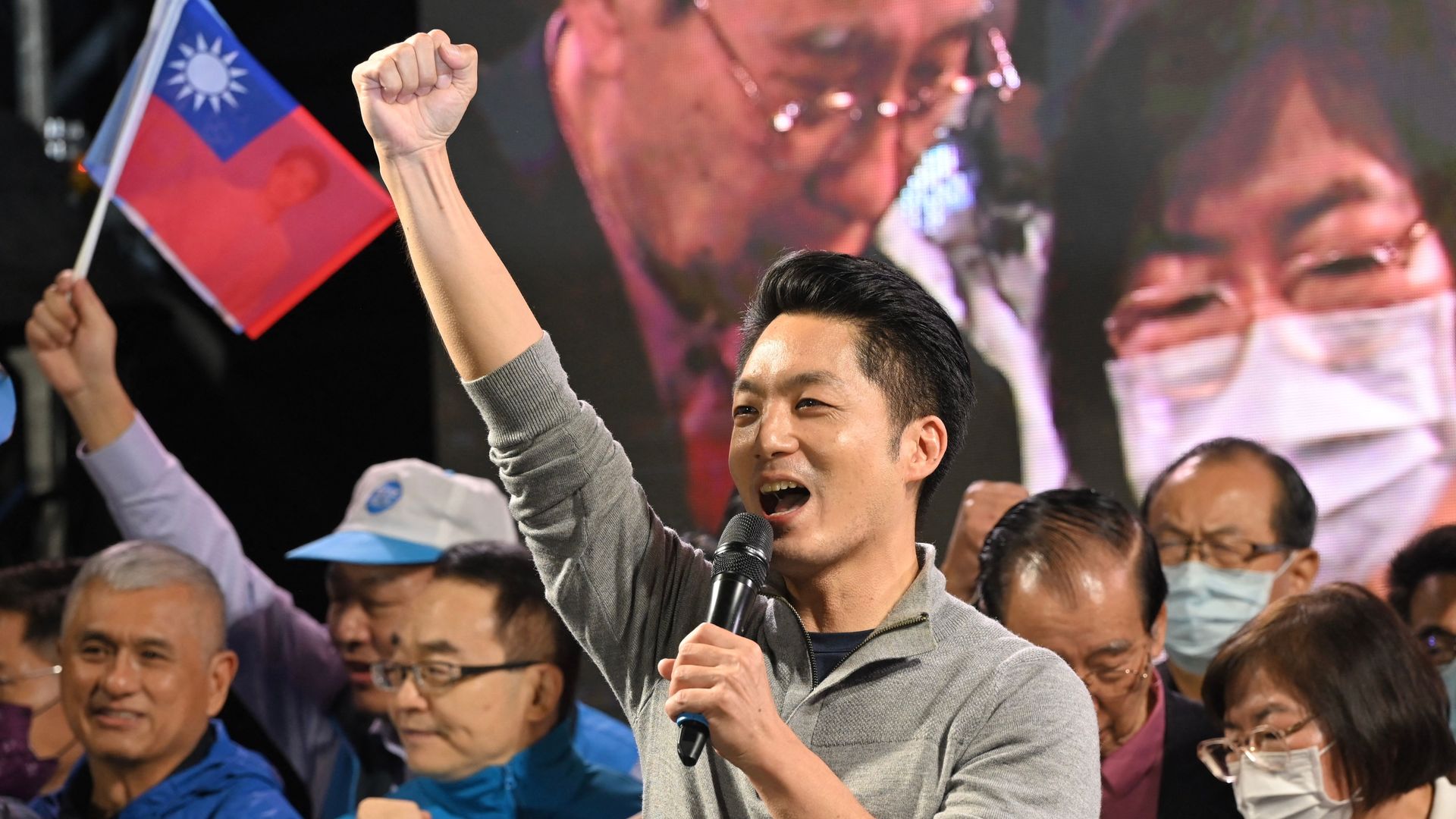
Chiang Wan-an waves after winning the Taipei mayoral election during a rally in Taipei on Nov. 26. Photo: Sam Yeh/AFP via Getty Images
Seven decades after Chiang Kai-shek retreated across the Taiwan Strait to Taipei, the former dictator's great-grandson was elected Saturday as mayor of the Taiwanese capital, Axios' Dave Lawler writes.
The big picture: That was the biggest in a series of local election wins for the Kuomintang (KMT), which was the only legal party in Chiang Kai-shek's day but has more recently floundered in opposition to the tough-on-China Democratic Progressive Party (DPP).
- President Tsai Ing-wen stepped down as DPP chair after Saturday's setbacks, which analysts attributed more to pandemic fatigue and economic concerns than to the China issue, on which the KMT lacks a coherent position.
- Chiang Wan-an, the new mayor, was a corporate lawyer in the U.S. before returning to Taiwan and entering politics.
A big thank you to Alison Snyder for edits, Sheryl Miller for copy edits, and Han Chen and Dave Lawler for contributing.