Axios China

August 15, 2023

Welcome back to Axios China. Today we're looking at China's looming debt crisis, unemployment data, the U.S.-South Korea-Japan summit, and lots more.
- 🚨We'll be sending out a special edition of Axios China on Sunday, with the second installment of our investigative series China's Shadow War.
- Axios China will be off next Tuesday and will return to your inbox on Aug. 29.
Today's newsletter is 1,275 words, a 5-minute read.
1 big thing: Beijing's dilemma in trying to manage debt crisis
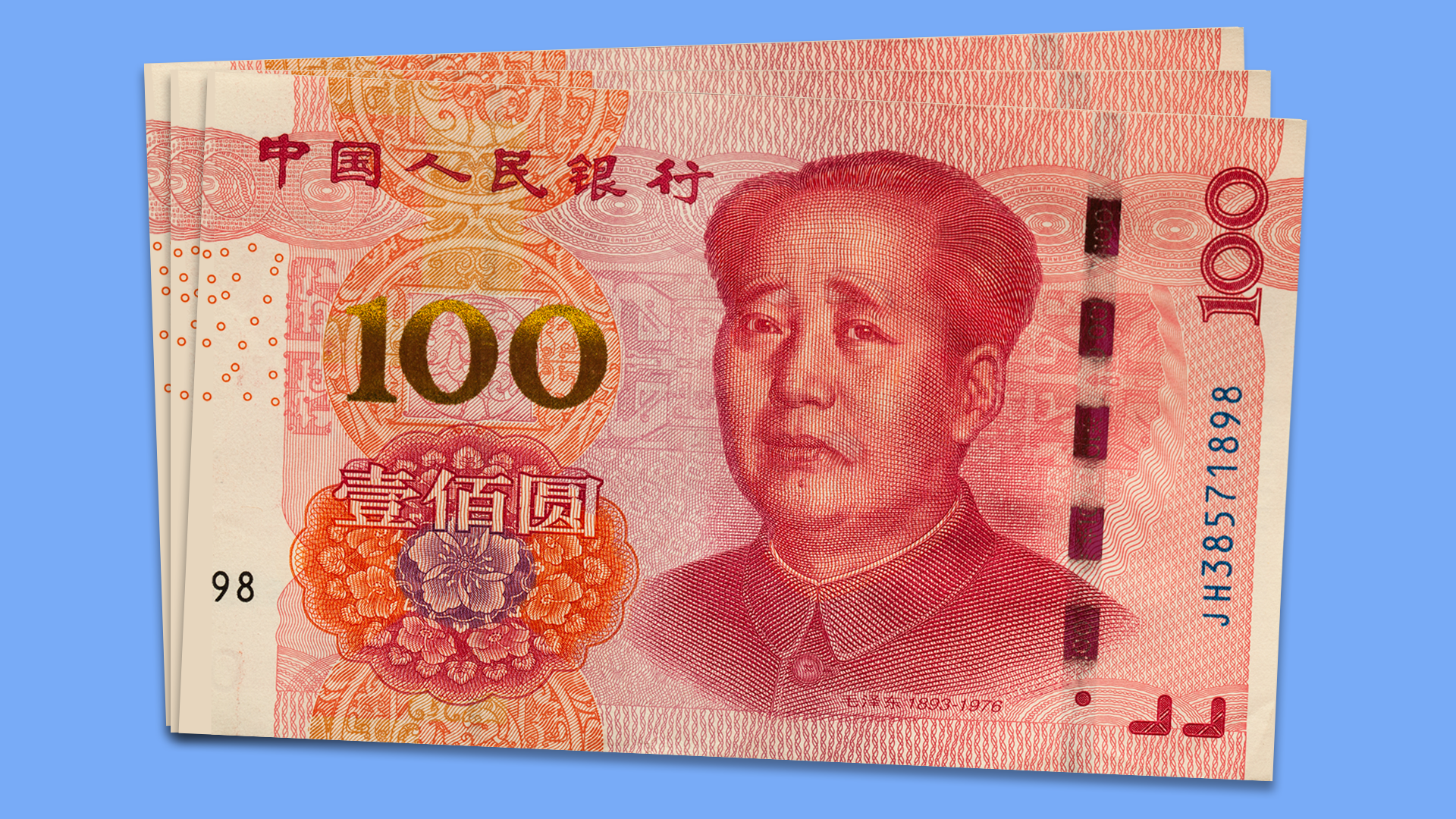
Illustration: Sarah Grillo/Axios
Beijing is caught between rolling out more stimulus to prop up the Chinese economy, or pulling back government incentives that fueled the real estate bubble — and risking a deeper economic slowdown that could create social unrest, experts say.
Why it matters: China has already reported a slew of weak economic data. A collapse in the financial and real estate sectors could plunge the country into recession.
- Mismanagement of a real estate debt crisis could cause a sustained period of stagnation like the one Japan experienced in the 1990s.
- A recession in China could also have vast ramifications for the global economy.
What's happening: China's central bank unexpectedly cut interest rates on Tuesday for the second time in three months, Bloomberg reports, as fresh economic data showed deepening economic challenges.
- But analysts say the Chinese government is unlikely to take stronger measures to prop up the country's economy and real estate sector.
What they're saying: "Deep down, Beijing wants to deflate the sector," Louis Lau, a director of investments at U.S.-based Brandes Investment Partners, tells Axios. "Right now the government is trying to do as little as it can without provoking social unrest."
- Protests broke out in more than 100 cities last year as mortgage owners demanded that developers finish the apartments they had already paid for, sometimes years in advance.
Background: Years of central government stimulus encouraged a flurry of infrastructure and real estate development in cities across China, which in turn created rapid economic growth.
- Local governments often took out loans to pay for expensive and sometimes wasteful infrastructure projects. Many of the developers that bought that land are now deep in debt themselves.
- These policies created a huge real estate bubble, which analysts for years have predicted was unsustainable.
That bubble finally seems to be bursting. Economic damage from China's zero-COVID policy, as well as heavy-handed government meddling in the tech sector and other major industries, have driven down growth.
- China's economy is also facing deflation risk, which can make debt worse.
- "Deflation means the real value of debt goes up," David Dollar, a senior fellow at the Brookings Institution, told Insider. While high inflation can actually help relieve the burden of debt over time, he said, "deflation does the opposite."
What to watch: "I think the industry will remain in a state of life support for quite some time," Lau said.
2. China stops releasing youth unemployment data amid slowdown
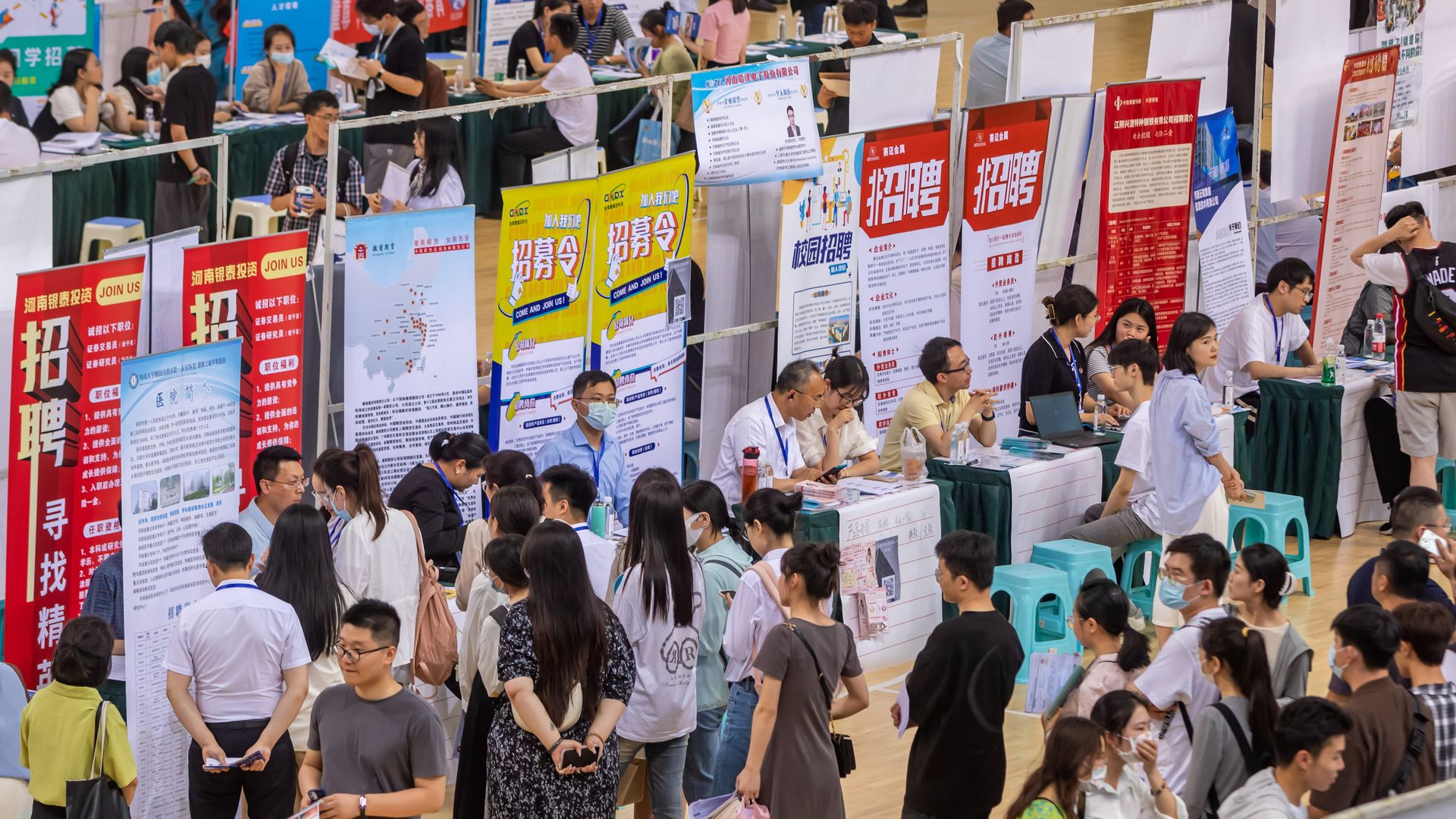
Students look for employment opportunities at a job fair at Zhengzhou University on June 7. Credit: Feature China/Future Publishing via Getty Images
China's National Bureau of Statistics has stopped releasing data on the unemployment rates of young urban people, per the BBC.
Why it matters: Recent sky-high youth unemployment in China — more than 20% — is an indicator of the country's serious economic troubles.
- The data had been released regularly since 2018.
Between the lines: Beijing has a history of obscuring inconvenient data.
- As COVID-19 swept China in the latter half of 2022, the Chinese government's official figures on the number of COVID-related deaths remained unrealistically low.
- Months later, authorities also chose not to release cremation data, useful for calculating the number of deaths, for that same period.
- Authorities recently told Chinese economists to downplay negative economic news and focus on positive trends.
The big picture: The high unemployment among urban youth is caused in part by a "college bubble," meaning there are more young people earning college degrees than there are skilled jobs for them to fill, experts say.
- Graduating now, as China's economy is slowing, makes the job search even harder.
Yes, but: Overall unemployment in China remains relatively low, at 5.3%, according to data released in July.
3. Catch up quick
1. Taiwan's current vice president and presidential election frontrunner William Lai called on the world to fight authoritarianism, in a speech in New York during a brief stopover in the U.S., Reuters reports.
2. The Biden administration banned some outgoing U.S. investments to China's technology sector to prevent China's military from gaining an edge over the U.S. and its allies. Go deeper.
3. Chinese tech giants Baidu, ByteDance, Tencent and Alibaba have ordered $5 billion in high-performance chips used in generative AI as they anticipate further restrictions from the U.S., the Financial Times reports.
4. Flooding in China earlier this month displaced more than a million people, CNN reports.
4. Biden to broker crisis hotline with Japan, South Korea
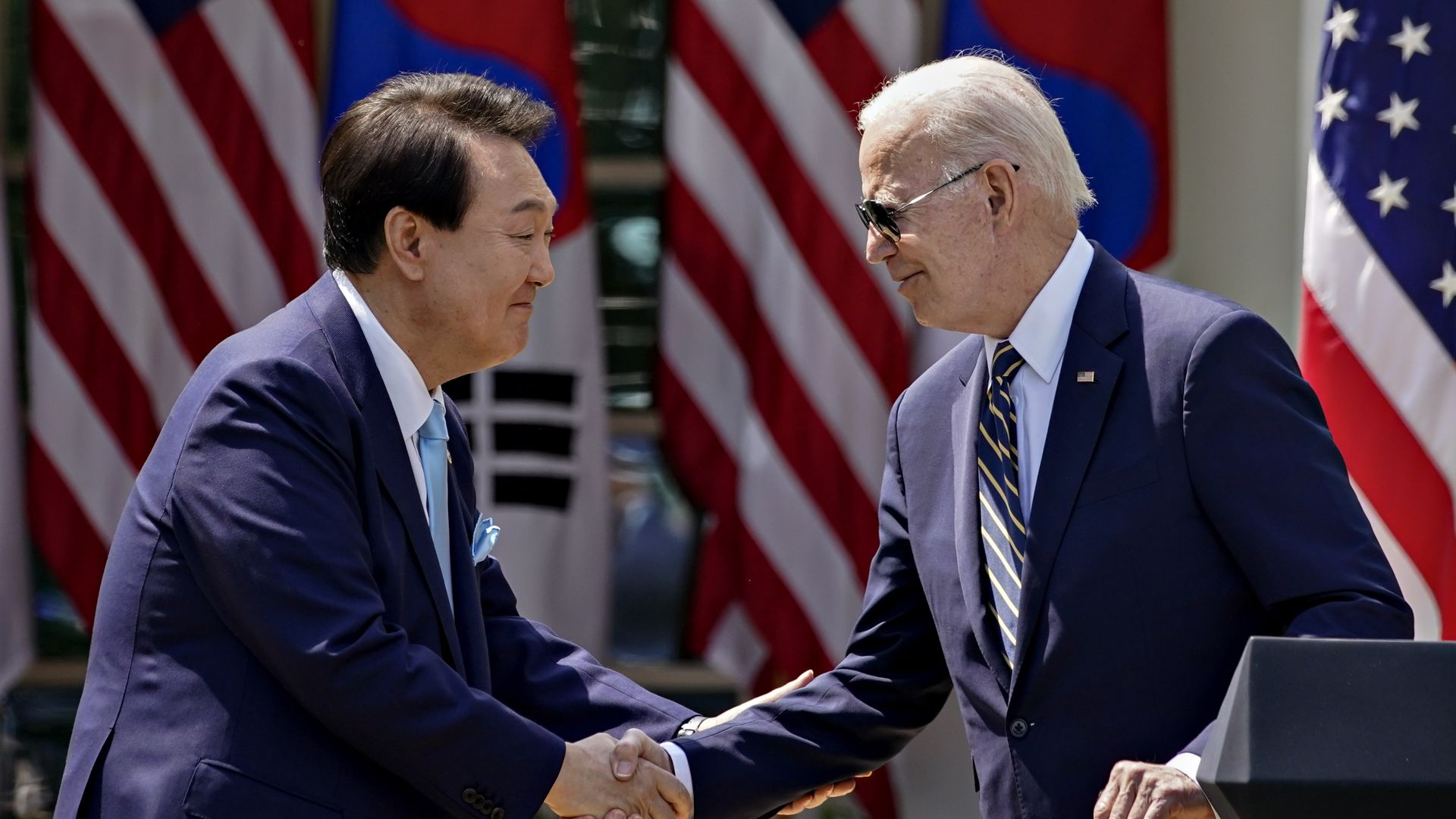
South Korean President Yoon Suk-yeol and President Biden during a news conference at the White House in April. Photo: Jim Watson/AFP via Getty Images.
President Biden will host Japan's prime minister and South Korea's president this week for his first-ever leaders summit at Camp David, with plans to announce joint military exercises — and a possible new crisis hotline between the three allies, Axios' Hans Nichols writes.
Why it matters: Friday's summit is designed to send a loud and clear message to China and North Korea that the allies are fortifying their military and economic ties, according to people familiar with the matter.
Driving the news: The summit is the result of months of U.S. diplomacy, as officials tried to persuade Japan and South Korea to look beyond their complicated past and toward a united future.
- Biden, Japan Prime Minister Fumio Kishida and South Korea President Yoon Suk-yeol are preparing to announce the Camp David Principles, a new set of protocols to govern their relationship.
- "The symbolism of meeting at Camp David cannot be overstated," a senior administration official tells Axios.
- "There is no question because of their rapprochement, we are able to do way more," the official said.
Zoom out: From the beginning of his presidency, Biden has worked to strengthen alliances in the Indo-Pacific — and around the globe — as a way to counter China's ambitions.
- One of his first virtual summits was with the so-called Quad. The leaders of the U.S., Japan, Australia and India discussed their collective security interests.
- In September 2021, the U.S. and the U.K. announced a plan to help Australia deploy nuclear-power submarines to challenge China's territorial claims in the region.
- China and North Korea have been increasing their military pressure on their neighbors, with China using training exercises to probe Taiwan's territorial boundaries and North Korea conducting missile tests.
Zoom in: Bringing South Korea and Japan closer together has been central to Biden's regional approach to China.
- Besides scheduling training exercises, the three parties are aiming to establish a regular summit between their national security advisers and improve their early warning data-sharing on North Korean missile launches.
5. What I'm reading
Nuclear subs: The AUKUS wager (Foreign Affairs)
- "For much of the postwar period, the United States has pursued a policy of primacy or preeminence in the Indo-Pacific.... But AUKUS underscores how that policy goal is now unrealistic, potentially counterproductive, and probably unnecessary."
- "Moreover, primacy was built around a hub-and-spoke alliance model, according to which the United States dictated the terms of its security relationship with its allies. That model is no longer practical. ... At its core, AUKUS represents a fundamental decision to empower America's key allies and, in doing so, give them increased capacity to play a larger role of their own in Indo-Pacific security."
Dark money: A global web of Chinese propaganda leads to a U.S. tech mogul (New York Times)
- A network of progressive groups like No Cold War and Code Pink that have defended China's human rights abuses in Xinjiang and Hong Kong "is part of a lavishly funded influence campaign that defends China and pushes its propaganda...At the center is a charismatic American millionaire, Neville Roy Singham" who "works closely with the Chinese government media machine and is financing its propaganda worldwide," the Times found in this investigation.
- "Years of research have shown how disinformation, both homegrown and foreign-backed, influences mainstream conservative discourse. Mr. Singham's network shows what that process looks like on the left."
6. 1 summer thing: It's vacation time in Beijing too

Beachgoers enjoy the seaside resort at Beidaihe in northeast China on Aug. 6, 2012. Credit: Ed Jones/AFP/GettyImages.
Washington, D.C., is a sleepy city for the first two weeks of August each year. Congress is in recess, and just about everybody else is too.
- Conveniently, China's news cycle is typically slow during this time because the government is sort of in recess too; China's political leaders all go on vacation together at the seaside resort Beidaihe.
Sign up for Axios China
Analysis and intel from Bethany Allen-Ebrahimian, authority on Beijing intrigue and intentions.