Axios China

February 28, 2023

Welcome back to Axios China. Today we're looking at Belarus President Aleksandr Lukashenko's upcoming visit to Beijing and what that means for Ukraine and for China. We've also got a look at Xi Jinping's Global Security Initiative, COVID origins, and lots more.
- Send tips and suggestions to [email protected], or just hit reply.
Today's newsletter is 1,868 words, a 7-minute read.
1 big thing: Lukashenko's China visit suggests Beijing's growing involvement in war
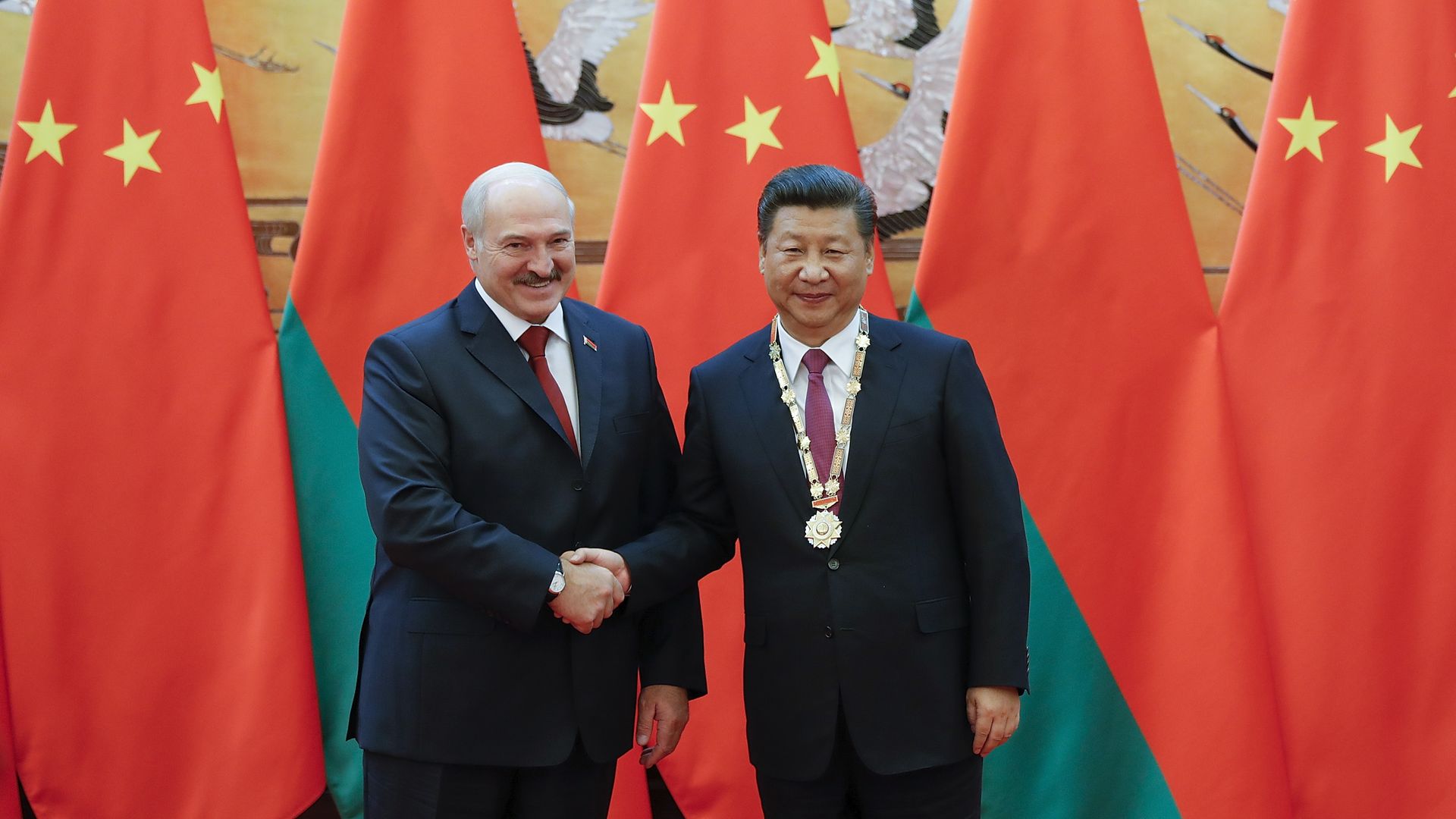
Aleksandr Lukashenko meets Xi Jinping at the Great Hall of the People on Sept. 29, 2016, in Beijing. Photo: Lintao Zhang/Pool/Getty Images
Belarus President Aleksandr Lukashenko will visit Beijing this week, on the heels of China's announcement of its proposed peace plan for the Russia-Ukraine war.
Why it matters: Welcoming a close Putin ally, while ignoring Ukraine's repeated requests for dialogue, suggests China's leaders will prioritize Moscow's interests over Kyiv's as they advocate for a cease-fire.
- Lukashenko's visit may also portend growing Chinese engagement in the Russia-Ukraine war if a cease-fire isn't reached, Yurii Poita, an expert on Ukraine-China relations at the Kyiv-based Center for Army, Conversion and Disarmament Studies, told Axios.
- "Our assessment is that Russian defeat would be the worst scenario for China," Poita said.
State of play: Russia's invasion of Ukraine has now stretched on for more than one year, with heavy losses on both sides. High Ukrainian morale, Western support for Kyiv and a weakened Russian army have made the war costly for Putin, and analysts don't see a clear path to victory for him in Ukraine.
- The Chinese government has taken no official position on the war, but it hasn't condemned it and refuses to refer to it as an invasion. Chinese officials have heavily criticized Western sanctions against Russia.
What's happening: Beijing called for a cease-fire last week and announced a 12-point proposal for a peace agreement between Russia and Ukraine that repeats anti-Western talking points and also implicitly criticizes some Russian actions, such as threats to nuclear plants and blocking grain exports.
- Ukrainian President Volodymyr Zelensky said last week that he welcomed some parts of the proposal. The Kremlin said the plan "deserves attention" but that conditions for peace do not yet exist.
- The announcement comes as the U.S. has claimed China's leaders are considering sending lethal military aid to Russia for the first time, a claim China's Foreign Ministry has denied.
Background: Lukashenko, who has led Belarus for almost 30 years and overseen a crackdown on media, civil society and political opponents, has allowed Russia to use Belarus as a staging ground for its military operations in Ukraine.
- Lukashenko has also sought closer ties with Beijing. He and Chinese President Xi Jinping met in September 2022 and upgraded the bilateral relationship to an "all-weather comprehensive strategic partnership."
- “Minsk has long considered China as a key foreign policy and economic partner and, therefore, invested a lot of time and political effort in deepening relations with Beijing," Yauheni Preiherman, who directs the Minsk Dialogue Council on International Relations, told the New York Times.
Between the lines: The visit may also have implications for discussions on the potential delivery of Chinese aid to Russia, Poita said, with Belarus becoming a way for Beijing to avoid the appearance of sending military aid directly to Russia.
- "There would possibly be no restrictions on China’s delivery of weapons to Belarus, which could then be delivered to Russia," Poita said, adding he had no specific knowledge of any planned negotiations in Beijing.
- “Cooperation in the military-industrial complex can surely be part of that, especially since the two countries already have a track record of cooperation in this realm,” Preiherman said.
Zelensky has sought dialogue with Beijing, most recently in a letter hand-delivered by Ukraine's first lady to the Chinese delegation at Davos in January.
- To date, that dialogue has not happened, and Xi has not called Zelensky or scheduled a meeting with him.
What to watch: If Lukashenko publicly endorses China's peace plan as his visit concludes, that would suggest Beijing is seeking to bolster the plan's international legitimacy, Poita said.
2. China seeks more military and police training with developing countries
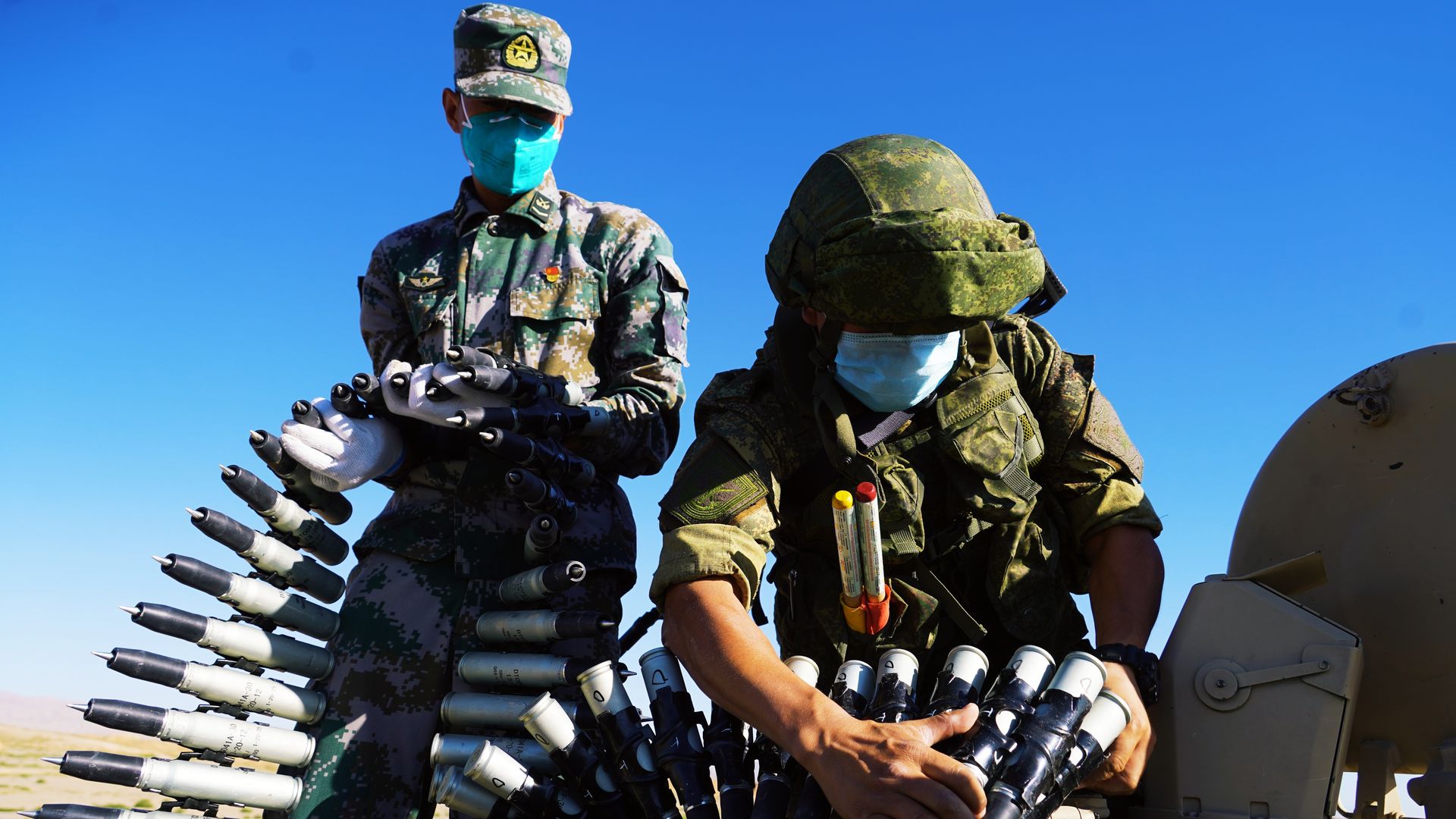
Military personnel prepare equipment for a joint military drill by the Chinese and Russian armies in 2021. Photo: Ding Kai/Xinhua via Getty Images
In a proposed global security framework unveiled last week, the Chinese government called for expanded training with security forces from other developing countries, a strategy that has alarmed the West, Axios' Han Chen and I write.
Why it matters: Terrorism and transnational crime are complex problems that require global cooperation. But critics worry that China's deepening security cooperation with other countries could extend Beijing's authoritarian reach into strategically important regions.
- "[China] wants to promote itself as a new power with global power projection capabilities and international partnerships, particularly since it has a lot of catching up with the U.S., which has a network of alliances and military bases worldwide," Vuk Vuksanovic, a senior researcher at the Belgrade Center for Security Policy in Serbia, told Axios.
Details: The Chinese government stated in a white paper detailing the proposed Global Security Initiative that it wants to "encourage more exchanges and cooperation among university-level military and police academies."
- It said China is "willing to provide other developing countries with 5,000 training opportunities in the next five years to train professionals for addressing global security issues."
- The document didn't specify what kind of training would be provided.
- Xi first proposed the security initiative last year, stating that countries should "oppose the wanton use of unilateral sanctions and long-arm jurisdiction" — a reference to frequent Chinese criticism of U.S. foreign policy — and "work together on regional disputes and global challenges such as terrorism, climate change, cybersecurity and biosecurity."
Between the lines: "These exchanges would help Beijing build a network of relationships and dependencies among security professionals worldwide," Vuksanovic said.
- "Many of these professionals, if they were to train with their Chinese counterparts, would develop social relationships with Chinese colleagues and would be more attuned to the Chinese way of thinking on police and military affairs, but could also become in time politically dependent on copying Chinese procedures and using Chinese resources."
Background: The Chinese government has established security partnerships with several countries in recent years, including the Solomon Islands and Serbia.
- The Solomon Islands signed a security agreement with Beijing in 2022 that included law enforcement training and Chinese military access to the country, alarming Australia and the U.S. due to the Pacific island nation's strategic location.
The Chinese government has previously attracted criticism for using Interpol, an organization for international police cooperation, to pursue political dissidents in the name of repatriating criminals.
- In recent months, the publication of a report detailing illegal Chinese police stations around Europe caused an outcry, and multiple governments have launched investigations into the unregistered Chinese police centers on their soil.
3. Catch up quick
1. U.S. federal agencies have 30 days to remove TikTok from phones and other devices, the White House announced on Monday. Go deeper.
2. The U.S. plans to quadruple the number of troops it has stationed in Taiwan, from 30 troops last year to 100 or 200, the Wall Street Journal reports.
- The Pentagon said it is expanding a training program to help the island defend itself in case of an attack from China.
3. A U.S. military reconnaissance plane flew through the Taiwan Strait on Monday, Newsweek reports.
- Beijing has increasingly sought to portray those waters as part of its sovereign territory, a claim neither the U.S. nor Taiwan recognize.
4. CIA director William Burns said Russia's inability to defeat Ukraine has likely caused China's leaders to have doubts about their military's ability to take Taiwan. Go deeper.
5. The social media accounts of two Reuters journalists were impersonated for several months, with the impersonators seeking information from Chinese activists about COVID protests in China, Reuters reports.
- Whoever impersonated the accounts was able to provide a photo of the journalists' press cards to help gain the activists' trust.
4. New COVID lab leak assessment reignites furor over pandemic origins

Illustration: Allie Carl/Axios
A new U.S. government assessment that COVID-19 likely originated from a lab leak in China has ignited yet another round of political furor around the issue, adding to many Republicans' anger over how the pandemic was handled even as many scientists remain convinced the virus most likely originated naturally, Axios' Tina Reed, Caitlin Owens and Adriel Bettelheim write.
Why it matters: The implications of the virus' origins go well beyond politics and could threaten what's already an increasingly tense U.S.-China relationship.
Driving the news: Department of Energy scientists concluded in a "low confidence" assessment that COVID-19 most likely arose from a laboratory leak, the Wall Street Journal reported Sunday.
- The department was previously undecided on a cause. The new report underscores how U.S. intelligence agencies are divided over COVID-19 origins, with none having reached a conclusion with a high degree of confidence.
- The National Intelligence Council and four government agencies still assess with "low confidence" that the virus came about through natural transmission from an infected animal, the Journal reported.
What they're saying: "The same people who shamed us, canceled us, & wanted to put us in jail for saying covid came from the Wuhan Lab ... are starting to say what we said all along," tweeted Rep. Marjorie Taylor-Greene (R-Ga.).
- "[B]eing proven right doesn’t matter. What matters is holding the Chinese Communist Party accountable so this doesn't happen again," tweeted Sen. Tom Cotton (R-Ark.), who first raised the lab leak theory in 2020.
The other side: "As I said before, I am willing to reconsider my hypothesis if presented with verifiable, affirmative evidence," tweeted Angela Rasmussen, a virologist at the Vaccine and Infectious Disease Organization.
- "[F]or now, I see no evidence that suggests the current scientific evidence base is incorrect. And that evidence base continues to suggest the pandemic originated via zoonotic spillover at the Huanan market."
The big picture: The new lab leak assessment could have broader implications for U.S.-China relations at a particularly sensitive time.
- But the ambiguity from conflicting intelligence assessments will probably prevent public demands for tougher policies against China, said Chris Meekins, a health care policy analyst at Raymond James.
What to watch: The new assessment will likely come up at today's House Oversight Committee hearing examining the federal government’s response to the pandemic.
5. What I'm reading
Liberal hawk: Ro Khanna on how to change the U.S.-China economic relationship (The Wire China)
- In this interview, the Democratic representative from California offers a progressive vision for a tough-on-China policy.
- "One of things I am trying to do is articulate a coherent theory of China policy, which I believe hopefully will be adopted by the Democratic Party. That is, again, tough economics, rebalancing trade, affirming the One China policy so that we don’t unnecessarily provoke China into a Cold War, and providing sufficient military training and equipment to Taiwan and our allies to deter any military move that China could make."
States of denial vs. states of momentum: Dangerous Chinese technology in U.S. state government systems and rising efforts to prohibit contracts supplying it (China Tech Threat)
- "Chinese companies that have been banned or restricted from U.S. military and national security networks — e.g. Lenovo, Lexmark, Hikvision, and DJI — can still contract with state governments."
- As of March 2020, "only one U.S. state restricted contracts with Chinese-owned or operated tech manufacturers. Today five states have laws or restrictions governing state contracts, with 11 additional states currently considering legislation as of this writing."
6. 📷 1 photo to go: "228" demonstration in Taipei
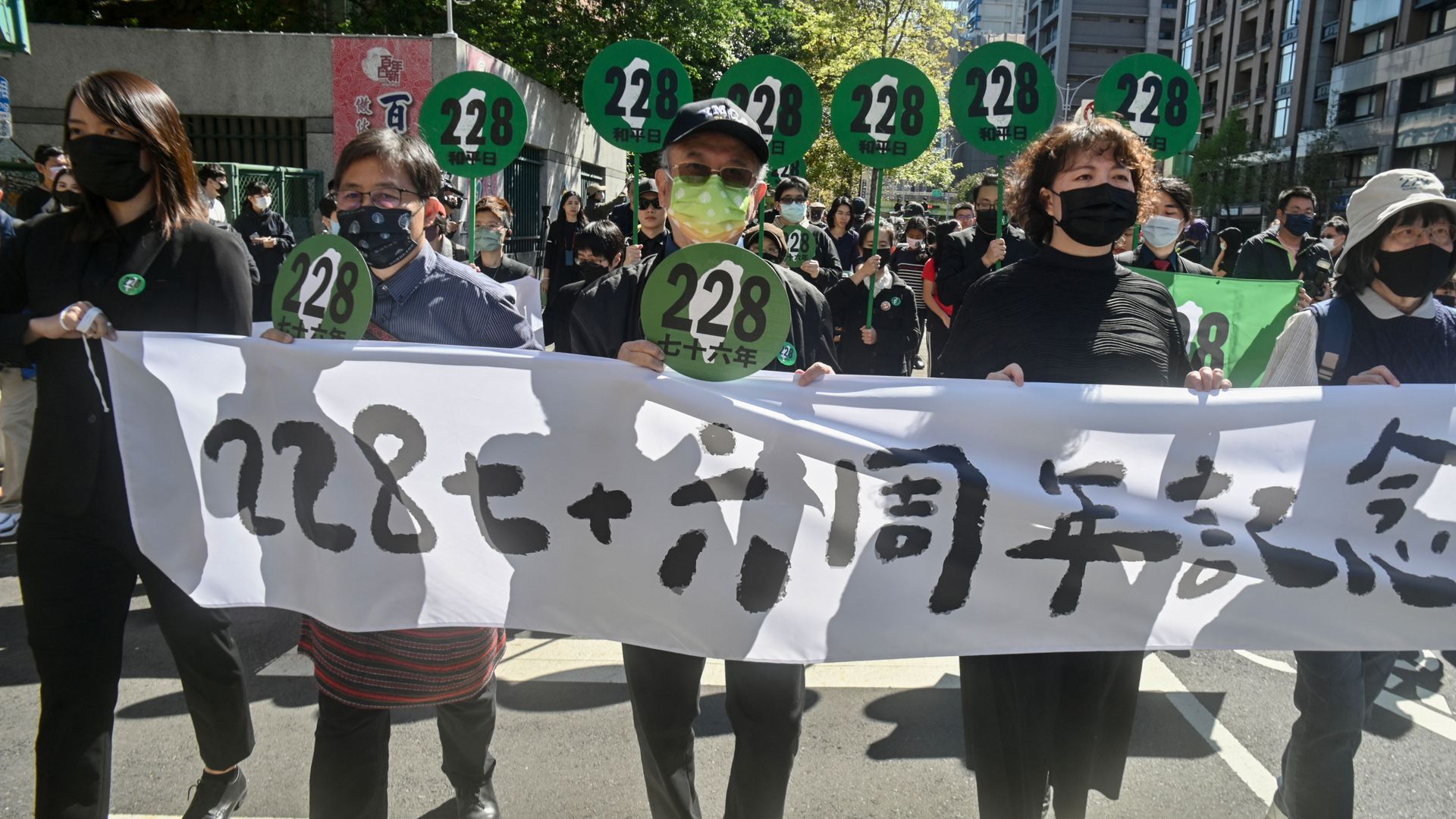
People display a banner to mark the 76th anniversary of the "228 incident" during a demonstration in Taipei on Feb. 28. Photo: Sam Yeh/AFP via Getty images
A crowd marched in Taipei today to demand transparency and accountability for the "228 incident," a military crackdown on protesters that began on Feb. 28, 1947, and may have killed up to 28,000 civilians.
- The march is held every year on the anniversary of the crackdown.
- The current mayor of Taipei, Chiang Wan-an, claims to be the great-grandson of former Taiwanese leader Chiang Kai-shek, who was responsible for the crackdown.
- Protesters today demanded Mayor Chiang "to honestly face history and what his family has done to this land."
Sign up for Axios China
Analysis and intel from Bethany Allen-Ebrahimian, authority on Beijing intrigue and intentions.