Axios China

February 28, 2024

Welcome back to Axios China. Today we're looking at the House China committee a year after its creation, an expanded state secrets law, 6G principles, and lots more.
- Some personal news: This is my last issue of Axios China. Thank you to all my subscribers — you've made it a joy to write 168 newsletters over the past four years. To stay in touch, you can follow me on X (formerly Twitter), or email me at [email protected].
- You can follow our China news reporting on Axios.com and subscribe to our other great newsletters including Axios AM and PM. Thanks for reading!
- And finally, a big thank you to Sheryl Miller for copy editing and to Alison Snyder for editing Axios China for the past four years.
Today's newsletter is 1,329 words, a 5-minute read.
1 big thing: One year on, the House China committee is leading the debate on China policy
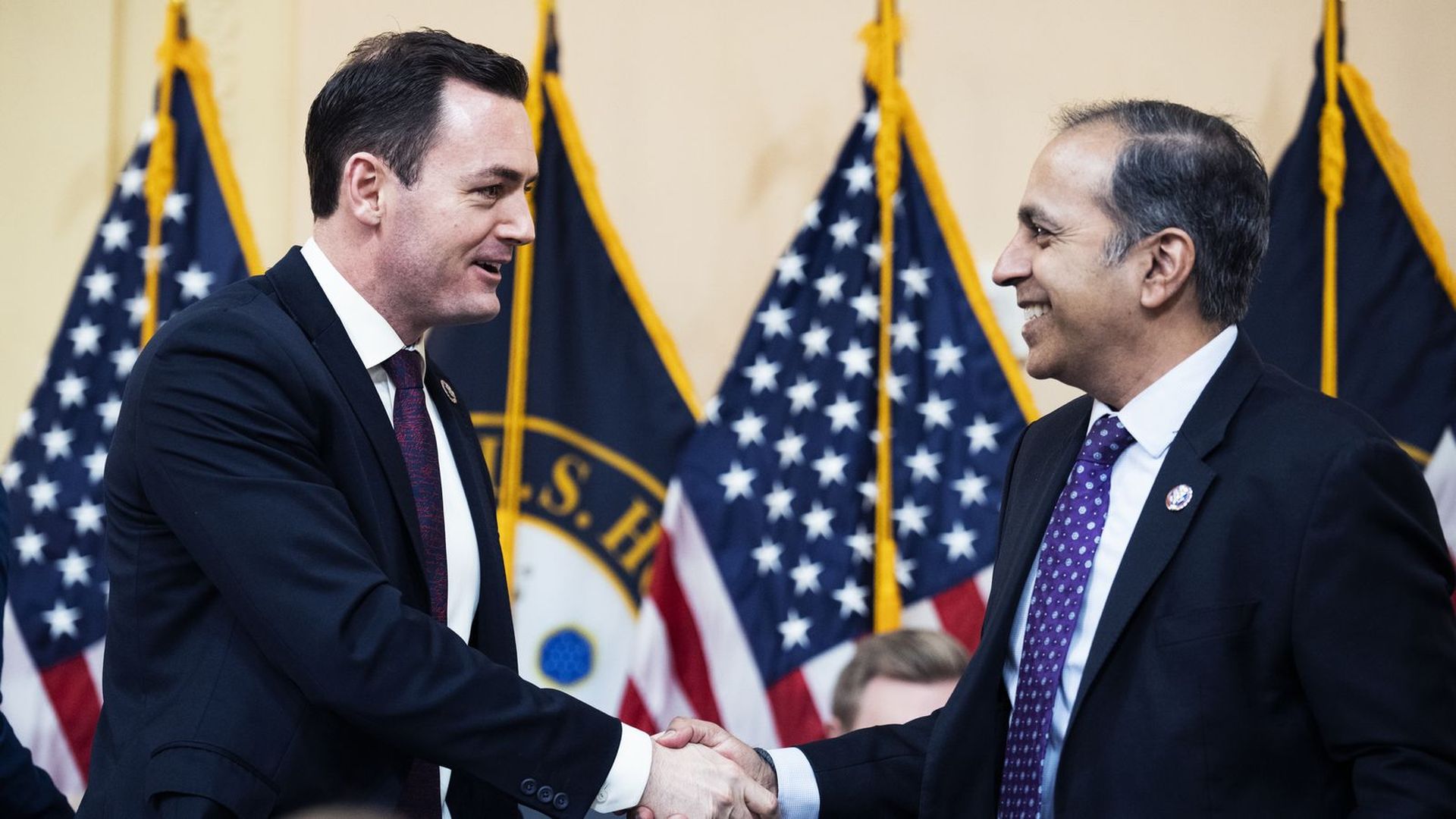
Reps. Mike Gallagher (left) and Raja Krishnamoorthi. Photo: Tom Williams/CQ-Roll Call, Inc via Getty Images
Despite the bitter gridlock in Congress, the House Select Committee on the Chinese Communist Party has avoided partisan chaos and gained traction to address some of the challenges China poses to the U.S., the committee chair and ranking member told Axios in a joint interview.
Why it matters: The committee has raised the national profile of key economic and security issues relating to China, including hacking, surveillance, trade fraud and human rights concerns, and it's setting the agenda for U.S. policy, Axios' Juliegrace Brufke and I report.
The big picture: The panel, led by Chair Mike Gallagher (R-Wis.) and Ranking Member Raja Krishnamoorthi (D-Ill.), has called for greater U.S. scrutiny of Chinese-owned tech and social media companies like TikTok, and it's held high-profile hearings with top U.S. officials testifying about Chinese government actions that harm U.S. interests.
- Research conducted under the committee's purview has spurred the federal government to take action, such as a Homeland Security Department investigation of a Chinese automobile parts company for alleged trade fraud.
- The panel has put together recommendations on a range of issues that were provided to standing committees. Many of those policy suggestions have been signed into law through the 2024 NDAA, including support for military cybersecurity cooperation and military training programs with Taiwan and a missile deployment strategy in the Indo-Pacific.
What they're saying: A key prerequisite for those achievements has been maintaining bipartisanship.
- "We don't want this to devolve in partisan chaos," Gallagher said.
- The people on the committee "want to address the problems as opposed to engage in personalities," Krishnamoorthi said.
Taiwan has been a key focus for the panel. Last week, the committee made its official first trip to Taiwan, where the delegation of committee members led by Gallagher and Krishnamoorthi assured President-elect William Lai of U.S. support amid rising tensions with China.
- Gallagher and Krishnamoorthi said during the trip that among their top priorities are speeding up the delivery of weapons promised to Taiwan and ensuring a Ukrainian victory against Russia because "you can't be tough on China and weak on your support of Ukraine."
The panel has regularly highlighted human rights issues as well, which can otherwise be easily overshadowed by growing national security and economic concerns.
- In September, the committee urged the administration to sanction more Chinese government officials deemed complicit in the genocide against Uyghurs in Xinjiang. Less than two months later, the Biden administration did just that.
- Without the committee, "I don't think that we would have a pressure point created on the executive branch to take those actions," Nury Turkel, senior fellow at the Hudson Institute and Uyghur activist, said.
Yes, but: Some of the committee's actions have faced criticism and run into serious roadblocks.
- The committee's recent efforts to restrict U.S. market access to Chinese pharmaceutical and biotech companies could dull the U.S. competitive edge, some analysts have said.
- Others have said the committee is "one-sided" and that it promotes alarmism about China.
What to watch: The committee released a report in December that included about 150 policy recommendations. Gallagher said this year the committee is focused on turning the most important of those "recommendations into reality." Those include:
- Action on TikTok, such as a ban or a forced sale.
- Legislation on outbound capital investment.
- Reforming CFIUS (Committee on Foreign Investment in the United States) to prevent China-backed land sales near U.S. military facilities.
2. China expands state secrets law to include "work secrets"
Illustration: Gabriella Turrisi/Axios
China's rubber-stamp legislature has expanded a state secrets law to require government agencies and companies to protect unclassified "work secrets," a move that analysts worry could mean less transparency and more risk for businesses operating in China.
Why it matters: The updated law comes as the Chinese government has cracked down on data sharing of many kinds, targeted U.S. businesses in China and detained employees on espionage charges.
Driving the news: U.S. ambassador to China Nicholas Burns said in an interview aired Sunday that Chinese authorities have raided as many as seven U.S. businesses on suspicion of espionage.
- Among those targeted have been auditing firms Mintz Group and Bain & Company.
Zoom in: The updated law mandates protection of information that is "not state secrets but will cause certain adverse effects if leaked," Reuters reports.
- Other security laws in China, including last year's counter-espionage law, have included similarly vague language, making it difficult for companies to know what kind of information is legal to collect and share and what isn't.
- "For foreign businesses, it's the lack of clarity that will remain an unquantified risk to doing business in China," Jeremy Daum, a senior fellow at Yale Law School's Paul Tsai China Center, told CNBC.
Zoom out: That risk has contributed to declining foreign direct investment in China and record lows in surveys among U.S. companies about their business outlook in China.
What to watch: The changes will take effect May 1.
3. Catch up quick
1. President Biden will sign an executive order today that aims to stop data brokers and other companies from selling Americans' data to organizations in adversarial foreign countries, including China and Russia. Go deeper.
2. China has dramatically increased the number of research ships it's sending near Taiwan's coast, the Financial Times reports.
- "Where the maritime research vessels go is where Chinese submarines will go in the future," said Christopher Sharman, director of the China Maritime Studies Institute at the U.S. Naval War College.
3. A trove of leaked documents is providing government officials and security researchers a rare public glimpse inside I-Soon, a private China-based offensive cybersecurity company. Go deeper.
- I-Soon, which is known to have China's intelligence agency as one of its clients, targeted government agencies in Taiwan, Malaysia, Kazakhstan, South Korea, Thailand and several other countries at the request of its customers.
4. U.S. and allies endorse 6G principles amid tech race with China

Illustration: Annelise Capossela/Axios
The U.S. and several international partners endorsed shared principles for developing 6G wireless communication systems, the White House said Monday, Axios' Sareen Habeshian reports.
The big picture: A battle is underway to influence the standards of 6G amid concerns by Western countries and their allies that authoritarian regimes could gain further control over the internet in their countries.
- Policies around wireless communications influence economic growth and national security, fueling the race between the U.S. and China — which claimed earlier this month that it had launched the world's first satellite to test 6G architecture, per state media.
State of play: The governments of the U.S., Australia, Canada, the Czech Republic, Finland, France, Japan, South Korea, Sweden and the U.K. released a joint statement saying that by working together, "we can support open, free, global, interoperable, reliable, resilient, and secure connectivity."
- They laid out principles including using systematic approaches to cybersecurity, being protective of privacy, and creating technologies that are widely available and accessible to developing nations.
Between the lines: "China views telecommunications as central to its geopolitical and strategic objectives," per analysis posted to the website of D.C. think-tank the Center for a New American Security.
- "China aims to dominate the development and rollout of 6G infrastructure, just as it did in 5G, where Chinese firms maintain 70 percent of the world's base stations and 80 percent of 5G connected devices."
5. What I'm reading
Tone Deaf: Beijing's crackdown on a celebrated, state-owned media outlet shows just how far Chinese censors have gone (The Wire China)
- "Because Sixth Tone is published in English, it often covered topics that were deemed off-limits for most Chinese state outlets. And for six years, it succeeded in carving out a precarious, but unique space in China's media ecosystem."
- "But The Wire's conversations with 15 former and current employees reveal how the publication has been neutered over the past year."
6. 🛫 1 airplane thing: U.S. permits more direct flights from China

Photo: Urbanandsport/NurPhoto via Getty Images
The U.S. Department of Transportation said it will raise the number of direct flights permitted from China to 50 per week, up from the current limit of 35, ahead of the summer tourist season, CNN reports.
- The current limit was put in place amid COVID restrictions. Before the pandemic, there were more than 150 round-trip flights each week.
What to watch: The allowed increase will take effect on March 31.