Axios China

May 24, 2022

Welcome back to Axios China. Today we're looking at China's transnational repression, a turning point in Asian American history, Biden's trip to Asia, and a whole lot more.
- Send tips and ideas to [email protected], or just hit reply.
- Today's newsletter is 1,674 words, a 6-minute read.
⚡️ Situational awareness: On Thursday, Secretary of State Antony Blinken will deliver the Biden administration's long-awaited China strategy speech.
1 big thing: The Justice Department takes on China's overseas repression

Illustration: Sarah Grillo/Axios
In a string of recent indictments, the U.S. Department of Justice is cracking down on Chinese state-backed repression of U.S.-based dissidents.
Why it matters: The Chinese government has spent decades harassing and trying to silence its critics abroad. Now the U.S. government is taking action to protect people on U.S. soil.
What's happening: Earlier this month, the DOJ announced it had charged a U.S. citizen and four others with a scheme that involved collecting information on U.S.-based pro-democracy activists, human rights groups and members of ethnic communities often targeted by the Chinese government, including Uyghurs and Tibetans.
- The U.S. citizen, Wang Shujun, is based in Queens, New York, where he helped found a pro-democracy organization. He allegedly used that organization as a platform to collect information on dissidents and supplied it to the other four defendants, who are employees of China's Ministry of State Security and remain at large, the indictment states.
- In a separate indictment unsealed in March, prosecutors allege another Ministry of State Security employee hired a private investigator to harass and physically assault a Chinese pro-democracy activist who was running for U.S. Congress in Long Island, in order to prevent him from carrying out his campaign.
What they're saying: “If anyone doubts how serious the Chinese government is about silencing its critics, this case should eliminate any uncertainty,” Alan E. Kohler Jr., acting executive assistant director of the FBI’s national security branch, said in a May 18 press release.
- “The Chinese government’s aggressive tactics were once confined to its borders. Now, the PRC is targeting people in the United States and around the world. The FBI and its partners remain committed to combatting transnational repression.”
The big picture: The term "transnational repression" has become more widely used over the past several years, as authoritarian governments, including China, Russia, Saudi Arabia and Iran, have sought to silence dissent beyond their borders through surveillance, threats and violence.
- The Chinese government has also sought to forcibly repatriate Uyghurs who have fled China by pressuring governments in Central Asia and the Middle East to deport them.
- The FBI website defines transnational repression as "when foreign governments stalk, intimidate, or assault people in the United States."
- The Chinese government is a top offender on U.S. soil. The FBI website provides 10 examples over the last two years relating to actions it has taken on cases of transnational repression. Eight involve the Chinese government; two involve the Iranian government.
Between the lines: U.S.-based Chinese pro-democracy activists, Tibetans and Uyghurs have told me repeatedly over the past decade that they suspected they were being followed and spied on by Chinese state agents operating on U.S. soil — and that they believed there were informants within their own ranks.
- But for years, they would report these incidents to the FBI and nothing would happen.
This began to change during the latter part of the Trump administration, when the DOJ began issuing public indictments for cases in which Chinese security officials tried to silence U.S.-based critics.
- A prominent early example was the December 2020 indictment of a China-based Zoom employee for cooperating with Chinese security officials to shut down U.S.-based Zoom accounts of pro-democracy activists.
2. Biden launches new Indo-Pacific trade pact
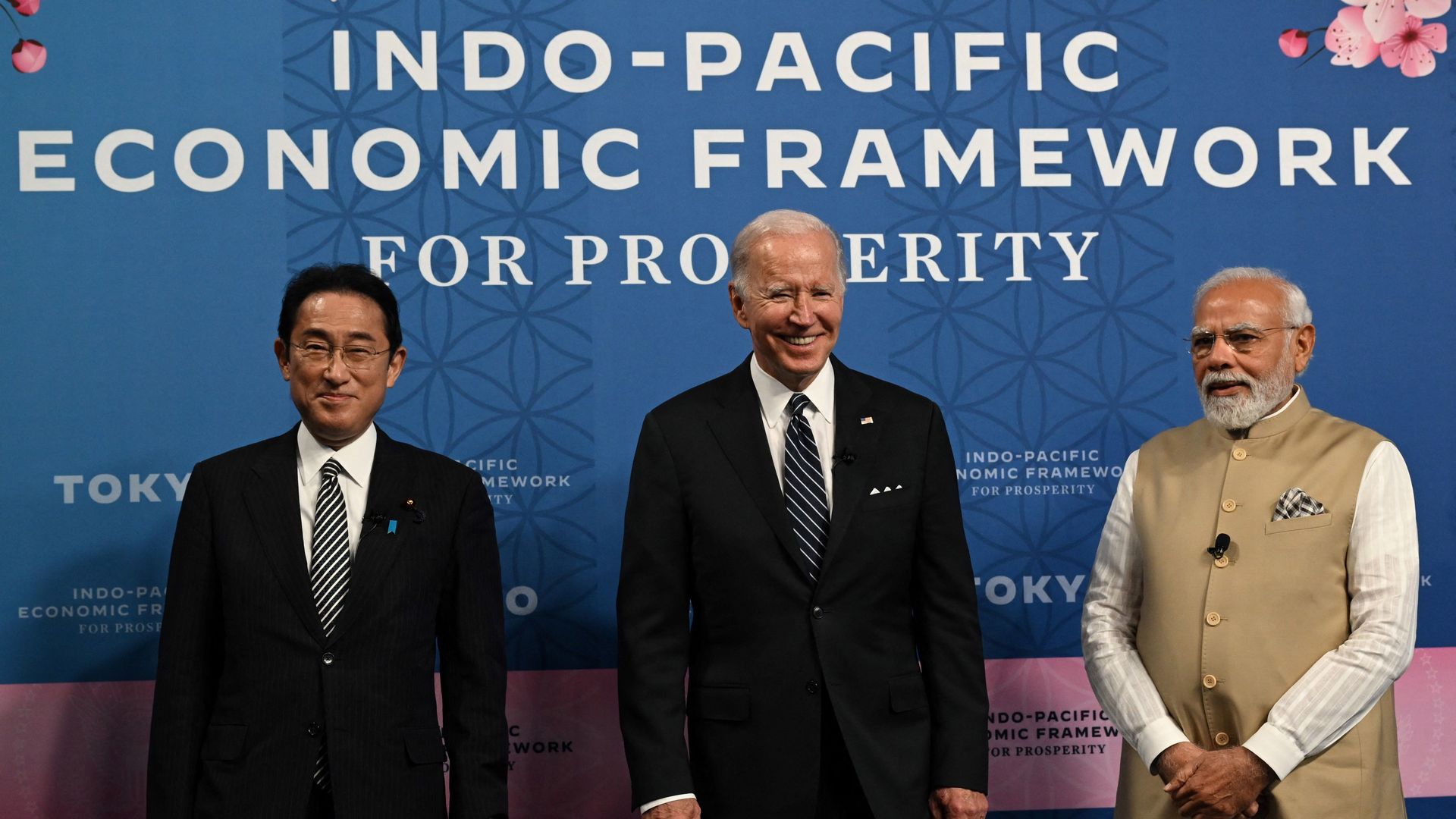
Japanese Prime Minister Fumio Kishida, President Biden and Indian Prime Minister Narendra Modi in Tokyo on Monday. Photo: Saul Loeb/AFP via Getty Images
President Biden announced Monday that the U.S. and 12 countries were joining a U.S.-led Asia-Pacific trade pact designed to counterbalance the influence of China's government in the region while strengthening ties with allies, Axios' Rebecca Falconer writes.
Driving the news: The Indo-Pacific Economic Framework for Prosperity (IPEF) "will enable the United States and our allies to decide on rules of the road that ensure American workers, small businesses, and ranchers can compete in the Indo-Pacific," per a White House statement.
- The new framework "will help lower costs by making our supply chains more resilient in the long term, protecting us against costly disruptions that lead to higher prices for consumers," the White House added.
Details: Initial IPEF partner countries with the U.S. are Australia, Brunei, India, Indonesia, Japan, South Korea, Malaysia, New Zealand, the Philippines, Singapore, Thailand and Vietnam.
Go deeper: U.S. looks to rejoin Asia trade game
3. Catch up quick
1. A leaked Xinjiang police database revealed thousands of images of Uyghur prisoners as young as 15 years old, the BBC reports.
2. The UN's top human rights official landed in China, as Beijing cites COVID as the reason for restricted access, Reuters reports.
3. Airbnb plans to remove its listings in China, ending its domestic presence in the country. Go deeper.
4. China seeks more security pacts with Pacific island nations, the Financial Times reports.
5. The Hong Kong government is considering blocking messaging app Telegram, Bloomberg reports.
6. A prehistoric forest was discovered inside a giant sinkhole in China's Guangxi province, NPR reports.
4. The 1898 moment: A turning point in Asian American history
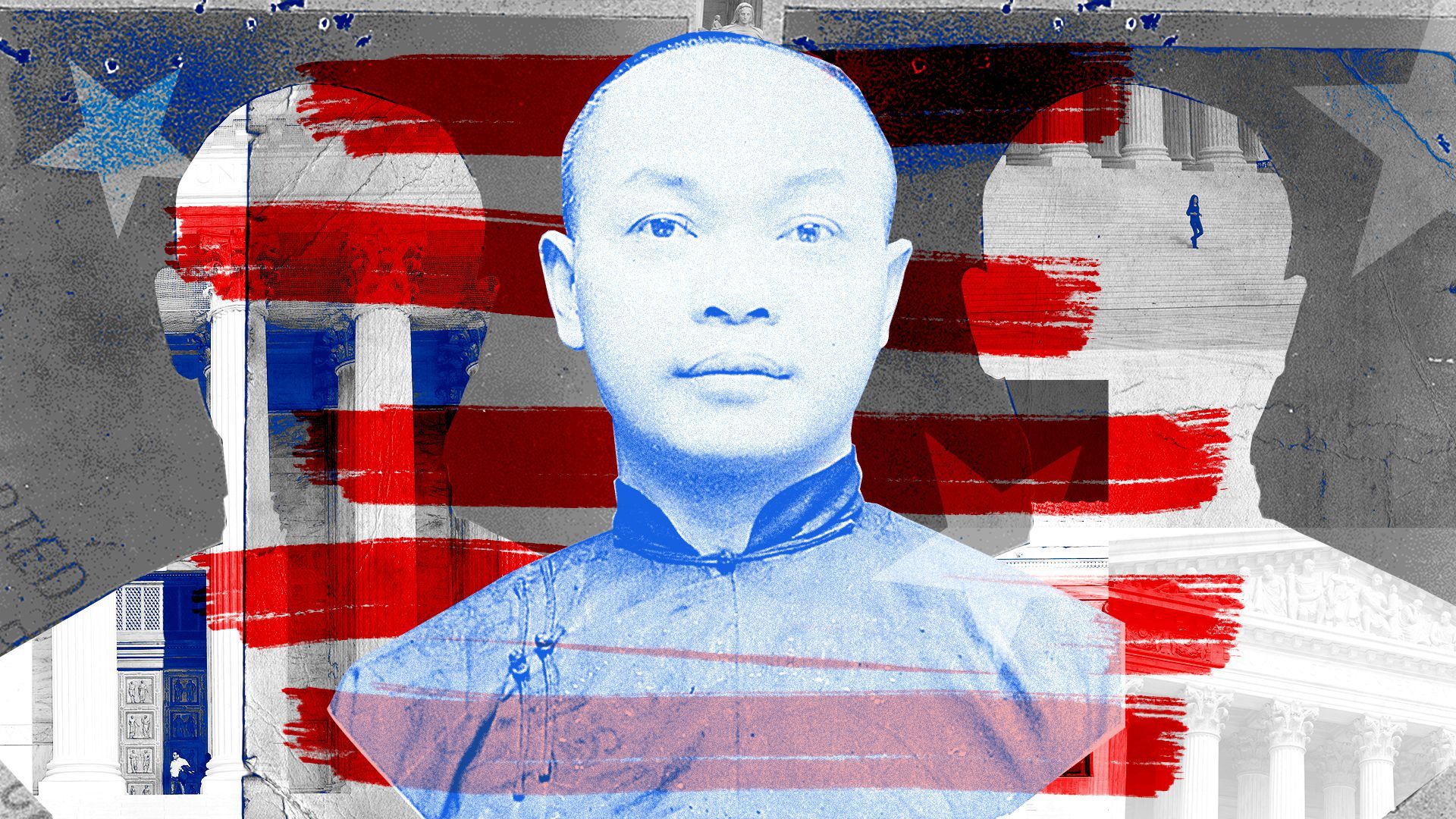
Photo illustration: Shoshana Gordon/Axios. Photo: National Archives ID 296479
Few people in the U.S. know much Asian American history beyond Chinese migrants building railroads and Japanese American detention during WWII. Advocates hope attention to an 1898 Supreme Court ruling changes that, Axios' Russell Contreras writes.
Why it matters: The Wong Kim Ark case affirmed that American-born people of Asian descent were U.S. citizens — giving protections to millions of Asian Americans, Latinos and even Native Americans decades later. It's an overlooked example of how Asian American civil rights fights transformed the nation.
- The Wong Kim Ark ruling is a gateway to open students up to more Asian American history for a complete picture of the U.S., Lynn Lin, who teaches Chinese languages to fourth graders up to middle schoolers in New York City, told Axios.
Driving the news: Connecticut lawmakers are considering a bill to make Asian American history a requirement in public schools.
- The proposal mirrors a bill passed last year in Illinois that made it the first state to require schools to teach Asian American history. New Jersey passed a similar measure this year.
- Arizona, Ohio, California, New York and Florida have considered their own versions of Asian American history requirements.
Details: San Francisco-born Wong Kim Ark returned to the city of his birth in 1895 after visiting family in China, but he was refused re-entry.
- John Wise, an openly anti-Chinese bigot and the collector of customs in San Francisco who controlled immigration into the port, wanted a test case that would deny U.S. citizenship to ethnic Chinese residents.
- But Wong fought his case all the way to the Supreme Court, which ruled on March 28, 1898 that the 14th Amendment guaranteed U.S. citizenship to Wong and any other person born on U.S. soil.
Between the lines: The Wong Kim Ark case established the Birthright Citizenship clause and led to the dramatic demographic transformation of the U.S.
- The U.S.-born children and grandchildren of immigrants from Asia and Latin America are among the nation's fastest-growing populations. They are expected to be the majority of the country by mid-century.
5. A guide to new books on Xinjiang
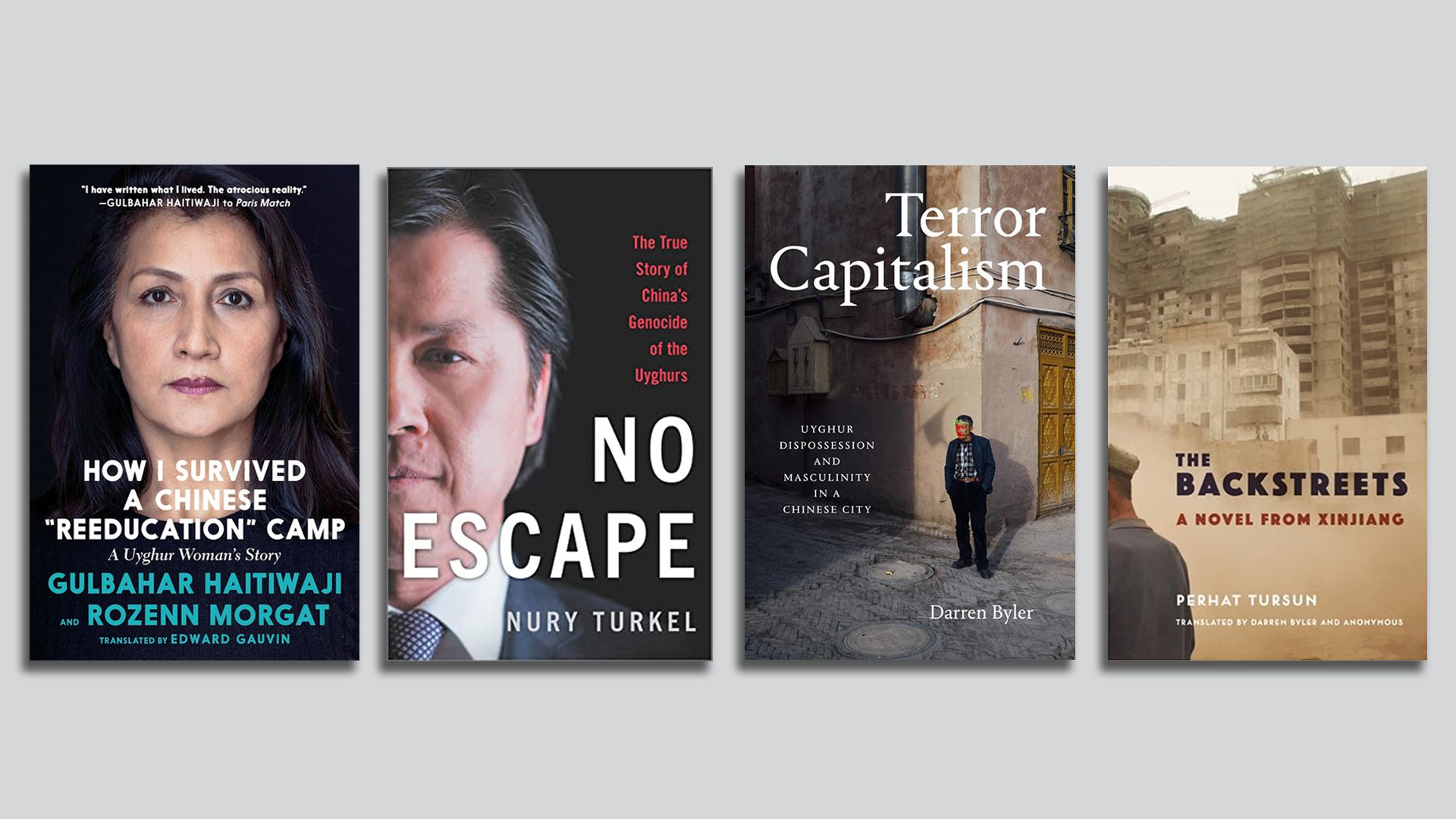
Image: Seven Stories Press, 2022; Hanover Square Press, 2022; Duke University Press, 2022; Columbia University Press, 2022
Several excellent books and memoirs — and one novel — about the Chinese government's repression of Uyghurs in Xinjiang have been published recently. Below is a selection of some of the latest.
Memoir: "How I Survived a Chinese 'Reeducation' Camp" by Gulbahar Haitiwaji and Rozenn Morgat, translated by Edward Gauvin.
- Gulbahar left Xinjiang in 2006 with her two daughters to join her husband in France, where he had received asylum. In November 2016, Gulbahar returned to sign some paperwork, but was detained and put in a camp. For two years, she was subjected to interrogations, torture, terrible conditions and a fake trial that lasted nine minutes.
- She writes of her time in a mass internment facility called Baijiantan: "The classroom, the bathroom, the mess hall, the cell: there was nowhere in Baijiantan where we were not subject to violence or coercion from the teachers, police officers, and guards. ... We were reduced to living like disposable creatures, eternal victims bowed beneath the weight of threats."
Memoir: "No Escape" by Nury Turkel.
- Turkel is vice chair of the U.S. Commission on International Religious Freedom and co-founder of the Uyghur Human Rights Project.
- Turkel's memoir tells the story of the Uyghur people through his own life, which began when his mother gave birth in a Chinese re-education camp, and through the Uyghurs he has met in his work as an advocate.
Academic work: "Terror Capitalism" by Darren Byler.
- Byler is an anthropologist at Simon Fraser University in Vancouver who lived in Xinjiang for several years.
- "What began as a developmental state project to draw Uyghurs into the multicultural Chinese nation had been transformed at least in part into a profit-making security project funded by state capital and used as a space for techno-political experimentation in surveillance," Byler writes.
Novel: "The Backstreets" by Perhat Tursun, translated by Darren Byler and Anonymous.
- Perhat is a novelist and intellectual born in Xinjiang and educated in Beijing. Unlike Gulbahar and Nury, Perhat was not able to escape Xinjiang. Friends learned in 2018 that he had been detained. In 2020, he was given a 16-year prison sentence. He remains in jail.
- Perhat first published this work of fiction in 2013 in a Uyghur-language online forum.
- In his introduction, Byler compares Perhat's book to Albert Camus' "The Stranger" and Ralph Ellison's "The Invisible Man": "The Backstreets should be read simultaneously as a slice of history and a prismatic literary fable of the ethnic and racialized outsider," Byler writes. Like Camus and Ellison, Perhat is "using fiction to think, spin out the logics of a world that he himself has experienced and see where it takes him."
6. 1 D.C. thing: Tiananmen exhibit to open
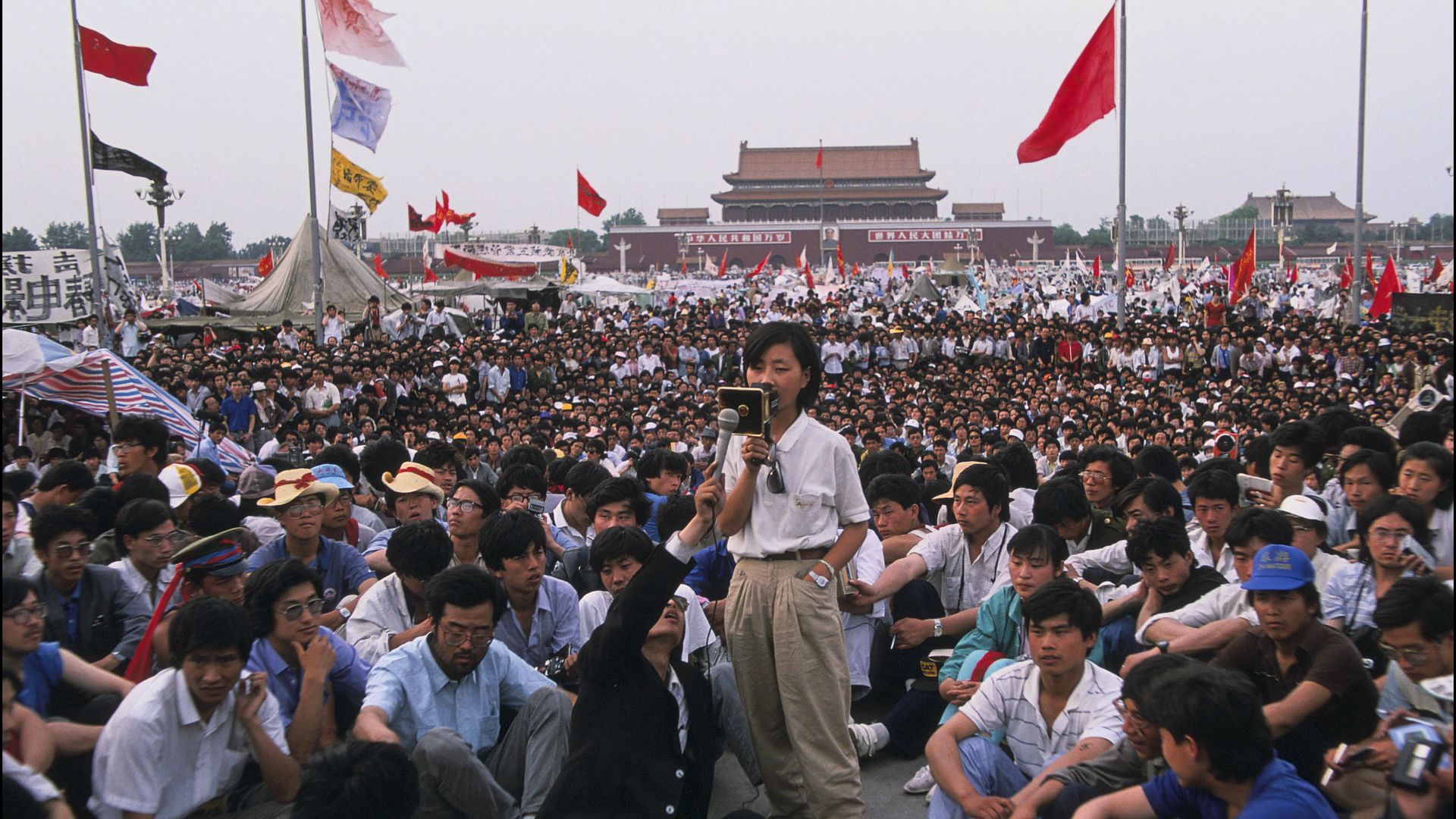
Chai Ling, student movement leader at Tiananmen Square in Beijing on May 28, 1989. Photo: Chip HIRES/Gamma-Rapho via Getty Images
A new exhibit called "Tiananmen 1989" will open on June 13 in Washington, D.C.
- The exhibit will include film, photos and items from the protest movement, including a blood-spattered T-shirt worn by one of the activists.
- It is hosted at the new Victims of Communism Museum, which also opens on June 13. There is a $5 entrance fee.
Wang Dan and Zhou Fengsuo, both student leaders during the 1989 pro-democracy protests in China, helped create the exhibit.
- Wang told Axios the exhibit is part of a long-term plan to open a Tiananmen museum in the U.S., motivated in part by the forced closure of the well-known June 4 Museum in Hong Kong last year.