Axios C-Suite

April 04, 2026

Happy Saturday! Great response to our debut edition โย so please keep the feedback coming: Too long, too short? How can it be more useful to YOU? Email me.
- To recommend other CEOs or C-level execs, hit our C-Suite Concierge.
What you can expect today (Smart Brevityโข count: 1,698 words ... 6ยฝ mins.):
- ๐ค๐ฆพ Altman's CEO advice.
- ๐จ๐คฆโโ๏ธ Dimon's sell signal.
- โ๏ธ๐ Asymmetric threat.
1 big thing: What I learned this week
I'm going to share intel picked up from top officials in government, AI and business. It was shared confidentially, but with the knowledge I'd use it without sourcing it.
๐จ๐จ High alert: I've learned that Anthropic is very close to unveiling the breakthrough AI update, which I told you about last weekend. The new Claude model, Mythos, has stunning power to detect and exploit holes in the cybersecurity of businesses and nations.
- Here's a new twist: After private briefings by Anthropic, some in the Trump administration are rethinking its blacklisting of Anthropic.
- "The new model is so powerful that the government has to think seriously about the implications," said a source briefed on Claude's coming capabilities. "The new model's ability to identify vulnerabilities in cybersecurity is unlike anything we've ever seen. The government has to recognize what it could expose [in other nations], as well as weaknesses here that could be exploited by others."
- Every person who's been briefed seems freaked out by the capabilities.
โ๏ธ Wiles' health scare: I can't recall a staffer's health mattering more to governance than Susie Wiles' cancer scare. The 68-year-old White House chief of staff is currently undergoing breast cancer treatment.
- She's the most important conduit for CEOs to President Trump (outside his cell) and a rare check on Stephen Miller's power. Miller is Cheney-like in knowing how to pull the levers of government to impose his hardline views. Wiles is the neutralizer.
- This is a bad time for her to miss any time or beat. Trump reacts poorly to forces beyond his control โ in this case, the second-order economic effects of the war he started and the political environment that has grown worse for his party.
- Hard to imagine Pam Bondi's firing being so sloppy if Susie were fully engaged.
- What to watch: With GOP fears of losing the Senate rising, Trump has a short window for easier confirmation for new cabinet officials. So brace for more ousters โ and more volatility.
๐ณ๏ธ Newsom's Hillary + Mitt problem: Based on polls and betting markets, California Gov. Gavin Newsom seems like Dems' 2028 front-runner. But dig deeper โ then think superficially โ and you see a big problem.
- MS NOW's Chris Hayes, in a must-listen podcast with the NYT's Ross Douthat, turned me onto Newsom's Hillary problem: He's so well-known as a liberal Californian that he'll have a hard time convincing voters he's not a lefty. Behind the scenes, top Dems are passing around polling showing Newsom more unpopular than other '28 hopefuls.
- Then consider his Mitt Romney problem: He looks so central-casting handsome, so hair-perfect slick, that normal voters just assume he's full of it when he shifts or evolves positions.
- Watch our interview with him on "The Axios Show" through this new lens.
๐ฎ๐ท Iran's red line: The smartest strategic insight I've heard this week on the war: Iran's present and future depends on the Strait of Hormuz, not nuclear weapons. It's their only remaining source of wealth, influence and power, regionally and globally.
- Axios Middle East expert Barak Ravid, the world's best-sourced reporter on the topic, told me: "During the war, Iran really discovered how it can hold the world by the balls with the Strait of Hormuz. ... Even if the Iranians reopen it at the end of the war, they know they have deterrence for the future."
2. ๐ก Sam's AI advice for YOU

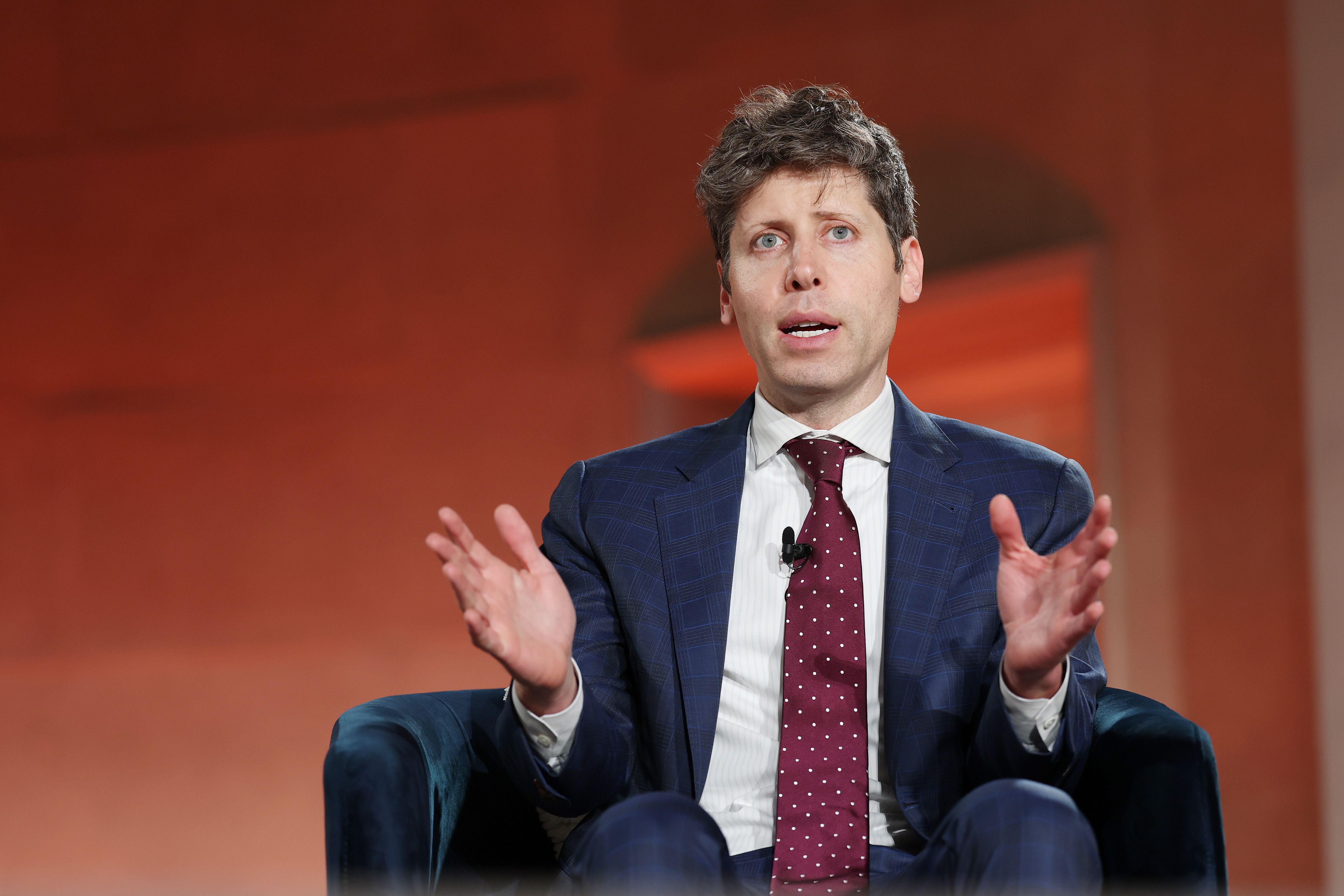
OpenAI CEO Sam Altman offered up three tips in an interview this week with Axios' own Mike Allen for C-Suite readers thinking about AI implementation in the next 6-12 months:
- Lock in your AI capacity now. Altman warns of "a pretty severe capacity crunch" and says CEOs should be racing to secure tokens from model providers or cloud partners before supply gets tighter.
- Change usage metrics. Measure whether your people actually use AI, not just how much. Too many CEOs or CTOs are looking at token usage alone. That's "probably better than measuring nothing," but the real measure is whether every person is reimagining their work around AI.
- Start AI-ing your own job. Altman says too many CEOs preach AI transformation company-wide and then "change absolutely nothing about their own workflow." In reality, "our job is maybe one of the more automatable jobs, not the least automatable job" because an AI assistant can have 10x the context any human executive can carry.โโโโโโโโโโโโโโโโ
3. The age of AI asymmetry
The most consequential force reshaping geopolitics and business can be captured in one word: asymmetry.
- The small can now destroy the big. The cheap can neutralize the expensive.
- Drones proved it on the battlefield. AI is proving it everywhere else.
Why it matters: Every CEO now faces the same question the Pentagon does: Are you the $3 million missile or the $35,000 drone?
Lessons from war: Iran and Ukraine, both outgunned on paper, turned cheap drones into strategic equalizers. They mass-produce weapons at $20Kโ$50K a pop and unleash them with missile-like precision. Both Russia and America are now racing to build their own.
- The gut punch: We've shot down drones that cost less than a used car with $3 million missiles that take years to build. That's structurally unsustainable.
Lessons for your company: AI is the drone. Your org chart โ and perhaps your company โ is the Patriot missile.
- We all need to rethink: What are the smallest teams, fewest steps and quickest paths to do everything at every layer?
Those winning right now aren't the biggest. They're the leanest and fastest.
- Midjourney: 100 employees. $500M+ in revenue. Over $5M per employee. Zero outside funding. Adobe, which competes in the same space, employs 30,000.
- Lovable: A Swedish startup that lets anyone build software by typing what they want went from zero to hundreds of millions in ARR in barely a year. 150 employees and no engineering army.
Lessons for your teams: 15 people can now do what 150 did. The most dangerous unit in business is no longer the biggest division โ it's the small team with proven AI leverage.
- The old playbook: Throw headcount at the problem.
- The new playbook: Give a tight team the right tools and get out of the way.
Lessons for individuals: One person orchestrating a team of AI agents can now do company-sized work.
- That's the most radical shift.
4. ๐ See it: Asymmetry in real time
Anthropic just acquired Coefficient Bio โ an 8-month-old, 9-person biotech AI startup โ for roughly $400 million. That's north of $40 million per head.
- No massive revenue. No sprawling org chart. Just a small team that built an AI platform to make drug discovery more efficient.
๐ช Labor asymmetry: A tiny, elite team can now build a platform that a multi-billion-dollar giant considers essential enough to pay almost half a billion dollars for.
โฐ Time asymmetry: In traditional biotech, $400M exits usually take a decade of clinical trials. This happened so fast because what they built is how you think through drug development, not a drug itself.
5. ๐ช What's working
Scott Pulsipher, president of Western Governors University, read our debut edition and asked for more on what's working in real-time. So, "What's Working" was born.
Here's something all of us can do today: Test-drive asymmetry.
- Find a project that doesn't require complex integration with your broader technology systems. (Think: using AI to build a weekly competitive intelligence brief on your top 3 rivals โ synthesizing their earnings calls, news, hiring patterns and social chatter into something your strategy team never had time to produce. Or using AI to generate a different monthly report you WISH you got on a specific part of your business.)
- Find a hungry, rank-and-file staffer. I simply asked my direct reports for non-technical AI superusers. Let them do the work.
- When they nail it โ and they will โ put them in front of staff so they can show, instead of you telling, the future unfolding. This inspires others to embrace AI more fully.
6. ๐ฃ CEO quote of the week
C-Suite reader Jamie Dimon, on the worst business advice he always hears others offer:
"Build a legacy. ... I always say, if a CEO says they have to have a legacy, sell the stock!"
Watch: Dimon's advice to CEOs.
7. ๐ก CEO ideation
Jamie Dimon told me CEOs need to step up and do a lot more beyond running their company. We have platforms others don't to push new ideas to staff and beyond. Shoot me ones others should consider. Here's mine ...
EVERY college โ and ideally every high school, too โ should mandate that all students complete an AI Basics course starting this fall. Teach the different models, prompting, agents and some basic safety and ethics tips.
- After speaking to students at several top universities, I was alarmed at the skepticism and fear โ even ignorance โ about AI.
- One bright young woman articulated to me why she'll never even consider using AI. I told her: "I'm gonna tell you what your teachers and apparently your parents aren't. Don't ever say that again or think it again, or you'll never get a job anywhere."
๐ง You can be cautious about AI. But you can't be oblivious or incapable of using it.
8. Influencer to know

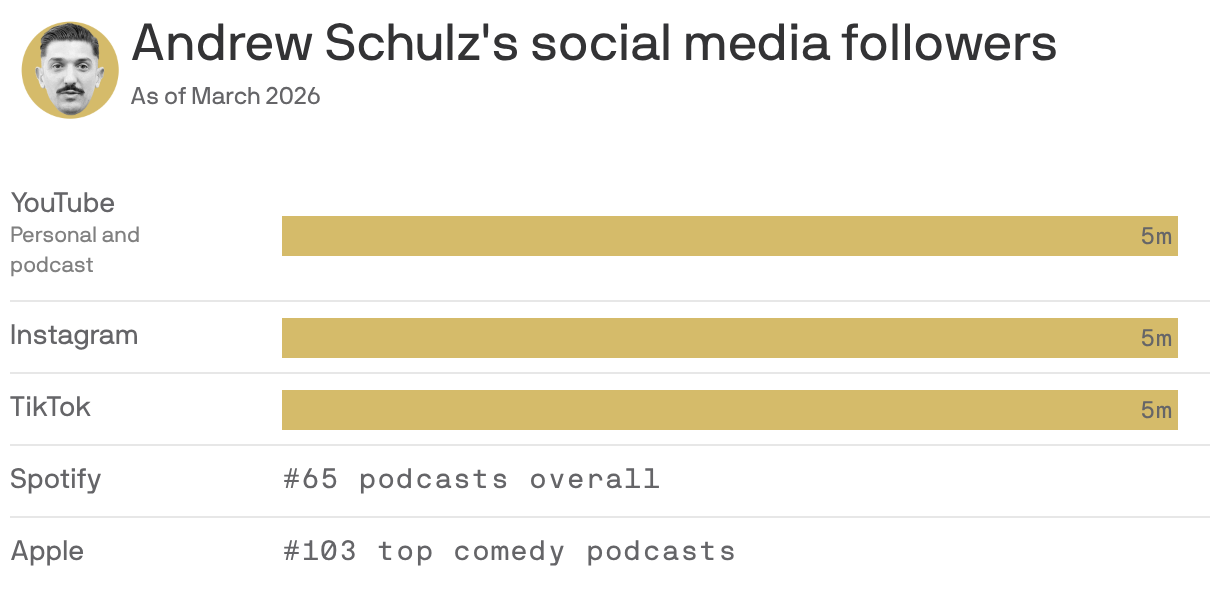
You've probably heard all about podcast bros' shifting sentiment on Trump. Andrew Schulz's "Flagrant" podcast is ground zero for that trend. His 2024 episode with then-candidate Trump pulled down almost 10 million YouTube views. But his subsequent pullback from the president became the top for a splashy piece in The Atlantic, "The Manosphere Turns on Trump."
- Why you should care: Your under-30 male employees are more likely to form political opinions from Schulz than from any cable network or newspaper. A taste of some of his politically-minded guests from last year: Zohran Mamdani, Ro Khanna and Ezra Klein.
๐ Of all the office inventions of the last century, the dry-erase board is easily the most remarkable. Got a better joke than that? Email me, I'll make sure it gets in a future C-Suite: [email protected].
- Written by Jim VandeHei | Edited by Shane Savitsky | C-Suite is powered by the reporting and insights of the full Axios newsroom.
Sign up for Axios C-Suite