Axios Boston

August 11, 2026

Hello, Tuesday.
- We bring you a back-to-school edition with the latest on "freedom to read" legislation, cellphone bans and school supply costs.
โ๏ธ Today's weather: Sunny, with a high of 87 and a low of 68.
๐ Happy birthday to Axios Boston member Kate Deeley!
๐ Our members are the driving force behind our newsroom. Join them today.
Today's newsletter is 1,049 words โ a 4-minute read.
1 big thing: Putting "freedom to read" law on the books
Massachusetts is the latest state to pass laws that aim to curb book bans based on identity.
Why it matters: The so-called "freedom to read" laws are blue states' answer to the book banning movement, which has revolved around books that focus on race, gender and sexuality.
Driving the news: Gov. Maura Healey signed the bill yesterday at the Franklin Public Library, the nation's first public lending library.
- The law will require school and public librarians, or other educators selecting library materials, to pick media that's age-appropriate and for educational purposes.
- Each selection must be based on the instructor's professional training "and not on personal, political or doctrinal" views.
Yes, and: This law shields school and public librarians from professional, civil and criminal penalties over a controversial book selection, including a license revocation.
What they're saying: "We're keeping book bans out of Massachusetts," Healey said before signing the bill into law.
Context: Campaigns to ban books in Massachusetts libraries have increased by 50% since fiscal 2023, mirroring the rise of book ban campaigns nationwide.
How it works: School districts, charter schools and local education agencies will adopt book selection rules based on the American Library Association standards.
- The Massachusetts Board of Library Commissioners will be tasked with writing a policy on media selection and use, also based on ALA standards.
- The new law also mandates a public process and a threshold for removing a challenged book.
Zoom in: If a book is challenged, a school has to keep it on the shelves unless or until a complaint undergoes a public hearing and a vote from a school committee or board of trustees to remove it.
- A student, parent or guardian could fight a school committee's vote to remove library materials in Superior Court or the Supreme Judicial Court.
- If a book is removed from a public library, an author, creator or resident could fight that decision in Superior Court.
2. ๐ต The limits of school cellphone bans
Schools nationwide are cracking down on student cellphone use, but a new study suggests the restrictions bring mixed results.
The big picture: Schools that require students to lock away their phones during class have seen phone use decline substantially, per a study shared by the National Bureau of Economic Research in April.
- Student well-being also appears to improve the longer the rules remain in place.
Catch up quick: School cellphone bans gained bipartisan support over the past few years as concerns grew about worsening youth mental health and plunging test scores post-pandemic, the Washington Post reports.
- The restrictions are also popular among teachers.
Yes, but: "For academic achievement, average effects on test scores are consistently close to zero," the researchers wrote.
- And they found "little evidence" those policies affect attendance, attention in class or perceived online bullying.
By the numbers: Roughly two-thirds of states have enacted legislation limiting student phone access, per the study.
- Massachusetts lawmakers have passed a school cellphone ban in the House and Senate, but they still need to hash out the differences and send a final bill to Gov. Maura Healey.
- Meanwhile, high schools in Ipswich, Newburyport and other communities have imposed their own cellphone bans during the school day.
- Nearly 5,000 schools use lockable phone pouches, according to the study.
The bottom line: Cellphone bans may still benefit students โ even if they don't directly translate into higher test scores.
3. ๐ Back That Mass Up: Abortion law expansion

Gov. Maura Healey yesterday signed legislation that expands abortion access to patients who are 24 weeks pregnant or later "based upon the professional judgment of the physician." (Globe)
๐ถ๏ธ Taylor Farms, the company that recalled lettuce linked to cyclospora cases this summer, is recalling several prepared food products made with jalapeรฑos amid a salmonella outbreak linked to them. (CBS Boston)
- In Massachusetts, the recall includes rice and bean burritos sold in Hannaford and pico de gallo sold in Stop & Shop and Hannaford.
A Boston federal judge ordered Immigration and Customs Enforcement to release a Chelsea construction worker who was detained on May 15 as agents sought someone else. (Universal Hub)
๐ฒ The state began construction yesterday on a new bicycle and pedestrian underpass under the Wellington Bridge in Medford. (StreetsblogMASS)
4. School recess is back in play

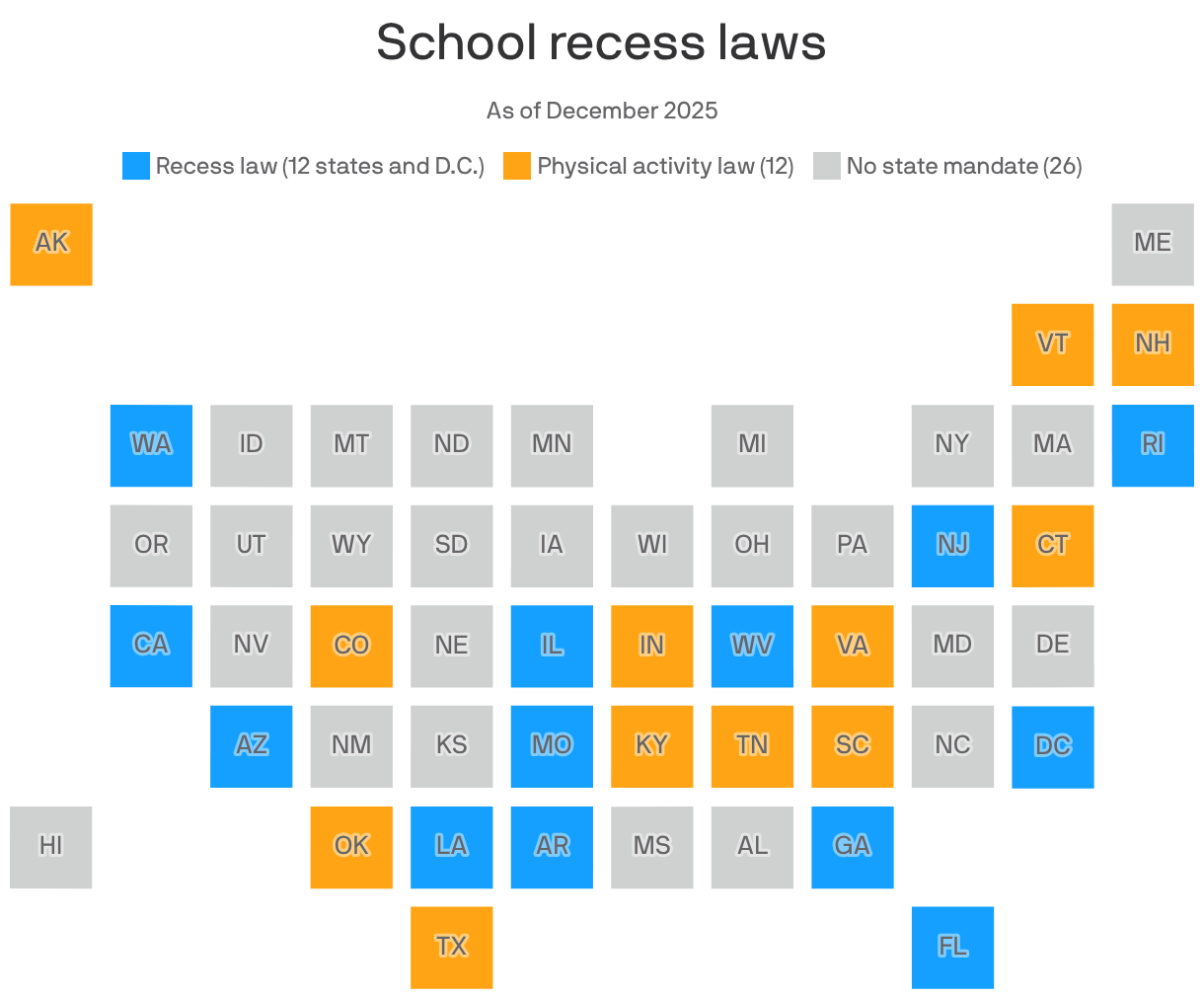
After decades of diminishing recess time, half of U.S. states now require it or other physical activity by law.
Why it matters: Researchers, pediatricians and parents say recess crucial for young students' physical and mental health.
By the numbers: As of December, school recess was mandated in 12 states and D.C., and laws requiring physical activity existed in 12 states, according to Johns Hopkins research.
- Most recently, Oklahoma's law mandating 40 minutes of daily recess became effective in July.
- Massachusetts, however, has no such law on the books. Nor does it have a broader law requiring "physical activity," though there is one requiring gym class.
5. Where back-to-school shoppers spend most


U.S. families expect to spend nearly $1,000 on average on back-to-school shopping this year, according to a PwC survey.
- Nearly half expect to spend more than they did last year.
State of play: Families in the Northeast, West and Midwest plan to outspend the national average of $922, which includes clothes, tech, equipment for after-school activities, books, school supplies and other one-time purchases.
Context: Prices are higher, classroom needs have changed and kids have more say over what families buy โ including requests for pricier items.
- They're seeing more ads on screens and often using digital wallets to buy things without parental interference, PwC's Kelly Pedersen tells Axios.
The big picture: Total K-12 back-to-school spending could climb around 10% this year compared to last, hitting a record $43.3 billion, the National Retail Federation forecasts.
Reality check: The spending doesn't stop once school starts.
- Households nationwide plan to spend $635 a month on recurring expenses like meals, snacks and tutoring, per PwC.
Deehan is back at work for the sprint to the Sept. 1 primary election.
Steph finally read "What My Bones Know."
This newsletter was edited by Jeff Weiner.
Sign up for Axios Boston