Axios @Work

November 24, 2020
Welcome back to @Work. Get in touch with me at [email protected] or on Twitter @erica_pandey.
- A must-read story from this week: My colleague Bryan Walsh breaks down the cognitive science behind American's collective numbness to the nation's coronavirus death toll, which currently sits at 258,000.
I've got 1,617 words for you this afternoon, which should take about 6 minutes to read. To start...
1 big thing: Remote work shakes up geopolitics

Illustration: Eniola Odetunde/Axios
The global adoption of remote work may leave the rising powers in the East behind.
The big picture: Despite India's and China's economic might, these countries have far fewer remote jobs than the U.S. or Europe. That's affecting the emerging economies' resilience amid the pandemic.
Driving the news: 16% of jobs in China and 12% of jobs in India can be done remotely, per a new McKinsey Global Institute analysis of 800 jobs across several nations. Compare that with the 33%, 30% and 29% of jobs that be done from home in the U.K., Germany and the U.S., respectively.
- That's because a huge share of jobs in India and China are in in-person sectors, like manufacturing, agriculture and retail, Susan Lund, one of the report's authors, tells me.
- And even though the majority of jobs in the U.S. and Europe are also in-person jobs, these countries are much likelier to pursue a remote-heavy future of work than their Eastern counterparts.
What's happening:
- "India has definitely taken a big, big hit because most people simply canβt work from home," says Bhaskar Chakravorti, dean of global business at Tuft's Fletcher School of Business. The country's GDP growth rate fell more than 23% between Q2 2019 and Q2 2020.
- China's economic recovery has been quite successful. But its low share of remote-capable jobs could hurt its future capacity to compete on the global stage, especially if teleworking proves to boost worker productivity as early studies have indicated.
- "In the end, the geopolitical contest between China and the world is going to be a contest for productivity and GDP growth," says Jonathan Ward, founder of the Atlas Organization, a consultancy focused on Chinese and Indian national strategy. "The ability to make productivity gains with remote work could potentially put the West at an advantage."
Worth noting: Even when jobs can theoretically be done from home in India or China, it often doesn't work that way in practice, Chakravorti says.
- In the big cities in those countries, people may be living in close quarters or without reliable broadband access β factors which require professionals to go into their offices to be productive.
The bottom line: Says Chakravorti, "This is going to be quite a turning point in terms of these countries' ability to bounce back."
2. $10,000 to move to Tulsa
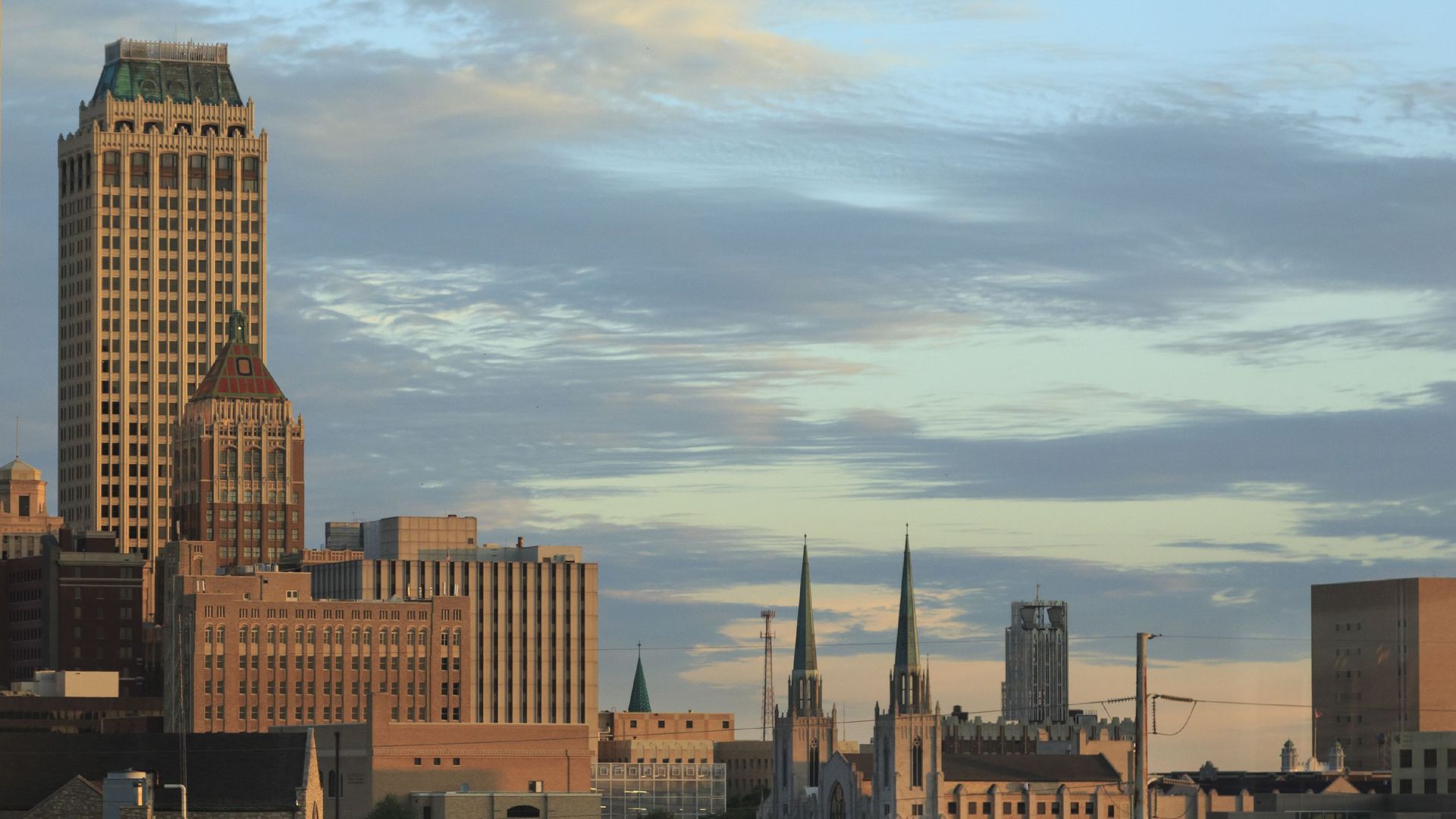
Tulsa, Oklahoma, at sunrise. Photo: Jumping Rocks/Universal Images Group via Getty Images
If you're going to be working remotely for the foreseeable future and want to save some money on rent, you could move to Tulsa β and get paid $10,000 to do so.
Why it matters: Tulsa Remote β the Kaiser Family Foundation-funded program that's offering this perk to teleworkers β is a prime example of smaller cities attempting to leverage remote work to draw in talented professionals from the big, coastal metros.
The backdrop: Tulsa Remote launched well before the onset of the pandemic, in 2018, but has seen a spike in applications this year, says urbanist Richard Florida, who served as a consultant for the program.
Here are the rules: You must be a full-time remote worker over the age of 18 and commit to living in Tulsa for at least a year.
- Of the 400 people who've moved to the city since the program launched in 2018, only three have left, CNN Business reports.
- 100 more new residents will have settled in by the end of 2020.
Tulsa Remote's target demographic is "people who are at the family formation stage and for whom trying to make a life in New York or Washington or San Francisco has become incredibly expensive," Florida says.
- The program is also attempting to diversify Tulsa by pulling in residents of different races, ethnicities and backgrounds, he says.
Go deeper: Americans are moving again
3. Tracking three types of restaurant jobs


The food service sector β which was dealt a massive blow during the pandemic β is coming back, but not all jobs are experiencing the same recovery.
The big picture: While restaurants are hiring almost as many cooks as they did last year, job openings for bartenders and banquet servers have plummeted, according to an analysis of job postings by Indeed economist AnnElizabeth Konkel.
- "The differences between these three occupations are directly linked to the pandemic," Konkel writes.
- "Many restaurants have reopened, even if only for takeout, and they need cooks. Bars have faced steeper challenges. Itβs no longer safe to have imbibing crowds packed in enclosed spaces, and thatβs taken a huge toll on demand for bartenders."
- "Similarly, large events have all but halted, devastating banquet server job postings. Until mass gatherings can once again take place safely, those jobs have little chance of recovery."
The outlook for these workers is especially bleak because the sectors adjacent to food service β like hospitality and leisure β are also struggling, which gives furloughed or laid off people few options for pivoting, Konkel tells me.
4. WeWork β but make it Uber
Illustration: Sarah Grillo/Axios
WeWork is turning into Uber.
The big picture: The rise of remote work has been disastrous for WeWork, which placed a hugely expensive bet on offices. Now the company is trying to find its place in the future of work by making its office space available on demand.
What's happening: WeWork is expanding WeWork On Demand, which it piloted in New York City over the summer, to 160 of its locations in 11 cities.
- Through the app, anyone can book a desk in a shared workspace for $29 per day or reserve a private meeting room starting at $10 per hour.
- 43 of the WeWorks that are available to book are in New York City, and the rest are scattered across Atlanta, Austin, Boston, Chicago, Denver, Los Angeles, Philadelphia, Seattle, D.C., and the Bay Area. The company says it plans to expand to several more locations around the U.S. and the world by next year.
Between the lines: A free-for-all in which anyone can book space at any number of WeWorks raises safety questions as we navigate the pandemic.
- WeWork says it'll follow social distancing guidelines and mandate masks, as well as ask app users to provide information for contact tracing.
- WeWork has also upgraded ventilation systems. "Pretty much every WeWork now has better circulation than before," says Prabhdeep Singh, the company's global head of marketplace.
While On Demand is a way for WeWork to make some money during pandemic-era telework, the company plans to keep it going even after the coronavirus is behind us.
- WeWork is betting on a hybrid remote and in-person future of work, says Singh.
- And the company is hoping that, on days when people don't go into the office, they will grab space at a WeWork β instead of a coffee shop or the local library β to make some calls or just get out of the house.
What to watch: The sharing economy has worked with cars and vacation homes, but you don't really see this kind of thing in commercial real estate. Office space leases are usually several years β or even decades β long.
5. A troubling, global trend
Illustration: Eniola Odetunde/Axios
People of color, women and LGBTQ+ employees in 11 countries report greater difficulties working during the pandemic, according to a McKinsey report released last week.
Why it matters: Existing inequities have only been exacerbated by the pandemic. The disproportionate effects on these communities won't disappear as COVID-19 continues to ravage the world, Axios' Shawna Chen writes.
The big picture: Compared to their peers in the countries surveyed, underrepresented employees shared greater:
- Concerns about job opportunities.
- Mental health challenges.
- Anxieties with work-life balance and workplace health and safety.
- Loss of connectivity and belonging.
The number of acute challenges cited by underrepresented employees was higher in emerging economies.
- On average, underrepresented employees in the U.S. reported experiencing 1 to 2 of the challenges in the above list. In India, it was 6 to 7; in Brazil, 5 to 6.
The bottom line: People of color are overrepresented in frontline occupations, making them more vulnerable to infection and burnout.
- The fact that these disparities exist around the world, regardless of the health care system, shows βa global pattern,β said William Spriggs, chief economist at the AFL-CIO, the U.S.βs largest federation of unions.
- "We do know that in the U.K., as in the United States, a disproportionate share of the frontline workers are Black or Asian or some other ethnic minority, and they suffer the same disparities in death by race that we do in the U.S. because they have the same disparities in who does the frontline risky jobs."
6. Worthy of your time
Illustration: Eniola Odetunde/Axios
The delayed robo-job apocalypse (Axios)
- Technological advances in AI and automation will have an enormous impact on the workforce, but it may take decades for those effects to be fully felt. That gives business leaders and politicians a last chance to change labor and education policies that have left too many workers locked in low-quality, low-paying jobs.
Bring back hazard pay (Washington Post)
- Workers at Amazon, Walmart, Kroger, Petco and other big retailers are asking their employers to bring back extra pandemic-era pay as the holiday shopping season kicks into gear. Although the pandemic has been raging on for months, retailers stopped giving out hazard pay early in the summer
What it takes to keep a bar in business (The California Sunday Magazine)
- Dan Stone dives into the stress of flip-flopping lockdowns and reopenings, the difficulty of securing PPP loans, and the difficult pandemic-era conversations between bosses and workers β all relayed through the story of one bar in Oakland.
A Zoom Thanksgiving using telework techniques (Wall Street Journal)
- Here's how you can translate eight months of skills you've picked up from working remotely into ensuring your video Thanksgiving runs smoothly.
7. 1 sign of the times: The small turkey shortage
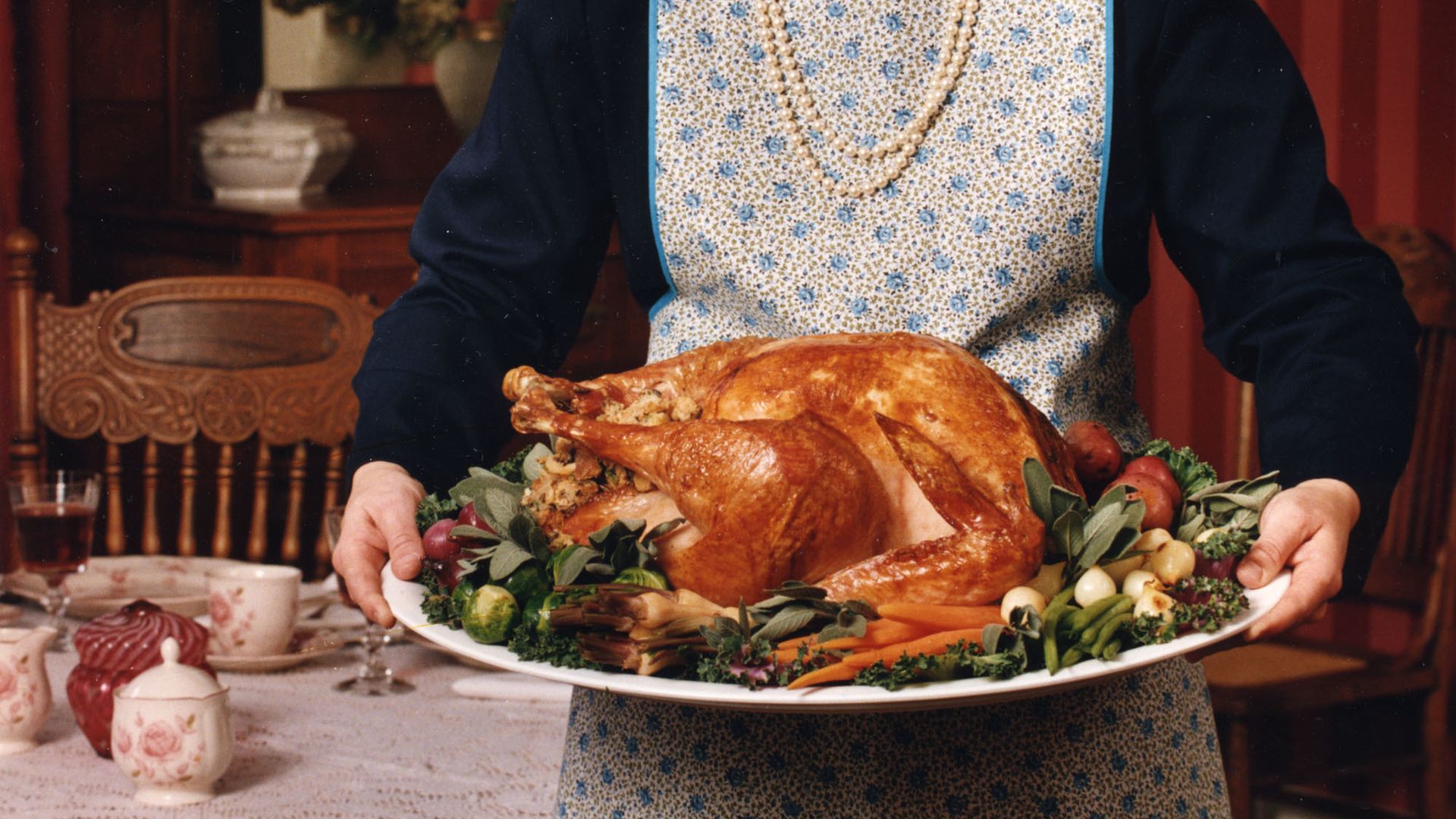
Photo: Rita Reed/Star Tribune via Getty Images
More Americans are staying home this Thanksgiving and celebrating with just their immediate households.
- That's causing a shortage of small turkeys, reports Quartz, citing USDA data.
- Demand for 8 lb. to 16 lb. birds is far outpacing demand for 16 lb. to 24 lb. birds.
The Wall Street Journal's Jennifer Levitz and Charles Passy spoke to several "turkey first-timers" β folks who are usually Thanksgiving dinner guests but who are attempting to go-it-alone this year in light of pandemic travel and group gathering concerns.
- As Terry Gant from Evanston, Illinois, put it to the Journal: βWe donβt do this ourselves. How the hell do you do Thanksgiving?β
Thanks for reading, and have a happy, healthy Thanksgiving!
Sign up for Axios @Work

Explore the economic & social shifts upending the workplace by business reporter, Erica Pandey. Weekly - Tuesday