Axios AM

June 04, 2025

🐫 Happy Wednesday! Smart Brevity™ count: 1,994 words ... 7½ mins. Thanks to Noah Bressner for orchestrating. Copy edited by Bryan McBournie.
🦾 Our Axios AI+ Summit in Manhattan today kicks off at 2:30 p.m. ET. Guests include New York Gov. Kathy Hochul, actor Joseph Gordon-Levitt, Runway CEO Cris Valenzuela and more. Tune in here.
1 big thing: Your AI survival kit
Anthropic CEO Dario Amodei's warning in our column last week about a looming AI-driven white-collar job apocalypse ignited a national conversation that pulled in everyone from former President Obama to President Trump's AI czar, Jim VandeHei and Mike Allen write in a "Behind the Curtain" column.
- Critics saw the warning as alarmist, saying the "doomer" attitude fails to account for the new jobs and economic riches AI might shower on the U.S. public.
- On the flip side, Obama and others saw the interview as vital truth-telling — a clear-eyed warning that government and companies should consider deeply and urgently.
Why it matters: In the flood of conflicting views, one broad consensus emerged. Every U.S. citizen should start preparing today for society-shifting AI advancements coming soon.
- So we plucked the best of what AI experts, government officials, business leaders, AI-savvy college students and Axios readers sent us to compile a toolkit for turning AI into a force multiplier for you.
Learn the models: There are many generative AI models you can use now for free. Here's a cheat sheet for where to get each one, what it's best for, and what you get if you upgrade to paid version, via Axios chief tech correspondent Ina Fried:
- ChatGPT (OpenAI): The pioneering chatbot offers image and video generation, and can be used through mobile and computer apps as well as via ChatGPT.com (and even an 800 number). ChatGPT Plus service ($20/month) offers more and earlier access to the latest models, plus additional privacy options. Check out the advanced voice mode's natural back-and-forth conversation.
- Claude (Anthropic): Though less-known than ChatGPT, Claude is favored by many businesses for its impressive coding skills and neutral, helpful tone. The $20-per-month version allows for more usage, priority during busy times and early access to new models.
- Grok (X): Built into X (formerly Twitter), Grok pitches itself as a "truth-seeking AI companion for unfiltered answers" — though its responses tend to be similar to those of other engines. Free users get a limited number of queries and image generations. Paid options include the $30-per-month SuperGrok and premium subscriptions to X (starting at $8/month).
- Perplexity: Perplexity has carved out a niche as a combination of AI chatbot + search engine. The $20-per-month Perplexity Pro service offers image generation and access to a range of models, allowing you to see their different responses in one place.
- Gemini (Google): Google's assistant can integrate with Gmail and offers a well-regarded tool called NotebookLM that can turn your notes (or any document) into a podcast. The $19.99-per-month Pro plan includes more access to its Whisk and Veo video tools plus more storage.
- Meta AI: Meta's AI assistant is available across Facebook, WhatsApp and Instagram, with free access to image generation and a chatbot based on the company's Llama model.
- Apple: Apple has the most limited AI of the group. But Apple Intelligence offers a taste of the technology in the apps you already use on your iPhone or Mac, including tools to tweak your writing, create a custom emoji or generate images. Apple Intelligence is free but requires a recent Mac or iPhone.
Experiment aggressively: You only see the possible magic by experimenting. Three easy ways to start:
- Writing: Train the model to write in your voice by asking the LLM to save your writing style after feeding in things you've written in the past. The more you feed, the better it mimics. Jim has a JimGPT, trained on hundreds of speeches and columns, as well as a saved version of our Smart Brevity™ style, fine-tuned to his personal quirks.
- Health: Feed in as much health information as you feel comfortable, including lab results, and you'll be amazed by generative AI's ability to help guide you on health choices, workouts, warning signs and supplements. (Always consult a doctor where appropriate!)
- Research: AI chatbots can be great for preparing for a meeting, understanding a new subject or planning a trip. Just ask for what you want to know — background on a person or company, or some good day trips in the city you're visiting.
Column continues below.
2. 🤖 Part 2: How to own AI

Master the prompts: This is the first advanced technology that you don't need to be a computer nerd or coder to master. You simply need to master the art of prompting, Jim and Mike continue.
These tips are excerpted from a Substack synthesis by Elvis Saravia, a U.K.-based machine-learning research scientist, summarizing a Y Combinator roundtable:
- Be hyper-specific & detailed (the "manager" approach): Treat your LLM like a new employee. Provide very long, detailed prompts that clearly define their role, the task, the desired output, and any constraints.
- Assign a clear role (persona prompting): Start by telling the LLM who it should act like (e.g., "You are a manager of a customer service agent," "You are an expert prompt engineer"). This sets the context, tone, and expected expertise.
- Outline the task & provide a plan: Clearly state the LLM's primary task (e.g., "Your task is to approve or reject a tool called..."). Break down complex tasks into a step-by-step plan for the LLM to follow.
- Meta-prompting ("LLM, improve thyself!"): Use an LLM to help you write or refine your prompts. Give it your current prompt, examples of good/bad outputs, and ask it to "make this prompt better" or critique it.
🥊 Reality check: AI bots are known to sometimes make things up, known as hallucinating. Verify the information you get if you plan to rely on it.
- Be sure you're comfortable with the information you're sharing with an AI assistant. In some cases, companies may use the data you share to train the models or serve advertising.
- Paid versions sometimes allow you to limit this. This Axios series, "What AI knows about you," details how the various chatbots train their systems.
Know the danger zones: If you're worried about your current major or job, be clear-eyed that the following list is areas AI experts think are most vulnerable:
- Programming and coding jobs, particularly entry-level, are likely to be the first to be hit.
- Telemarketers, some types of teachers, political scientists and arbitrators are quite vulnerable to automation by LLMs, a study by professors at Princeton, NYU and the University of Pennsylvania found.
- Image-generating AI will affect opportunities for interior designers, architects, art directors and mechanical drafters, the study says.
Own it: Figure out, now, ways to leverage LLMs to vastly improve your productivity, creativity and enjoyment. This is a snooze-you-lose moment. But if you jump in, start to master LLMs, and try to 2x your output this year and 10x it down the road, this could be a game-changer for your career.
- We encourage Axios colleagues to share their best findings with others in related gigs so that everyone grows with AI.
3. 👀 New Trump-Musk tension

Elon Musk's all-out disdain for President Trump's "big, beautiful bill" is devolving into a cold war between the country's most powerful men — and setting up a major test of Musk's political sway.
- Why it matters: Insiders say Musk and Trump remain friends and allies. But Musk's scathing rhetoric — threatening yesterday to "fire all politicians who betrayed the American people" — signals that tension is growing, Axios' Marc Caputo writes.
Musk's post on X calling Trump's legacy legislation a "disgusting abomination" of pork spending blindsided Trump's team when it was posted during a White House press briefing.
- His comments gave fresh ammunition to budget hawks in the Senate demanding trillions of dollars of additional spending cuts to vote for the bill — and delighted Democrats searching for another opening to attack Republican infighting.
🎨 The big picture: Trump was irked by Musk's social media sabotage, according to two insiders in frequent communication with both.
- "Elon was butthurt," one source said of the largest Republican donor of the 2024 cycle.
Between the lines: Republican regrets about the megabill have also erupted in the House, where two members say they want a do-over for parts of the legislation.
- Rep. Marjorie Taylor Greene (R-Ga.) said yesterday she hadn't read a section banning states from passing their own AI regulations. Greene said she'd be a "no" on final passage unless the measure is removed.
- Rep. Mike Flood (R-Neb.) said last week he hadn't read a section that would make it harder for judges to hold officials in contempt of court. Flood said he'll ask the Senate to remove the passage.
Go deeper: Four reasons Musk attacked Trump's "big beautiful bill."
4. 📈 Charted: Social security surge
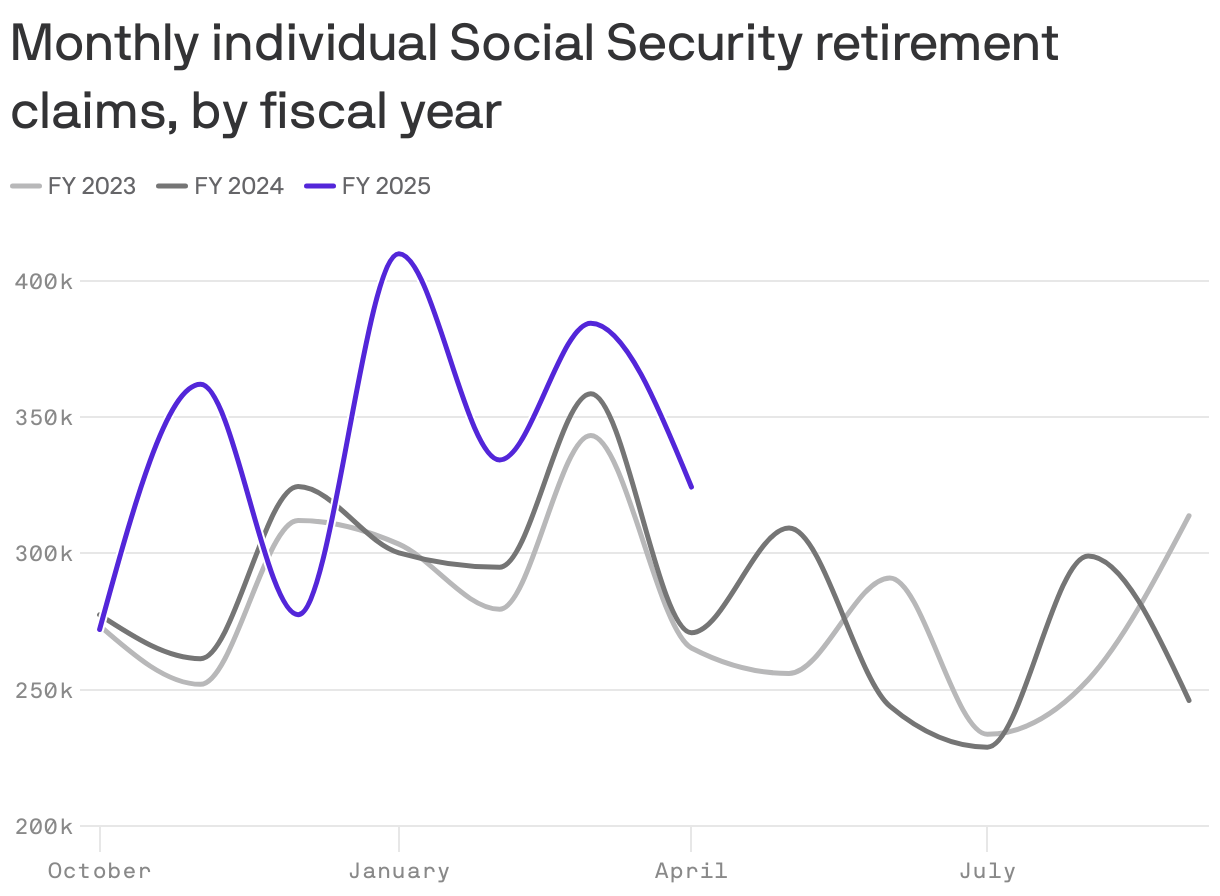
Social Security retirement claims are on track to increase 15% this year from 2024, Axios' Emily Peck writes from an analysis by the Urban Institute.
- From 2012 to 2024, claims increased by 3% per year, on average.
Between the lines: Experts say it's a mix of seniors fearing DOGE cuts and wanting to claim earlier than they would have otherwise, plus the general growth of the 65+ population.
5. 🏭 Manufacturers stare down supply shortages

American manufacturers are having pandemic flashbacks: some say tariff disruptions are starting to stack up to the COVID era, with nearly as much difficulty securing critical inputs, Axios' Courtenay Brown writes.
- Why it matters: Tariffs were supposed to spur a manufacturing renaissance, not bring the manufacturing economy grinding to a halt.
The big picture: Factories are reporting longer delivery times for supplies. Material prices are rising at a faster rate. Automakers are warning of supply disruptions shutting down assembly lines, with at least one carmaker pausing production.
- This time, there's no deadly virus, though trade wars and tariffs are still sending shockwaves through global supply chains, which could leave consumers with fewer options on shelves.
6. 💡 Why AI is still making things up
AI makers could do more to limit chatbots' penchant for "hallucinating," or making stuff up — but they're prioritizing speed and scale instead, Axios' Megan Morrone writes.
- Why it matters: High-profile AI-induced gaffes keep embarrassing users, and the technology's unreliability continues to cloud its adoption.
The big picture: Hallucinations aren't quirks — they're a foundational feature of generative AI that some researchers say will never be fully fixed.
- Last week it was a report from RFK Jr.'s MAHA commission citing studies that didn't exist. Experts found evidence suggesting OpenAI's tools were involved.
- A week earlier, The Chicago Sun-Times published a print supplement with a summer reading list full of real authors, but hallucinated book titles.
- AI legal expert Damien Charlotin tracks legal decisions in which lawyers have used evidence that featured AI hallucinations. His database details 30 instances in May 2025.
7. ⚓ Rare Navy renaming

Defense Secretary Pete Hegseth has ordered the Navy to rename the USNS Harvey Milk, a highly rare move that will strip the ship of the moniker of a slain gay rights activist who served as a sailor during the Korean War, AP's Lolita C. Baldor writes.
- Why it matters: It marks the latest move by Hegseth and the Trump administration to purge programs, policies, books and social media mentions of references to DEI.
The Navy is also considering renaming yet-to-be completed ships honoring Ruth Bader Ginsburg, Thurgood Marshall and Harriet Tubman, CBS reports.
8. 🍸 Scoop: MAGA hotspot's Kennedy Center deal

Butterworth's, the MAGA-favorite watering hole on Capitol Hill, is partnering with the Kennedy Center and will offer discounts to some of its customers, Axios' Tal Axelrod writes.
- Why it matters: The deal is the latest sign of MAGA's growing entrenchment in the Washington cultural scene.
The popularity of Butterworth's and Trump's reshaping of the Kennedy Center are two examples of MAGA making good on its promise to disrupt Washington's culture, not just its politics.
Go deeper: "The Restaurant Where Trump Acolytes Go to See and Be Seen," by the N.Y. Times' Robert Draper (gift link).
📬 Thanks for reading! Please invite your friends to join AM.
Sign up for Axios AM


/2025/06/03/1748982577855.gif?w=3840)