Axios AM

April 13, 2026

🌼 Good Monday morning! Smart Brevity™ count: 1,974 words ... 7½ mins. Thanks to Noah Bressner for orchestrating. Edited by Andrew Pantazi and Bill Kole.
🕶️ If you're in D.C.: Get your mind off Tax Day by joining our Axios News Shapers extravaganza this Wednesday at 7:30 a.m. Courtenay Brown will interview Sen. Chris Van Hollen (D-Md.) and former World Bank president David Malpass. RSVP here.
1 big thing: Race to revive Iran talks
Pakistani, Egyptian and Turkish mediators will continue talks with the U.S. and Iran in the coming days in an effort to bridge the remaining gaps and reach a deal to end the war, Axios' Barak Ravid reports.
- Why it matters: All parties still believe a deal is possible. The mediators hope that narrowing the gaps could enable another round of negotiations before the ceasefire expires on April 21.
A regional source told us: "We are not in a complete deadlock. The door is not closed yet. Both sides are bargaining. It's a bazaar."
- A U.S. official added that a deal could be reached if Iran shows more flexibility and recognizes that the Islamabad proposal is the best it will get.
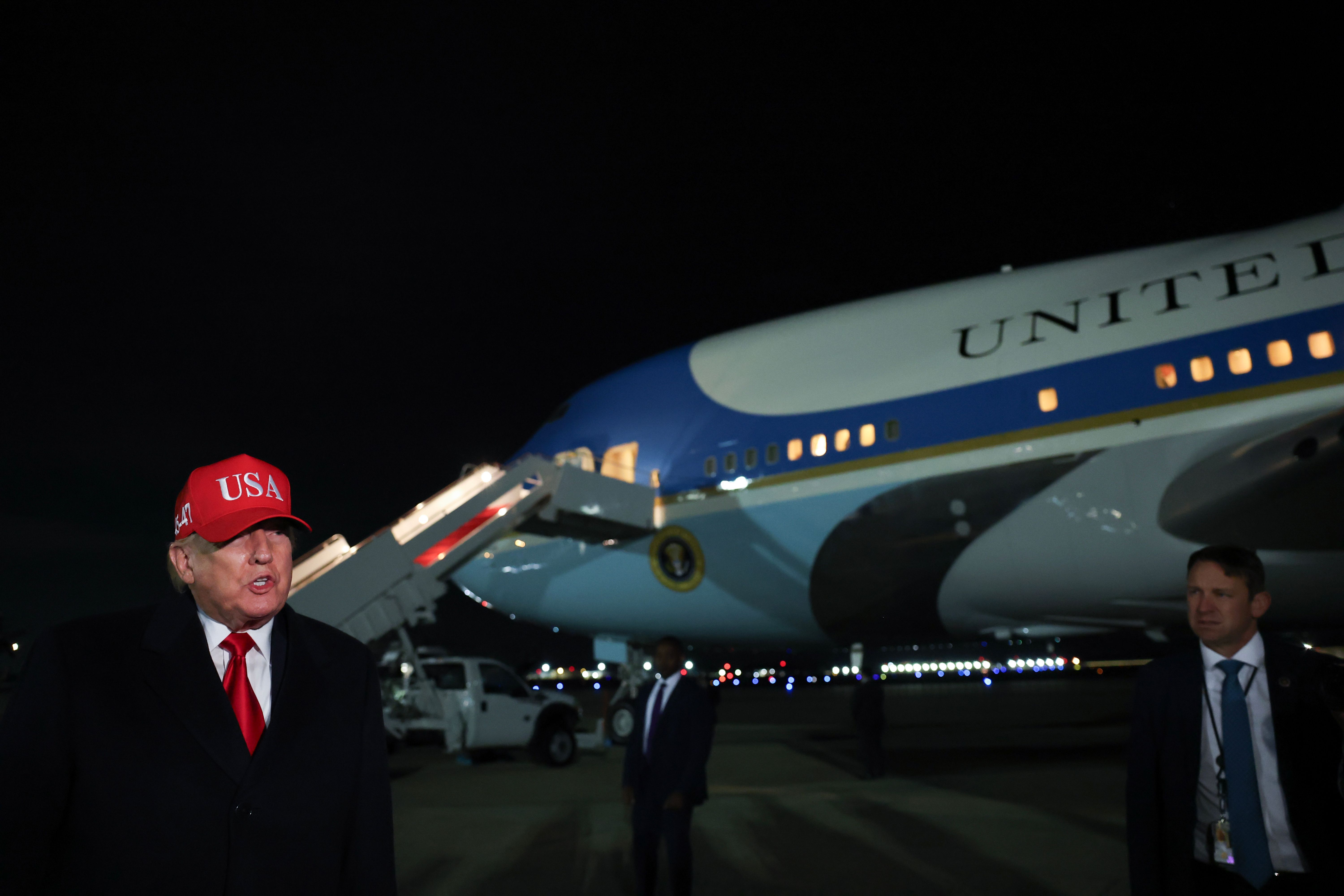
🖼️ The big picture: President Trump is considering resuming strikes if a U.S. naval blockade doesn't make Iran change course, sources said.
- Targets could include infrastructure he threatened to attack before the ceasefire was announced.
- The blockade, like the U.S. decision to walk away from the talks in Pakistan, is part of the ongoing negotiations, a U.S. official said.
The official claimed Trump wants to prevent Iran from using the Strait of Hormuz as leverage.
Behind the scenes: The main gaps during the 21-hour negotiations between the U.S. and Iran in Pakistan focused on the nuclear issue.
- One was U.S. demands that Iran freeze uranium enrichment and surrender its stockpile.
- Another was the amount of frozen money Iran wants the U.S. to release in return for its nuclear concessions, sources said.
👀 What to watch: U.S. Central Command says the naval blockade begins this morning at 10 a.m. ET.

🛢️ Trump is pairing his Iran blockade with a sales pitch: Countries squeezed by the Strait of Hormuz — especially China — should buy more oil from the U.S. instead, Ben Geman writes for Axios Future of Energy.
- "China can send their ships to us. China can send their ships to Venezuela," Trump said on Fox's "Sunday Morning Futures."
🥊 Reality check: The U.S. doesn't have the capacity to come close to replacing the massive flows normally moving through the Strait of Hormuz.
2. 💡Building a bionic YOU
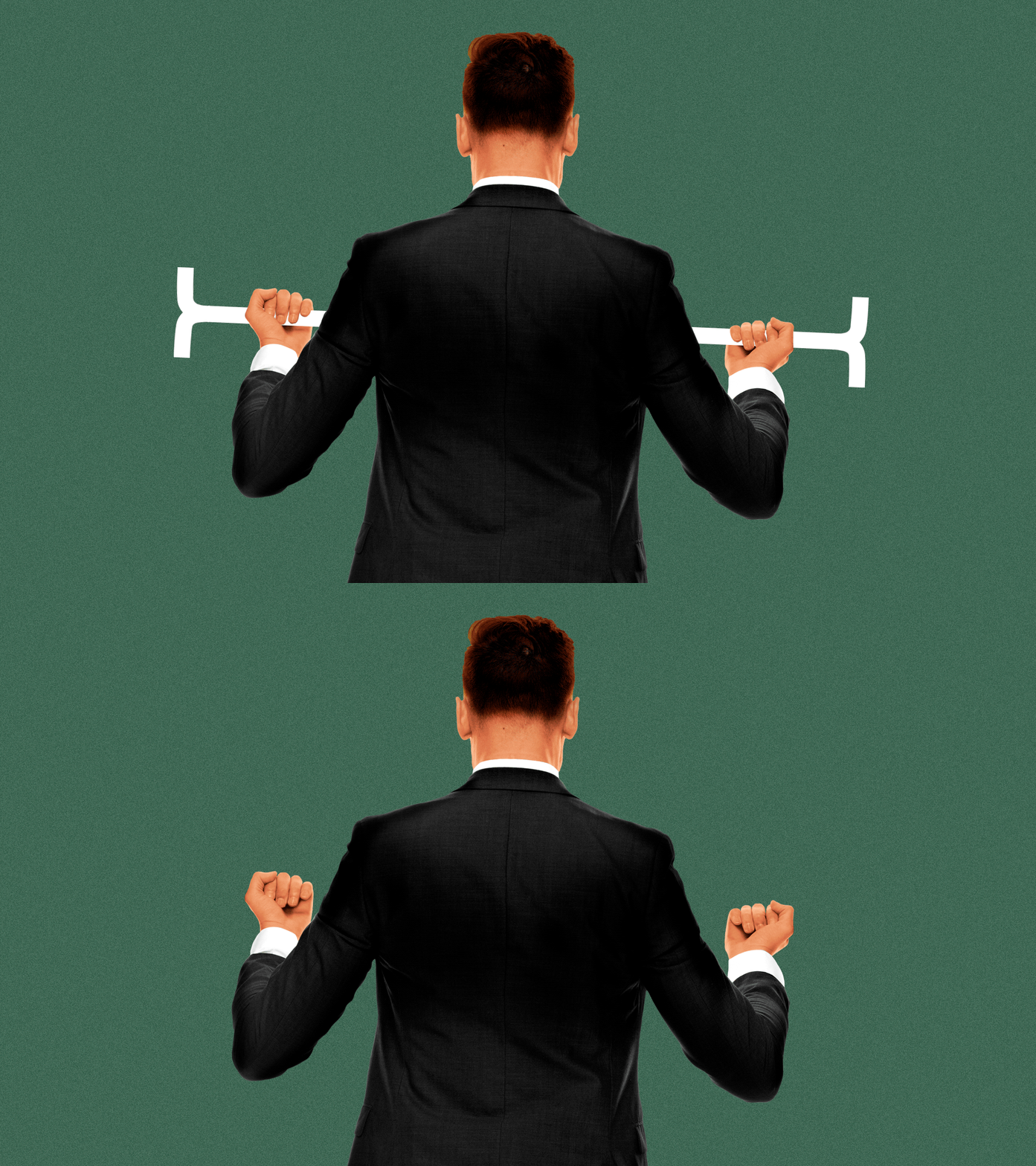
When I've had it with VandeHei, I sometimes tell him to "just ask JimGPT" — a personalized LLM he has meticulously built based on his speeches, internal memos, columns and TV appearances.
- His new newsletter, Axios C-Suite, had tips this weekend for building a YouGPT. I thought they'd be useful to all AMers:
A CEO agent can give you superpowers, like exploring ideas and even designing new business lines yourself. And it can provide highly tailored intelligence reports on competitors or your own micro-passions.
💡 How Jim did it: He loaded everything he's said publicly into both ChatGPT and Claude to create JimGPT.
- The models write in Axios style and in his voice — tight, punchy sentences, data-based answers — whenever he asks.
How you can do it: Upload your own writing into a Claude project or custom GPT. Then set instructions for tone, length and style. The more you feed it, the better it gets.
The key insight: Don't ask the AI to go find your voice. Give it your voice. The CEO who uploads 50 documents gets a 10x better clone than the one who types a few simple prompts.
⏱️ The bottom line: He got JimGPT rocking in an hour or so. Overnight, you can have a bionic YOU.
🪄 4 magical prompts
Try these four use cases — no tech team required.
- None will be perfect. But they'll help you fine-tune your prompts. Once you get the prompt right, you can cut and paste it whenever you want to use it or ask the AI to save it under a specific name in its memory.
1. Run a premortem on your next big decision. Before you green-light a deal, launch or reorg, stress-test it with AI the way you'd stress-test it with your best board member — except this one has no political agenda or institutional bias.
- Try this prompt: "I'm the CEO of a [X]-person company in [industry]. We're about to [decision]. Play devil's advocate. Give me the five strongest arguments this will fail, based on highly reputable data and sources only. Identify what I'm likely not seeing because of confirmation bias. Be blunt and be prescriptive. Then tell me what you'd do instead."
2. Build yourself a weekly briefing. Most CEOs get information filtered through layers — or the eyes of someone not operating at their level. Cut through it.
- Try this prompt: "I am the CEO of [a few sentences describing your company and competitive position]. I need the most useful and insightful briefing about my industry, fine-tuned for peak relevance to my company. Give me the five most important developments over the past six days ranked by impact on me and my business. Use only reputable sources and cite the source and provide a direct link after each. Write it bluntly and clinically."
3. Turn a vague instinct into a testable thesis. CEOs often sense something is shifting — a market, a competitor, a customer behavior — but don't have the data team's bandwidth to explore it. AI is your first-pass analyst.
- Try this prompt: "I have a hunch that [trend/shift] is taking place. Knowing I am the CEO of [company] in [industry], give me the five data points or signals I should look for to confirm or kill this theory, and suggest the cheapest way to test it this quarter. End by telling me an adjacent idea I am missing or underappreciating."
4. Use game theory on AI's impact on YOU. Truth is, you're lucky if 1% of your company is truly AI smart-and-sophisticated. Most aren't. Don't wait for someone to tell you what AI might do to your company. Ask the AI yourself. You can create a weekly AI intelligence report for YOU.
- Try this prompt: "I am the CEO of [a few sentences describing your company, its size and business model]. I need the smartest, most clinical understanding of how AI will impact me personally and my company broadly. Write me a five-item newsletter in Axios style on the most important things happening this week in AI or adjacent tech that you believe will have the greatest impact on me and my company. Include a 'why it matters to me' summary at the end of each item."
📈 If you're a CEO or on a CEO's team: Sign up now to join Jim's new Axios C-Suite weekly newsletter.
3. 🗳️ Earthquake in Hungary

Hungarian voters have ousted Prime Minister Viktor Orbán after 16 years in power, delivering a stunning rebuke to one of the Western world's most entrenched populist leaders, Axios' Zachary Basu writes.
- Corruption and self-dealing were major reasons for Orbán's defeat.
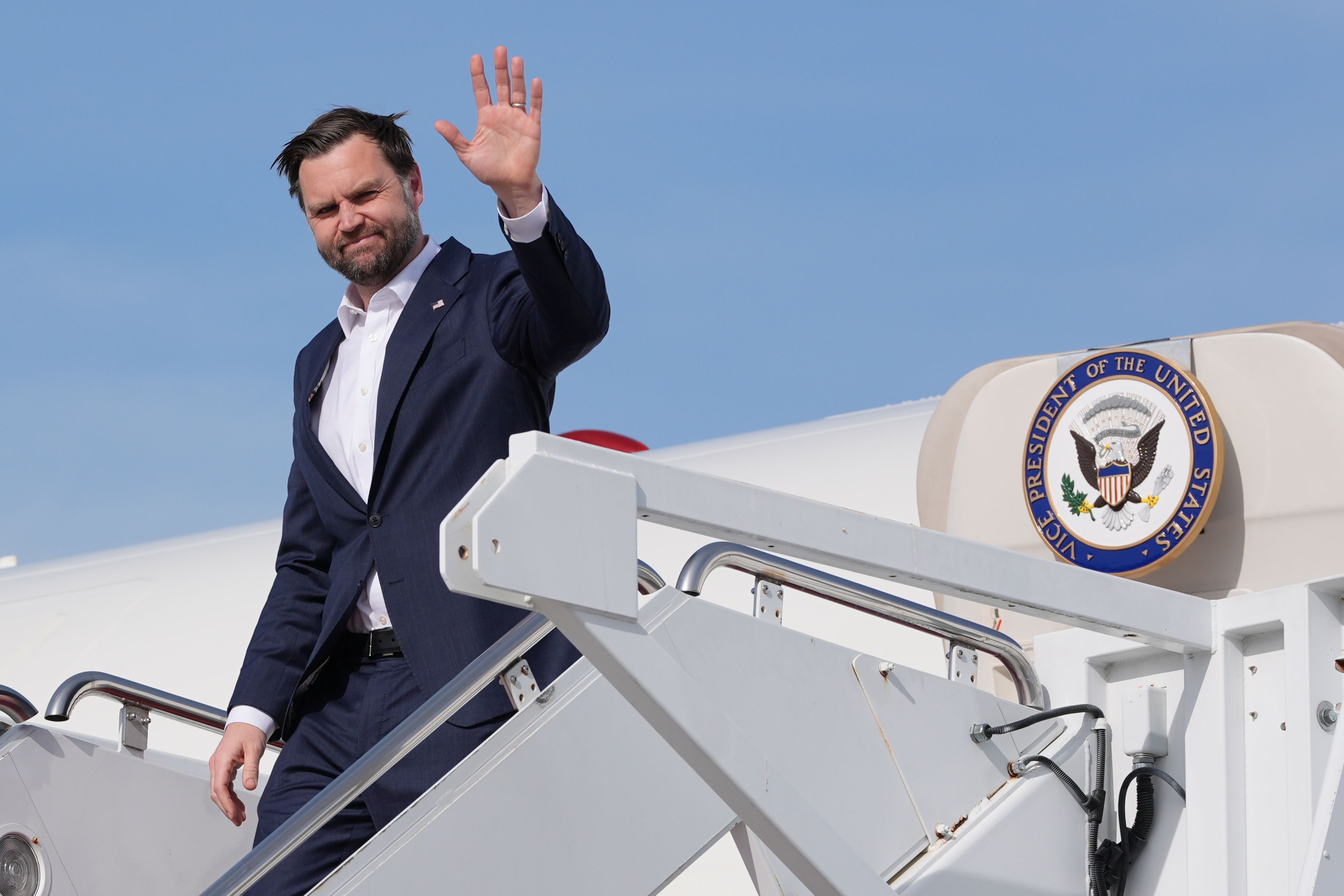
Why it matters: The political earthquake in Hungary, where Vice President Vance campaigned for Orbán in the campaign's final days, will ripple far beyond Budapest.
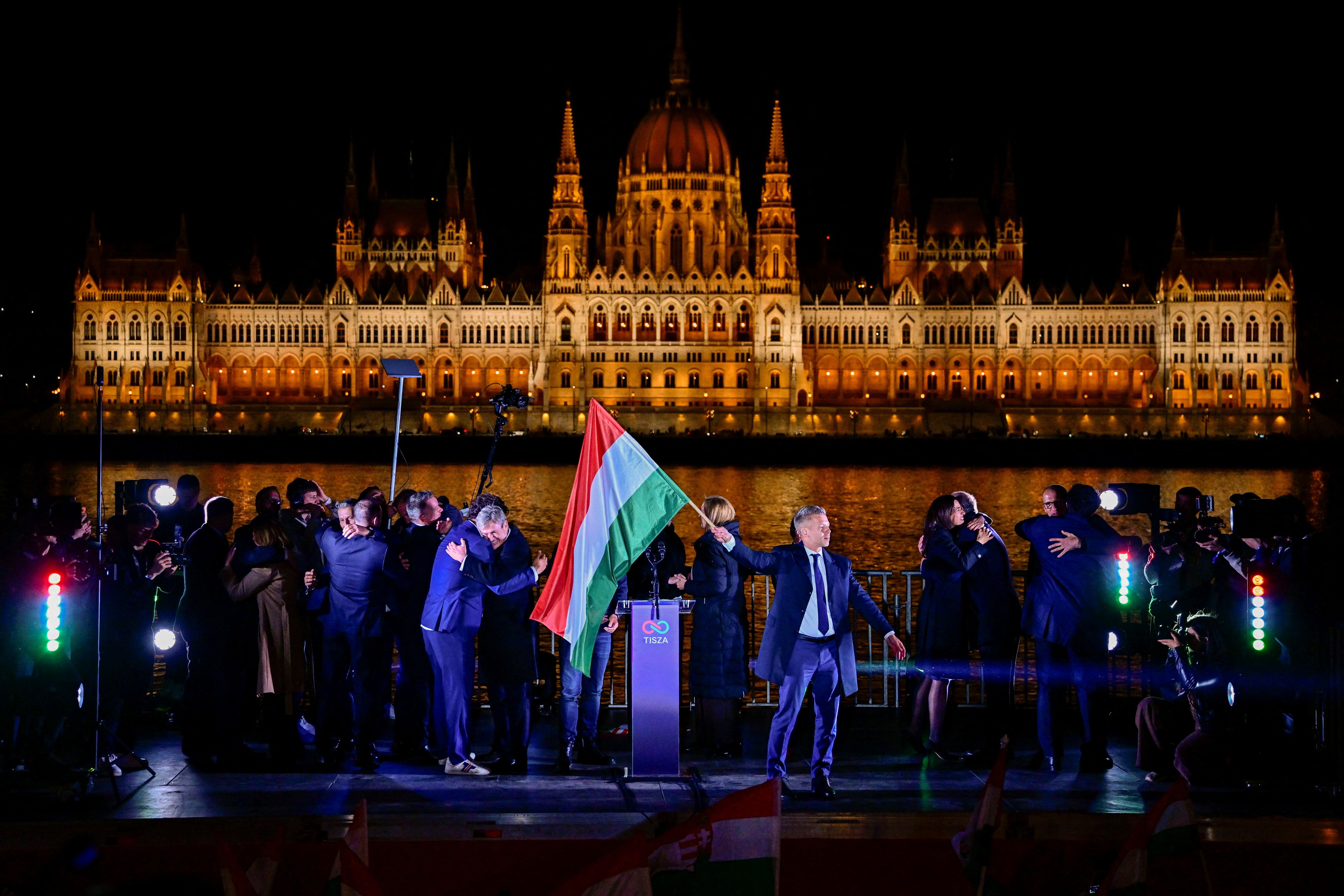
Péter Magyar, 45, a former insider who broke with Orbán two years ago and built the upstart Tisza party into a juggernaut, claimed victory last night.
- Magyar has promised to clean out corruption.
4. 📸 Pic du jour: Trump's newest statue
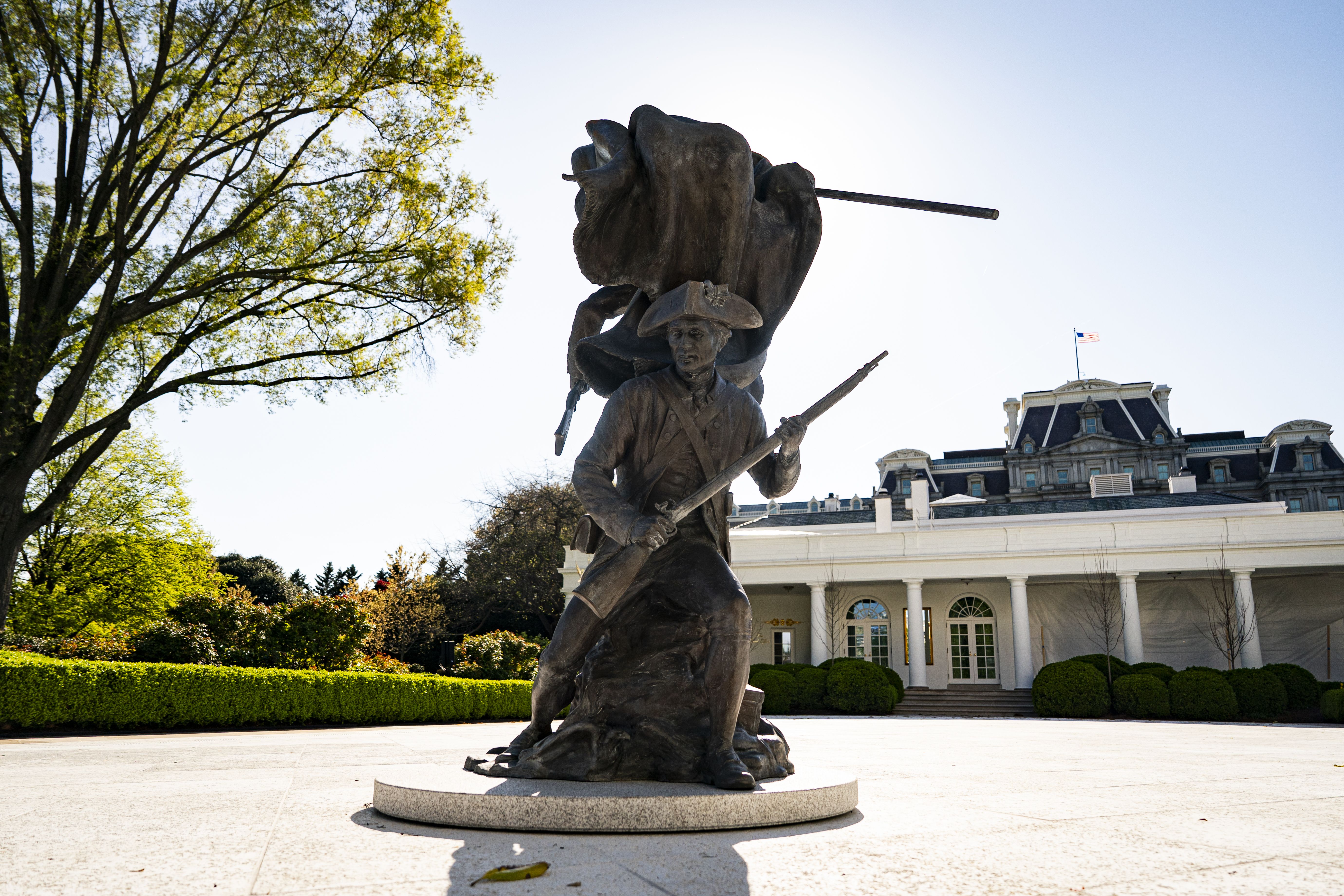
A new bronze statue — "Freedom's Charge," by Chas Fagan — was installed last week in the White House's renovated Rose Garden.
- President Trump describes it as "a life-size sculpture representing the revolutionary struggle to win America's independence."
Trump has also added statues of George Washington, Benjamin Franklin and Alexander Hamilton to the White House campus.
5. 🤖 The 3 AI realities

Breaking: OpenAI CEO Sam Altman's San Francisco home appears to have been attacked for the second time in three days. Early Sunday, a person riding in a Honda appeared to fire a live round at the property, The San Francisco Standard reports. Two suspects in their 20s were arrested.
Three distinct camps are forming around AI: power users, doubters and resisters, Axios AI+ co-author Ina Fried writes.
- Why it matters: AI isn't just advancing — it's fragmenting how people see the world.
🦾 1. Power users run AI agents around the clock, trading tips on how to automate work and decision-making.
- Former OpenAI and Tesla AI leader Andrej Karpathy told the "No Priors" podcast that he now spends 16 hours a day issuing commands to AI agent swarms and rushes to exhaust his tokens every month.
🤷♂️ 2. Doubters and more casual users still see AI as glitchy chatbots and viral fails. They aren't using its full capabilities.
- Anthropic's March economic impact report points to a new gap between advanced users and everyone else.
⚠️ 3. Resisters are getting louder. They understand AI, think they know where it's headed and want no part of it.
- Protests are becoming more common in San Francisco and in communities targeted for new data centers.
In some cases, the backlash is turning violent. In the first attack on Altman's house, a man was arrested after allegedly throwing a firebomb.
- In Indianapolis, a legislator said his home was hit by gunfire, with a note left behind saying "no more data centers."
6. 🔎 Swalwell suspends campaign
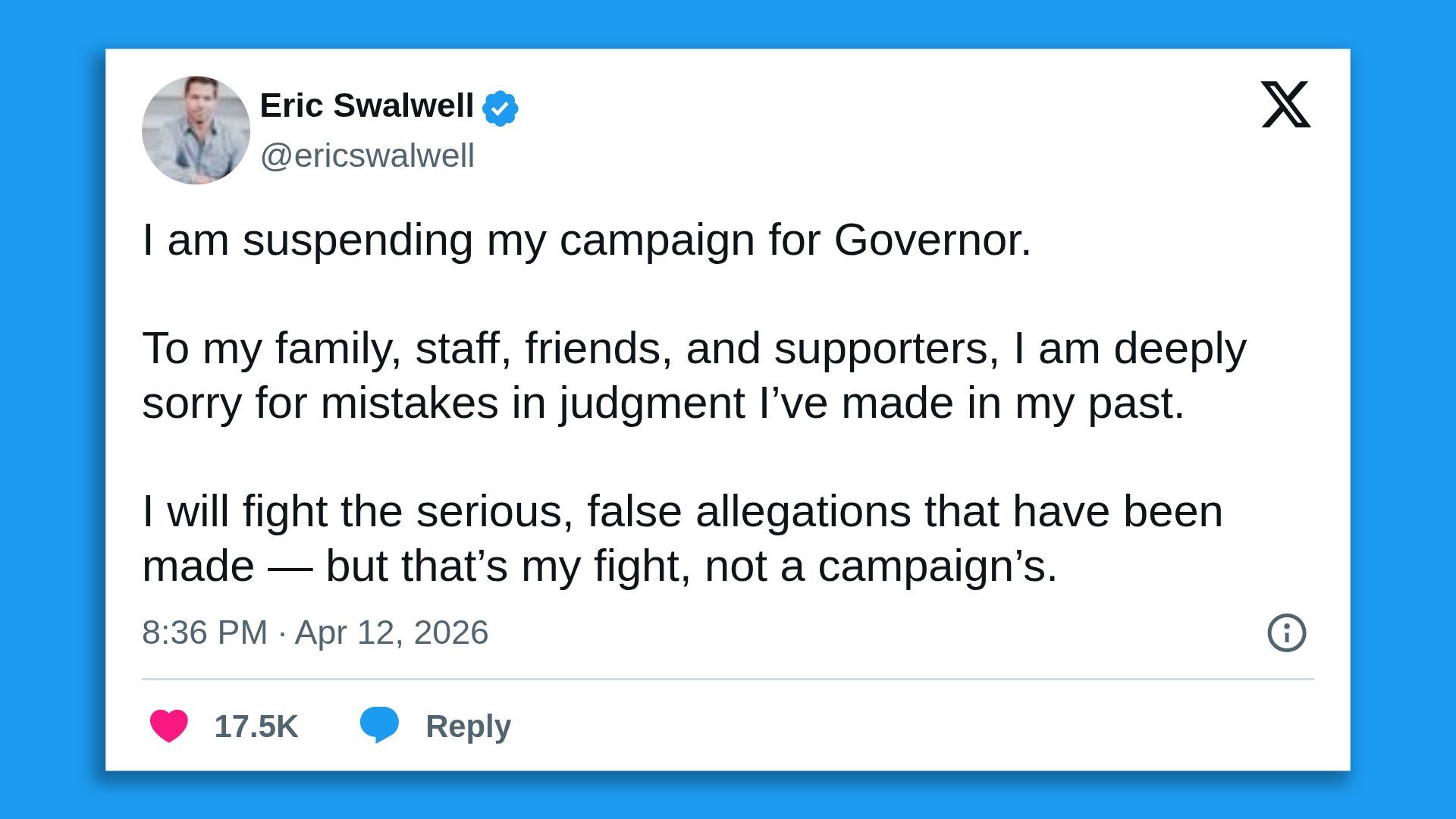
Rep. Eric Swalwell (D-Calif.) announced last night that he's suspending his campaign for governor amid allegations of rape, sexual assault and sexual misconduct that he denies.
- Why it matters: Swalwell was one of the Democratic frontrunners in the race. His exit is a colossal shakeup of what has already been one of the most volatile gubernatorial races in recent memory, Axios' Andrew Solender writes.
He offered no indication that he plans to give up his House seat after calls from colleagues in both parties for him to resign.
- Rep. Anna Paulina Luna (R-Fla.) has said she plans to force a vote to expel Swalwell when the House returns to session this week. That would require a two-thirds majority.
7. 🥊 Trump's papal broadside

President Trump lashed out against Pope Leo XIV last night, calling him "WEAK on Crime, and terrible for Foreign Policy."
- Why it matters: The comments escalate already high tensions between the president and the first U.S.-born pope, who has spoken out on Trump administration immigration policies and the Iran war.
Pope Leo, speaking today on a flight to Algeria, said he has "no fear of the Trump administration" and that the Church's role is as "a peacemaker," not a political actor, per OSV News.
- The pope, urging people of goodwill to pray for peace, had said Saturday: "It is here that we find a bulwark against that delusion of omnipotence that surrounds us and is becoming increasingly unpredictable and aggressive."
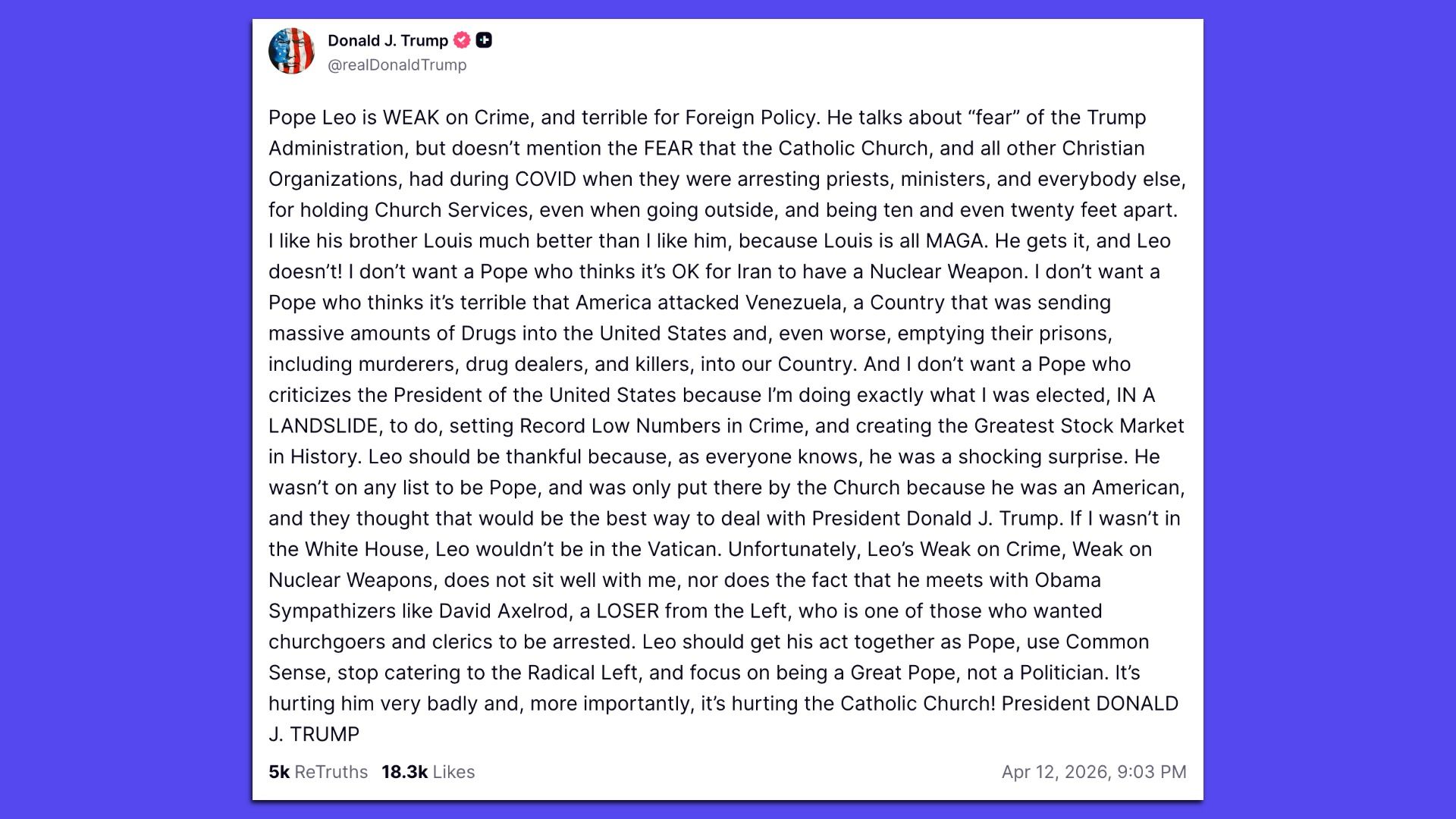
In a 300+-word Truth Social post, Trump criticized the pope on matters including the Catholic Church's stance during the COVID pandemic and said he likes Leo's "brother Louis much better" than him because, he claimed, he's "all MAGA."
⏱️ Shortly before Trump's papal post, CBS News' "60 Minutes" aired interviews by Norah O'Donnell with three U.S. cardinals on "why Pope Leo's church has emerged as a voice of moral opposition to the war in Iran and the crackdown on immigration." Read/watch the segment, "Pope Leo's Church."
8. 👓 1 for the road: Masters loophole

Rory McIlroy became just the fourth golfer to earn back-to-back green jackets after winning the Masters yesterday.
- The last consecutive win: Tiger Woods in 2002.
📱 Tales from Augusta: Some fans this year found a loophole for the tournament's famous no-cellphones policy: Meta's smart glasses and Apple Watches, the U.K.'s Golf Monthly notes.
The tournament's updated list of prohibited items now includes "devices capable of transmitting photo/video." But "fitness tracking bands and electronic watches" are fine.
📬 Thanks for starting your week with us! Please invite your friends to join AM.
Sign up for Axios AM