Axios AM

May 28, 2025

🐫 Hello, Wednesday! Smart Brevity™ count: 1,983 words ... 7½ mins. Thanks to Noah Bressner for orchestrating. Copy edited by Bryan McBournie.
1 big thing: White-collar bloodbath
Dario Amodei — CEO of Anthropic, one of the world's most powerful creators of artificial intelligence — has a blunt, scary warning for the U.S. government and all of us:
- AI could wipe out half of all entry-level white-collar jobs — and spike unemployment to 10-20% in the next one to five years, Amodei told us in an interview from his San Francisco office.
- Amodei said AI companies and government need to stop "sugar-coating" what's coming: the possible mass elimination of jobs across technology, finance, law, consulting and other white-collar professions, especially entry-level gigs.
Why it matters: Amodei, 42, who's building the very technology he predicts could reorder society overnight, said he's speaking out in hopes of jarring government and fellow AI companies into preparing — and protecting — the nation, Jim VandeHei and Mike Allen write in a "Behind the Curtain" column.
Few are paying attention. Lawmakers don't get it or don't believe it. CEOs are afraid to talk about it. Many workers won't realize the risks posed by the possible job apocalypse — until after it hits.
- "Most of them are unaware that this is about to happen," Amodei told us. "It sounds crazy, and people just don't believe it."
🖼️ The big picture: President Trump has been quiet on the job risks from AI. But Steve Bannon — a top official in Trump's first term, whose "War Room" is one of the most powerful MAGA podcasts — says AI job-killing, which gets virtually no attention now, will be a major issue in the 2028 presidential campaign.
- "I don't think anyone is taking into consideration how administrative, managerial and tech jobs for people under 30 — entry-level jobs that are so important in your 20s — are going to be eviscerated," Bannon told us.
Amodei — who had just rolled out the latest versions of his own AI, which can code at near-human levels — said the technology holds unimaginable possibilities to unleash mass good and bad at scale:
- "Cancer is cured, the economy grows at 10% a year, the budget is balanced — and 20% of people don't have jobs." That's one very possible scenario rattling in his mind as AI power expands exponentially.
⚡ The backstory: Amodei agreed to go on the record with a deep concern that other leading AI executives have told us privately. Even those who are optimistic AI will unleash unthinkable cures and unimaginable economic growth fear dangerous short-term pain — and a possible job bloodbath during Trump's term.
- "We, as the producers of this technology, have a duty and an obligation to be honest about what is coming," Amodei told us. "I don't think this is on people's radar."
- "It's a very strange set of dynamics," he added, "where we're saying: 'You should be worried about where the technology we're building is going.'" Critics reply: "We don't believe you. You're just hyping it up." He says the skeptics should ask themselves: "Well, what if they're right?"
Column continues below.
2. 🤖 How it unfolds

Here's how Amodei and others fear the white-collar bloodbath is unfolding:
- OpenAI, Google, Anthropic and other large AI companies keep vastly improving the capabilities of their large language models (LLMs) to meet and beat human performance with more and more tasks. This is happening and accelerating.
- The U.S. government, worried about losing ground to China or spooking workers with preemptive warnings, says little. The administration and Congress neither regulate AI nor caution the American public. This is happening and showing no signs of changing.
- Most Americans, unaware of the growing power of AI and its threat to their jobs, pay little attention. This is happening, too.
And then, almost overnight, business leaders see the savings of replacing humans with AI — and do this en masse. They stop opening up new jobs, stop backfilling existing ones, and then replace human workers with agents or related automated alternatives.
- The public only realizes it when it's too late.
The other side: Amodei started Anthropic after leaving OpenAI, where he was VP of research. His former boss, OpenAI CEO Sam Altman, makes the case for realistic optimism, based on the history of technological advancements.
- "If a lamplighter could see the world today," Altman wrote in a September manifesto — sunnily titled "The Intelligence Age" — "he would think the prosperity all around him was unimaginable."
But far too many workers still see chatbots mainly as a fancy search engine, a tireless researcher or a brilliant proofreader. Pay attention to what they actually can do: They're fantastic at summarizing, brainstorming, reading documents, reviewing legal contracts, and delivering specific (and eerily accurate) interpretations of medical symptoms and health records.
- We know this stuff is scary and seems like science fiction. But we're shocked how little attention most people are paying to the pros and cons of superhuman intelligence.
Anthropic research shows that right now, AI models are being used mainly for augmentation — helping people do a job. That can be good for the worker and the company, freeing them up to do high-level tasks while the AI does the rote work.
- The truth is that AI use in companies will tip more and more toward automation — actually doing the job. "It's going to happen in a small amount of time — as little as a couple of years or less," Amodei says.
That scenario has begun: Hundreds of technology companies are in a wild race to produce so-called agents, or agentic AI.
- You need to understand what an agent is and why companies building them see them as incalculably valuable. In its simplest form, an agent is AI that can do the work of humans — instantly, indefinitely and exponentially cheaper.
- That's why Meta's Mark Zuckerberg and others have said that mid-level coders will be unnecessary soon, perhaps in this calendar year.
💡 Amodei was eager to talk to us about solutions. Here are a few ideas distilled from our conversations with Anthropic and others deeply involved in mapping and preempting the problem:
- Speed up public awareness, with government and AI companies more transparently explaining the coming workforce changes.
- Slow down job displacement by helping American workers better understand how AI can augment their tasks now.
- Begin debating policy solutions for an economy dominated by superhuman intelligence. An idea Amodei floats is a "token tax": Every time someone uses a model and the AI company makes money, perhaps 3% of that revenue goes to government and is redistributed.
3. 🚨 Scoop: Miller demands ICE supercharge arrests

In a tense meeting last week, top Trump aide Stephen Miller and Homeland Security Secretary Kristi Noem demanded that immigration agents seek to arrest 3,000 people a day, Axios' Brittany Gibson and Stef W. Kight scoop.
- Why it matters: The new target is triple the number of daily arrests that agents were making in the early days of Trump's term — and suggests the president's top immigration officials are full-steam ahead in pushing for mass deportations.
The increased pressure on agents comes as border-crossing numbers have plummeted in Trump's first four months. It signals an increasingly aggressive approach to making arrests in non-border communities nationwide.
- It also comes as the Trump administration's heavy-handed tactics in rounding up unauthorized immigrants — and in some cases, legal residents and even U.S. citizens — appear to have contributed to President Trump's slipping poll numbers on immigration.
🔎 Zoom in: Miller, the White House's deputy chief of staff and leading architect of President Trump's immigration policy, laid into top immigration officials during the May 21 meeting at ICE headquarters in D.C., according to four people familiar with the meeting.
- Miller demanded that field office directors and special agents in charge get arrest and deportation numbers up as much as possible, pointing to the waves of unauthorized immigrants who were able to enter the U.S. during the Biden administration.
Noem took a milder approach in pushing for more arrests, soliciting feedback from ICE leaders.
- Miller's directive and tone had people leaving the meeting feeling their jobs could be in jeopardy if the new targets aren't reached, two of the sources said. A third person said Miller was trying to motivate people with a harsh tone.
4. 🌡️ Mapped: America's warming summers
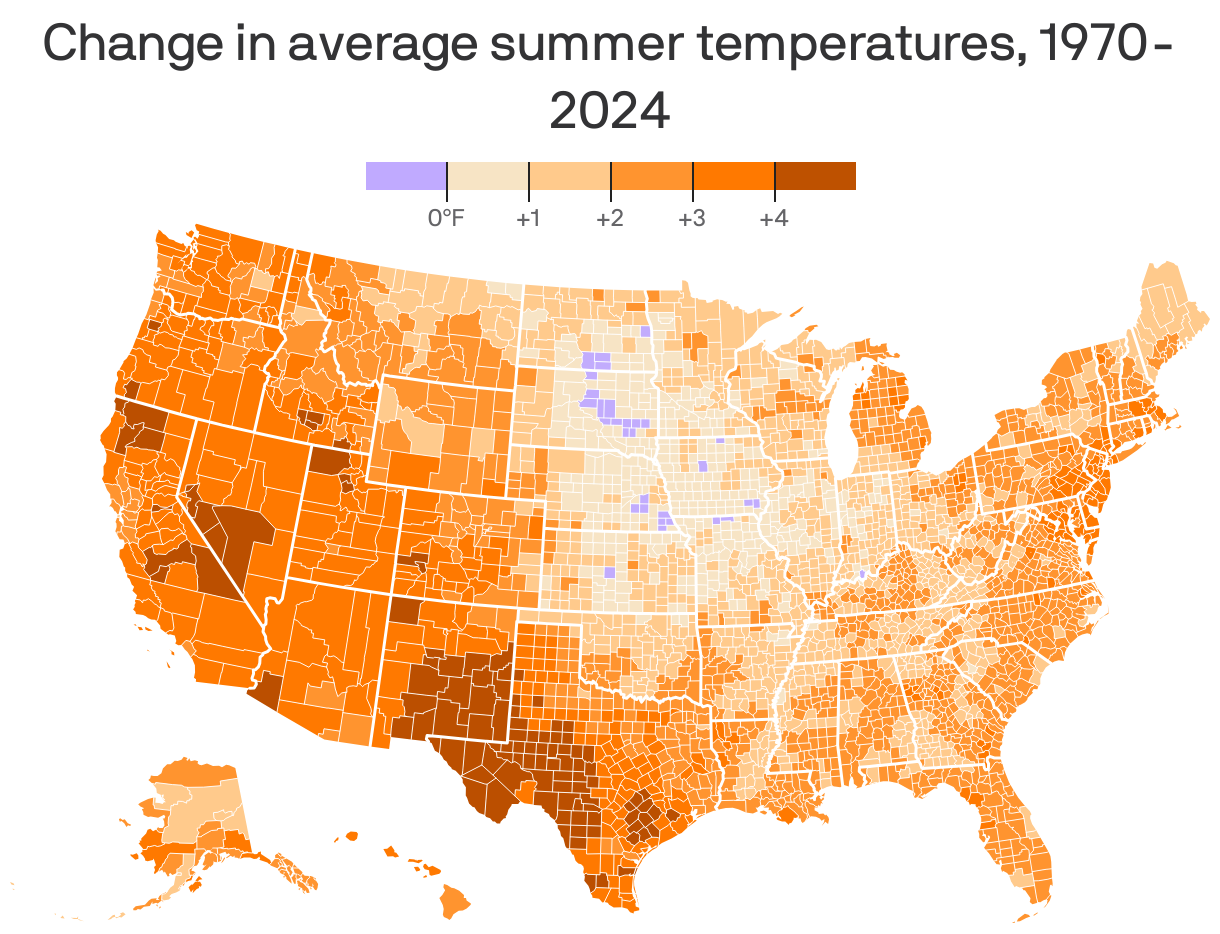
Summers are getting warmer nearly nationwide, Axios' Alex Fitzpatrick writes from a recently updated analysis.
- Why it matters: Hotter summers are one of the most tangible ways we're experiencing climate change — and they're a health risk for vulnerable groups like children, pregnant women, the elderly and homeless people.
Zoom in: Reno, Nevada (+11.3°F), Boise, Idaho (+6.3°F), and El Paso, Texas (+6.2°F) saw the greatest rise in average summer temperatures between 1970 and 2024.
5. 🚀 SpaceX loses control of Starship

SpaceX's latest test of its Starship mega rocket — the biggest and most powerful rocket ever built — tumbled out of control and broke apart last night after reaching space.
- Why it matters: CEO Elon Musk said the launch was a "big improvement" over the last two launches, which both ended in explosions over the Atlantic Ocean.
It was the first time the rocket used a recycled booster that had been saved from a previous test using giant "chopsticks."
- But the spacecraft began spinning as it skimmed space toward an uncontrolled landing in the Indian Ocean.
🔮 What's next: Musk says SpaceX will step up the cadence of launches for the next three flights to one every three to four weeks.
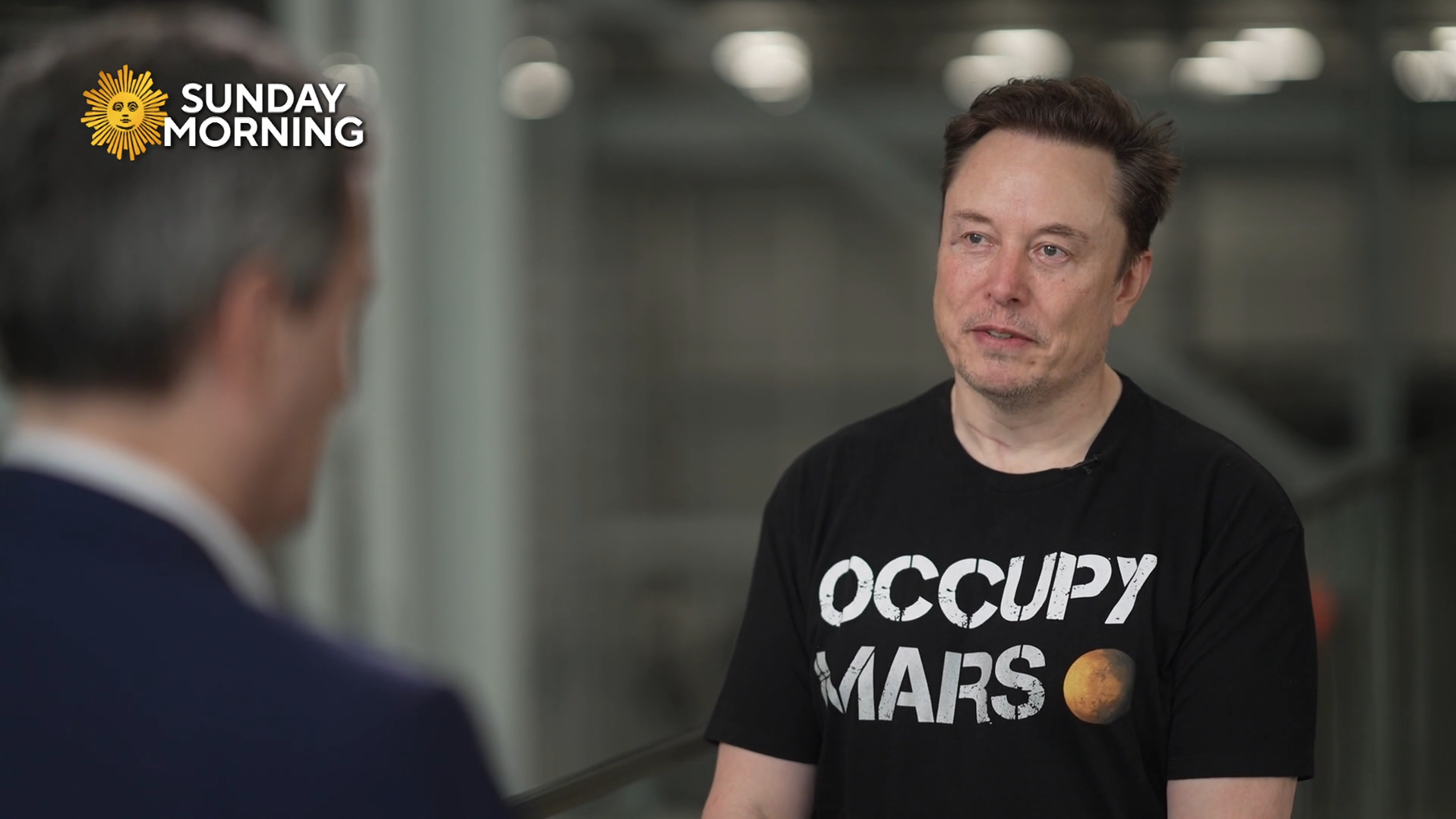
In an interview with "CBS Sunday Morning," Musk said President Trump's "big, beautiful bill" "undermines" DOGE's cost-cutting efforts: "I think a bill can be big or it can be beautiful, but I don't know if it can be both."
6. 💥 Golden Dome doubts

Intercepting missiles — hitting a bullet with a bullet — is difficult. Overcoming bureaucracy may be even harder, Axios Future of Defense author Colin Demarest writes.
- Why it matters: President Trump's Golden Dome, a continent's worth of 24/7 overhead defense, will be a jigsaw puzzle of ideas, authorities, personalities, contractors, procurements, production lines, users, fixers, technological leaps and diplomacy.
Realizing even the most basic form in three years, as the president and Pentagon promised, will require intense coordination.
- Getting it done fast means resisting the D.C. way: new offices, task forces and blue-chip studies.
7. 💸 Exclusive: Small business optimism

More than 70% of U.S. small- and mid-sized businesses say tariffs have already increased their operating costs — but almost all still expect to be able to grow internationally in the coming years, Axios' Ben Berkowitz writes from a new HSBC survey.
- Why it matters: In an increasingly volatile and uncertain environment, corporate leaders are staying optimistic, even while they concede that it's getting more expensive to do business.
🧮 By the numbers: 72% of U.S. companies said tariffs have already increased their costs, and 77% expect those costs to rise further by the end of the year, according to HSBC's Trade Pulse survey of 5,700 companies in 13 countries.
- But that's not stopping companies from growing, they say.
- While more than 70% said they're trying to increase domestic reliance in the face of trade pressure, more than 90% said they still expect to be able to grow internationally in the next two years.
8. 👑 1 fun thing: New Texas barbecue king
A barbecue joint about 40 minutes northeast of San Antonio is the new No. 1 in Texas Monthly's legendary BBQ ranking, Axios Dallas' Gregory Castillo writes.
- Burnt Bean Co. in Seguin, Texas, moved to the top spot from No. 4.
Why it matters: The list, released every four years, is the definitive ranking of Texas barbecue.
- Texas Monthly taste testers visited 319 barbecue joints last summer and fall and then the magazine's barbecue editor revisited the top spots.
Full list: Top 50 spots in Texas ... Get Axios Local: Newsletters in 31 cities, including four in Texas.
📬 Thanks for reading! Please invite your friends to join AM.
Sign up for Axios AM


/2025/05/28/1748393082127.gif?w=3840)