Axios AM

September 25, 2024

1 big thing: Trump's miracle cure
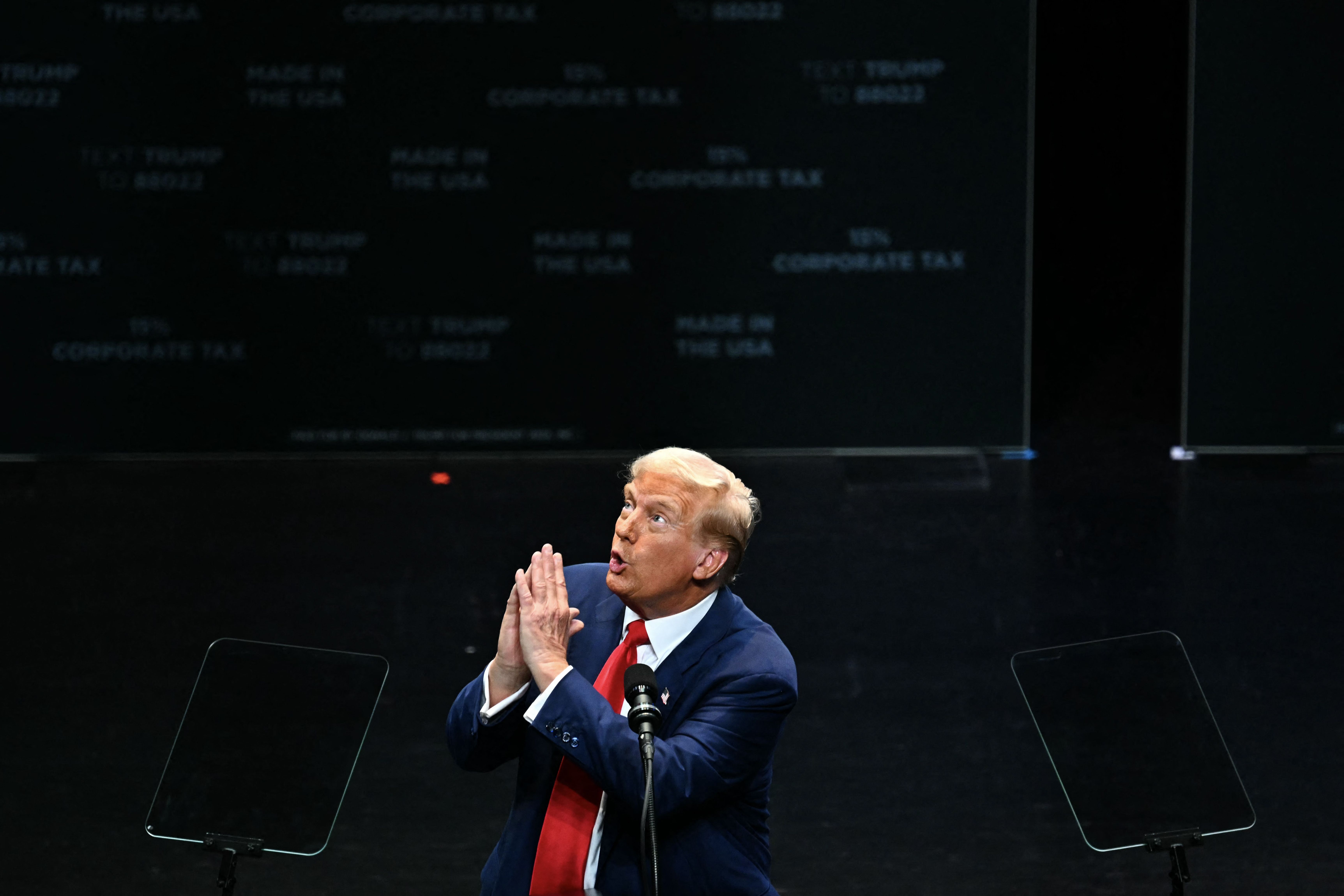
Former President Trump's fixation with tariffs has become an obsession — a policy panacea he claims will fuel a manufacturing boom, lower grocery prices, cut the deficit, stop wars, pay for tax breaks and even solve the child care crisis, Axios' Zachary Basu writes.
- "Tariffs are the greatest thing ever invented," the former president declared at a town hall in Michigan last week.
Why it matters: The impact of Trump's plan to impose massive tariffs — with or without the support of Congress — has become the single biggest economic question of the 2024 election.
Vice President Harris sees the issue as fertile ground to close Trump's polling edge on the economy, and hammer him over proposals that mainstream economists say would reignite inflation.
- Despite those warnings — and with nervous opposition from many fellow Republicans — Trump has doubled down on his populist vision for transforming the global economy.
In a speech yesterday in the port city of Savannah, Ga., Trump vowed to "relocate entire industries" to the U.S. by slashing taxes and regulations — and punishing companies that don't manufacture at home.
- "You will see a mass exodus of manufacturing from China to Pennsylvania, from Korea to North Carolina, from Germany to right here in Georgia," Trump said, referring to a "New American Industrialism."
He pledged to impose a 100% tariff on "every single car coming across the Mexican border," a day after threatening John Deere with 200% tariffs if the agricultural giant moves production to Mexico.
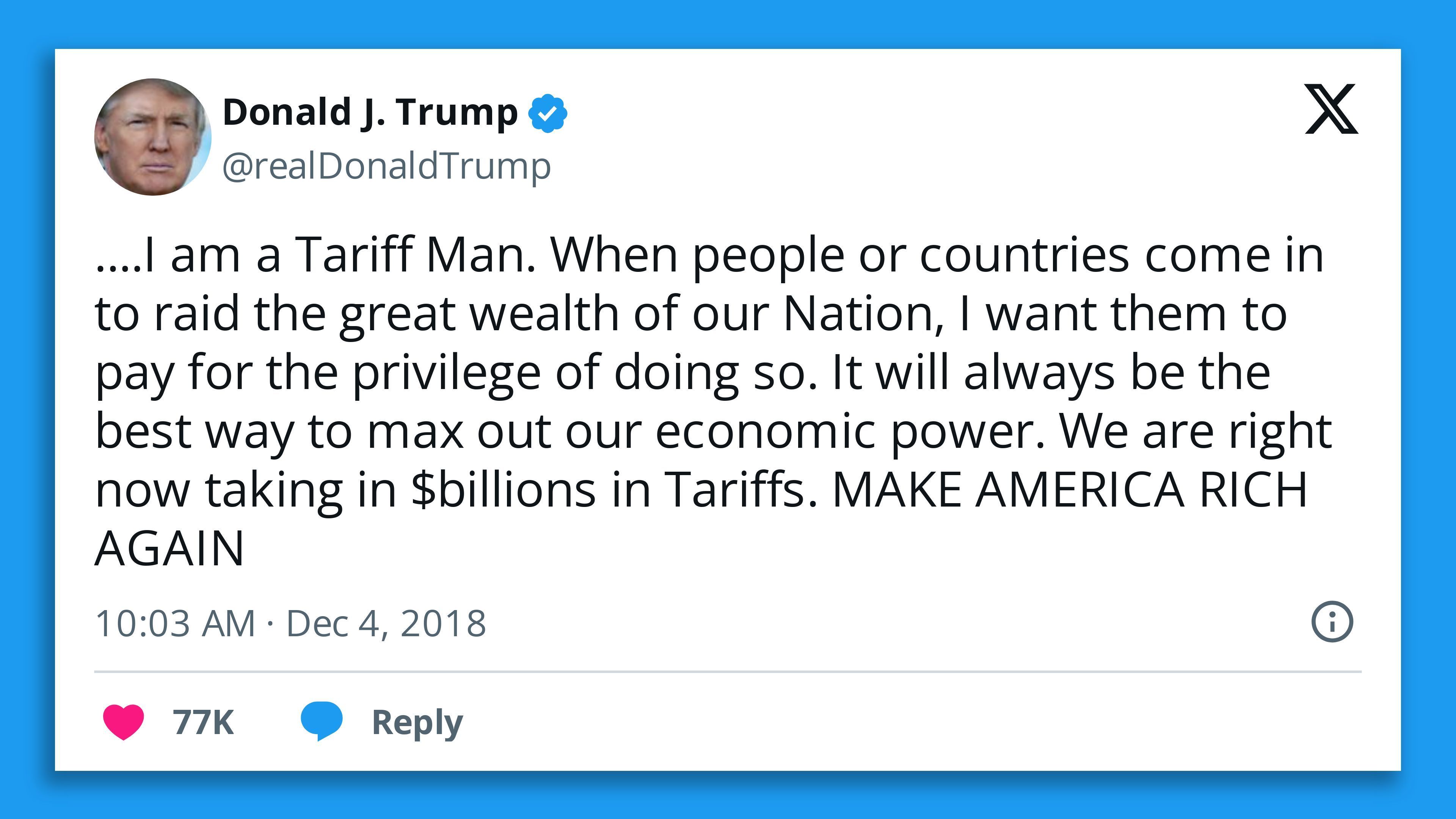
Trump's well-documented devotion to tariffs has only grown deeper on the 2024 campaign trail, where he has cast the policy tool as an antidote to America's ailments.
- War: "You go to war with another country that's friendly to us, or even not friendly to us, you're not going to do business in the United States and we're going to charge you 100% tariffs."
- De-dollarization: "You leave the dollar, you're not doing business with the United States, because we're going to put 100% tariff on your goods."
- Child care: "We're going to be taking in trillions of dollars, and as much as child care is talked about as being expensive, it's — relatively speaking — not very expensive, compared to the kind of numbers we'll be taking in."
🥊 Reality check: Trump's math doesn't add up, as Axios' Neil Irwin notes.
- For one, Trump has falsely claimed for years that foreign countries pay tariffs. In reality, they're a tax on imported goods — meaning the money comes from a U.S. buyer who typically passes on those additional costs.
- Trump rarely mentions the inevitable retaliatory tariffs against American exporters, which could damage major U.S. industries such as agriculture, energy and aerospace.
- Trump's unprecedented proposals for blanket tariffs of 10% to 20% — and 60% tariffs on Chinese goods — would likely ignite a global trade war of epic proportions.
2. 🇮🇱 Biden's big fear comes true
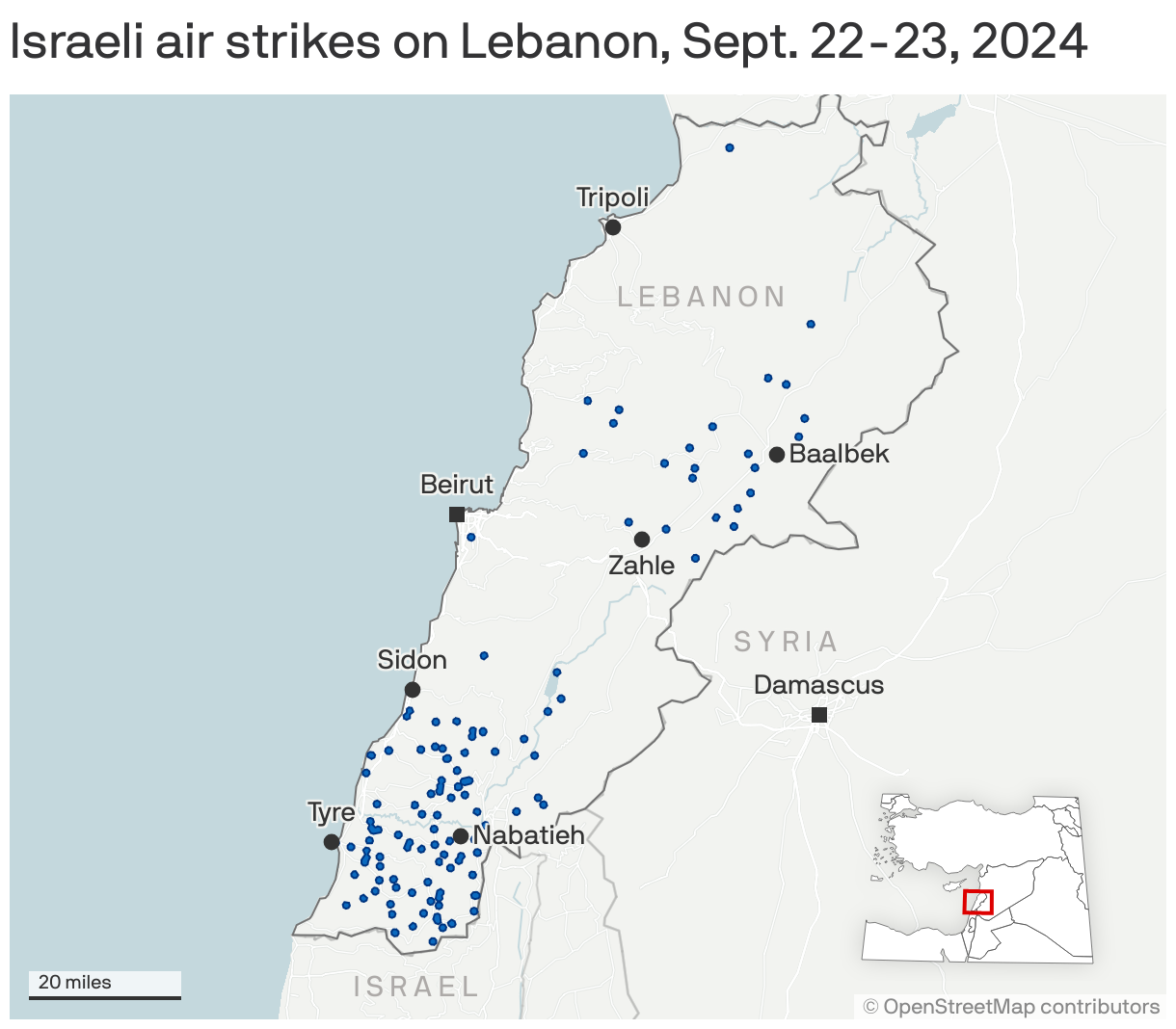
President Biden has spent nearly a year plotting and praying he could help prevent the war in Gaza from spreading. The rapidly expanding conflict between Israel and Hezbollah signals his power has reached its limit, Axios' Barak Ravid writes.
- Why it matters: U.S. officials privately admit the massive fighting that's killed at least 560 people in Lebanon over the past two days looks like another war — even if the Biden administration doesn't officially call it one.
🔍 Zoom in: White House deputy national security adviser Jon Finer — at an Axios House event in Manhattan yesterday — told Barak the airstrikes and rocket attacks between Israel and Hezbollah could get much worse.
- "There is a conflict in Lebanon ... but that could be a much bigger war and what we are extremely concerned about is a much bigger war, a wider war," Finer said.
After Hezbollah began launching attacks against Israel on Oct. 8, the U.S. tried to contain the conflict and keep it to skirmishes along the Israel-Lebanon border.
- U.S. officials began working on a diplomatic solution in an attempt to stop the fighting, push Hezbollah's forces back from the border and allow tens of thousands of civilians to return to their homes on both sides.
- But as the war in Gaza continued, the skirmishes between Israel and Hezbollah slowly and gradually escalated.
🔎 Behind the scenes: A day after senior Biden adviser Amos Hochstein traveled to Israel last week and warned Netanyahu of the negative consequences of a war in Lebanon, Israel conducted the first in a series of deadly attacks: remotely detonating pagers carried by Hezbollah members.
- Hochstein was livid — not only because the Israelis kept him in the dark about the attack, but because they completely ignored everything he told them, U.S. officials said.
🔭 Zoom out: While some of Biden's advisers saw the Israeli pager attack as "a reckless march to war," at the end of the day the White House accepted what the Israelis describe as a plan of "de-escalation through escalation," U.S. officials said.
- Some of Biden's aides agreed with the logic of Israel's leaders.
- Others concluded U.S. influence on Israel's decision-making is now limited.
What we're watching: Now the U.S. objective is to prevent an Israeli ground invasion of Lebanon, and deter Iran from intervening and supporting Hezbollah, U.S. officials said.
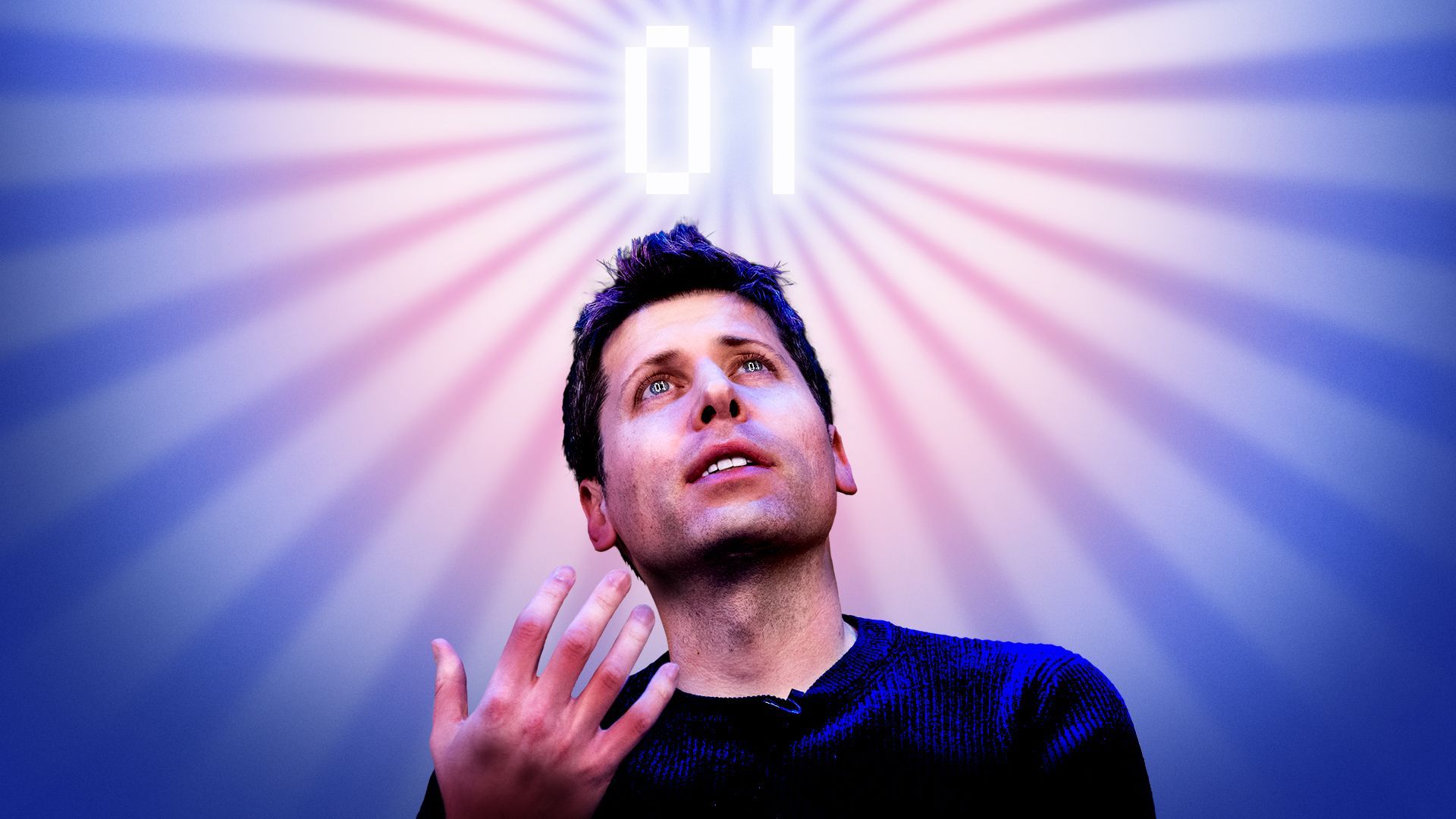
3. 🤖 Altman's hazy AI utopia
4. Harris won't reveal death penalty position
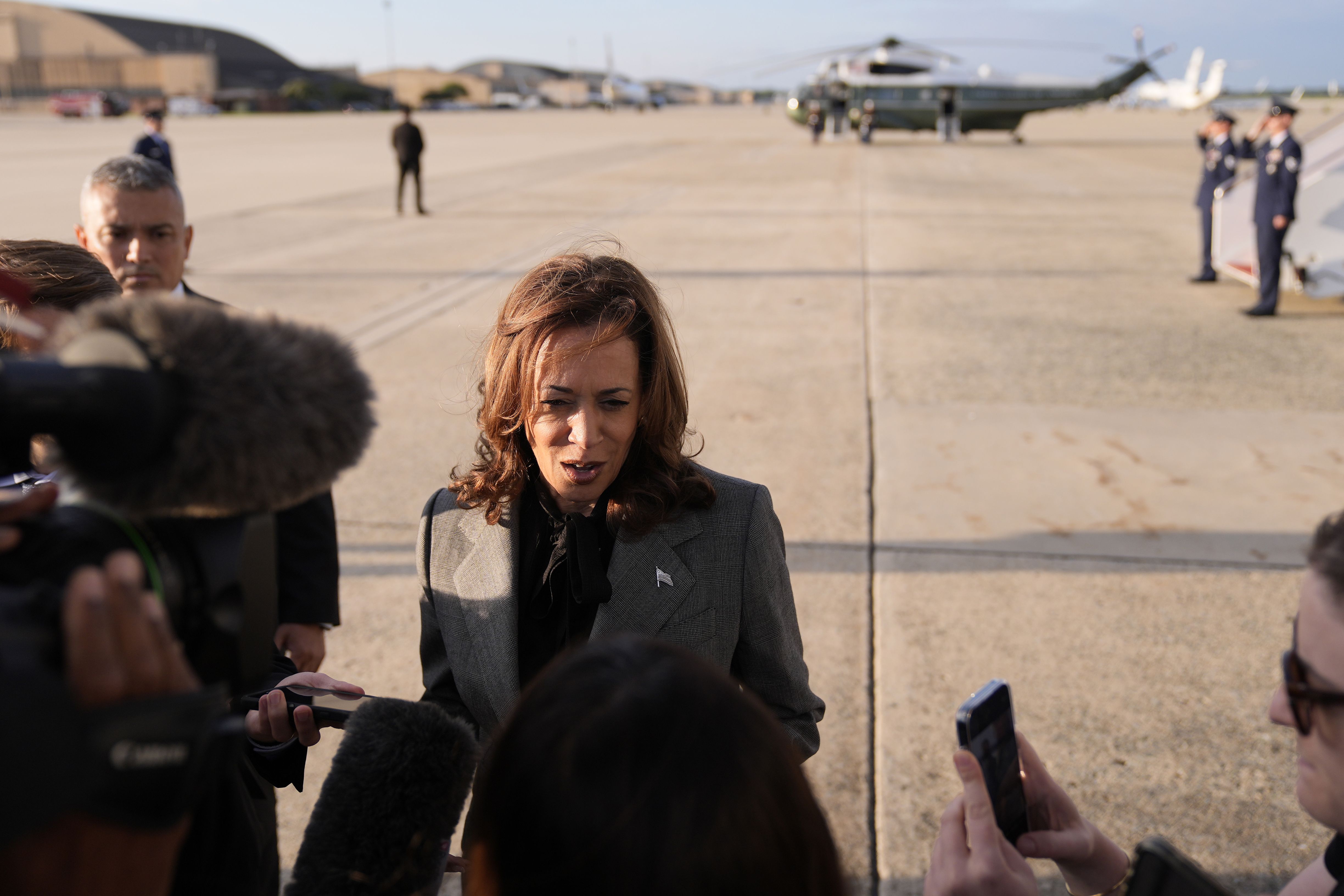
For two decades, Vice President Harris has opposed the death penalty. Now her campaign is declining to say whether she'd fight to end it as president, Axios' Alex Thompson writes.
- Why it matters: Harris and her team have dodged questions about what she believes on several policy fronts as she's changed some of the liberal positions she's held.
Harris has a long record of opposing the death penalty.
- As a presidential candidate in 2019, she rolled out a criminal justice reform plan that included ending it.
- "Kamala believes the death penalty is immoral, discriminatory, ineffective and a gross misuse of taxpayer dollars," her campaign website read.
5. 💰 Scoop: Trump super PAC's biggest buy

Right for America PAC, a Palm Beach, Fla.-based super PAC backing former President Trump, has booked a monster $40 million in ad spending between Labor Day and Election Day, Axios has learned.
- Why it matters: This is a notable boost for the Trump campaign, which is being outraised and outspent by the Harris campaign.
🐘 Who's who: Right for America's biggest donor is billionaire Ike Perlmutter — former chairman of Marvel Entertainment, a Trump friend and Mar-a-Lago member — and his wife, Laurie.
- Other key players are Sergio Gor, Doug Leone, Anthony Lomangino and Lee Rizzuto.
🧮 By the numbers: Right for America has booked $37.2 million in advertising across broadcast TV, cable TV, satellite TV, regional sports networks and OTT/CTV (streaming TV) between Labor Day and Election Day.
- Most of the spending will be on TV — especially in the swing states of Pennsylvania, Georgia and Arizona.
- The super PAC also is spending on radio and digital, including X, Meta and Google.
📺 On the air: In a new ad, which began running Tuesday, the super PAC focuses on Harris' changed views on fracking and other issues since she ran for president in 2019.
The other side: James Singer, a Harris-Walz campaign spokesperson, disputed the ad's facts and said it's "why so many Americans are ready to turn this page from Donald Trump's negative and divisive politics."
6. 🗳️ States unleash AI crackdown
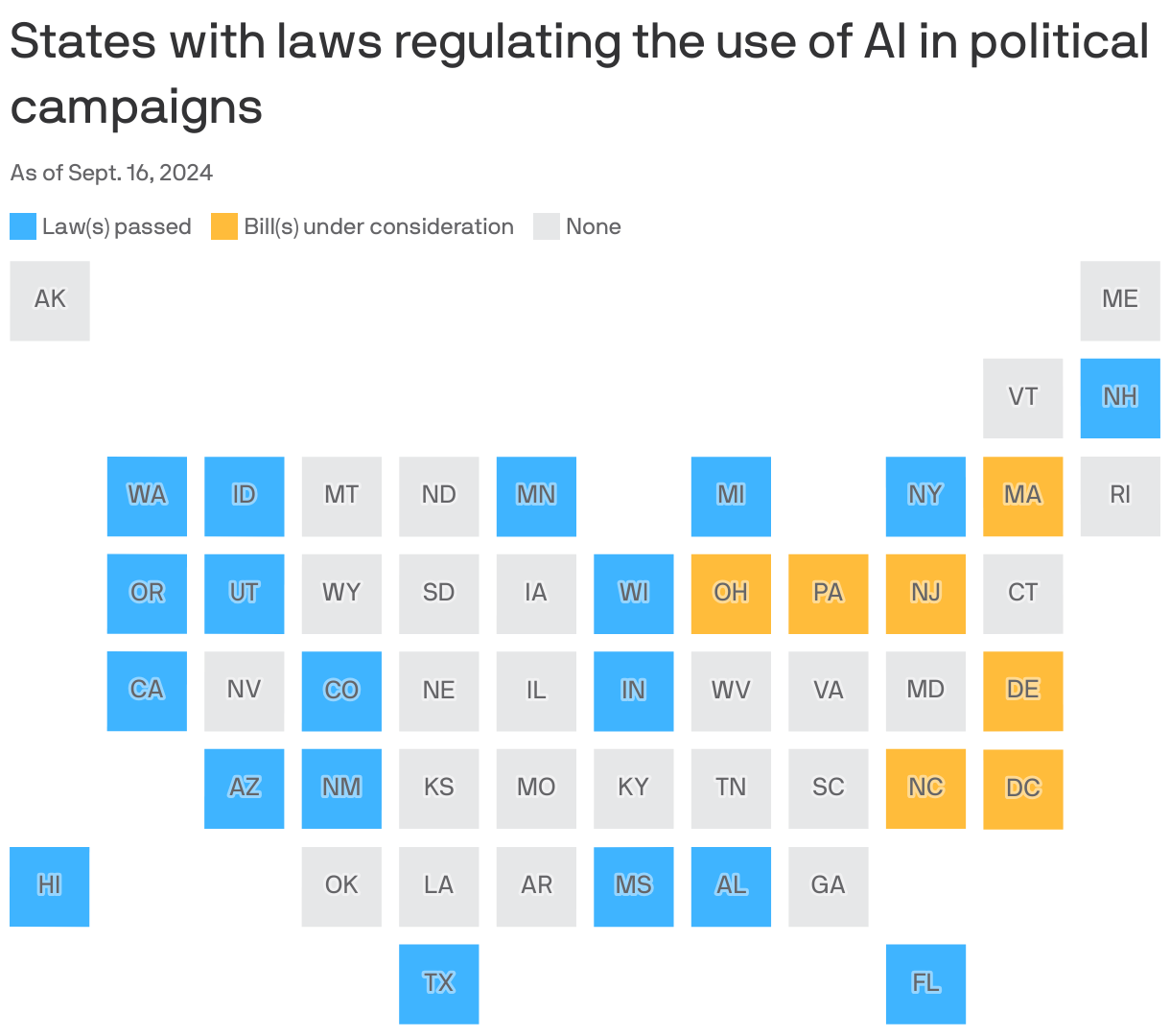
19 states have passed laws regulating the use of generative AI in election-related communications, according to an analysis by Axios' Ivana Saric.
- At least seven more are considering similar bills.
Why it matters: Few federal guardrails regulate the use of AI.
- There have already been instances of generative AI being "used to confuse — and even suppress — voters," Sen. Mark Warner (D-Va.) told Axios.
- In January, a spate of fake robocalls in New Hampshire used an AI-generated impersonation of Biden's voice to urge Democrats not to vote in the state's primary.
7. ⚓ Navy's China buildup

8. 👀 1 for the road: Strange cellmates
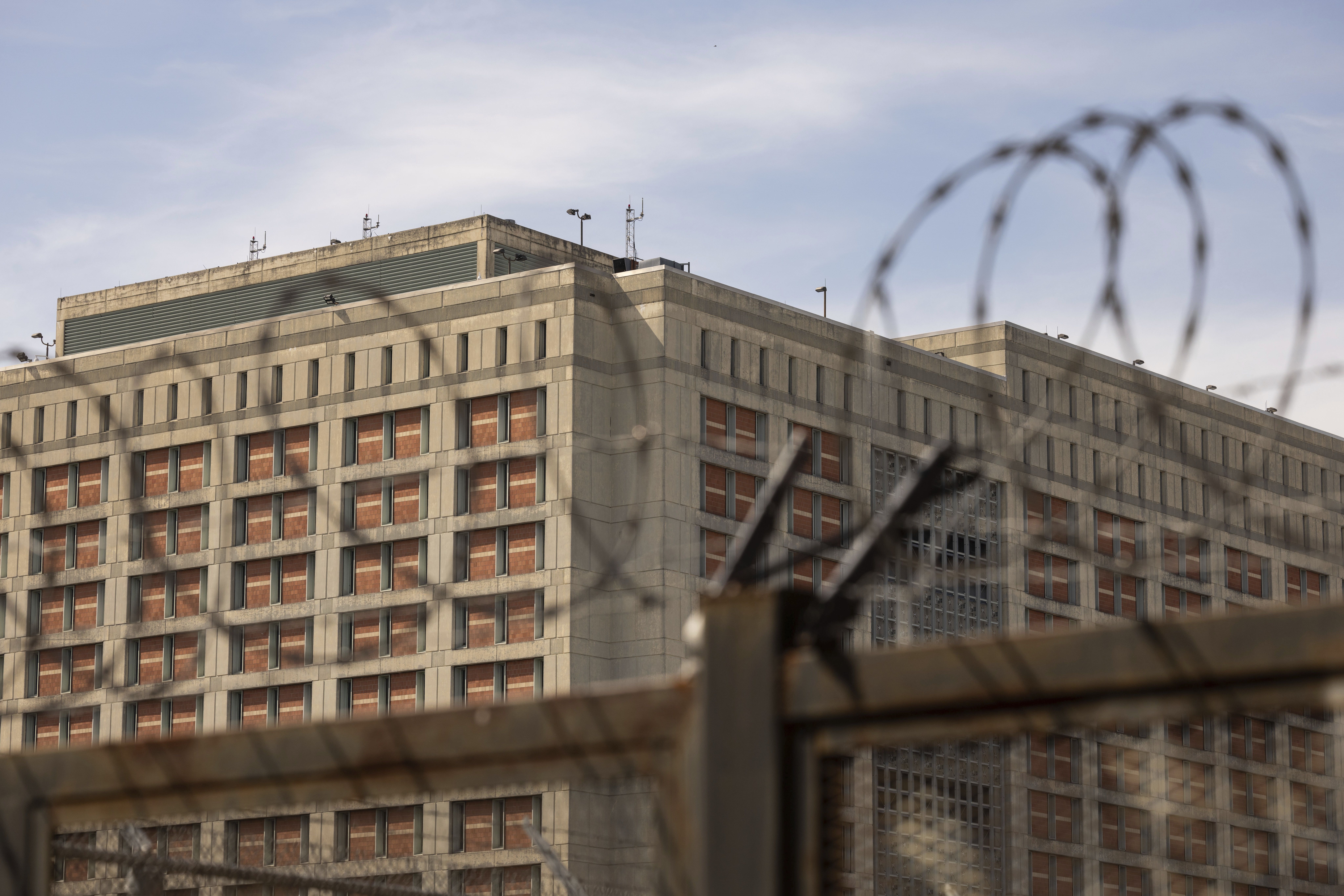
Two now-infamous moguls are living in the same dormitory-style room at a New York jail: Sean "Diddy" Combs and Sam Bankman-Fried, the N.Y. Times reports.
- The pair — who also live with other inmates — is "in a special housing unit that often holds high-profile inmates."
SBF, sentenced to 25 years in prison, asked to stay at the Metropolitan Detention Center in Brooklyn while he appeals his fraud conviction.
- Combs is awaiting trial after pleading not guilty to sex trafficking charges.
Keep reading (gift link).
Axios AM