Axios AM

December 09, 2025

☀️ Hello, Tuesday! Smart Brevity™ count: 1,621 words ... 6 mins. Thanks to Noah Bressner for orchestrating. Edited by Andrew Pantazi. Copy edited by Bill Kole.
⚡ Situational awareness: The Trump administration plans to lift a blockade on exports of Nvidia's powerful H200 chips to China — with the U.S. government getting a 25% cut of future sales, Axios' Nathan Bomey writes.
1 big thing: AI's energy gusher
The age of AI is ushering in the golden age of American energy, Axios' Amy Harder writes.
- Why it matters: Long prized for being boring — cheap, reliable, predictable — American power is exploding with new growth, wild ideas and sci-fi level possibilities.
It's a massive economic growth engine brimming with once-unimaginable investment and experimentation.
💡 How it works: The AI boom is shifting the tectonic plates of our stubborn energy systems. One plate has been squarely in our face (and our power bills) this past year. Three others are also sliding into place.
Let's break them down:
- A data center land rush is pushing up electricity prices, igniting NIMBY fights and straining grid reliability. The latest sign of stress: The NAACP is holding an event this week called "Stop Dirty Data" to highlight its concerns.
- Skyrocketing power demand is boosting once-too-expensive clean-energy technologies — from advanced nuclear to carbon capture — by giving them massive prospective customers such as Google and Microsoft willing to pay top dollar.
- AI itself could accelerate cleantech breakthroughs, including long-promised dreams like fusion. It's already helping with geothermal discoveries.
- AI is also boosting oil and gas, improving subsurface mapping and squeezing more fuel from existing fields. Mike Sommers, head of the American Petroleum Institute, told us: "Artificial intelligence is … going to be the next fracking boom. It is going to allow us to explore the subsurface in a way we never have before."
🥊 Reality check: Like past energy golden ages — shale oil and gas, electrification, the rise of cars — this one carries its own underbelly: data center backlash, higher power prices and new equity concerns.
- And if the AI boom turns out to be a bubble and bursts, as some analysts predict, this energy gusher could dry up just as fast as it has opened, risking billions of dollars of stranded assets.
2. 🏛️ Scoop: GOP expects SCOTUS boost
President Trump's political team privately told big GOP donors that the Supreme Court will soon issue rulings on voting rights and contribution limits that could tilt future elections their way, Axios' Alex Isenstadt writes.
- Bullish Trump lieutenants Chris LaCivita and Tony Fabrizio told a Republican National Committee retreat in New Orleans over the weekend that rulings on political contribution limits and congressional redistricting will be transformational if they break the GOP's way.
LaCivita and Fabrizio — who steer the president's cash-flush political operation and were senior strategists on his 2024 campaign — expressed confidence in the midterms despite doomsday projections for the party.
- During a Q&A with RNC chair Joe Gruters, LaCivita told donors the conservative-led high court has "the ability to upend the political map," a person in the room told Axios.
The two cases Trump's team believes could help Republicans maintain power:
1. Louisiana v. Callais. The court is set to decide whether to gut Section 2 of the Voting Rights Act — the 1965 law that resulted in the creation of districts designed for minority voters.
- For years, Republicans have sought to weaken the law, arguing that it constitutes federal overreach and unfairly creates Democratic-friendly districts.
2. National Republican Senatorial Committee v. FEC. The court hears oral arguments today in a case that could eliminate a federal law capping how much big-money party committees can spend in direct coordination with favored candidates.
- It's widely seen as the most consequential campaign finance case since Citizens United.
3. 🎯 First look: Battle for the "manosphere"

YouTube is emerging as the media center of gravity for the increasingly influential "manosphere," Axios' Eleanor Hawkins writes from "The Manosphere Index" — a report out today by Precision Strategies and Tunnl.
- Why it matters: The ideas circulating in the "manosphere" — male-only, creator-driven spaces shaping modern masculinity — are steering elections, spending habits and cultural expectations.
💡 Precision Strategies, founded by top Democratic adviser Stephanie Cutter, partnered with Tunnl, led by Republican strategist Sara Fagen, this fall to survey 1,000 men under 60, followed by a nationally representative survey of 6,000 adults, to understand the influences behind modern masculinity.
- Economic pressures, an eroding sense of identity, and a fragmented media landscape are shifting how men work, consume news and respond to being influenced.
- For example, many are opting for gig work in place of 9-to-5 office jobs, choosing YouTube over mainstream media and looking to creators to shape their political ideology.
🧮 By the numbers: YouTube is the go-to platform for men, with 86% using it weekly, according to the survey. Nearly 60% identified as heavy users, spending six hours or more a week on YouTube.
- Keep reading ... Full report ... Sign up here for Eleanor's weekly "Axios Communicators."
4. 🫏 Dems face their own Tea Party
Hours after former NFL star Colin Allred quit the Texas Senate race yesterday, rabble-rousing Rep. Jasmine Crockett jumped in — the latest sign Democrats are facing a Tea-Party-style revolt from progressives, Axios' Holly Otterbein and Stephen Neukam write.
- Why it matters: Senate Democratic leaders have tried to tip the scales in favor of their preferred 2026 candidates. But they've lost some power as much of the party's base has turned on them in President Trump's second term.
Senate Minority Leader Chuck Schumer (D-N.Y.) and the Democratic Senatorial Campaign Committee "probably could have tried to keep Crockett out" if they "were strong," a national Democratic strategist told Axios.
- "But they're not. They're the weakest they've ever been."
🔎 Zoom in: Yesterday's filing deadline left Texas with one of the hottest Senate races of 2026.
- Allred's exit leaves progressive social media stars Crockett and state Rep. James Talarico in the Democratic primary. Sen. John Cornyn and Texas Attorney General Ken Paxton lead the GOP field.
- The Republican standoff was long expected. But the Crockett-Talarico contest showcases a new generation shaped by growing liberal activism in the red state's restless Democratic Party.
Crockett, 44, has built a huge online following and fundraising base through her feuds with Trump. But many top Democrats doubt she could win a general election in Texas.
- Talarico, 36, an aspiring minister who quotes the Bible in his criticisms of Trump and the far right, has appeared on Joe Rogan's popular podcast.
5. 💰 Trump's self-inflicted trade wounds


The White House is taking some of its biggest steps yet to address the economic pain caused by its own tariffs, Axios Macro co-author Courtenay Brown writes.
- Why it matters: A move yesterday to heal the financial damage to farm country — an important hub of Trump supporters — is the latest attempt to address the tariff fallout that has contributed to Americans' souring economic sentiment.
President Trump announced a $12 billion plan to bail out American farmers after China paused purchases of U.S. soybeans earlier this year. (China is slowly resuming them.)
- Last month, the White House announced it would roll back tariffs on a slew of grocery items.
🇨🇳 The intrigue: Even with Trump's tariffs in place, China said it had reached an unprecedented milestone — a trade surplus topping $1 trillion so far this year (charted above).
6. 👀 U.S. pushes Zelensky for swift yes

Ukrainian President Volodymyr Zelensky faces growing U.S. pressure to accept major territorial losses and other concessions in President Trump's peace plan, two Ukrainian officials tell Axios' Barak Ravid.
- Why it matters: After weeks of intense diplomacy, the Ukrainians still think aspects of the U.S. plan favor Moscow and that U.S. officials are pushing Zelensky much harder than they're pushing Russian President Vladimir Putin.
A U.S. official denied that, stressing the U.S. also pressed Putin to soften his demands.
- A Ukrainian official said the U.S. offer had worsened from Kyiv's perspective after Trump advisers Steve Witkoff and Jared Kushner's five-hour Kremlin meeting with Putin last week.
7. 💼 Women in corporate America are backsliding

Women in corporate America are falling behind — getting less support from employers and reporting lower ambition than men, Axios' Emily Peck writes from a new report by McKinsey and Lean In.
- Why it matters: The findings cap a year of setbacks for women, from political attacks on corporate diversity efforts to return-to-office mandates that hit mothers hardest.
Sheryl Sandberg, the former Facebook executive who founded Lean In, tells Axios: "This is a moment where corporate America is backsliding on women."
- Despite years of corporate pledges to advance women, just 54% of HR professionals say women's career advancement is a priority at their organization.
- That marks a sharp drop from 2017, when 88% of companies told Lean In it was a high priority.
Keep reading ... Full report.
8. 📦 1 fun thing: Crash-testing packages
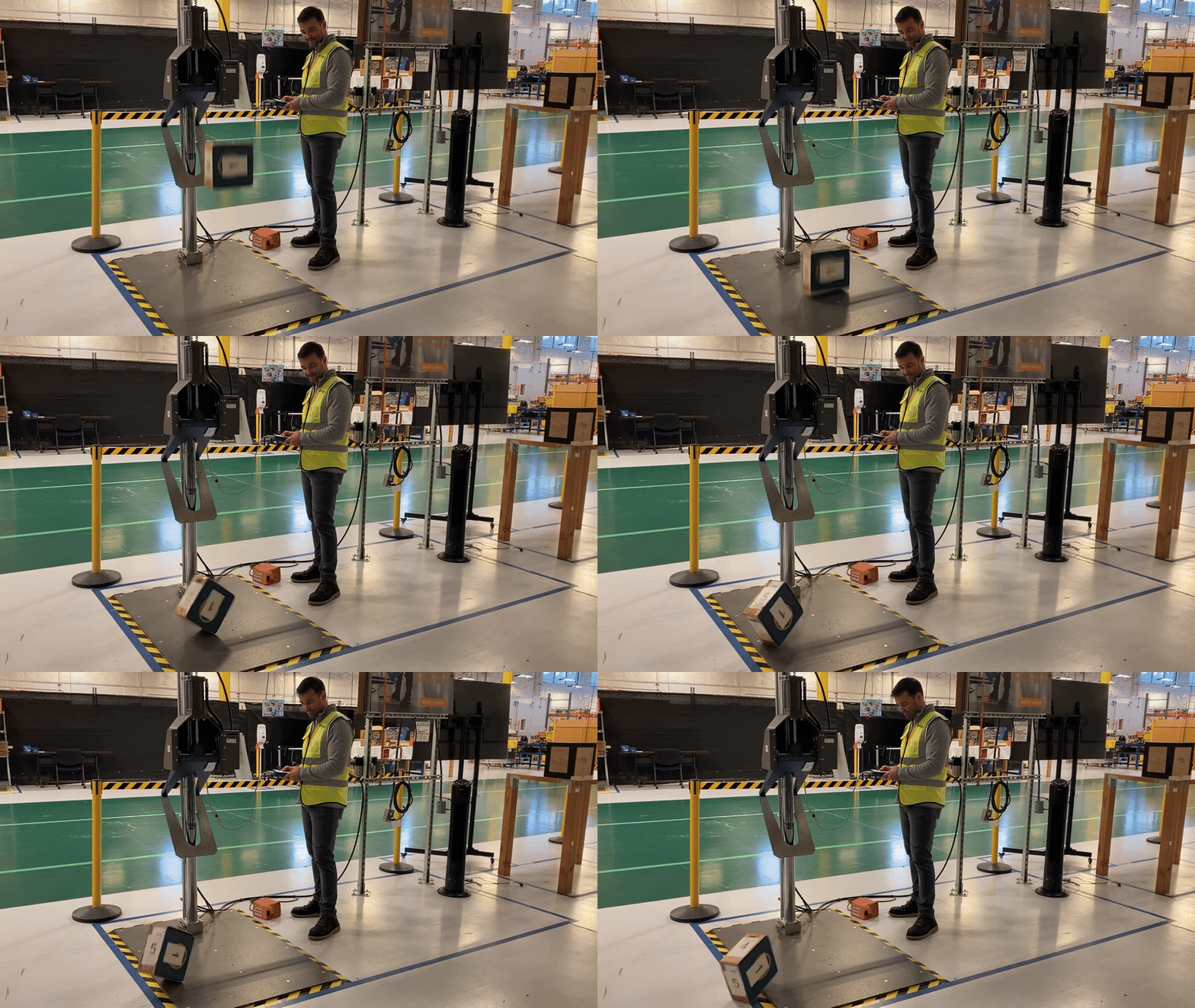
In a warehouse south of Seattle, Amazon spends its days doing unspeakable things to innocent packages, Axios Seattle's Christine Clarridge writes.
- Why it matters: This abuse is the specialty of Amazon's Packaging Innovation Lab, where engineers work to shrink the mountain of cardboard and plastic that cradle orders en route to doorsteps.
In this cavernous 10,000-square-foot facility, boxes are stacked under the weight of a small car or squeezed until their sides bow. Vibration tables simulate the shaking inside trucks and planes.
- Boxes holding delicate items are dropped from precise heights onto every edge and corner.
📺 The big picture: Amazon uses big-screen TVs as a kind of final boss test for packaging.
- Engineers strap TVs onto an incline impact machine — "basically a crash simulation," said Amazon's John Sly — to see what happens when a truck has to slam on the brakes.
- "If we can ship a 65-inch piece of glass without adding a box, we should be able to do the blender or the air fryer," Sly added.
Keep reading ... Get Axios Local: Newsletters in 34 cities.
📬 Thanks for reading! Please invite your friends to join AM.
Sign up for Axios AM