Axios AM

August 13, 2025

๐ช Happy Wednesday! Smart Brevityโข count: 1,477 words ... 5ยฝ mins. Thanks to Noah Bressner for orchestrating. Copy edited by Bryan McBournie.
๐ค Join Axios' inaugural Media Trends Live event in NYC on Sept. 18, featuring NASCAR commissioner Steve Phelps, N.Y. Times executive editor Joseph Kahn, Condรฉ Nast CEO Roger Lynch & more. Get your ticket here.
1 big thing: Pre-summit scramble
Ukrainian President Volodymyr Zelensky and his team are doing everything in their power to influence President Trump's thinking before he sits down with Russian President Vladimir Putin. His last big chance could come today, Axios' Barak Ravid, Dave Lawler and Marc Caputo write.
- Why it matters: Zelensky faces a perfect storm โ a sudden Russian battlefield breakthrough, mounting discontent at home, and a high-stakes summit in Alaska on Friday that could back him into a diplomatic corner.
Driving the day: Trump is expected to hold a virtual meeting today with Zelensky and a group of European leaders.
- Zelensky has been downplaying Russia's recent gains, and working the phones to leaders in Europe and beyond to hedge against an unfavorable outcome in Alaska.
๐ Behind the scenes: After a series of largely fruitless phone calls over the last six months, Trump has been itching to meet Putin face to face to gauge his willingness to make peace, U.S. officials say.
- "The President feels like: 'Look, I've got to look at this guy across the table. ... I want to look this guy in the eye,'" Secretary of State Marco Rubio told radio host Sid Rosenberg yesterday.
- Trump said Monday at his presser on D.C. policing that he'll probably in "the first two minutes, I'll know exactly whether or not a deal can be made."
Zelensky and other European leaders are concerned that when Trump looks Putin in the eye, he will actually agree with his hardline demands.
- "Nobody knows what Trump wants to get from Putin on Friday," a Ukrainian official told Axios. "We don't know how much influence we can have on Trump, but we have to keep trying."
๐ Behind the scenes: U.S. officials argue that if Trump's rhetoric sounds pro-Russian at times, it's because he believes that kind of public messaging will help him get a deal.
- One told Axios that Trump is still "pissed off" at Putin: "The general view for months is that we can bring down the Russian economy tomorrow. There are more ways to ruin Ukraine. But if he had to choose a side, he would start to bring down the Russian economy. He's really had enough."
- "Maybe Trump can't get this done, but he's going to do his level-best," the official said.
2. ๐ฅ Border drone war
On the U.S. side of the Southwest border, local law enforcement officials have begun using AI-programmed drones to locate drug traffickers and migrants, Axios' Russell Contreras writes.
- On the Mexico side, drug cartels are using their own drones to stake out desert areas in the U.S. to smuggle their products.
Why it matters: The U.S. government โ whose own patrol drones help create what it calls a "virtual wall" โ has long fueled the tech war along the border. But now even small local agencies are stepping into this arms race against cartels and illegal immigration.
๐ผ๏ธ The big picture: The drone wars are unfolding even as migrant traffic has dropped to its lowest levels in decades.
- They're being driven in part by staffing shortages in police and sheriff's departments, as well as cuts in federal aid that have limited traditional patrols.
- The number of U.S. law enforcement agencies using drones has jumped 150% since 2018, according to a report released this year.
State of play: Suspected cartels in Mexico are flying thousands of drones over U.S. territory, Department of Homeland Security officials say.
- Steven Willoughby, deputy director of DHS's counter-drone program, told a Senate committee last month that cartel drones made more than 27,000 flights within 500 meters of the southern border during the last six months of 2024.
- He said the drones can fly for more than 45 minutes, reach more than 100 mph and carry more than 100 pounds.
Some drones operated by cartels have dropped explosives on rival factions in Mexico, Willoughby said, although no such actions have been reported on the U.S. side.
3. ๐ข Wall Street's new fear
Investors and CEOs fear they're going to be flying blind on investments without sufficient data on the economy's health, Axios' Courtenay Brown and Emily Peck write.
- Why it matters: The U.S. government produces some of the world's premier economic data. The future of those indicators looks murkier than ever, with no private sector source readily available to replace them.
๐จ The big picture: President Trump is nominating Heritage Foundation economist E.J. Antoni โ a MAGA favorite โ to lead the Bureau of Labor Statistics.
- Economists on the right and the left have questioned whether Antoni is qualified to lead the agency.
Between the lines: BLS produces crucial data on jobs and inflation.
- Other sources, including private sector employment data from payroll processor ADP, help shape the understanding of how the economy is performing. But nothing yet can replace traditional government data.
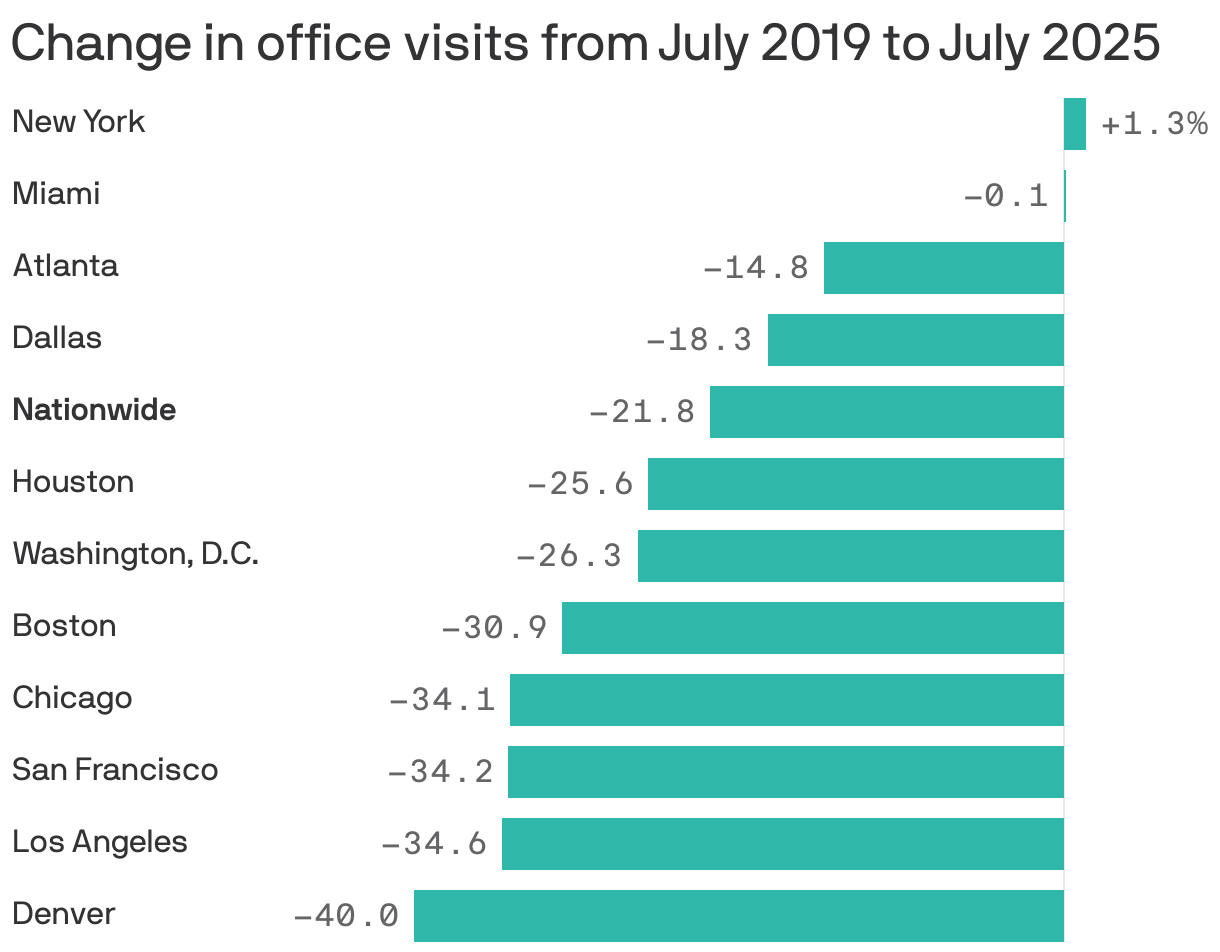
4. ๐๏ธ Charted: NYC office rebound

The number of workers going to New York City offices is now higher than pre-pandemic levels โ the first time that's happened since COVID hit, Axios' Ben Berkowitz writes from a new analysis by Placer.ai.
- Why it matters: New York is the first of the major metropolitan areas tracked by the company to return to growth. Miami is close behind.
Reality check: While Placer's data indicates a return to pre-COVID levels, other data sources suggest the city hasn't fully recovered.
- Kastle, which tracks security access data from 2,600 buildings in 47 states, says office occupancy on Tuesdays (the peak day of the week) in July in the NYC metro was 66% of pre-pandemic levels.
5. ๐ค Axios interview: New Windsurf CEO Jeff Wang

Coding startup Windsurf just survived a wild month โ almost getting sold to OpenAI, its CEO and top talent decamping to Google, then managing to sell itself.
- Why it matters: With potentially $100 billion in annual sales at stake, there's a fierce battle among tech giants and startups to become the choice for AI-assisted programming, Axios chief tech correspondent Ina Fried writes.
New CEO Jeff Wang, based in S.F., tells Ina that the company is back to doing what it set out to do, being Switzerland in a world of competing AI coding models.
The backstory: Windsurf was in the process of selling itself to OpenAI. The deal fell apart in July, largely due to concerns over what access Microsoft would have to the technology.
- Google then hired its CEO and top researchers, leaving the rest of the team in limbo. "People were crying," Wang said.
6. ๐ฟ MAGA rails against "pothead" culture
Prominent MAGA leaders are urging President Trump to back off his plans to review federal restrictions on marijuana, warning of a one-way ticket to societal ruin, Axios' Tal Axelrod writes.
- Why it matters: Reclassifying marijuana as a Schedule III drug would open the door to expanded research and deliver a major boost to the legal cannabis industry, which is now constrained by a patchwork of state laws.
As a Schedule I drug, marijuana is grouped alongside heroin and LSD as "drugs with no currently accepted medical use and a high potential for abuse."
- Many Trump allies are vehemently opposed to easing federal restrictions โ portraying marijuana as a gateway to a smelly, lazy, dirty society.
๐ฌ Zoom in: Trump confirmed reports that he was considering reclassifying marijuana in the next few weeks, though he seemed torn between medical benefits and other side effects.
- MAGA luminaries sounded the alarm after The Wall Street Journal reported on Trump's discussions with the cannabis industry โ which has donated millions to his political groups โ about possible reclassification.
7. ๐ New poll: Our Sydney Sweeney divide

There's a stark partisan divide in how young people are reacting to American Eagle's viral jeans ad featuring actress Sydney Sweeney, Axios' Erica Pandey writes from a new Generation Lab poll.
- Why it matters: The ad has sparked debates over "wokeness," beauty standards and race โ even pulling in President Trump.
๐งฎ By the numbers: In the poll of undergraduate and graduate students across the country, 64% of Democrats strongly or somewhat agreed that the ad felt out of touch, compared with 39% of Republicans.
- 38% of Republicans agreed the ad felt authentic, compared with 10% of Democrats.
- 63% of young women said the ad was out of touch, compared with 44% of young men.
8. ๐บ 1 screen thing: Streaming enters profit era
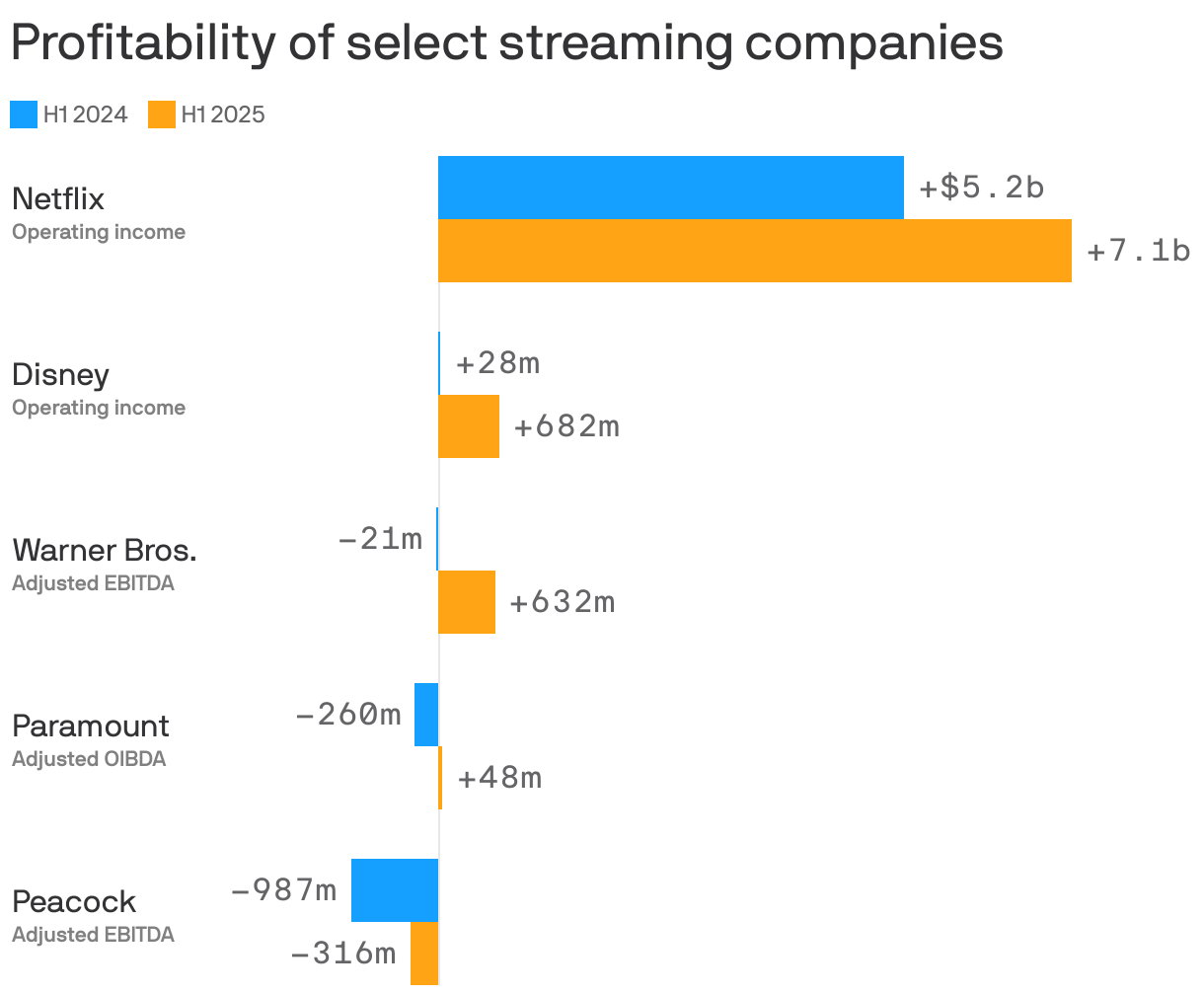
Most major streamers in the U.S. have started to turn a steady profit, signaling the streaming wars have entered a new era of maturity, Axios Media Trends author Sara Fischer writes.
- Why it matters: To expand margins and compete with Netflix, traditional media companies are looking to streamline their services and bundle them.
Go deeper: Read the full story with a Media Trends Executive membership.
๐ฌ Thanks for reading! Please invite your friends to join AM.
Sign up for Axios AM