Axios AM

June 23, 2024

🍳 Happy Sunday! Erica Pandey — [email protected] — is your host.
- Smart Brevity™ count: 1,383 words ... 5 mins. Edited by Donica Phifer.
1 big thing: AI from now to 2034
Leopold Aschenbrenner — formerly of OpenAI's Superalignment team, now founder of an investment firm focused on artificial general intelligence (AGI) — has posted a massive, provocative essay putting a long lens on AI's future.
- Why it matters: Aschenbrenner, based in San Francisco, relies on lots of speculation and projection. So none of this is set in stone. But his opus is a useful, eye-opening synthesis of high-level Silicon Valley conversations.
💡 Here's what leaped out at Mike in Aschenbrenner's 50,000-word, 165-page paper, "Situational Awareness: The Decade Ahead":
1. "Trust the trendlines ... The trendlines are intense, and they were right."
- "The magic of deep learning is that it just works — and the trendlines have been astonishingly consistent, despite naysayers at every turn."
2. "Over and over again, year after year, skeptics have claimed 'deep learning won't be able to do X' and have been quickly proven wrong."
- "If there's one lesson we've learned from the past decade of AI, it's that you should never bet against deep learning."
- "We're literally running out of benchmarks."
3. It's "strikingly plausible that by 2027, models will be able to do the work of an AI researcher/engineer."
4. "By 2027, rather than a chatbot, you're going to have something that looks more like an agent, like a coworker."
5. The data wall: "There is a potentially important source of variance for all of this: we're running out of internet data. That could mean that, very soon, the naive approach to pretraining larger language models on more scraped data could start hitting serious bottlenecks."
- Share our takeaways ... Five more ideas below.
2. 🤖 "AI progress won't stop at human-level"

More takeaways from Leopold Aschenbrenner's 50,000-word, five-chapter "Situational Awareness: The Decade Ahead":
6. We could "rapidly go from human-level to vastly superhuman AI systems."
- Superintelligence, coming in 2030 A.D.?
7. AI products are likely to become "the biggest revenue driver for America's largest corporations, and by far their biggest area of growth. Forecasts of overall revenue growth for these companies would skyrocket."
- "Stock markets would follow; we might see our first $10T company soon thereafter. Big tech at this point would be willing to go all out, each investing many hundreds of billions (at least) into further AI scaleout. We probably [will] see our first many-hundred-billion-dollar corporate bond sale."
8. "Our failure today to erect sufficient barriers around research on artificial general intelligence "will be irreversible soon: in the next 12-24 months, we will leak key AGI breakthroughs to the [Chinese Communist Party]. It will be the national security establishment's single greatest regret before the decade is out."
9. Superintelligence "will be the United States' most important national defense project."
10. There's "no crack team coming to handle this. ... Right now, there's perhaps a few hundred people in the world who realize what's about to hit us, who understand just how crazy things are about to get, who have situational awareness."
🥊 Reality check: Aschenbrenner, with roots in the effective altruism movement, is an AI investor — not a disinterested party.
- His perspective on AGI is a minority in the industry, Axios managing editor for tech Scott Rosenberg tells me. Aschenbrenner, and many at OpenAI and elsewhere, believe AGI will inevitably develop out of today's genAI language models and bots. The wider consensus among experts is that it won't.
- That's not pessimism: The consensus sees so much value and utility in AI where it is now, and where it's headed long before it gets to AGI, that AGI isn't really the point.
Get Axios AI+, our daily newsletter ... Go deeper: Axios explanation of AI vs. AGI ... Read Aschenbrenner's essay.
3. 🚀 Women's sports blast off


We're watching an explosion of new women's sports leagues and teams in America.
- At least 20 new teams will play their inaugural seasons in 2024, in existing leagues and entirely new leagues, according to an analysis from Axios' Ashley Mahoney and Simran Parwani.
Why it matters: The women's sports industry is predicted to break the $1 billion barrier for the first time in total revenue this year — a 300% increase from 2021, Axios' Analis Bailey notes.
For the first time in Olympic history, the Paris Games this summer will have an equal number of men and women athletes, Axios' Sara Fischer reports.
- The Athletic, TIME and Sports Illustrated are all investing more in women's sports coverage.
Go deeper: Read Sara's deep dive on the state of women sports, featuring exclusive interviews with media executives at the ad festival in Cannes this past week.
4. 🥵 Charted: It's not just summer
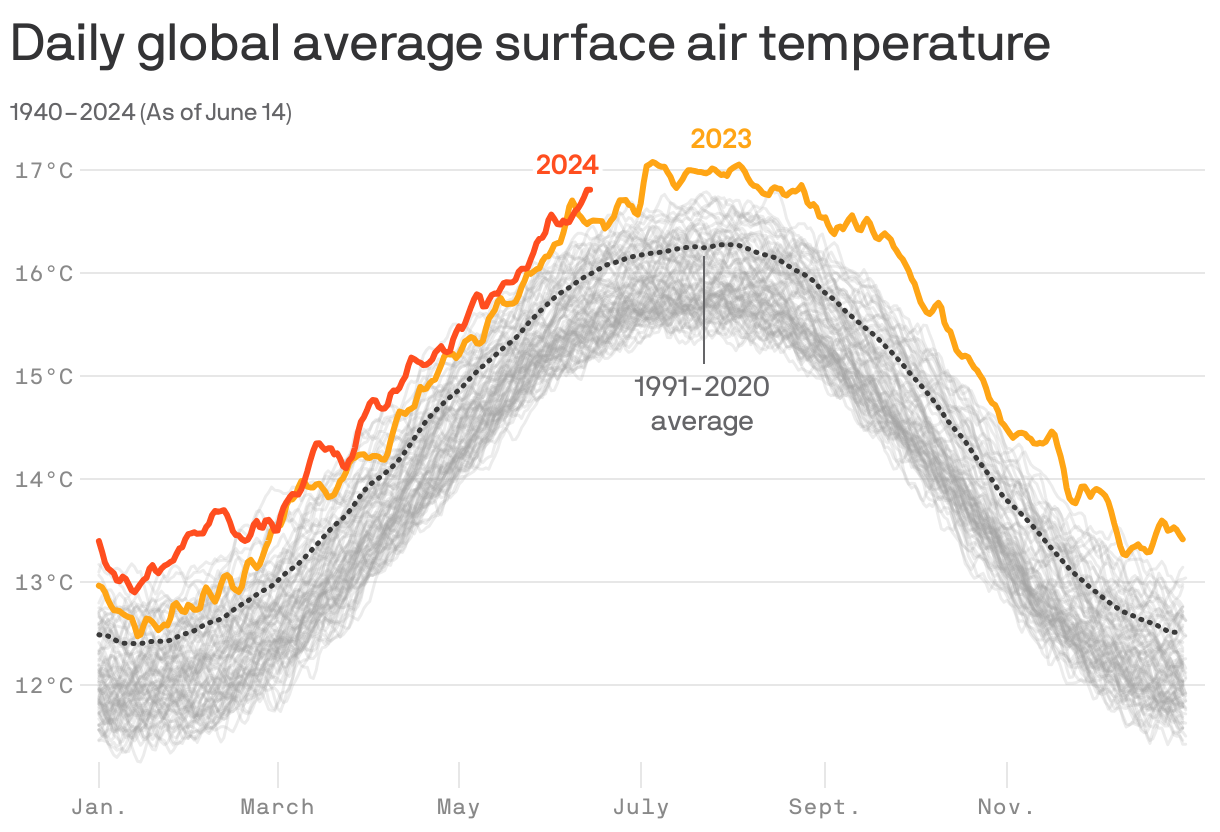
Global average temperatures are outpacing the record-setting year of 2023, Axios' Andrew Freedman writes.
- The outlook shows that continuing next month.
Longstanding temperature records fell in Canada and northern New England this month.
- Mexico tied its national all-time high-temperature record for any day of the year on Friday, with a high of 125.6°F.


Between the lines: One of the top reasons for global record warmth is the extraordinarily hot ocean temperatures.
- Coral reefs are dying around the world, from the Florida Keys to the Great Barrier Reef of Australia, given how susceptible many coral species are to hot water.
Go deeper: What to do in extreme heat.
5. ☀️ Heat days are the new snow days

School days are getting cut short, and summer camps are changing their schedules to beat the heat, Axios' April Rubin writes.
- The big picture: The Midwest and Northeast are ill-equipped to handle temperatures in the 90s or higher this early in the season.
🌡️ Zoom in: Worcester, Mass., the state's second-largest school district, ended the school year a couple of days early amid the heat wave because many of its buildings don't have air conditioning.
- In New Jersey and New York, some school districts set early dismissal.
Camp North Star in Poland Spring, Maine, is moving outdoor activities, including tennis and soccer, from 1:30 p.m. to 9:30 a.m., The Washington Post reports.
- Camps in Augusta, Mich., switched to slower-paced activities and indoor games.
6. 🦾 AI goes to war
A briefing in The Economist takes on a frightening topic: AI and warfare.
- Militaries are training for much more complex scenarios, in which AI would be tasked with analyzing a chaotic battlefield situation — with thousands of data inputs — and concocting a coherent plan.
Why it matters: AI is already being used in warfare, from helping Israel target suspected Hamas fighters, to identifying when Ukrainian artillery units will need to be resupplied, the article notes.
But there are major ethical and technological hurdles, Axios' Dave Lawler writes.
- AI might allow a drone to more precisely identify and strike an enemy hideout, reducing the risk of civilian casualties.
- But it might also not recognize if those fighters are attempting to surrender.
💭 Our thought bubble: Most use cases for AI in battle are more advanced in theory than practice, Axios' Colin Demarest notes.
- Those bullish about AI's battlefield prowess argue it will be able to run thousands of simulations and produce results at lightning speeds.
- But what if an adversary poisons the training data before the operation takes place?
🚀 Axios will launch a weekly Future of Defense newsletter this summer. Sign up here.
7. 🛒 Summer of discounts
Discount retailers and restaurants are slashing prices to bring in cash-strapped consumers.
- Spending at discount grocery stores began to increase in fall 2023, likely as shoppers traded down from premium to value grocers to manage inflation, Axios' Kelly Tyko writes from a Bank of America report.
Walmart, Target, Aldi, Walgreens and Ikea have started to roll out a string of discounts.
- The new $5 McDonald's value meal is coming Tuesday. Burger King and Starbucks have also released new meal deals.
🍟 "This is likely to be a summer of value, or maybe a year+ of value, to draw more price-sensitive customers back to fast food," Morgan Stanley analyst Brian Harbour wrote in a research note.
8. 🐶 1 fun thing: Ugly pooches

Wild Thang, a Pekingese from Oregon, was crowned the 2024 winner of the Sonoma-Marin Fair's annual World's Ugliest Dog contest on Friday in Petaluma, Calif.
- It was his fifth run for the title. Organizers said: "His victory is a testament to his undeniable charm and resilience."

Ozzie, one of Wild Thang's adorable competitors, is held up during judging.
📬 If you love AM, invite your friends to sign up.
Sign up for Axios AM