Axios AM

October 29, 2025

🐫 Happy Wednesday! Smart Brevity™ count: 1,693 words ... 6½ mins. Thanks to Noah Bressner for orchestrating. Copy edited by Bryan McBournie.
🌏 President Trump's charm offensive in Asia sends Tokyo's Nikkei index to a record: His upbeat comments on relations with major economies, including Japan and China, have fueled regional rallies. Keep reading.
1 big thing: How a job apocalypse unfolds

One of the most important real-time, real-world debates in America is whether AI causes a short-term job apocalypse among white-collar workers, Jim VandeHei and Mike Allen write in a "Behind the Curtain" column.
- Two developments unfolding this week show urgent reasons for acute concern:
- Amazon announced Tuesday that it's cutting 14,000 white-collar jobs. JPMorgan, Walmart and others have revealed plans to slow hiring. All cited AI. PwC, the accounting and consulting giant, cut staff globally, partly because of AI. Nestlé cut jobs, blaming automation.
- As importantly, a 2-year-old company with a 22-year-old CEO, founded by three college dropouts, was just valued at $10 billion, according to The Wall Street Journal. The San Francisco company, Mercor, pays doctors, lawyers and others to train AI so machines can perform like human professionals. This is part of a mad rush to fine-tune AI with true human expertise so it can do for free what junior employees do now — and, later, what senior ones get paid good salaries to do.
Why it matters: All of this amplifies publicly what we keep hearing from CEOs privately. Almost every company is planning to slow hiring in the short term, and operate with much smaller human workforces in the future.
- Yes, new technologies usually result in a net increase in labor and wealth over time. But the transition is often painful.
- That's why Anthropic CEO Dario Amodei told us that LLMs, like his Claude, could wipe out half of all entry-level white-collar jobs.
Don't get distracted by record stock prices. (The S&P 500, Dow and Nasdaq all hit new highs yesterday for the third session running.) The surging companies are all benefiting from AI for a simple reason: Companies expect more powerful AI, more productivity, greater profits and fewer workers. The market can easily surge even if joblessness spikes.
- So listen closely when companies announce big plans for smaller workforces. And pay attention to Mercor, or the revelation that OpenAI is hiring former investment bankers to help train machines to do analysis better than humans.
- In the short term, that means fewer jobs.
The bottom line: AI is coming. CEOs know it, and the academics who understand the labor market best know it, Axios managing editor Ben Berkowitz points out.
- The question is whether workers themselves are paying attention.
💡 News you can use: Microsoft released a detailed report this summer on specific tasks AND jobs most at risk to AI — a useful guide to what might lie ahead for your job or specific tasks. See our list of the 10 most-threatened (interpreters and translators) and least-vulnerable (dredge operators) jobs.
2. ⚠️ Layoff tipping point
The wave of major companies announcing large-scale layoffs is a warning that the U.S. labor market could be starting to tip over, Axios' Neil Irwin writes.
- Why it matters: Corporate psychology looks to be shifting. The worker shortages of 2021 are fading into memory, and AI advances hold the promise of doing more with less.
🖼️ The big picture: Employers have been cutting back on the rate at which they hire new workers. But to date, they haven't meaningfully increased the rate at which they fire people, which has remained near historic lows.
- Executives and economists have attributed this to a combination of continued strong demand — fueled by the AI investment boom, a surging stock market and tax cuts — and the remnants of the post-pandemic period, when labor was scarce and employers were hoarding workers.
- The risk for workers is not so much that AI can fully replace human jobs today. It's that companies are looking to get as lean as they can to be ready for opportunities to come.
🥊 Reality check: The high-profile layoffs could turn out to be isolated. Much larger job reductions were announced in late 2022 and 2023, and the unemployment rate rose by half a percentage point or so before leveling off.
- In other words, not every wave of layoffs translates into a recession or a job-pocalypse.
But with sluggish hiring, it wouldn't take much in terms of new layoffs to turn what has been a steady labor market into something considerably worse.
3. ⚡ Hiring 10,000 people turns out to be hard
ICE is struggling to quickly hire 10,000 qualified agents for mass deportations — even as it offers signing bonuses of up to a year's salary, Axios' Brittany Gibson writes.
- Why it matters: The agency has received a flood of applications and fast-tracked its training for some recruits. But it's a huge challenge to add 10,000 agents to a force of 6,000.
White House border czar Tom Homan acknowledges a "high fail rate" on physical standards.
- "I mean, if you can't run a mile and a half, you probably shouldn't be a federal law enforcement officer," Homan told Axios. Recruits have to do 15 push-ups and 32 sit-ups, and run 1.5 miles in 14 minutes.
Some new recruits were described in an internal email as "athletically allergic," according to reporting in The Atlantic.
- Others are failing tests on immigration law. "I'm concerned that every agent is fully trained in immigration law, Fourth Amendment training," Homan said, referring to the constitutional ban on unreasonable searches and seizures.
🔎 Zoom in: "ICE has received more than 175,000 applications, for 10,000 roles," Assistant Homeland Security Secretary Tricia McLaughlin said in a statement. She wouldn't say how many of those new applicants have been hired.
4. 🌀 Hurricane wind record

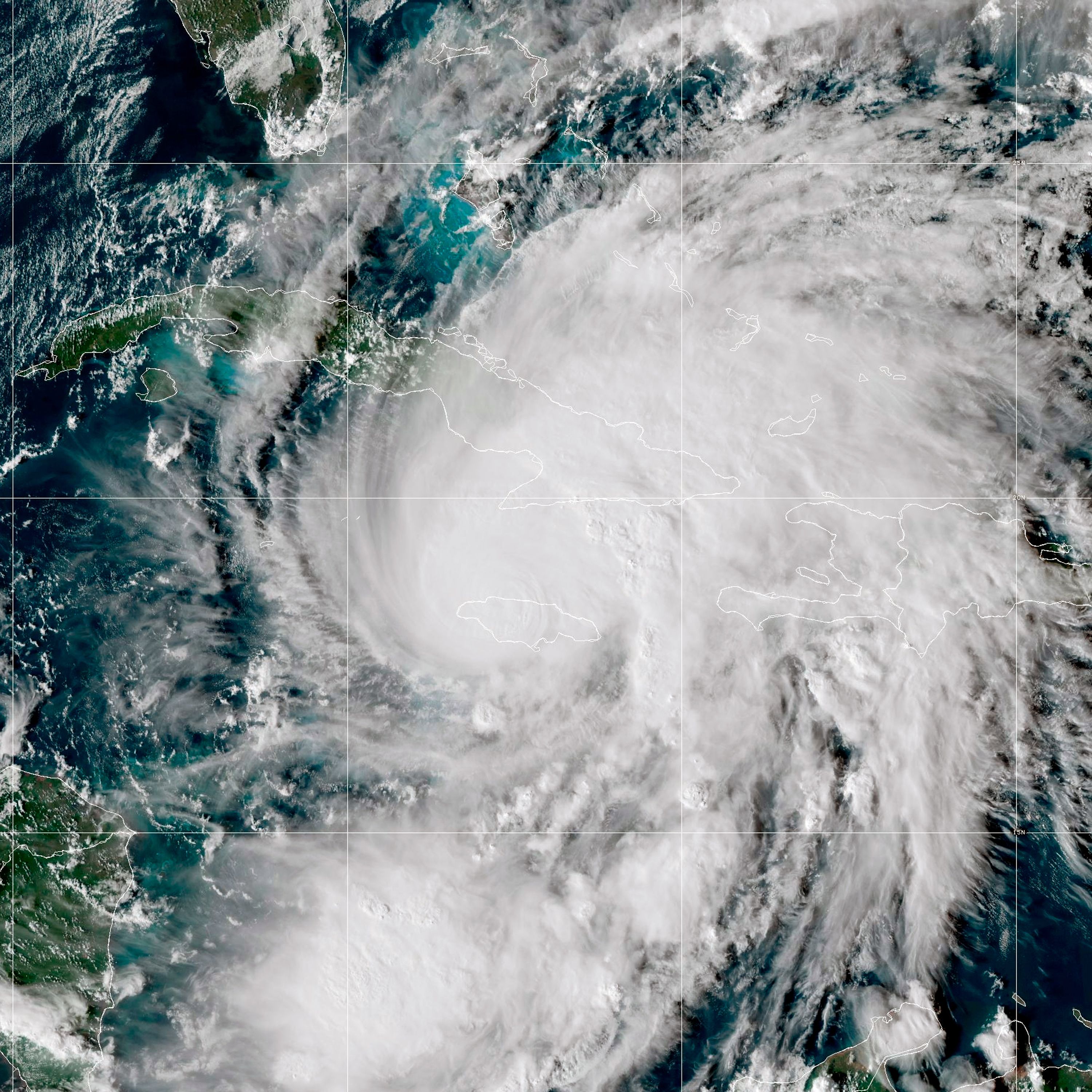
Hurricane Melissa hit Jamaica yesterday as one of the most powerful hurricanes on record.
- The storm, which made landfall as a Category 5 hurricane, tied the record for the strongest wind speeds by an Atlantic storm while making landfall.

Melissa's sustained 185 mph winds were matched only by Dorian, which battered the Bahamas in 2019, and the 1935 Labor Day hurricane in the Florida Keys.
5. 👀 Sour shutdown mood


The government shutdown is beginning to weigh on public opinion, Axios' Emily Peck writes from new consumer sentiment data.
- Why it matters: Public attitudes toward the nearly month-long government shutdown act as a crucial pressure point on lawmakers. Until now, the public's been largely indifferent.
🧮 By the numbers: Consumer confidence, a measure of how Americans are feeling about the economy, was "slammed" by the shutdown over the past week, according to a report yesterday from Morning Consult.
- "The U.S. government shutdown is exerting significant downward pressure on U.S. consumer sentiment," Morning Consult chief economist John Leer writes.
Confidence fell 2.6% for all adults yesterday compared with a week ago. It fell 4.6% for households earning more than $100,000 and around 2% for those making less money.
6. 🔌 AI energy chokepoint
A leading business group — in a report shared exclusively with Axios — is trying to jump-start efforts in Congress to cut red tape so that new AI and other energy projects can roll out more rapidly, Axios' Chuck McCutcheon writes.
- Why it matters: The National Association of Manufacturers (NAM) carries considerable clout with Republicans.
The group's report says AI "has become integral to modern manufacturing." 60% of the manufacturers NAM surveyed expect to deploy artificial intelligence by 2027, while 80% say it'll be essential to growing their business by 2030.
- But it said bureaucratic red tape — permitting in industry parlance — remains a hindrance to further progress.
7. 💡 Some evangelicals "quiet quit" MAGA

Evangelicals and Catholics uneasy with President Trump's rhetoric and immigration policies are subtly distancing themselves from MAGA — and taking some congregation members with them, Axios' Russell Contreras writes.
- Some churches are seeing a "quiet quitting" trend as pastors avoid political sermons and help members disengage from Trump's movement — without ostracizing family members who might still be MAGA devotees.
🔭 Zoom in: Some pastors and their followers are angry that Trump's administration has lifted bans on immigration agents going into churches to make arrests.
- Others are dismayed by cuts to humanitarian aid programs at home and abroad.
Reality check: Precisely how many evangelicals are "quietly quitting" MAGA isn't clear — most don't announce it publicly for fear of being criticized or harassed online.
8. 🎞️ 1 film thing: Pentagon vs. Netflix thriller

The writer of Kathryn Bigelow's new nuclear-fallout thriller — "A House of Dynamite," now streaming on Netflix — is pushing back on a Pentagon memo contending the film is overhyped and underestimates U.S. defense capability.
- "It is a thriller, not a documentary," Noah Oppenheim — the award-winning screenwriter and former NBC News president — told me. "But that doesn't mean we didn't take very seriously the obligation to be accurate."
- The filmmakers constantly consulted technical advisers with knowledge of U.S. defense systems.
🎥 The plot: When a single, unattributed missile is launched at the continental U.S., "a race begins to determine who is responsible and how to respond."
- 18 minutes could decide the fate of civilization. The U.S. military must "hit a bullet with a bullet."
Spoiler alert: An internal memo by the Defense Department's Missile Defense Agency — first reported by Bloomberg, and obtained by CNN — says that the "fictional interceptors in the movie miss their target ... [F]acts and results from real-world testing tell a vastly different story."
- "A House of Dynamite" shows that "deterrence can fail, which reinforces the need for an active homeland missile defense system," the memo adds.
🚀 Oppenheim tells Axios: "We're thrilled the Pentagon watched the movie and has chosen to join this debate with policymakers and scholars over missile defense."
- "Triggering more discussion of these issues was one of the reasons we made the movie," he added. "We believe all the experts who told us the current system is highly imperfect — and hope the dialogue leads to solutions that make us all safer."
Watch the trailer ... Read an interview with Oppenheim ... Guide to the cast.
📬 Thanks for reading! Please invite your friends to join AM.
Sign up for Axios AM