Axios AM

May 21, 2026

😎 Happy Thursday! Smart Brevity™ count: 1,541 words ... 6 mins. Thanks to Noah Bressner for orchestrating. Edited by Andrew Pantazi and Bill Kole.
1 big thing: 2 hours that changed AI
Over the course of two hours yesterday afternoon, the AI industry produced an extraordinary stream of headlines mapping the vast architecture of its ambitions, Axios' Zachary Basu writes.
- Why it matters: One historic news cycle peeled back virtually every layer of the AI revolution — smarter systems, exploding revenues, roaring markets, staggering infrastructure demands and a federal government racing to catch up.
Zoom in: Yesterday's developments crystallized the core pillars of the emerging AI order.
🧠 1. Brains: OpenAI announced one of its general-purpose reasoning models autonomously cracked a famous geometry problem that stumped mathematicians for 80 years.
- The implications are enormous: An AI capable of original mathematical discovery could unlock breakthroughs across science, engineering and medicine.
📈 2. Demand: Anthropic's explosive growth has the company on track for its first profitable quarter, with revenue projected to more than double to $10.9 billion in Q2, The Wall Street Journal reported.
- The estimated $559 million operating profit arrives two years ahead of internal projections — a turning point for an industry whose spending has long outrun its earnings.
⚡ 3. Power: Anthropic expanded its compute partnership with SpaceX, agreeing to spend roughly $1.25 billion per month through 2029 for access to the company's Colossus supercomputing infrastructure.
- Ahead of SpaceX's IPO next month, the deal cements Elon Musk as a power broker in the AI economy, where access to compute infrastructure is becoming as strategically valuable as the models.
🤖 4. Chips: Nvidia delivered another monster quarter, posting $81.6 billion in revenue — with its data center business alone bringing in $75.2 billion.
- CEO Jensen Huang said demand has gone "parabolic" and described the AI boom as the "largest infrastructure expansion in human history," reinforcing Nvidia's dominance over the hardware powering this economy.
💰 5. Wall Street: SpaceX's long-awaited IPO filing (see Item 2!) revealed a company rapidly transforming into an AI infrastructure giant, with massive compute operations and ambitions stretching far beyond rockets and satellites.
- The blockbuster filing arrived as OpenAI and Anthropic race toward potential public offerings this year that could value all three companies in the trillions.
- Also yesterday afternoon, The Wall Street Journal popped the news that OpenAI is working with bankers on a draft IPO prospectus to be filed confidentially with regulators as soon as tomorrow.
🏛️ 6. Government: President Trump has summoned top tech CEOs to Washington today for the signing of his AI executive order, prompted by mounting cybersecurity fears.
- CEOs on the invite list, Axios' Ashley Gold learned, include Musk, Alphabet's Sundar Pichai, Amazon's Andy Jassy, Meta's Mark Zuckerberg, Microsoft's Satya Nadella, OpenAI's Sam Altman, Anthropic's Dario Amodei and Apple's Tim Cook.
2. 🚀 SpaceX's IPO surprise
One of the most unexpected bits of AI news was just how big SpaceX is (or isn't). Axios' Dan Primack, who's been covering IPOs for more than 25 years, writes:
Elon Musk's SpaceX isn't the financial juggernaut many were expecting, according to its IPO prospectus filed yesterday.
- Why it matters: It's expected to be the largest IPO ever and could make Musk the world's first trillionaire.
But the prospectus shows just how much the IPO depends on expectations for future growth and investor servility to Musk — not the current underlying business.
- Those expectations will be tested if SpaceX really wants a $1.75 trillion valuation, which would make it one of the world's 10 most valuable companies.
🧮 By the numbers: SpaceX is wildly unprofitable, reporting a $4.9 billion net loss on $18.67 billion in consolidated revenue for 2025.
- For context, 200 companies in the S&P 500 had more revenue last year than SpaceX. This includes Tesla, where sales were five times higher.
3. 🎯 Trump's 2028 revenge targets

Fresh off his takedowns of GOP dissenters in this month's primaries, President Trump is already making a list of Republicans who could be on his 2028 chopping block, Axios' Alex Isenstadt writes.
- Why it matters: Trump's string of primary wins has reaffirmed his dominance over the party — and now he's looking to extend that influence after he leaves office in January 2029.
🔭 Zoom in: Trump hasn't been shy about identifying future GOP targets after unseating Rep. Thomas Massie (R-Ky.) and Sen. Bill Cassidy (R-La.) over the past two weeks:
- Colorado Rep. Lauren Boebert: Trump took to Truth Social over the weekend to solicit a primary challenger to Boebert, calling her "weak-minded" and "very difficult." He was infuriated she'd campaigned for Massie.
- Kentucky Sen. Rand Paul: Trump repeatedly attacked Paul for supporting Massie, who shares the senator's libertarian instincts. The president also has criticized Paul for voting against Trump's "big, beautiful bill" and opposing his decision to attack Iran.
- Ohio Rep. Warren Davidson: The White House has signaled Davidson could be targeted for initially opposing the "big, beautiful bill." He backed Massie's reelection.
- Pennsylvania Rep. Brian Fitzpatrick: Trump yesterday tore into Fitzpatrick — who represents a swing suburban Philadelphia district that Kamala Harris won in 2024 — for voting "against me all the time."
🌴 What's next: Trump must decide whether to oppose Rep. Nancy Mace (R-S.C.) — who co-led a push with Massie and Boebert to force the release of the Epstein files — in the June 9 primary for South Carolina governor.
4. 😱 Each party's nightmare map
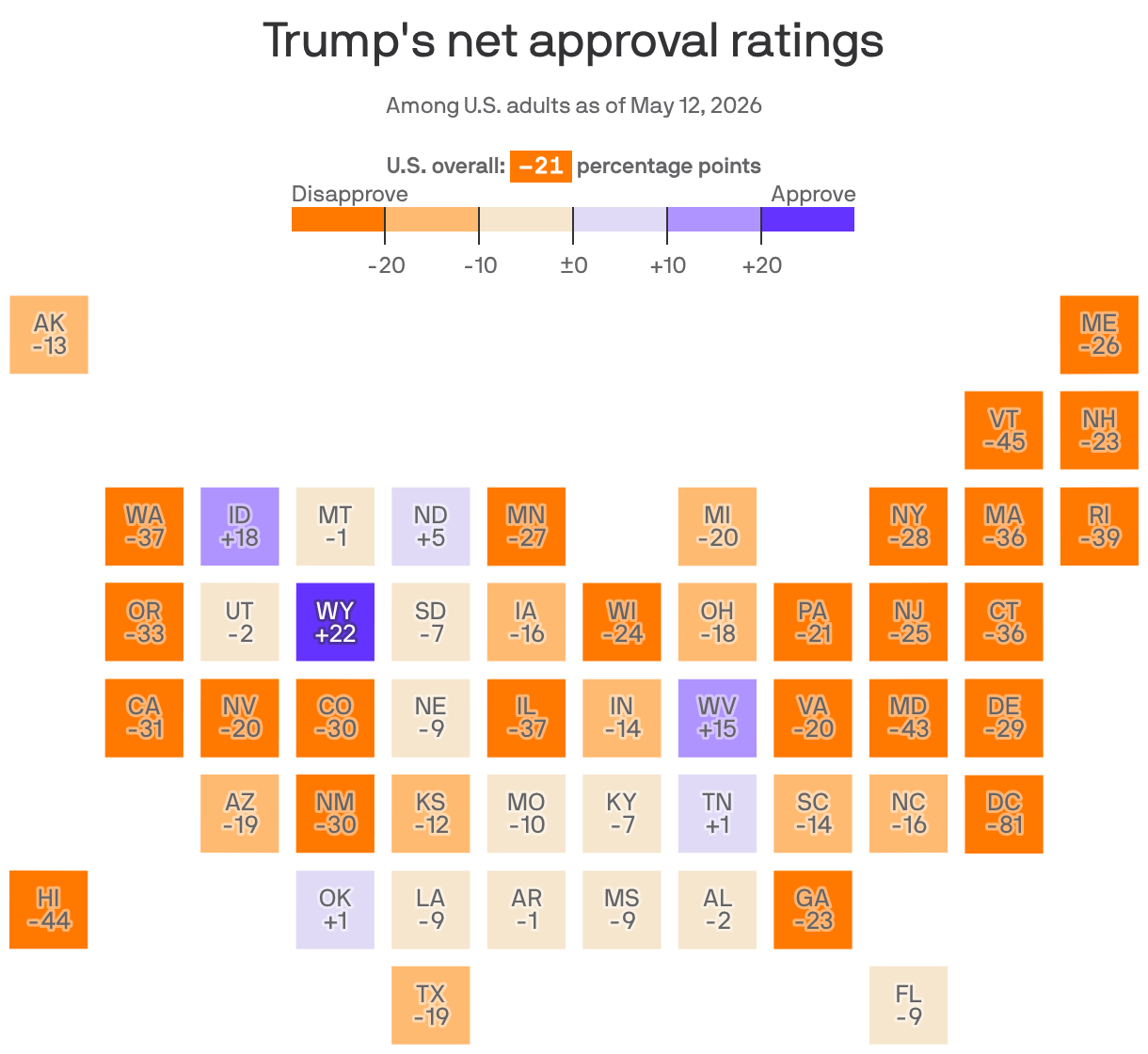
Axios CEO Jim VandeHei writes in his weekly C-Suite newsletter:
For the next two election cycles, this map lays bare why Republicans have heartburn: President Trump is underwater, almost everywhere.
- Blame his five-alarm economy.
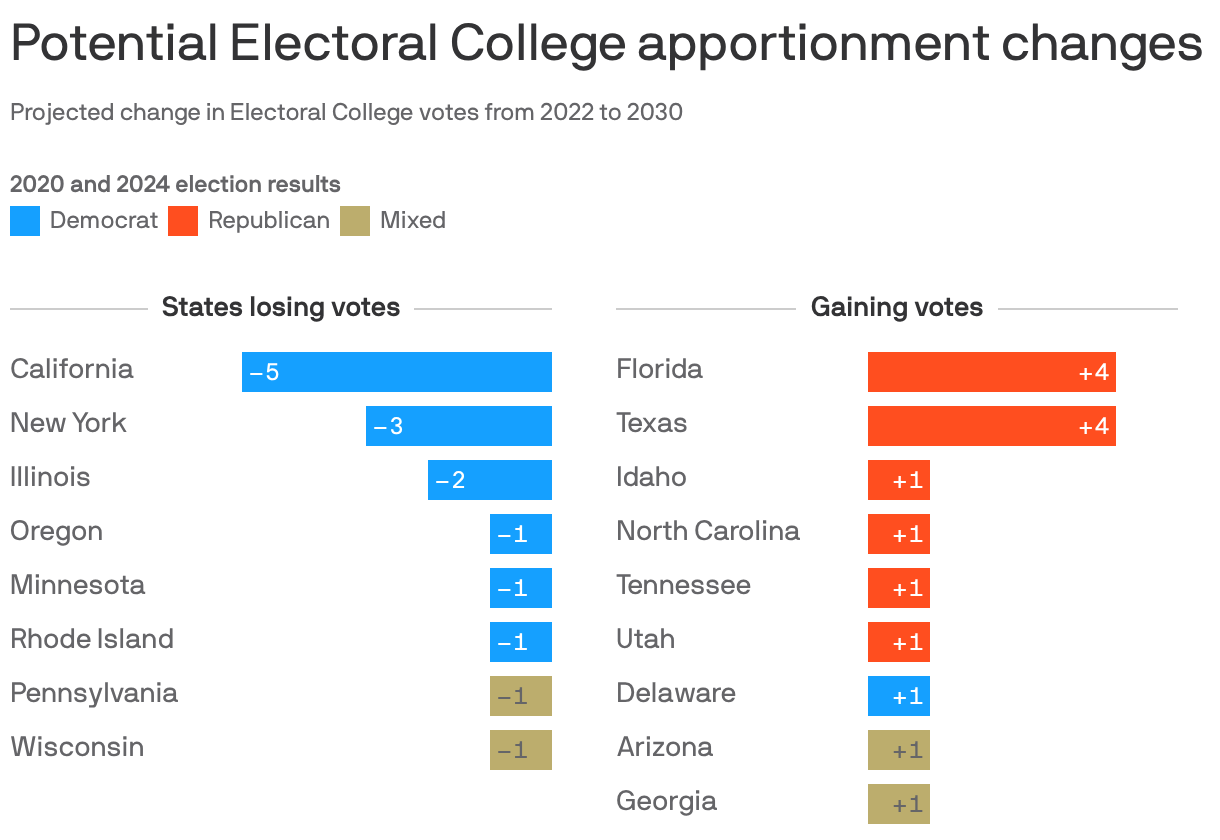
Look four years ahead, and you can see why some top Democrats worry they're screwed.
- Thanks to population shifts, red states are set to gain big from the once-a-decade redistribution of House seats in 2030.
💡 If you're a CEO or on a CEO's team: Ask to join Jim's new weekly Axios C-Suite newsletter.
5. 🦾 Google's plan to win the AI war

Axios' Ina Fried writes from Google's I/O developer conference in Mountain View:
Google is trying to pull off one of the trickiest balancing acts in tech: aggressively disrupting its own products with AI while protecting the businesses generating tens of billions in profit.
Why it matters: Unlike OpenAI and Anthropic, Google enters the AI race with enormous scale, distribution and cash flow — but also a vast empire to defend.
- "One of the cool things we get to do here at Google is build technologies that get immediately deployed into multibillion-dollar products," Google DeepMind co-founder and CEO Demis Hassabis told Ina in an interview. "It's pretty, pretty exciting, and I would say pretty unique."
🖼️ The big picture: Public perception of the AI race swings wildly based on whichever company most recently released a flashy model.
- For a while, OpenAI was seen as unbeatable. Then late last year, Google was seen as pulling ahead. And now many point to Anthropic as having surged thanks to Mythos.
- But executives at Google, OpenAI and Anthropic increasingly describe the frontier race as neck-and-neck, with companies making different tradeoffs on cost, speed and computing resources.
- This was highlighted by Google's choice to debut the latest Gemini not with a behemoth version to compete with Anthropic's Mythos but with the faster, cheaper Gemini 3.5 Flash.
6. 🪖 Scoop: Palantir's Pentagon fight

Palantir is battling the Pentagon's Defense Intelligence Agency for the ability to bid for a contract to modernize its data analytics system, according to a filing obtained by Axios' Maria Curi.
- Why it matters: Palantir's already massive Pentagon foothold could expand to the agency tasked with providing foreign military intelligence to prevent and win wars.
Palantir argues in its protest that the DIA is wasting taxpayer money, and flouting the law, by refusing to consider a commercial solution for its data analytics modernization.
- The agency launched MARS (Machine-assisted Analytic Rapid-Repository System) eight years ago and has been developing it ever since to replace a Cold War-era system.
The White House wants any company to be able to compete, a senior Trump national security official told Axios.
- "The president has issued several EOs pushing to field the best tech the private sector has to offer," the official said. "I wouldn't be surprised if there's swift action to remedy this and ensure any company that wants to compete is given a fair chance."
7. 😶 Neutral brands win America
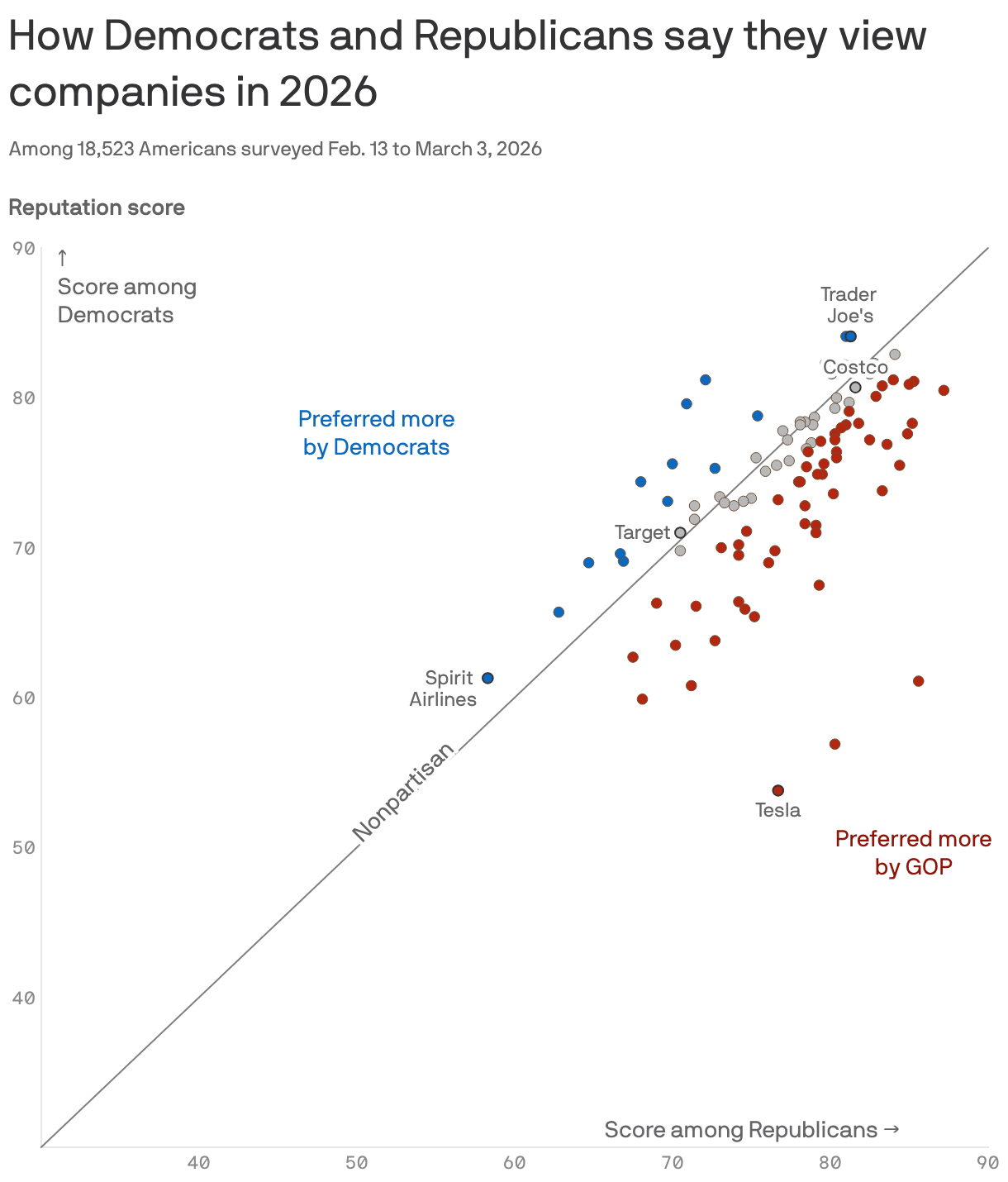
Americans' favorite brands this year are perceived as more politically neutral and associated with wellness and optimism, according to the new Axios Harris Poll 100 rankings.
- Ranked No. 1 overall, Chewy's reputation goes beyond selling pet supplies, extending to emotional connection and support.
- Eli Lilly (No. 13) is now more associated with GLP-1 weight loss drugs like Mounjaro and Zepbound than other treatments.
- Athletic Brewing (No. 8) embraces nonalcoholic beer, while Alo Yoga (No. 7) has built a brand around wellness wear.
8. 📺 1 for the road: Colbert's curtain call

Stephen Colbert's final episode of "The Late Show" — tonight at 11:35 p.m. ET on CBS — will go longer than the program's typical hourlong runtime, Entertainment Weekly reports.
- CBS has kept the finale's guest list a secret. The show's final days have featured a star-studded lineup with Jon Stewart, Steven Spielberg and Bruce Springsteen.
- Former President Obama, Oprah Winfrey and David Letterman also appeared in the show's closing weeks.
NBC's "The Tonight Show" with Jimmy Fallon and ABC's "Jimmy Kimmel Live!," which typically air against "The Late Show," will broadcast reruns tonight.
📬 Thanks for reading! Please invite your friends to join AM.
Sign up for Axios AM