Axios AM

November 17, 2026

โ Hello, Tuesday! Smart Brevityโข count: 1,764 words ... 6ยฝ mins. Thanks to Noah Bressner for orchestrating. Edited by Bill Kole.
๐ฐ Axios BFD, our fifth annual dealmakers summit, returns to Manhattan today at 2 p.m. ET. The lineup includes Donald Trump Jr., Kalshi CEO Tarek Mansour, Alex Rodriguez & more. Watch here.
1 big thing: If competence were cool
So many government problems, like last week's nationwide aviation meltdown, are foreseeable ... and foreseen, Jim VandeHei and Mike Allen write in a "Behind the Curtain" column.
- Why it matters: Again and again, we choose to do nothing until a crisis hits.
A big reason: These are huge, tedious, complex, unsexy, antiquated systems that require persistence and competence to fix.
- A big new problem: These systems are deeply intertwined with our daily lives, and highly susceptible to malfunctions, mishaps and AI-enhanced cyberattacks. They're boring until they're vital.
๐ผ๏ธ The big picture: We have federal agencies and congressional committees designed explicitly to monitor, protect and improve these complex systems. But they've atrophied as power has been centralized in the presidency and congressional leadership, where daily political warfare rarely includes sober discussion of competence and essential interconnected systems.
Here are a few of the foreseeable (and foreseen) crises that have been staring at us, many for literally decades:
- The skies: We've known for years that the air-traffic system relies on copper wire and floppy disks. We've seen and known the vulnerabilities through Democratic and Republican administrations. We've known the fix is expensive: $31.5 billion, Transportation Secretary Sean Duffy told lawmakers last year. At Friday night's briefing at the White House, Duffy said: "I want $50 billion."
- The grid: We've known for a long time that our electricity is delivered through an aging patchwork system vulnerable to accidents or attacks. The nonprofit power authority NERC (North American Electric Reliability Corp.) warned this spring that the system is so strained by rising energy needs from AI and humans that it could jam up or break.
- The water: Drinking and wastewater systems are old and in dangerous disrepair โ a huge risk to hospitals, in particular. In July, cyberattacks hit over 30 municipal water systems in Minnesota, with Iran as a likely culprit.
- The government's computers: Washington spends over $100 billion a year on information technology. Roughly 80% goes to keeping old systems alive. Eight of the 11 systems most in need of replacement run on dying languages like COBOL. The people who can read, write and fix them are retiring.
- The debt: We paid $1.052 trillion in interest last fiscal year. That's more than we spent on defense. The Congressional Budget Office sees the interest doubling to $2.1 trillion in 2036. Every dollar of interest is a dollar that can't fix another crisis on this list.
- The retirement cliff: Social Security's retirement fund runs dry in 2032. Current law then cuts benefits by 22%, automatically. Medicare's hospital fund follows in 2033. We have known those dates for decades, and they've been creeping up. Now they're just a few years away.
- The shriveled arsenal: Rebuilding the advanced weapons we've burned through in the Iran war will take years. Back in May, a paper from the Center for Strategic and International Studies estimated that replacing some interceptors used heavily in the war, including Patriot and THAAD anti-missile systems, would take three years.
- The minerals: China controls 91% of the world's rare-earth refining capacity, giving the other superpower a chokehold on vital ingredients of AI. We're one trade war away from slowing AI and the entire economy.
The bottom line: When choosing and rating leaders in harrowing times, put a premium on competence. We'll need it.
2. โ ๏ธ Time capsule of this post-processable week

Talk about timing! After a remarkable string of tech failures disrupted American life, the federal government will conduct a nationwide broadcast test of its emergency alert system โ you know the sound โ today at 2:20 p.m. ET. The test will air on radio, broadcast, cable and satellite TV.
- The test timing is a coincidence. It was announced in September, long before yesterday's outages at JPMorgan Chase and United Airlines, last week's Microsoft meltdown and the FAA's longest nationwide ground stop since 9/11.
But that hasn't stopped a wave of online conspiracy theories, including viral claims that today's test signals the start of a 90-day nationwide blackout.
- FEMA's tweet: "We've heard a lot of rumors about [today's] EAS [Emergency Alert System] test. ๐บ๐ป Let's clear things up. It lasts 1 minute, and no action is required. No blackouts, no secret emergencies. Just our legally mandated, routine test on TV and radio at approximately 2:20 PM ET."
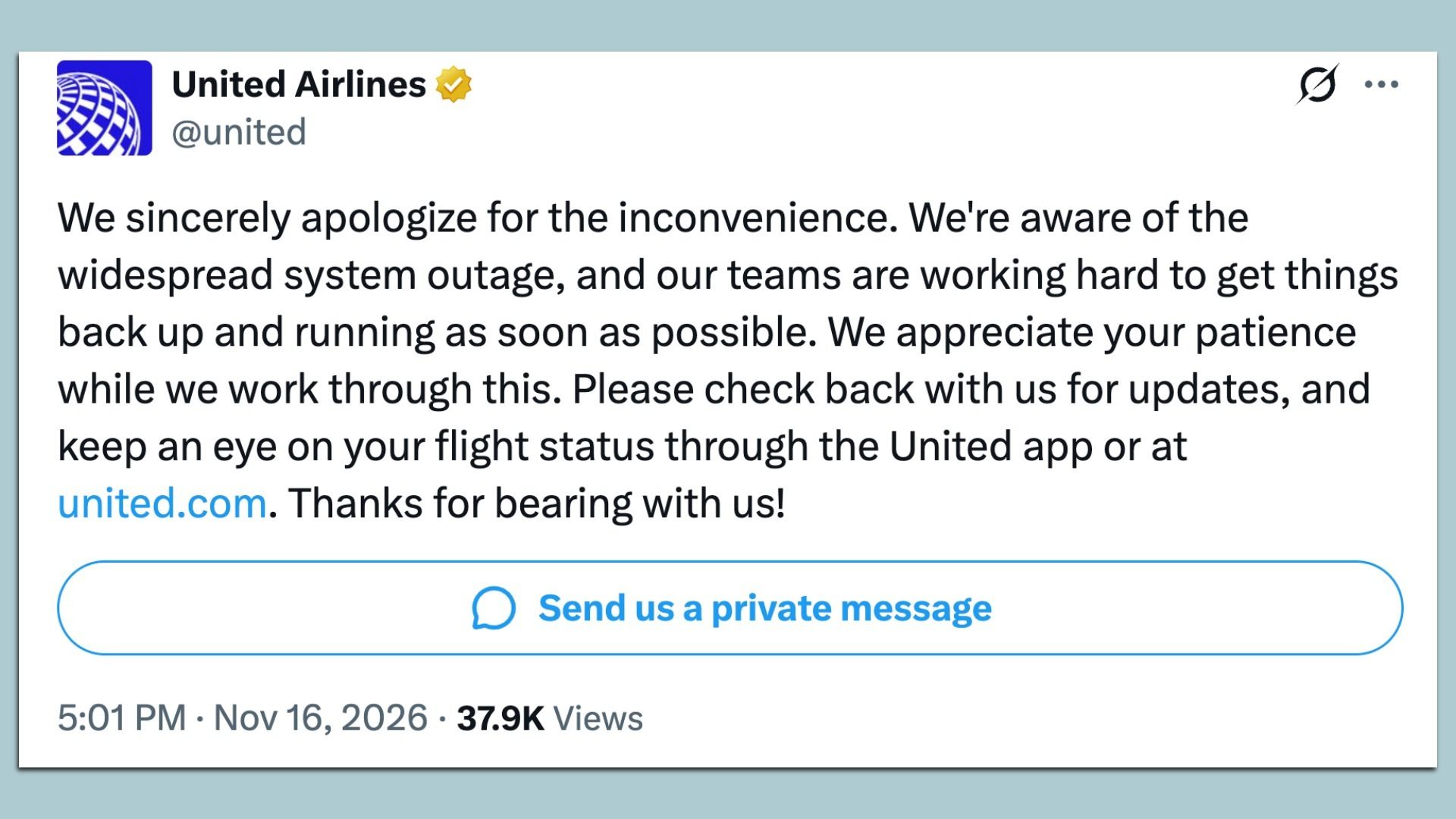
๐ What happened yesterday: Thousands of bank customers reported difficulty accessing online accounts and transferring money through Zelle after a technical issue at JPMorgan Chase.
- Chase blamed a software bug and said transactions were back to normal last night.
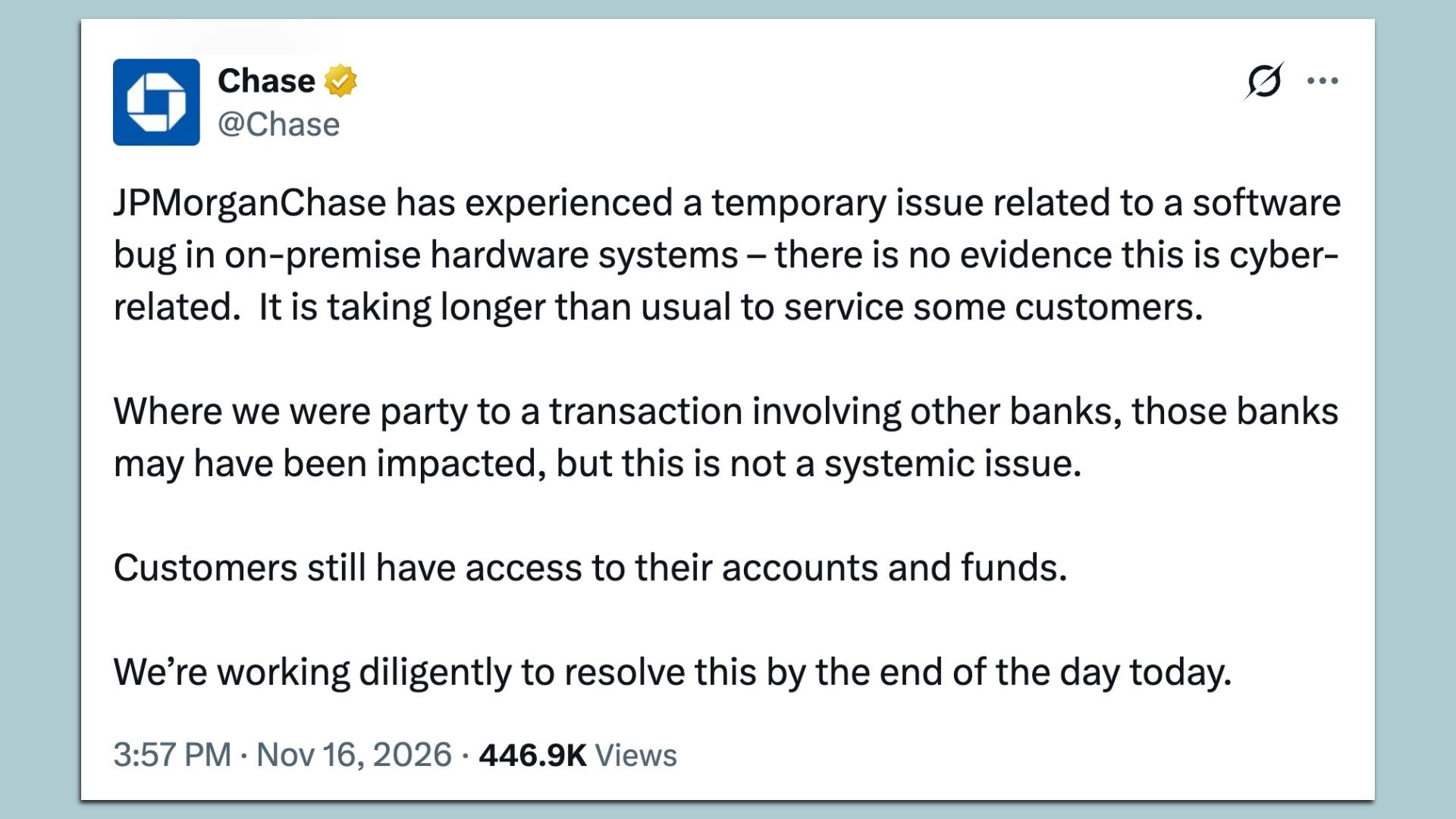
Separately, United Airlines resolved a "widespread system outage" that delayed departing flights for about 90 minutes. The airline said there was no indication of a cybersecurity-related issue but didn't disclose the cause.
๐บ The intrigue: Homeland Security Secretary Markwayne Mullin told Fox News' Sean Hannity last night that federal cybersecurity officials have found no evidence linking the outages to a coordinated cyberattack.
- Mullin also speculated that AI could be behind the outages. He cited an unnamed person in the tech industry who suggested that AI programs writing and changing their own code could overwhelm older systems. He offered no hard evidence.
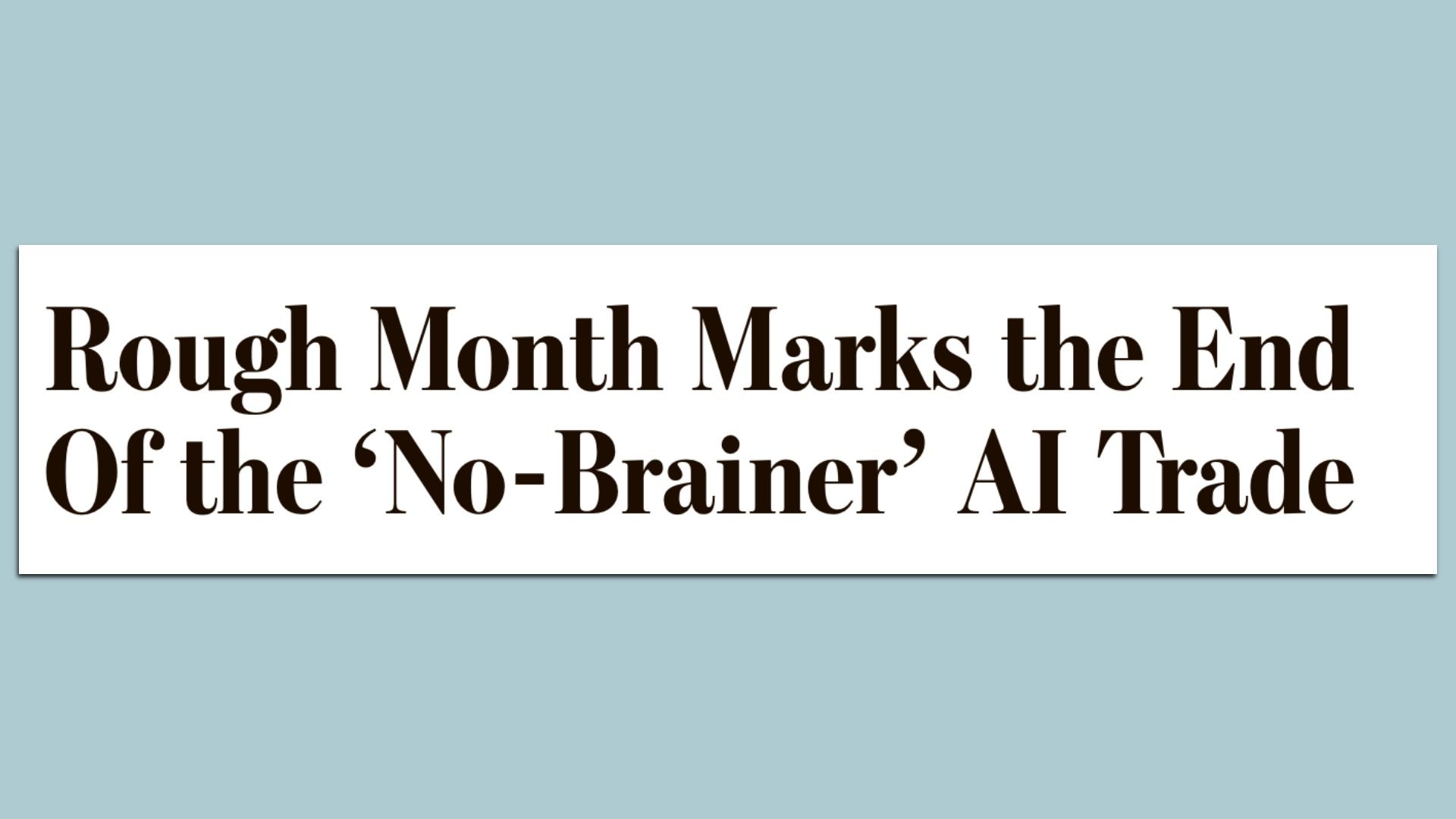
๐ซจ A Wall Street Journal front-page story today features a stark obit for the go-go AI market: "For three years, investors have minted money from the AI boom without having to make hard choices. Nearly every stock tied to what is projected to be the largest infrastructure spending spree in U.S. history zoomed higher, from chip makers to power companies to obscure equipment makers to cloud-computing companies of all sizes."
- "That 'no-brainer' era is over," the article continues. "A punishing bout of volatility stretching back to the Nasdaq's recent peak on Oct. 6, through the election's aftermath and Jensen Huang's stunning exit as CEO of Nvidia, has fundamentally rewired the AI trade. ... The AI trade is vulnerable from a dizzying number of angles."
Keep reading (gift link).
3. โก U.S. allies fear "Yalta II"

President Trump's trilateral summit with Xi Jinping and Vladimir Putin has the makings of an unpredictable spectacle โ and that's exactly what has U.S. allies anxious, Axios' Barak Ravid writes.
Why it matters: Trump's stated goal for the first-ever summit between the nations' three leaders is to start a discussion on nuclear disarmament.
- But European and Western diplomats fear he could go off script and take positions that undermine Ukraine or Taiwan โ or appear to side with their chief adversaries.
๐จ The big picture: Many U.S. allies are nervous that the meeting will project an image of the three leaders scheming to carve up the earth into spheres of influence.
- Some of them invoked "Yalta II" โ referring to the 1945 summit between the U.S., Great Britain and the Soviet Union that helped shape postwar Europe.
- Trump also floated a possible meeting with North Korean leader Kim Jong Un.

๐ Behind the scenes: The Trump-Xi-Putin summit was a topic of closed-door talks among European leaders at a meeting in Dublin last week, according to a European diplomat.
- Some of them raised concerns about what Trump might say about the war in Ukraine, the diplomat said.
4. ๐ฐ Jensen's billionaire backers
The battle to reinstate Jensen Huang is becoming a test of whether Silicon Valley's most powerful billionaires can still bend corporate America to their will, Axios' Ina Fried writes.
- For now, Nvidia's board isn't considering bringing him back โ putting it on a collision course with some of tech's biggest names.
Why it matters: Silicon Valley has long treated its most successful founders as indispensable. A new generation of tech titans, led by Elon Musk, has amplified that culture while swatting away efforts to curb their power.
- Huang's fate could signal whether the balance of power is beginning to shift away from Silicon Valley's billionaires.
๐ฌ Zoom in: A growing campaign to reinstate Huang has attracted more than 180,000 signatures, including thousands of people identifying themselves as Nvidia employees, following his departure after revelations of intimate relationships involving subordinates and an alleged Chinese spy.
- President Trump said yesterday he wouldn't mind seeing Huang return. Elon Musk has also backed the effort.
- Other supporters include Y Combinator CEO Garry Tan, Epic Games CEO Tim Sweeney and prominent investors Brad Gerstner and Gavin Baker.
๐ฅ Reality check: Huang's supporters face powerful headwinds. Nvidia's board, the FBI and Congress are investigating, and the company is battling a new shareholder lawsuit.
5. ๐ค Charted: Brutal tech dive
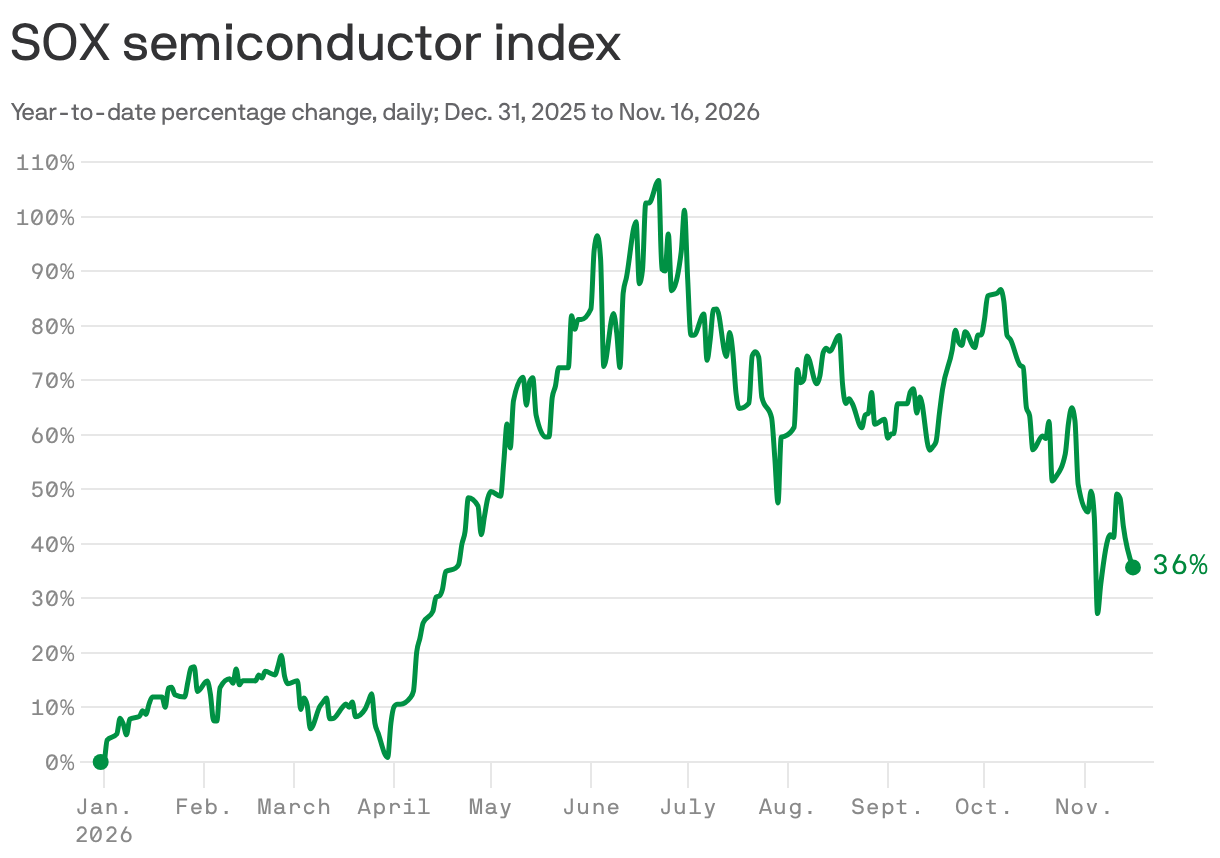
Tech stocks took a thumping yesterday as Jensen Huang's exit and jitters about Anthropic's looming IPO (due Thursday) spooked investors, Axios' Matt Phillips writes.
- Chipmakers were hit hardest: The SOX, an index of major semiconductor stocks, tumbled 5.3% and is now down 34.4% from its peak over the past year.
6. ๐๏ธ Trump's biggest project is running out of time
Look past the White House renovations, the proposed arch and the golf course: President Trump's border wall project is hundreds of miles behind schedule, Axios' Brittany Gibson writes.
- Why it matters: "Build that wall" helped build MAGA. But with two years to go, tough terrain and mounting political resistance threaten to leave Trump's signature promise unfinished.
At the current pace, the main wall won't be finished until late 2029, while Trump will leave office in January 2029.
- There are about 619 miles of primary wall left to build, according to data from Customs and Border Protection as of Nov. 10.
- The Trump administration has picked up the pace โ from 2.6 miles a week earlier this year to 3.9 miles a week between mid-June and earlier this month โ according to an Axios review of the agency data.
7. ๐ International student slump
Fewer international students are enrolling at American universities โ costing the economy billions of dollars and hurting college towns, Axios' Josephine Walker writes from data released by the Institute of International Education.
- Why it matters: International students typically pay higher tuition than their domestic counterparts.
๐งฎ By the numbers: New international student enrollment at U.S. colleges and universities fell 18% during the 2025โ26 academic year.
- Overall international enrollment dropped 3%.
- The decline is hitting graduate programs hardest. International grad student numbers fell 13%, while undergraduate enrollment barely budged, slipping just 0.3%.
8. ๐ฆ 1 fun thing: Top Thanksgiving side

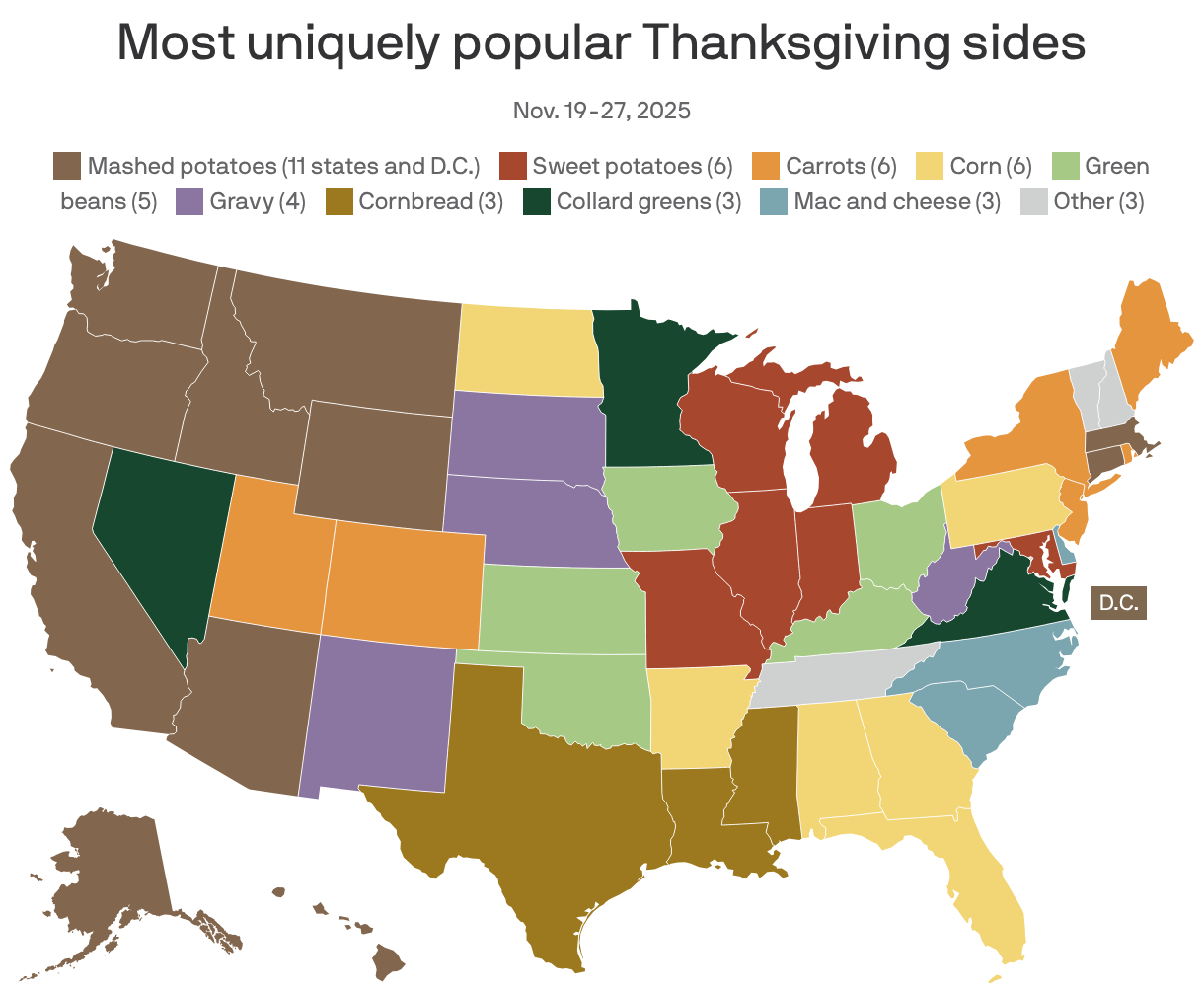
Mashed potatoes are America's most-ordered Thanksgiving side, Axios' Sami Sparber writes from new DoorDash data.
- Spuds lead nationally and over-index in 11 states and D.C. โ the most of any side.
- Carrots, corn and sweet potatoes each stand out in six states.
- Green beans claim five.
๐ฌ Thanks for reading! Please invite your friends to join AM.
Sign up for Axios AM