U.S. allies on edge as Trump heads to summit with Xi and Putin

Add Axios as your preferred source to
see more of our stories on Google.
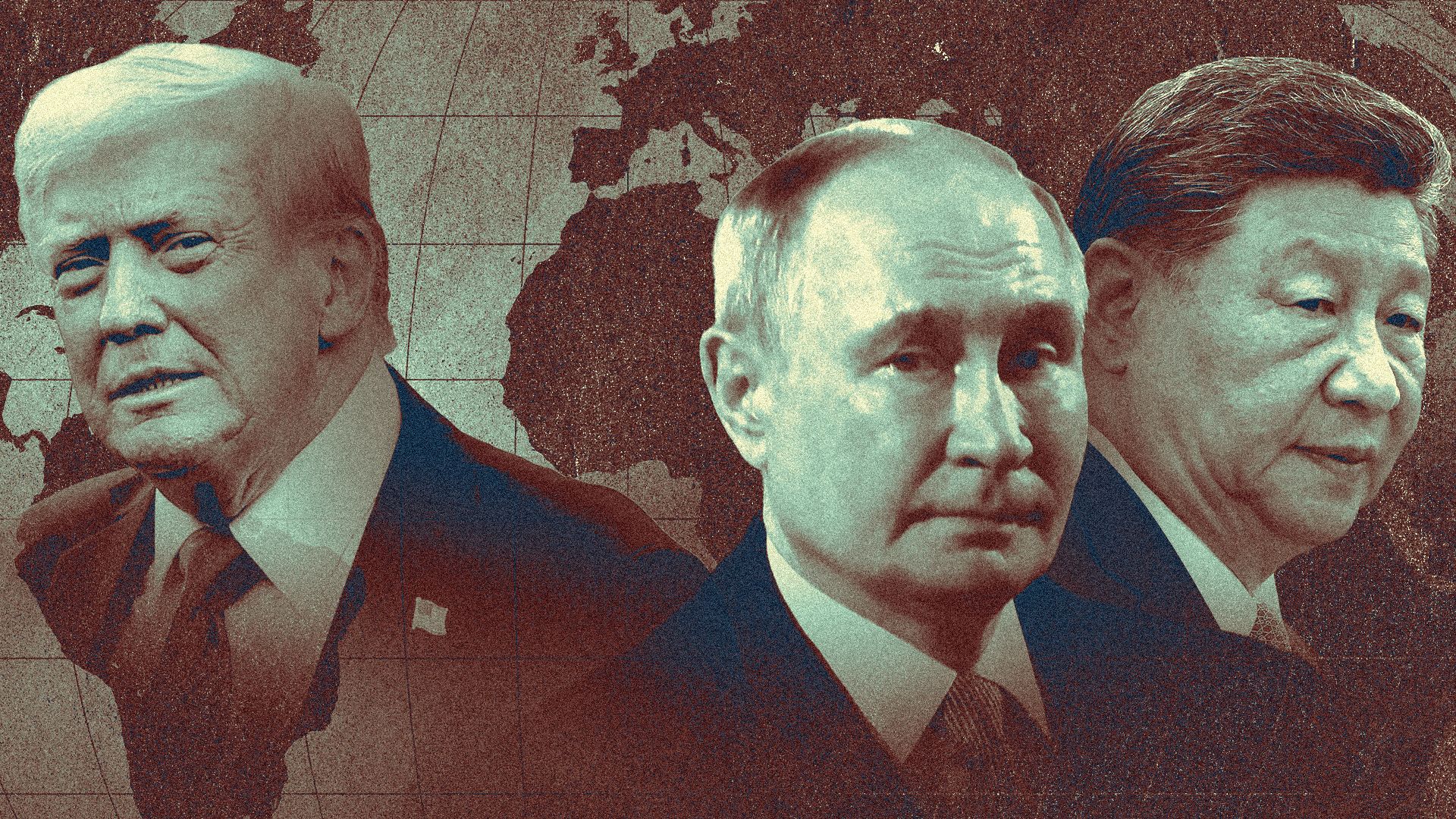
Photo illustration: Brendan Lynch. Photos: Getty Images
President Trump's trilateral summit with Chinese President Xi Jinping and Russian President Vladimir Putin has the makings of an unpredictable spectacle — and that's exactly what has U.S. allies anxious.
Why it matters: Trump's stated goal for the first-ever summit between the nations' three leaders is to start a discussion on nuclear disarmament. But the fear is that he could go off script and take positions on Ukraine or Taiwan that undermine their interests or appear to side with their chief adversaries, according to several European officials and Western diplomats.
- "We know that every time President Trump talks to or sees Putin, it translates into bad news for Ukraine and for Europe. We brace for anything," a European diplomat told Axios.
- Substance aside, Western diplomats worry about the optics of Trump appearing alongside two emboldened strongmen. On Monday, Trump also floated a possible meeting with North Korean leader Kim Jong Un.
Driving the news: Before leaving for the Philippines on Monday, Trump reiterated that his goal for the summit is to talk about denuclearization — a "tough subject," he said, "because it's very hard for any of us to say we'll get rid of our nukes, right?"
- But other topics will get attention, too, Trump went on to say.
- "We'll talk about Iran. We have Iran in very good shape, but we'll talk about Iran a little bit," he said.
- The president also said "we'll talk about my favorite subject, Ukraine."
- His comments came after U.S. officials stressed in a call with reporters on Friday that the summit would not deal with the war in Ukraine. Chinese officials said the same thing.
Context: Neither China nor Russia was enthusiastic about discussing denuclearization. But China agreed after Russian lobbying. And Putin saw the summit as a chance to lobby Trump on Ukraine.
Behind the scenes: The Trump-Xi-Putin summit was a topic of closed-door talks among European leaders at a meeting in Dublin last week, according to a European diplomat.
- Some of them raised concerns about what Trump might say about the war in Ukraine, the diplomat said.
- German Chancellor Friedrich Merz was among the more vocal during the private session. He then went out and spoke about it publicly.
- "Our message to the U.S. before Trump meets Putin is: No surprises, please," Merz said.
- Ukrainian officials expressed similar worries.
- Japanese officials also privately relayed concerns to U.S. counterparts about the message the summit might project about Washington's stance on Taiwan or Asia more broadly, according to a source with knowledge of the matter. A potential public meeting between Trump and Kim Jong Un would be even more concerning for Japan.
The intrigue: European diplomats said U.S. officials tried to downplay the summit and lower expectations about any substantive results.
- But many of the U.S. allies are nervous that the meeting will project an image of the three leaders scheming to carve up the earth into spheres of influence. Some of them invoked "Yalta II" — referring to the 1945 summit between the U.S., Great Britain and the Soviet Union that helped shape post-war Europe.
State of play: On the same day Trump meets with Xi and Putin, his envoys Jared Kushner and Steve Witkoff are expected to be in Berlin with senior officials from Ukraine, Germany, France, the UK, Italy, Poland, the EU and NATO, according to two sources.
- The purpose is to coordinate ahead of the next round of negotiations with Russia in Abu Dhabi the following week.
- On Monday, Kushner and Witkoff held a virtual meeting with the representatives of the different entities.
- "We discussed how to facilitate direct engagement between Europe and Russia, which has been largely absent over the past four years. It is important that both sides hear each other's concerns and proposals directly as we work toward a more stable and secure future for Europe," Kushner wrote on X.
The other side: Witkoff and Kushner also spoke on Monday with Putin's foreign policy adviser Yuri Ushakov about the next steps in the peace process.
- The White House said Putin had agreed to allow European representatives to join the negotiations with Ukraine and to launch a parallel track of talks regarding a Europe-Russia security deal.
- But Ushakov said no such agreement had been reached.
