Axios AM

May 01, 2026

👒 Happy May Day! Smart Brevity™ count: 1,372 words ... 5 mins. Thanks to Shane Savitsky for orchestrating. Edited by Ben Berkowitz and Bill Kole.
1 big thing: Filling up, and feeling down

The energy crisis in the U.S. is starting to eat into American wallets, Axios' Emily Peck writes.
Why it matters: Unlike in Asia and Europe, the U.S. is relatively insulated from the threat of actual gasoline or oil shortages.
- That's good for the economy and for stock prices. But it's cold comfort to basically everyone else who is forced to pay more to fill up the tank.
By the numbers: The average price of a gallon of gas hit $4.39 this morning — up 9¢ in just 24 hours, and 47% higher before the Iran war.
- A month ago, it was $4.06. A year ago, it was $3.19.
How it works: Higher gas prices can force people to make choices like trading down on spending for groceries or restaurants or clothing, says David Tinsley, senior economist at the Bank of America Institute.
- It's the latest chapter in the vibecession, where the economy holds up, but no one feels particularly great about it.
🚗 What to watch: Driving levels this spring are trending slightly lower than last year, according to data tracked by JPMorgan Chase.
- "We are already seeing higher pump prices begin to curb discretionary driving in the U.S.," Natasha Kaneva, head of global commodities strategy at the bank, tells Axios.
2. 🤖 Paging Dr. AI
Many voices are sounding the "not ready" alarm for AI replacing doctors, warning of legal risks from robot-enabled care. But the once-far-fetched idea is becoming reality, Axios Future of Health Care author Caitlin Owens writes.
🐝 It's playing out in Utah: The state has partnered with health startup Doctronic in a pilot program that will allow AI systems to automate some prescription refills for chronic conditions, with some human oversight.
- The initiative is still in the first phase, which requires human review and approval of every AI-renewed prescription. But the state medical board last month called for the program to be suspended and said it "potentially places Utah citizens at risk."
- Citing safety guardrails built into the agreement, the state agencies involved declined to suspend the program.
State of play: There's growing evidence that AI systems can do some things just as well as, if not better than, human doctors.
- A Mayo Clinic study published this week found that an AI model detected early signs of pancreatic cancer — one of the deadliest cancers — up to three years before human specialists.
Zeke Emanuel, a bioethicist and adviser to former President Biden, told Caitlin: "I think one of our most important questions is, as a profession: ... What is our value-add to patients? That's what AI is posing to us," he said.
- "There is going to be some displacement, absolutely."
3. 💵 Trump expands retirement plan access
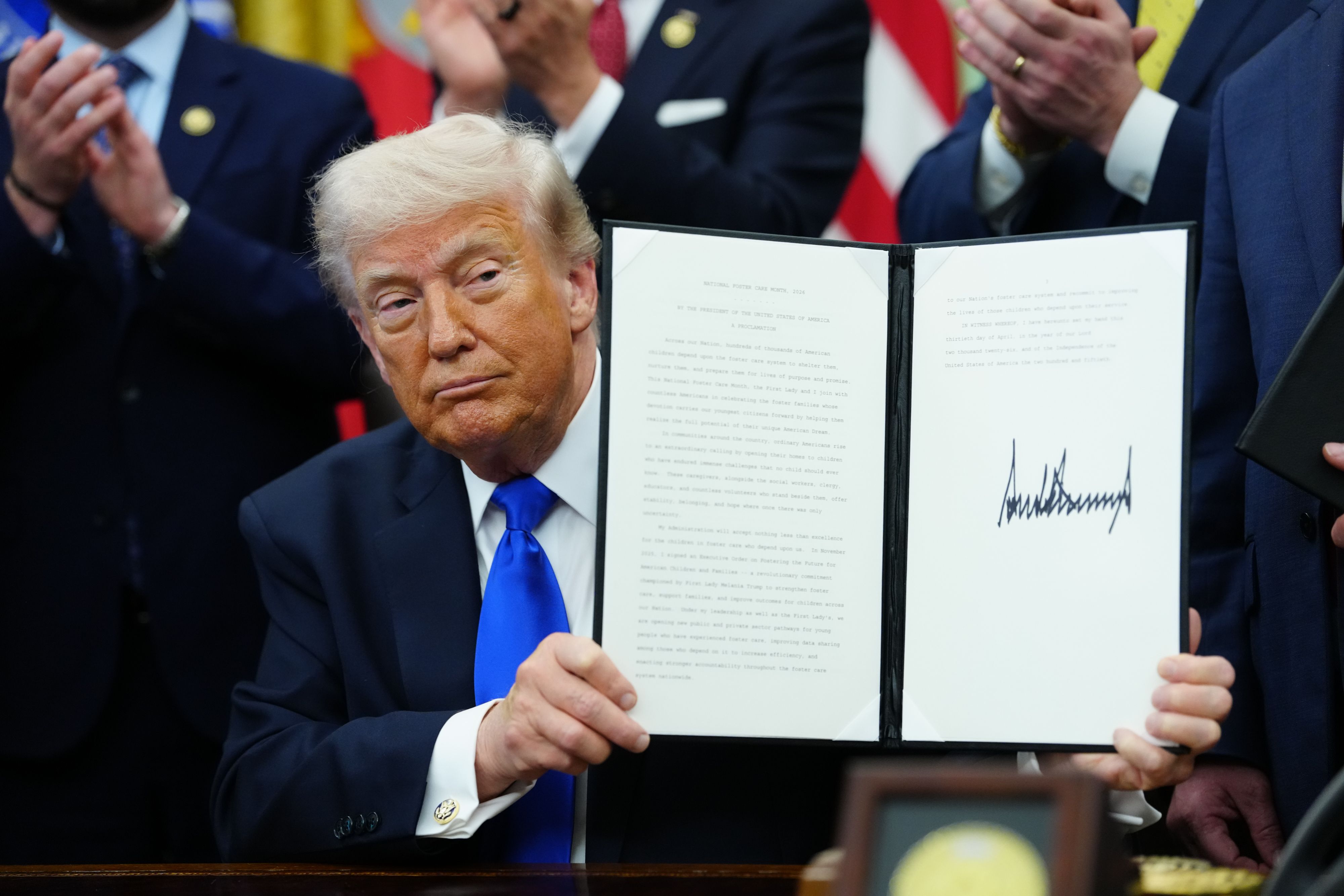
President Trump issued an executive order yesterday that expands access to retirement accounts for workers who don't get 401(k)s, Axios' Emily Peck reports.
- Why it matters: The order could be a game-changer for millions of lower-income Americans. It has a surprising amount of bipartisan support.
It's the kind of thing that many salaried types get from their employers.
- But about 54 million Americans lack access to an employer-based retirement plan, according to data from the centrist Economic Innovation Group, which floated the idea in 2021 and had worked behind the scenes with the White House.
Catch up quick: A law passed under former President Biden set up a small amount of matching funds for low-earning workers who put money into a retirement plan.
- The "saver's match" was set to take effect next year, and would give up to $1,000 in matching funds to certain workers who contribute $2,000 a year to an IRA.
- Trump is building off that to create a system where people can more easily sign up for retirement accounts, via a coming web portal, TrumpIRA.gov.
- The plans on offer will be vetted by the Treasury Department, and modeled on the well-regarded Thrift Savings Plan used by more than 6 million federal employees — typically low-fee index funds.
Yes, but: Advocates say the real game-changer for these workers would be a more robust match and automatic enrollment. But that requires legislation.
4. 📊 Teens' trusted sources
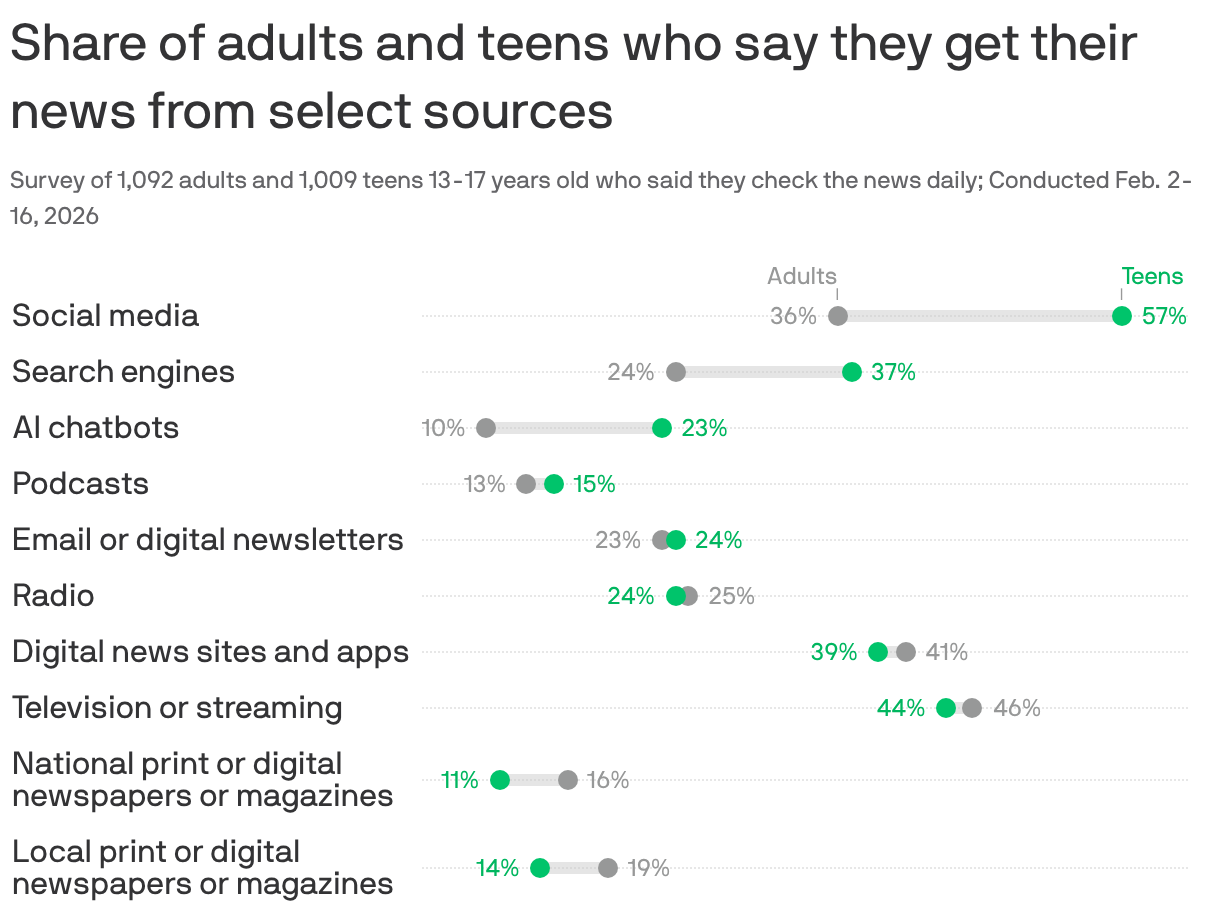
The generational divide in preferred news sources is stark in new AP-NORC polling.
- "Old" platforms (print, radio, TV) are slightly preferred by adults.
- "New" platforms (AI chatbots, social media, search engines) are much more widely used by teens aged 13-17.
Why it matters: Younger users are getting their news served to them via algorithm by tech companies that lack editorial accountability — all before they've ever built a habit of navigating directly to a traditional news source.
- There might be a bright spot: Noah Smith argued on Substack that AI could serve as a "digital Cronkite," an unbiased, moderating source of information that could drive Americans closer toward consensus.
5. ⚖️ Image of the day: Gunman charges dinner

Jeanine Pirro, the U.S. attorney for Washington, posted surveillance video showing the gunman barreling through security at last weekend's White House Correspondents' Association dinner, toward a ballroom packed with journalists and Cabinet members, with President Trump on the dais.
- The video appears to show the accused attacker, Cole Allen, 31, run through a magnetometer and point his weapon at a Secret Service agent, who fired back five times, according to authorities.
Pirro said: "There is no evidence the shooting was the result of friendly fire."
- Watch the video, including the suspect casing the hallway ... Read the story.
6. 🇺🇸🇨🇳 Bernie breaks again on AI

Intel from Axios AI + Government author Maria Curi on how progressive thinking on the AI arms race might play out:
Sen. Bernie Sanders (I-Vt.) is calling on Washington to collaborate with China on AI, breaking from a bipartisan approach that frames AI development as a race between the two countries.
- Why it matters: Sanders, who is writing the progressive playbook on AI, is shifting the focus away from U.S.-China competition and toward international cooperation around AI safety.
This week, Sanders brought together researchers from the U.S. and China to discuss the "existential threat" of AI and how the two countries could work together.
- "In the last five months, I've seen the emergence of what I like to joke with my wife as the Bernie to Bannon coalition," said MIT professor Max Tegmark, referring to MAGA influencer Steve Bannon.
- "Extremely unlikely bedfellows from across the whole political spectrum saying: 'This is crazy. This is absolutely nuts. Let's do something about it.'"
7. 🥃 Whiskey diplomacy

President Trump announced yesterday on Truth Social that he'd drop all tariffs and restrictions on whiskey imports after the D.C. visit of King Charles III and Queen Camilla:
- "The King and Queen got me to do something that nobody else was able to do, without hardly even asking! A wonderful Honor to have them both in the U.S.A."
- Cheers! Buckingham Palace said Charles "will be raising a dram to the President's thoughtfulness," per the BBC.
🏇 Another winner: Kentucky's bourbon industry, which had suffered from both retaliatory tariffs and a disruption of its supply of used barrels to Scotland for aging whiskey.
- Rep. Andy Barr (R-Ky.), the chair of the Congressional Bourbon Caucus, called it an "important victory for our signature Kentucky bourbon industry."
8. 📚 First look: So you want to be a sports owner?
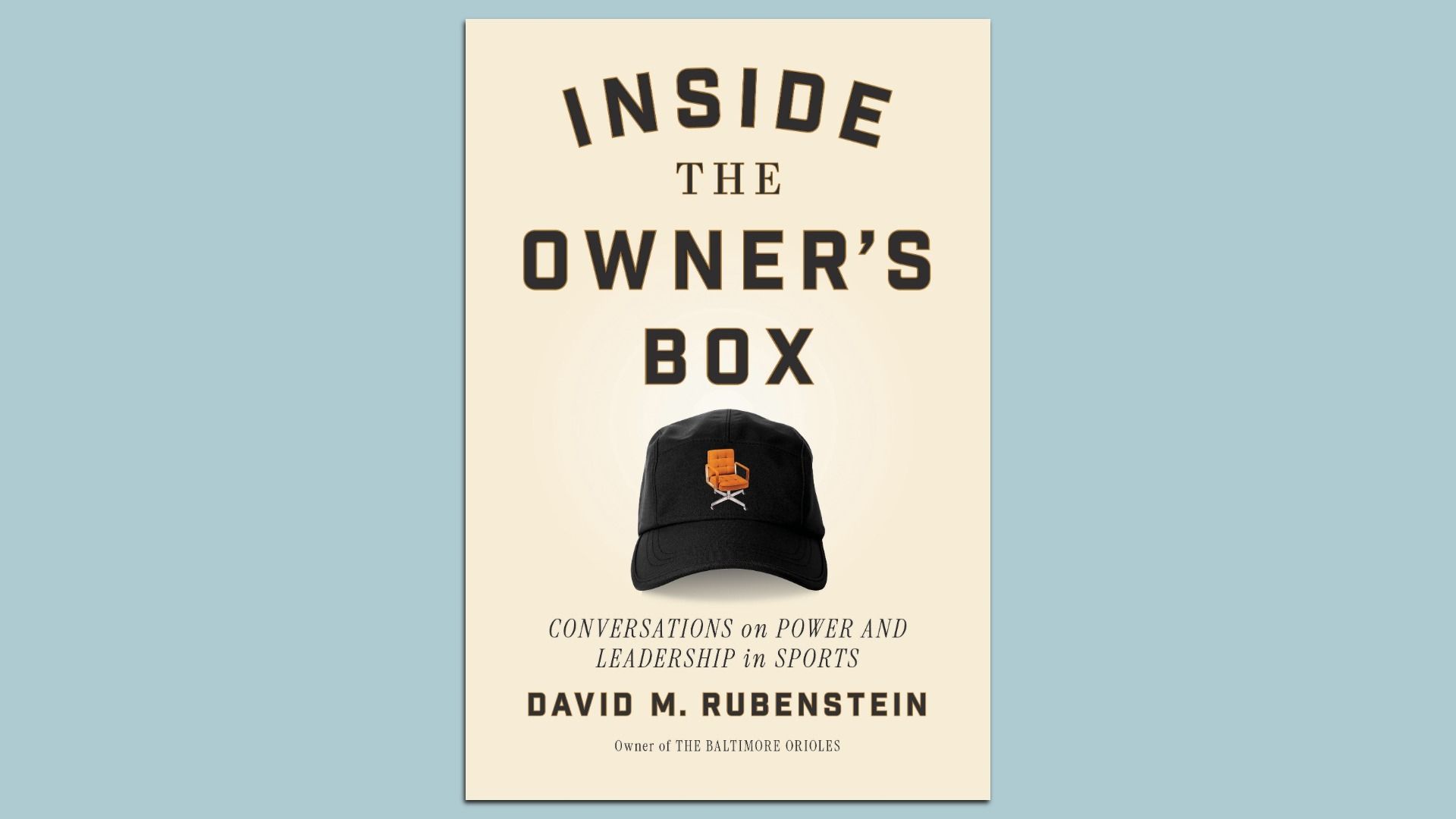
Baltimore Orioles owner (and Carlyle Group co-founder) David Rubenstein has a new book coming Sept. 22 on the high-stakes world of sports ownership: "Inside the Owner's Box: Conversations on Power and Leadership in Sports."
- It'll feature insights on dealmaking and leadership from 14 legendary owners across America's top leagues, including the New England Patriots' Robert Kraft, the Chicago Cubs' Tom Ricketts, the Brooklyn Nets' Clara Wu Tsai, the Philadelphia Eagles' Jeff Lurie, and Ted Leonsis of the Washington Wizards and Capitals.
Rubenstein also relates his own story of moving from finance to taking the helm of the Orioles.
- It's a great manual for early-career moguls: "How owners negotiate billion-dollar franchise acquisitions ... The financial playbook behind elite ownership — valuations, salary caps, private equity, and profit engines ... Mastering media rights, sports betting, and the evolving fan economy ... Building championship cultures that win on and off the field."
📬 Thanks for reading! Please invite your friends to join AM.
Sign up for Axios AM