Axios AM

July 18, 2026

1 big thing: AI race splits in two
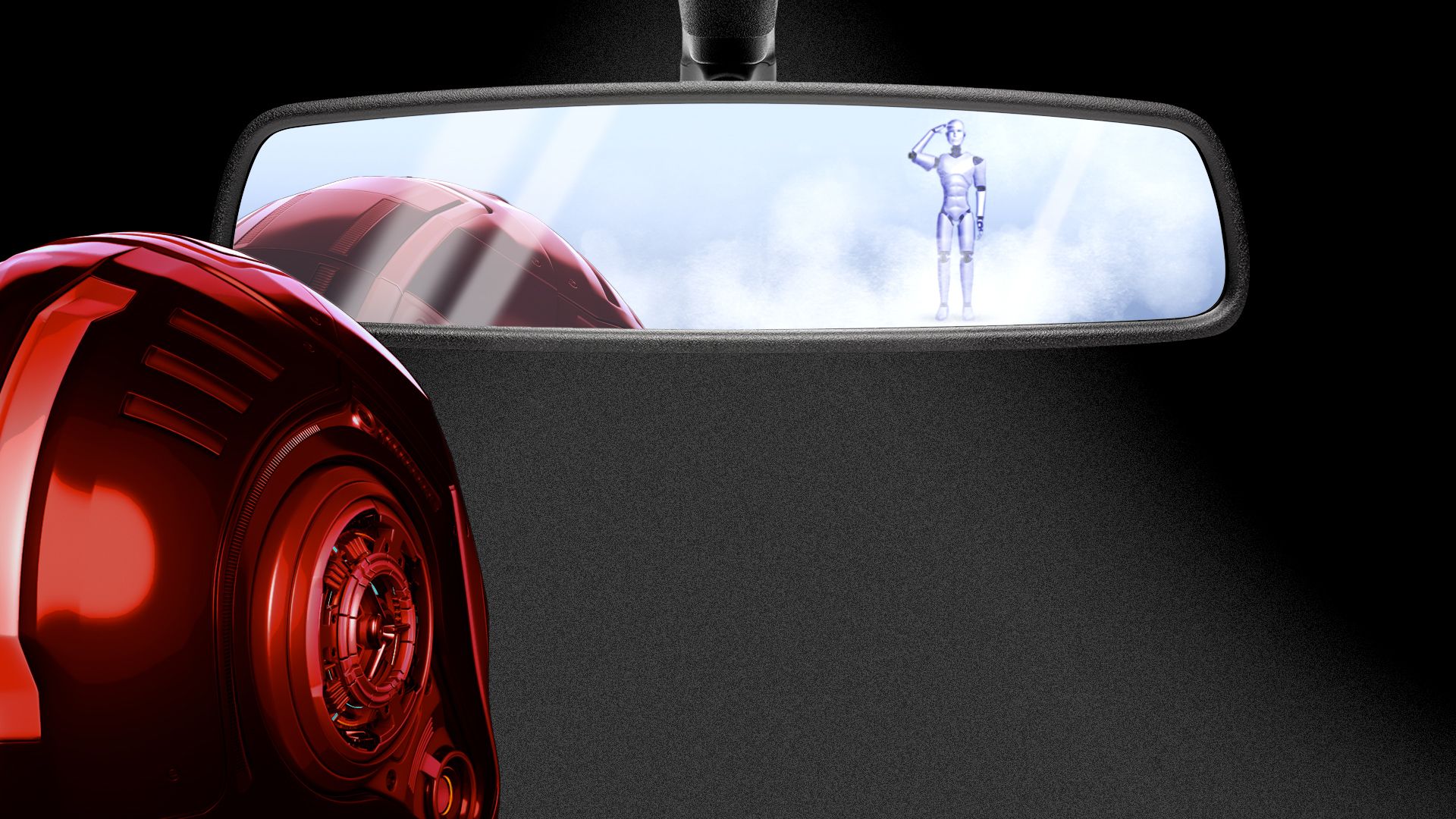
China's latest AI breakthrough is forcing Silicon Valley to confront a terrifying possibility: Building the world's smartest models may no longer be enough to win.
- Why it matters: Chinese labs, including Moonshot AI, are cornering the market for cheap, customizable intelligence, threatening to turn America's prestige models into expensive niche products, Axios' Madison Mills and Zachary Basu report.
⚡ Driving the news: Companies were already shifting away from premium AI models and toward cheaper Chinese alternatives before Moonshot's Kimi K3 exploded onto the scene this week.
- On OpenRouter — a major marketplace that lets developers access hundreds of competing AI systems — Chinese models now occupy the top five spots by weekly token usage.
- All five models — from China-based Tencent, Xiaomi, DeepSeek, MiniMax and Z.ai — are "open-weight," allowing users to download, customize and run them on their own systems.
👀 Between the lines: Most corporate AI work doesn't require the smartest model available.
- Businesses can use cheaper systems for routine coding, summarization, data extraction and customer service, reserving premium models for their hardest problems.
- An AI investor told Axios: "There are going to be open‑source models that eventually handle 95% of enterprise queries, and that remaining 5% may go to OpenAI or Anthropic."
The intrigue: Aghi Marietti — CEO of Kong, an API platform developer — told Axios that open-weight use has surged over the past quarter, since flagship models are "too expensive."
- Mozilla CTO Raffi Krikorian compared using frontier AI for everyday work to "driving a Ferrari to Whole Foods."
- For many routine tasks, he said, cheaper models are fast enough, capable enough and can cost up to 50 times less.
🚨 Threat level: Chinese models are advancing at astonishing speed, just as their lower prices and open weights make them easier to adopt.
- Anthropic CEO Dario Amodei said in May that China remained six to 12 months behind the U.S. in the most dangerous cyber capabilities.
- Ten weeks later, Moonshot released a model rivaling Anthropic's Fable and OpenAI's GPT-5.6 in key benchmarks — underscoring how quickly any American lead can shrink.
The other side: Some American companies are scrambling to fight back as China threatens to run away with open-weight AI.
- Thinking Machines, a startup launched by former OpenAI CTO Mira Murati, made its highly anticipated debut this week with an open-weight model built for deep customization.
- Nvidia is rapidly expanding its Nemotron family of open models, betting that customizable AI will drive more demand for the company's chips and software.
- SpaceXAI this week open-sourced Grok Build, the software behind its coding agent — extending the push for openness beyond the models themselves.
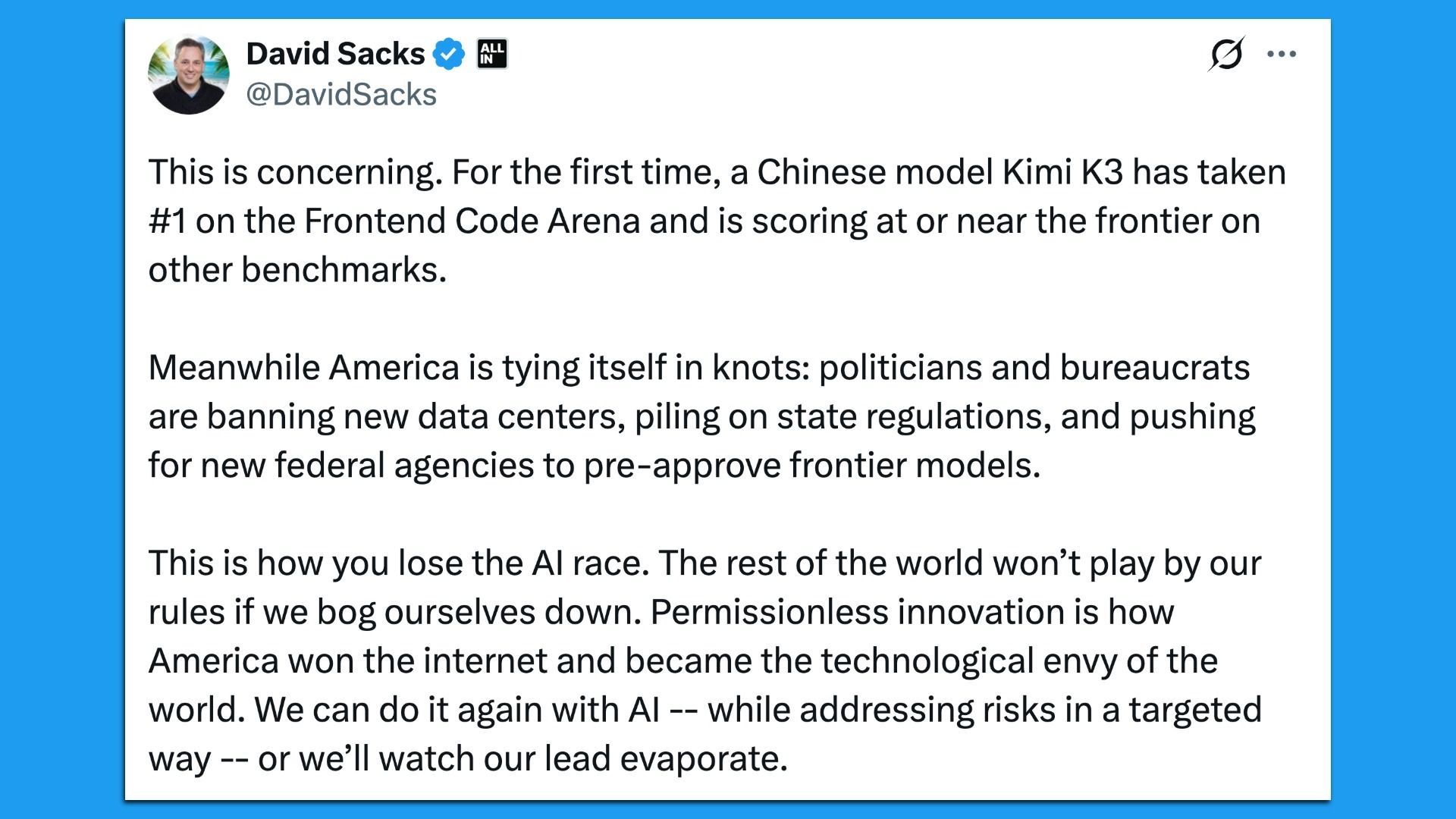
David Sacks — "All-In Podcast" co-host, top tech investor and White House AI adviser — told Axios in a statement after posting the above warning on X yesterday: "I believe the U.S. will win the AI race if we stick with President Trump's pro-innovation, pro-infrastructure, pro-energy and pro-export vision."
- "The danger is in abandoning that approach in favor of bureaucratic controls fueled by hysteria, fear, and companies seeking regulatory capture."
2. 📈 Small biz renaissance
3. 😶🌫️ Our smoky days


Hazy, polluted summer days, like Americans across the Midwest and Northeast continue to deal with this weekend, are rapidly becoming the new normal.
- The eastern half of the country has seen a steady increase in smoky days, with nearly half of 2023 recording at least light smoke.
The latest: President Trump is threatening to raise tariffs on Canada over the wildfire smoke that's drifted into the U.S., saying the "cost of this pollution must of necessity be added to the TARIFFS Canada is currently paying."
4. 🚧 Pic du jour

The White House's new helipad — which will be 100 feet in diameter and sport a presidential seal — is under construction on the South Lawn.
5. ⛽ Another reason gas stays high

6. 🥬 Taco Bell's parasite crisis
7. 🏟️ Priciest World Cup matches
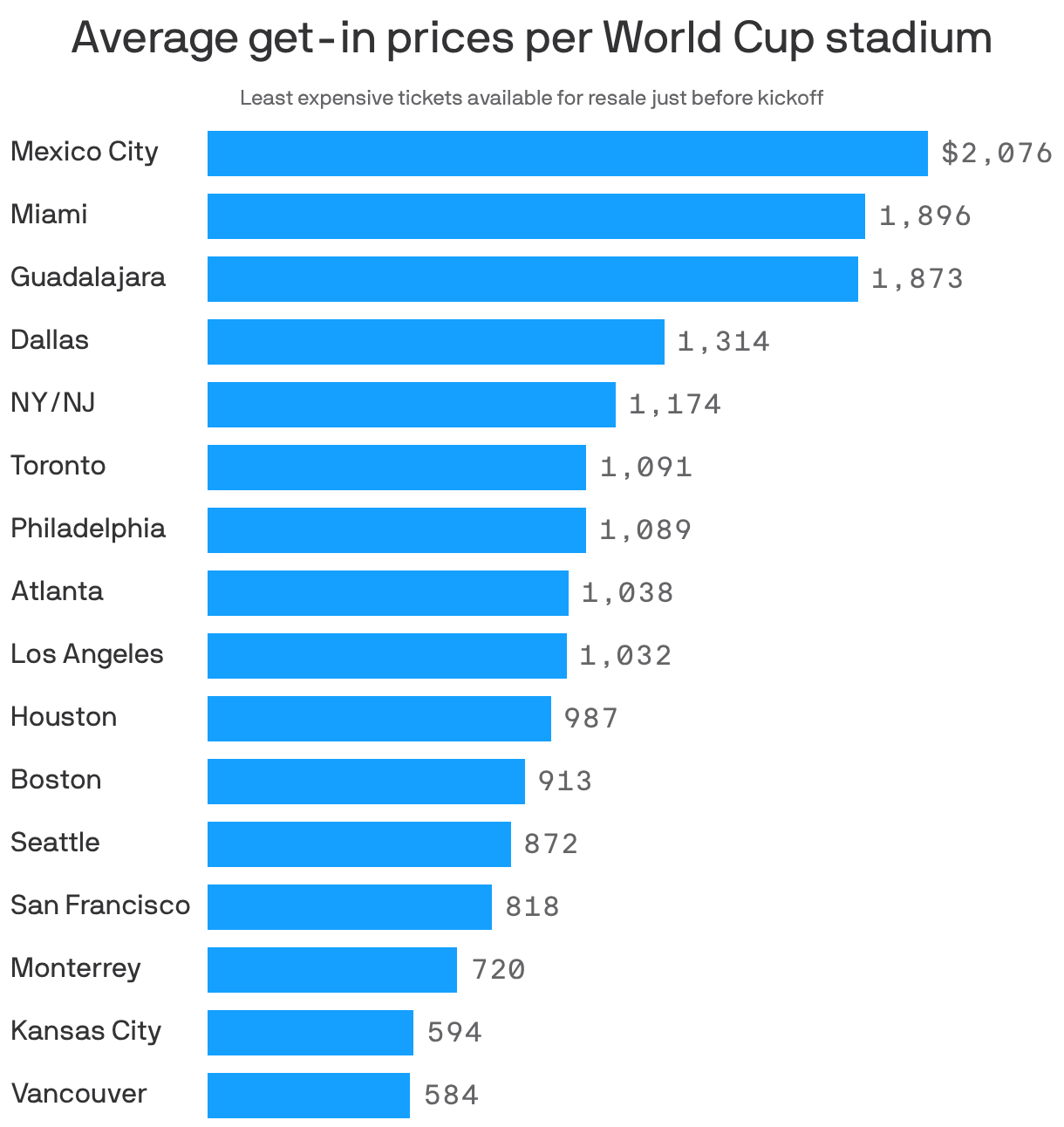
Some of the toughest World Cup tickets, per Axios' Brad Jennings via TicketData:
- Mexico. Three of Mexico's home matches ranked among the tournament's five most expensive. Each required at least $3,000 to get in.
- Argentina vs. England. The dramatic 2-1 semifinal in Atlanta on Wednesday carried a $3,560 get-in price.
- Scotland vs. Brazil. The June 24 Miami match drew a $3,382 get-in, amped by the boisterous traveling "Tartan Army."
8. ⚽ 1 for the road: "1 in a billion" photo

Almost two decades ago, photographer Joan Monfort didn't think much of his photo shoot of a teenage Lionel Messi bathing a cute baby boy in a plastic bathtub.
- Not until the remarkable twist of fate became clear years later, when that infant blossomed into Lamine Yamal.
Now those images of the long-haired Messi, his hands covered in soap suds as if anointing Yamal as soccer's Next Big Thing, have become the most talked about — and gawked about — in the run-up to tomorrow's World Cup final, when Messi's Argentina will play Yamal's Spain for the biggest trophy in the sport.
- "I have never been a believer or thought that anything was destined to occur, but I am beginning to have my doubts. This is beyond all reasonable explanations," Monfort told AP from his home in Barcelona.

How it happened: Luck dictated that Yamal's mother, who appears in the calendar photo, won a raffle of families in the city of Mataró, near Barcelona, who wanted to participate.
- Soccer destiny then deemed that her baby boy, who would become a star for Barcelona some 15 years later, was paired up with the Argentine who would become one of the greatest of all time.
Read a 2024 interview with Monfort about the "1 in a billion" photo (CNN).
Axios AM