Axios AM

April 05, 2025

Good Saturday morning. This Tariffs 101 special explainer edition was led by Axios executive editor Kate Marino, managing editor Ben Berkowitz and weekend editor Erica Pandey, and edited by Lauren Floyd.
- Smart Brevityโข count: 1,897 words ... 7 mins.
โกScoop: Israeli Prime Minister Benjamin Netanyahu plans to visit the White House on Monday, Axios' Barak Ravid reports.
๐ฎ Breaking: Nintendo said it's delaying preorders for the Switch 2 gaming device in the U.S. as it examines the potential impact of tariffs. Preorders won't start Wednesday, as planned, "to assess the potential impact of tariffs and evolving market conditions." Launch date of June 5 is unchanged. (Reuters)
1 big thing: Understanding the chaos

In one 48-minute speech, President Trump scrambled every American's budget, every U.S. company's balance sheet and every global alliance.
- Tariffs, a sometimes obscure economic tool, have massive power, especially when enacted this expansively, Axios' Zachary Basu and Erica Pandey write.
Why it matters: Think fundamental re-ordering of the economy. Americans are staring down a disruption to their standard of living. Companies are about to find out how bad bad can get. The ripple effects may be felt for years to come.
๐ก Trump's tariff revolution is rooted in a simple thesis: America has been humiliated and exploited by foreign nations for decades โ and only he has the guts to make them pay.
- Trump's personal victim complex has powered much of his political career. Now it's going global โ with the entire world, not just Trump's domestic enemies, feeling the weight of retribution.
๐ผ๏ธ The big picture: Never mind that the U.S. boasts the world's largest economy, most powerful military, record household wealth, and historically low unemployment.
- From uninhabited islands to impoverished enclaves, no country is too small, too irrelevant, or too loyal to escape the wrath of a president who believes America has been cheated for decades.
๐ฎ๐ฑ That includes Israel, where officials were shocked to face a 17% reciprocal tariff despite removing their own tariffs on the U.S. a day prior.
- ๐ฑ๐ธ It includes Lesotho, a tiny African nation where most people are too poor to import American goods, and which is now facing an existential crisis because of Trump's 50% tariff.
- ๐ฆ๐บ It even includes the volcanic Australian territory of Heard Island and McDonald Islands, whose population of mostly penguins was punished with a 10% tariff.
๐ญ Zoom out: Trump is right that plenty of countries engage in unfair trade practices, and that globalization has hollowed out key parts of America's industrial base.
- ๐จ๐ณ China, the world's second-largest economy, has a long record of trade abuses: IP theft, forced technology transfers, state subsidies and market access restrictions for foreign companies.
- ๐ช๐บ The European Union doesn't cheat the way China does. But it protects its own through generous agricultural subsidies and strict regulatory standards that often double as trade barriers.
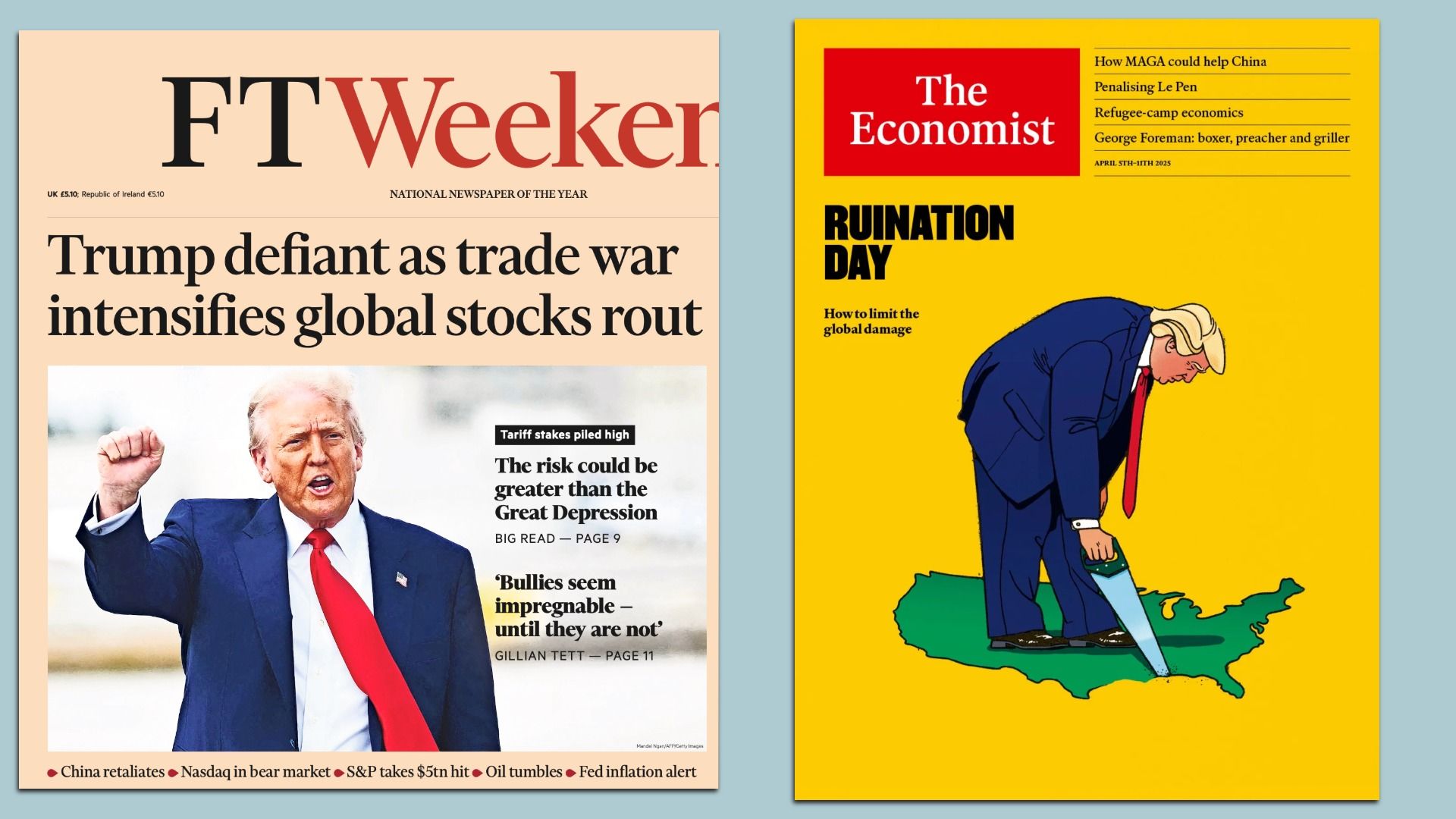
๐ฅ Reality check: That cost will likely be steep.
- Trump is inviting American factories to rise up and fill the demand for goods that consumers and companies get from other countries โ but factories can't do that overnight, if at all.
- In the 1970s, a quarter of Americans worked in manufacturing. Now, less than 10% do. Recruiting and training a manufacturing workforce will take time and money.
- One big reason the U.S. has trade deficits is that we spent decades becoming a services economy, with the economic might to make our goods more cheaply elsewhere and buy lots of them.
๐ฎ What to watch: Whether the Trump administration does anything to offset the pain.
- Tariffs will bring in some money themselves (the administration says up to $600 billion a year, which would cover about a third of the U.S. budget deficit). And Trump still wants to cut taxes โ not just extending his 2017 cuts, but new reductions on things like overtime and tips.
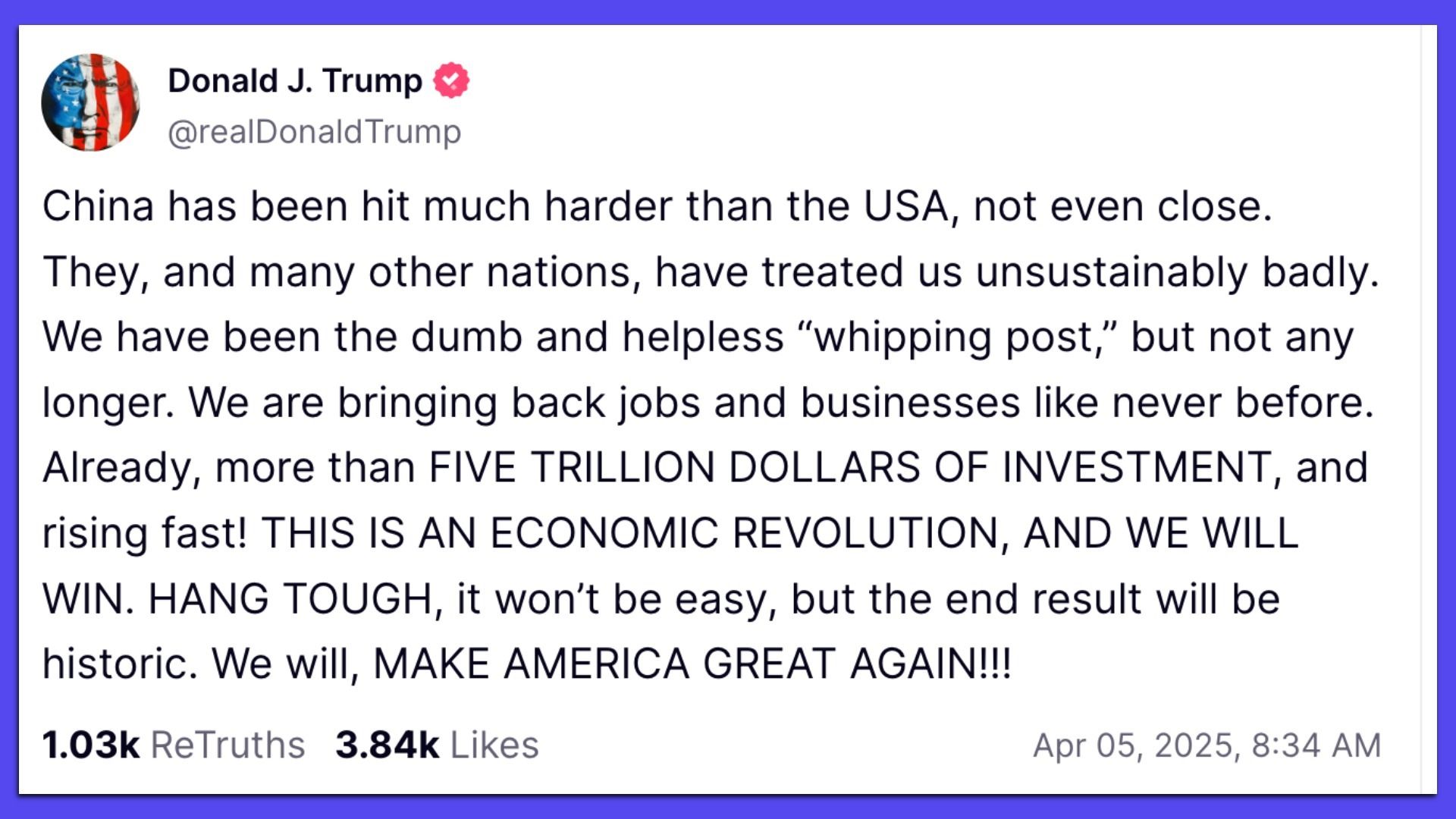
Trump this morning: "THIS IS AN ECONOMIC REVOLUTION."
2. ๐ Tariffs 101
Axios chief economic correspondent Neil Irwin breaks down the basics:
- ๐ข What's a tariff?
A tariff is a tax on imported goods. When a ship full of bananas or T-shirts or Toyotas arrives at a U.S. port, part of the paperwork for crossing the border is paying the applicable tariff.
2. ๐ When did America start using tariffs?
From the colonial era through the early 1900s, tariffs were the predominant source of the federal government's revenue.
- Taxes on imports were relatively easy to enforce even in the days before computers, Social Security numbers, and the like. When a ship arrived at a port, customs officers could inspect the goods, charge the appropriate tariff, and ensure tax compliance.
- The Constitution limited the federal government's taxing authority. So a modern income tax wasn't legally permissible until the enactment of the 16th Amendment in 1913.
3. ๐ฐ Why did the government back off of tariffs?
This reliance on tariffs had deep-seated problems, which is why their use has been mostly in retreat over the last century.
- They disadvantaged agricultural interests and other U.S. exporters, as other countries put in place corresponding barriers to trade.
- The tax burden disproportionately fell on lower-income people, who spend a bigger share of their money on basics than the rich.
- Tariffs didn't raise nearly enough money to pay for a modern government, with a large military, social welfare programs like Social Security and Medicare, and the like.
When the world economy stumbled in 1930, nations rushed to implement tariffs in hopes of bolstering domestic industry, particularly the Smoot-Hawley Act in the U.S. Mainstream economists view this cascade of protectionism as a key part of why that episode became the Great Depression.
- Based on those lessons, and as part of a broader effort to knit together the economies of the world's democracies in hopes of ensuring lasting peace, the U.S. and other advanced nations spent the postwar era gradually removing tariffs and other trade barriers.
4. ๐ง Then why do we still have ANY tariffs?
Even in the heyday of free trade enthusiasm, tariffs didn't move to zero.
- In recent years, tariffs have been relatively low โ down to 1.5% in 2017, after decades of bipartisan efforts to craft global trade deals. Trump then pushed those up to around 3% in his previous term (which President Biden mostly maintained).
The policies announced so far in Trump's current term are on track to push the average tariff to 22.5%, per the Yale Budget Lab.
- If the new tariffs announced this week stand, America's average tariff burden will be higher than nearly any living human has seen โ higher than they were in the Smoot-Hawley era and roughly at 1909 levels.
5. ๐ How can Trump impose tariffs if that's part of Congress' authority?
In his first term, Trump's tariffs came with careful legal limitations and a process for companies to seek exclusions โ and their total scale wasn't enough to have much effect on the overall U.S. economy.
- This time is different. Trump is implementing tariffs at a scale an order of magnitude higher, on every country on earth and nearly all goods, and by invoking an emergency authority never used for this purpose.
6. ๐๏ธ When can I expect prices to go up?
U.S. companies have been scrambling to import goods before tariffs hit to postpone the blow. But price hikes could come just days later if these tariffs go into effect Wednesday as planned.
3. ๐ Pocketbook pain

Tariffs will likely increase the prices of necessities like food, clothing and cars, Axios' Emily Peck writes.
- That's the view of the Fed chair and most economists (even most on the right), and The Wall Street Journal editorial page: "There will certainly be higher costs for American consumers and businesses. Tariffs are taxes, and when you tax something you get less of it."
๐ธ By the numbers: The tariffs hit to earning power amounts to an average 2.3% "pay cut," or decrease in disposable income, for every American household, according to a widely cited estimate from the Yale Budget Lab.
- That translates to $3,800 a year.
4. ๐พ Case in point: Owning a mill
Megan Murphy โ a former journalist who owns La Crosse Milling Company, which processes grains for food ingredients and animal feed in Cochrane, Wis. โ tells Axios' Courtenay Brown:
- "I don't think there's a single small U.S.-based agricultural company that thinks this is a good long-term strategy for building manufacturing competitiveness."
- "There isn't the capacity, knowledge, nor the facilities, to have American manufacturing compete on this scale over a 10-year horizon, let alone one."
5. ๐จ Market meltdown


With the historic two-day rout Thursday and yesterday, the major indices โ the S&P 500, the Nasdaq and the Russell 2000 โ are all lower than a year ago, Axios' Ben Berkowitz writes.
- The market capitalization of the S&P stocks fell $4 trillion this week. So your 401(k), your kids' 529 college savings and your nest egg are all a lot smaller than three days ago.
๐ญ Zoom out: All three touched all-time highs in the last six months.
- Now, the tech-heavy Nasdaq and the small-cap Russell are in a "bear market" โ 20% off their highs โ and poised to fall further.
- The S&P is down 17.4% from a new record in mid-February.
6. ๐ผ Corporate nightmare
When everything gets more expensive everywhere, that starts a cycle that can include higher prices, layoffs and even bankruptcies. Three business glimpses from Axios' Ben Berkowitz:
- Electronics trade group IPC estimates the cost of critical components coming from overseas will rise 30% to 50%. Even if you're already manufacturing domestically, the parts you need from somewhere will get expensive, quickly.
- Automaker Stellantis (Chrysler, Dodge, Jeep) paused production at multiple factories and laid off hundreds of people.
- Irrigation company Lindsay Corp. said the tariffs would increase its cost of goods, which it would pass through to customers. Those customers are farmers, who are getting squeezed by foreign retaliatory tariffs on U.S. goods.
7. ๐ค Tariff math


Axios AM reader question: "Is there any defensible reason why a country would impose a tariff on us but we shouldn't on them? I understand what a tariff is, and I understand the impact it has. But I really don't understand how other countries have tariffs on us, and we don't immediately have a tariff on them?"
There are lots of reasons why rich countries in particular don't like imposing tariffs on their trading partners, regardless of what those partners do in the other direction, Axios chief financial correspondent Felix Salmon writes.
- The main reason is that tariffs are a tax, which is payable by the companies importing goods. That tax is invariably passed on to consumers, in one form or another. Since neither companies nor consumers like paying taxes, they generally push for lower tariffs.
๐ How it works: Consider India. As it happens, the country produces a lot of things of use to Americans, including pharmaceuticals.
- The U.S. would like its medications to be as cheap as possible, so it levies no tariffs on, for example, imports of some antibiotics from India.
- But India charges a 10% tariff on U.S. exports in the same category.
- In the end, whatever India decides to do in its pharmaceutical market, it's to the benefit of Americans to treat their infections as inexpensively as possible.
8. ๐ท Parting shot: Microsoft icons

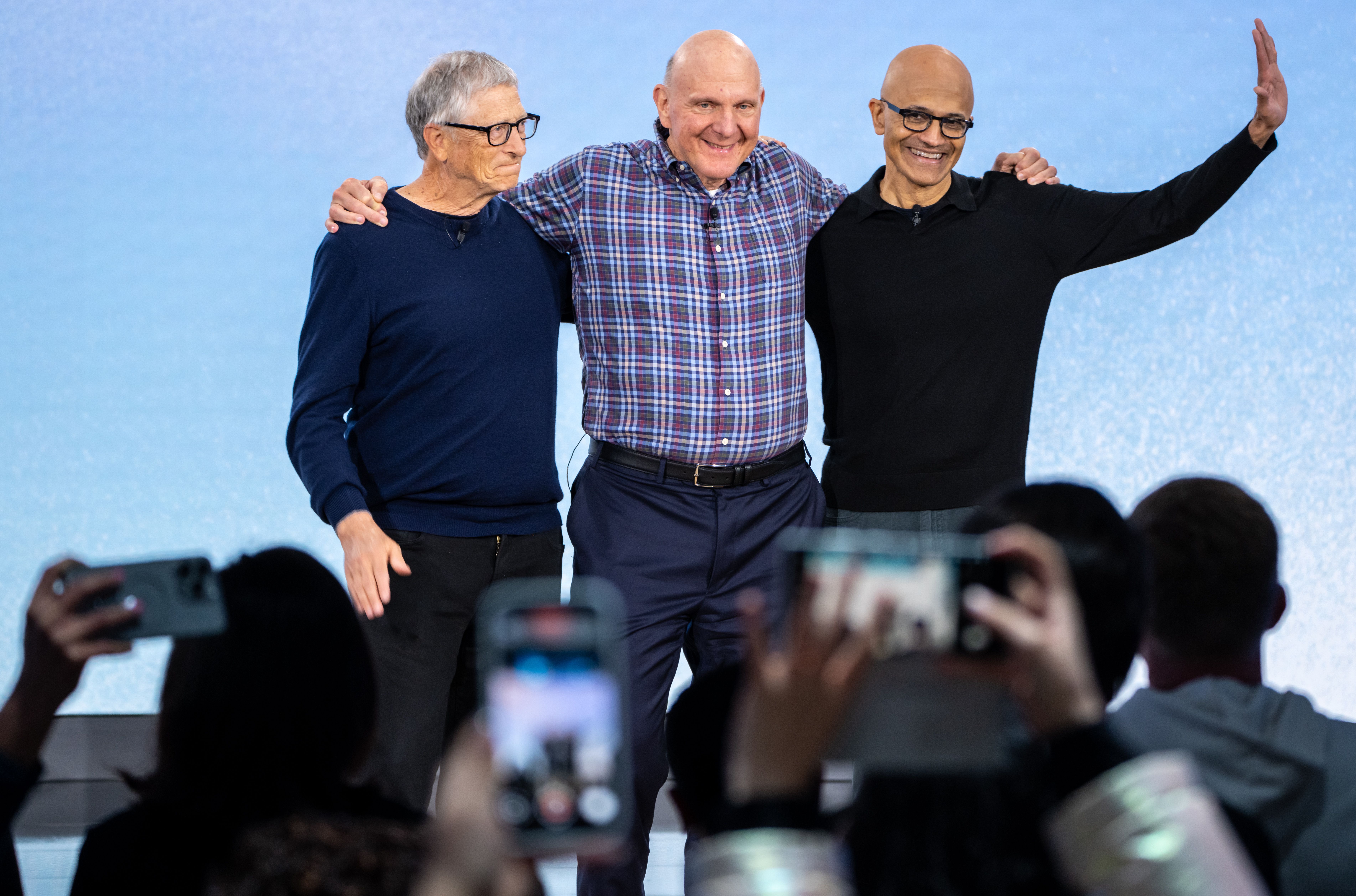
Microsoft's only three CEOs โ co-founder Bill Gates; his successor, Steve Ballmer; and the incumbent, Satya Nadella โ celebrate the company's 50th anniversary yesterday in Redmond, Wash.
๐ฌ Thanks for reading! Please invite your friends to join AM.
Sign up for Axios AM