Axios AM

December 01, 2025

βοΈ Good Monday morning, and welcome to December! Check out Kelly Tyko's guide to Cyber Monday.
- Smart Brevityβ’ count: 1,484 words ... 5Β½ mins. Thanks to Noah Bressner for orchestrating. Edited by Andrew Pantazi. Copy edited by Bill Kole.
Situational awareness: President Trump told reporters on Air Force One he "wouldn't have wanted" a second strike on survivors clinging to the wreckage of a suspected drug trafficking boat in the Caribbean, but added that "Pete [Hegseth] said he did not order the death of those two men."
1 big thing: Volatility vortex
Every president back to Bill Clinton enjoyed full party control of Congress and fantasized about lasting, durable governing dominance, Jim VandeHei and Mike Allen write in a "Behind the Curtain" column.
Why it matters: Nothing captures the volatility of American politics better than this win-big, lose-quick phenomenon. It's like a new law of political gravity: What the swing voter giveth, the swing voter abruptly taketh away.
- President Trump would need to defy gravity to avoid the same fate that hit him during his first term β¦ and hit Joe Biden β¦ and Barack Obama β¦ and George W. Bush β¦ and Bill Clinton.
πΌοΈ The big picture: We've been telling readers for a decade to expect whiplash political volatility for the foreseeable future. This makes business planning more difficult because the regulatory, political and economic policy environments shift so quickly and dramatically.
Both parties are prisoners to three stubborn political dynamics and realities:
- America is roughly a 33-33-33 nation. Roughly a third of voters are die-hard Democrats, and another third are die-hard Republicans. The other third (or slightly more) are perpetually open-minded and persistently dissatisfied with the new party in power. This dynamic has held firm for most of the past 30 years and shows no obvious signs of shifting. Almost every election since Clinton has flipped control of the White House or Congress.
- The number of truly competitive House races is shockingly small β roughly 10% of the 435 House seats, give or take. You can thank redistricting at the state level for meticulously chopping the nation into safe havens for very partisan Republicans or Democrats. That means the most important races are often primaries, where voter turnout is low and dominated by activists. Hence, the dominance of hyperpartisans.
- Big new policies take years to work their way into Americans' actual lives. Trump's tax cut bill, or Biden's infrastructure and green energy laws, or Obamacare were all substantial wins for the party in power. But any benefits usually take longer for voters to feel than the time left in a two-year election cycle.
So, like clockwork, a new party wins power, feels invincible, believes it'll defy gravity, obsesses about those hyperpartisans who vote in primaries β and ticks off both swing voters and the activists on the other side. And then loses again.
ποΈ What we're watching: The American electorate is so volatile that there are now scenarios in which the GOP could lose its House majority even before next year's midterms.
- We told you last week that rising security fears, and even death threats β along with MAGA infighting β are fueling the once-unthinkable conversation among House Republicans about quitting Congress early.
In a Gallup poll out Friday, Republican approval of Congress is an atrocious 23% β halved from a pre-shutdown 54% in September, and down from 63% in March.
- β¬οΈ Column continues below.
2. π Part 2: Watch that pendulum

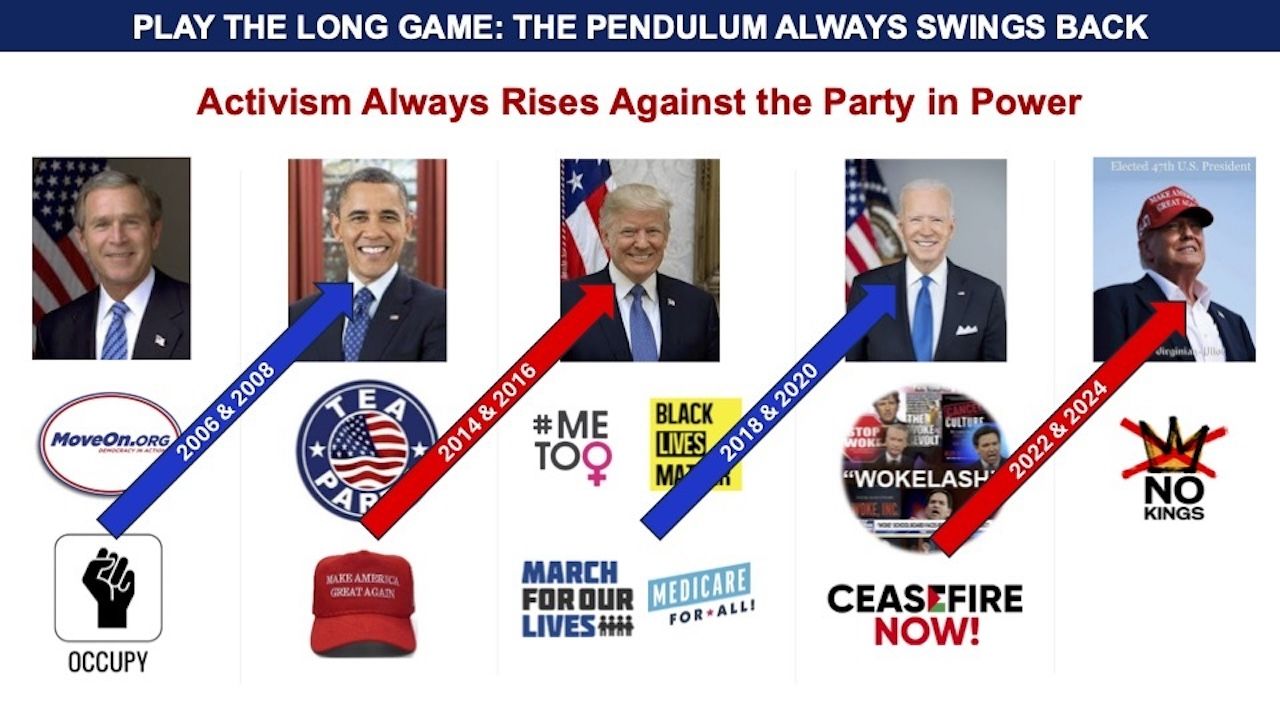
This thought-provoking graphic β part of the 100th issue of strategist Bruce Mehlman's always-useful "Six-Chart Sunday" β reminds America's powerful that they and their ideas could be on the outs soon enough, Jim and Mike continue.
- Mehlman reminds us that so far this century, 11 of 13 U.S. elections were "change elections," in which voters tossed out the party controlling the House, Senate or White House β a volatility streak unseen since the late 1800s, during the Gilded Age.
π₯ Flashback: In a column back in February, we reminded Republicans of the "payback precedent": "Copy the payback, punishments and precedent-shattering techniques practiced by the other party β if they prove effective. ... Republicans should fully expect future Democratic presidents to use and build on all [President Trump's] norm-busting moves."
- And back in June, Zachary Basu helped us chart the 10 "unprecedented new precedents" for presidential power that House and Senate Republicans have enabled.
The bottom line: Trump might be different. But that's what first-term Trump β and Biden, Obama, Bush and Clinton β all thought, too.
3. β‘ Putin peace talks tomorrow

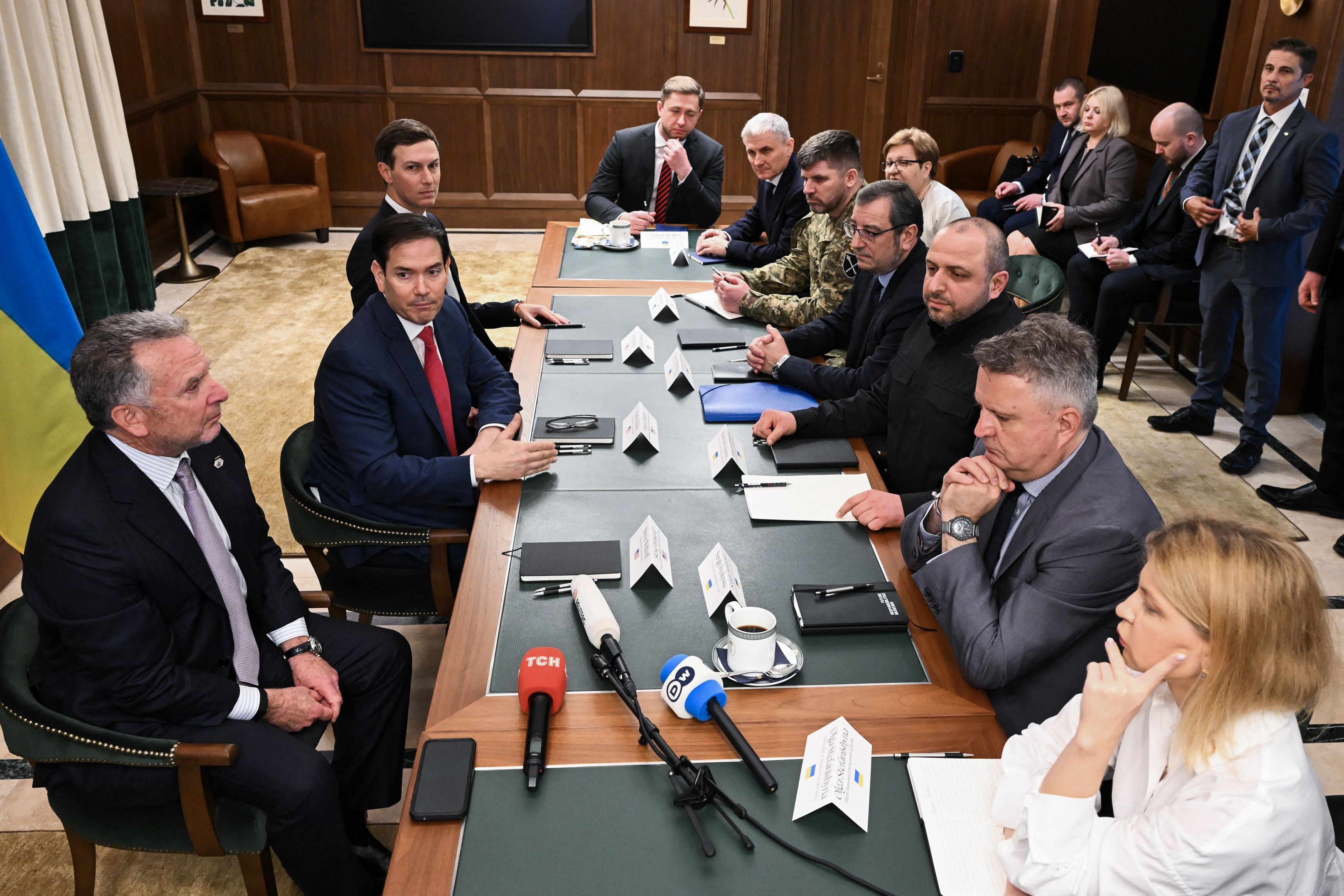
Negotiations between the U.S. and Ukraine yesterday outside Miami focused on where the de facto border with Russia would be drawn under a peace deal, two Ukrainian officials tell Axios' Barak Ravid.
- They described the five-hour meeting as "difficult" and "intense" but productive.
Why it matters: Russian President Vladimir Putin β who's expected to meet with President Trump's envoy tomorrow β insists Russia won't stop until it controls the entire Donbas region in eastern Ukraine.
- The U.S. wants Ukraine to hand over territory there to convince Putin to make peace, but that would be a painful and politically explosive concession.
π Behind the scenes: The U.S. side arrived at the meeting, held at U.S. envoy Steve Witkoff's exclusive Shell Bay golf club near Miami, hoping to make progress on the territory issue, which Witkoff could then present to Putin in their meeting.
- Witkoff plans to depart for Moscow today.
4. βοΈ Bill Gates' dim-the-sun scenario
Bill Gates says he would support deploying artificial cooling technologies to lower global temperatures β but only if the planet hits so-called climate tipping points, national energy correspondent Amy Harder writes in Axios Future of Energy.
- Why it matters: The Microsoft co-founder and philanthropist is a major funder of research into this controversial technology. His comments in a recent interview with Axios are among his most expansive yet.
π Zoom in: Gates said the world is largely on track to avoid the worst climate impacts thanks to rising clean-energy deployment.
- But he emphasized there's still an outlier chance of especially dire consequences driven in part by tipping points: You "would then need to reach for some other type of intervention."
When asked whether that meant geoengineering, Gates replied: "Yes, I've been a funder of trying to understand geoengineering."
- Much of his funding isn't publicly disclosed, but what is known includes past support for Harvard University's solar geoengineering program.
π‘ How it works: Solar geoengineering aims to cool the planet by reflecting sunlight.
- The most-discussed method involves injecting sulfuric-acid particles into the upper atmosphere, mimicking the cooling effect of volcanic eruptions.
5. π° Wall Street's 2026 winners
Wall Street thinks 2026 winners will be repeats of this year: gold and Big Tech, Axios Markets author Madison Mills writes from a Goldman Sachs survey of 900+ clients.
- Gold has surged to record highs this year. Nearly 70% of Goldman's investors expect prices to rise more by the end of 2026.
44% say they expect tech, media, and telecom stocks to outperform in 2026 β the highest of any sector.
6. β οΈ New smartphone warning
Preteens who own smartphones are likelier to have depression, obesity and insufficient sleep than their peers, Axios' Maya Goldman writes from a new University of Pennsylvania-led study.
- Why it matters: Roughly half of American kids now own a smartphone by the time they turn 11.
π¬ What they found: Kids who owned a smartphone at age 12 were found to have about 30% higher odds of depression, 40% higher odds of obesity and 62% higher odds of insufficient sleep than their peers who didn't have one.
7. πΏ "Zootopia 2" shatters records

Disney's "Zootopia 2" brought in roughly half a billion dollars over the weekend, making it the highest global animated box office opening of all time and the biggest global debut of the year, Axios' Sara Fischer writes.
- Why it matters: Huge openings for "Zootopia 2" and "Wicked: For Good" have helped the domestic box office recover from what has otherwise been a slow year for big hits.
"Zootopia 2" brought in $96.8 million over the weekend domestically and $400.4 million internationally, for a $497.2 million global total, Comscore estimates.
- Across the five-day Thanksgiving holiday weekend, the film earned $156 million domestically and $556.4 million globally.
π¬ Stunning stat: Those numbers make it the fourth-highest global movie opening of all time β after "Avengers: Endgame," "Avengers: Infinity War" and "Spider-Man: No Way Home."
8. π 1 for the road: Word of the year
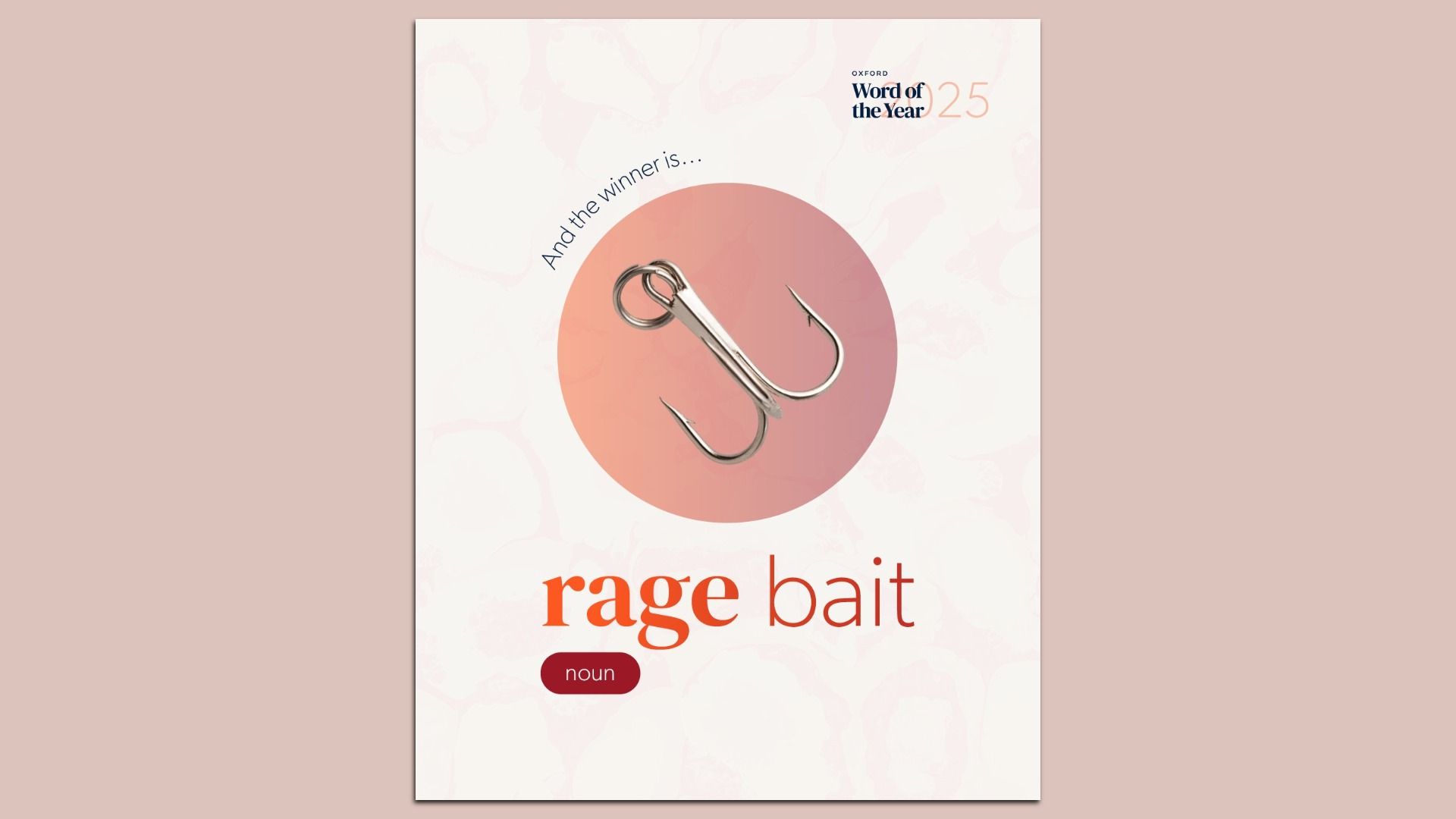
"Rage bait" is Oxford University Press' word of the year, Axios' Rebecca Falconer writes.
(n.) Online content deliberately designed to elicit anger or outrage by being frustrating, provocative, or offensive, typically posted in order to increase traffic to or engagement with a particular web page or social media account.
The term has seen a "three-fold increase in usage" over the past year, according to the publisher.
π¬ Thanks for reading! Please invite your friends to join AM.
Sign up for Axios AM