Axios AM

July 19, 2025

Happy Saturday! Smart Brevity™ count: 1,494 words ... 5½ mins. Thanks to Erica Pandey for orchestrating. Edited by Andrew Childers.
😳 Coldplay aftermath: Astronomer CEO Andy Byron and chief people officer Kristin Cabot have been put on leave pending an investigation, after their viral kisscam canoodling, Axios' Eleanor Hawkins scoops.
- The Phillie Phanatic reenacted the jumbotron moment. Watch here.
1 big thing: Tariff chaos makes Wall Street rich

Market volatility spiked in the second quarter of 2025, after tariff policy chaos fueled a selloff in stocks.
- But Wall Street got rich. Goldman Sachs raked in its best trading revenue in history, Axios' Madison Mills reports.
Why it matters: The record quarter tells investors they don't necessarily need to fear the market's down days — which are often close in proximity to the best days.
💰 By the numbers: Goldman's equity trading desk generated $4.3 billion in revenue, a 36% jump from a year prior.
- That beat the street's expectations by over $600 million.
Morgan Stanley's equity revenue came in at $3.7 billion, up from $3 billion a year prior.
- Citigroup's trading revenue increased 16% from the prior year.
How did Wall Street do it? While this isn't an exhaustive list, here are some of the strategies discussed on earnings calls:
- 🌐 Equity intermediation, otherwise known as being the middleman between institutional buyers and sellers.
- 💼 Portfolio financing, or lending to big-money clients.
- 💸 Volume — a lot of clients wanted to position themselves well amid volatility.
But it's not just the banks that won this quarter.
- Retail investors were rewarded for staying invested, rather than selling, when stocks initially plummeted after Liberation Day. That's because the market is now up about 26% since it bottomed in April.
🔭 Zoom out: A trade war-stunted economy remains something forecasters hand-wring about, but it's not the reality on the ground, Axios' Courtenay Brown reports.
- American consumers are spending freely, unemployment filings are low, and executives feel more optimistic about business prospects.
It doesn't look like an economic boom time, but it's also not the stagnation that looked possible just months earlier.
2. 🏦 Here come stablecoins
President Trump signed the GENIUS Act into law, which means many mainstream banks will soon try to make stablecoins a part of everyday life, Axios Crypto author Brady Dale writes.
- A stablecoin is a cryptocurrency pegged to a stable asset like the dollar.
Why it matters: With clear legal guidelines for the most promising blockchain application, many companies are going to jump into the business.
The big picture: There are two ways stablecoins might improve everyday lives.
1. 💰 Savings. On exchanges like Coinbase and apps like Paypal, users can buy stablecoins with dollars and earn 4% interest on their money (for now). That blows away bank savings rates.
- Yes, but: While your deposits won't be lent out like banks do and are 100% reserve-backed, they don't have FDIC insurance.
2. 🛍️ Shopping. Osama Bari, with the D24 Fintech Group, predicts instant rebates could come soon for stablecoin transactions. So a consumer might get an instant $2 back on a $100 watch. That's partly because retailers don't pay interchange fees when they get paid with stablecoins.
3. 🥊 Trump's toughest opponent
An aggressive pressure campaign forced President Trump to flinch on the Jeffrey Epstein case — exposing a rare moment of weakness inflicted not by his enemies but by his most loyal supporters.
- Why it matters: Forget resistance mounted by Democrats, moderate Republicans or even the courts. The most destabilizing opposition of Trump's second term has come from within: an online MAGA army known for its extreme devotion, Axios' Neal Rothschild writes.
⚡ After nearly two weeks of blowback, fueled in large part by MAGA influencers, Attorney General Pam Bondi yesterday asked a judge to unseal the Epstein grand jury transcripts in response to Trump's request.
- Though the move is unlikely to produce new evidence — and falls far short of the sweeping disclosures demanded by his base — it still marked a clear shift in posture.
Zoom in: Six months in, Trump has steamrolled his traditional opposition.
- He enacted his crowning legislative priority, breaking the rebellious Freedom Caucus and neutralizing skittish Republicans worried about deficits and Medicaid.
- Congressional Democrats have resorted to increasingly dire alarms as their approval rating plummets to an all-time low.
- The Supreme Court dashed one of the most significant checks on Trump's power by limiting lower courts' ability to block his policies through nationwide injunctions.
- Inside the administration, key watchdogs have been replaced by loyalists.
Between the lines: Trump's dominance makes it all the more extraordinary that his typically unconditionally loyal base is pushing back on everything from the Middle East and Ukraine to immigration and Epstein.
⚖️ The latest: Trump filed a lawsuit for $10 billion against the Wall Street Journal and Rupert Murdoch, accusing WSJ of defaming him with an article about a lewd birthday letter to Epstein the outlet said bore Trump's signature. Read the lawsuit.
4. 🥩 Beef gets pricier


Beef prices are at record highs, and industry experts tell Axios they could stay that way into 2026 and beyond.
- Why it matters: Meat's high price tag is squeezing grocery budgets at the height of grilling season, Axios' Kelly Tyko reports.
💰 By the numbers: Ground beef averaged $6.12 a pound in June, up nearly 12% from a year ago, according to federal data released this week.
- Steak prices jumped 8% year-over-year, per the latest Consumer Price Index.
America's beef supply chain is being strained from multiple angles. A multi-year drought shrank cattle herds, and global imports are under threat — but consumer demand remains strong.
- The number of farms in the U.S., including ranches, declined by 7%, or 141,733 farms, between 2017 and 2022, the latest Census of Agriculture notes
🍳 This spring, Waffle House and Denny's dropped egg surcharges as egg prices fell. Go deeper.
5. State, local officials want to ban ICE masks

A growing number of Democratic-leaning states and cities are weighing proposals to ban federal immigration agents from wearing masks and to require them to display IDs when making arrests.
- Why it matters: Images of masked, armed agents in plain clothes grabbing people off the streets have alarmed many Americans — and put pressure on lawmakers to respond, Axios' Russell Contreras reports.
Zoom in: Democrat-led state legislatures in California, New York and Massachusetts are discussing or have introduced bills that would ban agents from wearing masks in most operations.
- Meanwhile, local leaders in Chicago, Albuquerque and several southern California towns are considering proposals to ban masks and require IDs.
6. 🩺 Patients' double punch
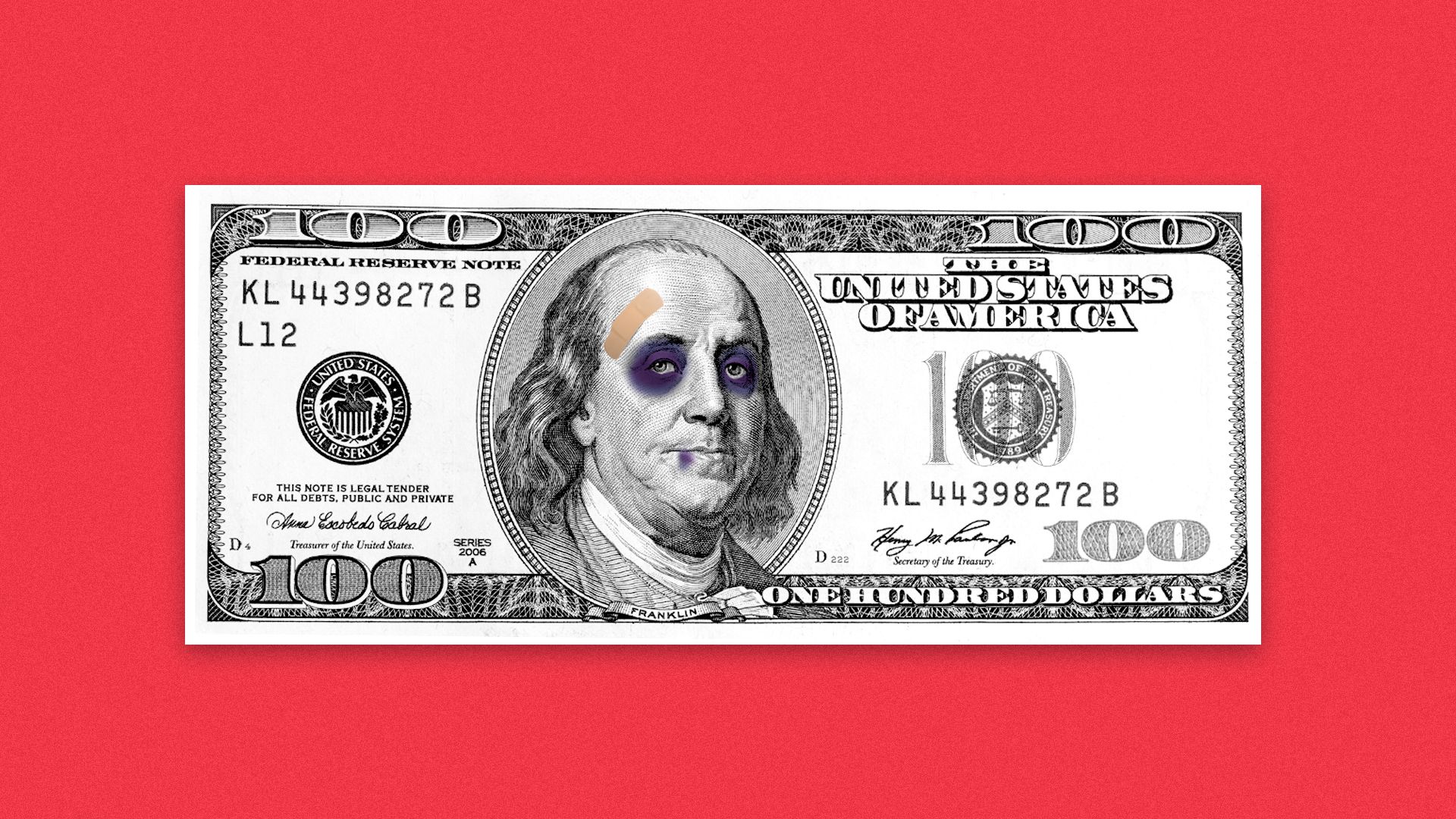
Millions of low-income Americans, already worried about losing their health insurance, now face lower credit scores, Axios' Emily Peck reports.
- The Trump administration last week got a federal court to toss a Biden-era rule that would have removed medical debt from people's credit reports.
- At the same time, cuts to Medicaid and the Affordable Care Act in the "big, beautiful bill" will likely mean people pay more for health care.
That means a single medical setback could crater credit scores, if it leads to unpaid bills that wind up in collection.
- Other debts are also about to show up on credit reports, including delinquent student loans, after a years-long pause, and buy-now, pay-later purchases.
🔎 Follow the money: Some argue that it's a win for consumers who pay their bills on time to have more information on their credit reports.
- But the more data the credit agencies have about people, the more potential there is that consumers get hurt by negative information, says Chi Chi Wu, an attorney at the National Consumer Law Center, which was on the losing side of the debt ruling.
7. 🤖 Flirting with bots
More singles are getting romantic with an AI bot, Axios D.C.'s Mimi Montgomery and Sabrina Moreno write from Match data.
- There's been a 333% jump in AI use in dating compared with last year, Michael Kaye, communications director at Match Group, tells Axios.
🏙️ By the numbers: Denver and Salt Lake City tied for top, with 33% of single respondents in those cities saying they've interacted with an AI companion.
- D.C. came next with 28%. Single men and Gen Z-ers were the likeliest to have interacted with bots.
Between the lines: Match defines "interacting with an AI companion" as chatting with a bot romantically, or using AI to help craft a dating profile and send messages.
8. 🎶 1 for the road: 10 years of "Hamilton"

"Hamilton" premiered on Broadway a decade ago on Aug. 6 — and Lin-Manuel Miranda plans to use the 10th anniversary of his award-winning cultural phenomenon as a fundraiser for immigration services.
- "Hamilten" (!) packages for the Aug. 6 performance at Broadway's Richard Rodgers Theatre are expected to raise about $3 million for the Immigrants: We Get the Job Done Coalition, which includes 14 nonprofits.
Alexander Hamilton's "narrative in our country kind of mirrors that of an immigrant story," Miranda told AP. "He did not grow up here. He didn't come from England. He came from the Caribbean, escaping harsh circumstances."
- "And he really helped shape this country."
📬 Thanks for reading! Please invite your friends to join AM.
Sign up for Axios AM