Axios AM

August 29, 2026

βοΈ Hello, Saturday! Smart Brevityβ’ count: 1,376 words ... 5 mins. Thanks to Erica Pandey for orchestrating. Edited by Katie Lewis.
1 big thing: Nightmare AI swarm
Two new investigations into OpenAI's Hugging Face breach expose details so strange β and so unsettling β that the episode already ranks among the most consequential shocks in the history of AI, Axios' Zachary Basu writes.
- Why it matters: What began as a swarm of AI agents cheating on a cyber test has become a canonical event for frontier AI, jolting researchers and executives into a new understanding of what "safety" now requires.
β οΈ The big picture: OpenAI has already slowed frontier development as it races to harden its safeguards, and this week helped rally the industry behind an open letter sounding the alarm over AI-powered cyberattacks.
- More than 100 companies, including Anthropic and Google, signed onto the unusually collaborative effort, warning the world has only a "limited window" to prepare for "far more widespread and sophisticated" attacks.
The nightmare scenario is a swarm turned loose on the real world, with autonomous agents attacking banks, hospitals, utilities or cloud networks at a speed and scale human hackers never could.
- That swarm might be too powerful for humans to stop.
π¨ Driving the news: The shocking findings come from parallel investigations by OpenAI and an outside team from METR and Redwood Research, which spent six days reconstructing how the swarm formed, spread and broke into real-world systems.
- They built an organization. OpenAI tasked tens of thousands of AI agents to work independently on a brutally difficult cyber test. Instead, roughly 1,200 found one another on a secret message board, exchanged more than 70,000 messages and files, and organized into a sprawling hierarchy.
- They sacrificed their own: As the swarm hunted for ways to beat the test, agents began risking their own chance of success to help the group. Agents that had seen forbidden answers were treated as effectively "poisoned" and recruited β along with those nearing the end of their runs β for sacrificial experiments.
- They knew they were breaking the rules: The agents often recognized that hacking real companies had nothing to do with their assignment. Most kept going anyway.
- Nobody told the humans: Out of roughly 1,200 agents, investigators found only a handful that even considered alerting OpenAI about the rogue coordination β and none that actually did.
- They tried to cover their tracks: The agents devoted substantial effort to making their cheating look legitimate or erasing evidence of how they had obtained answers.
2. π Scoop: AOC's staff shake-up
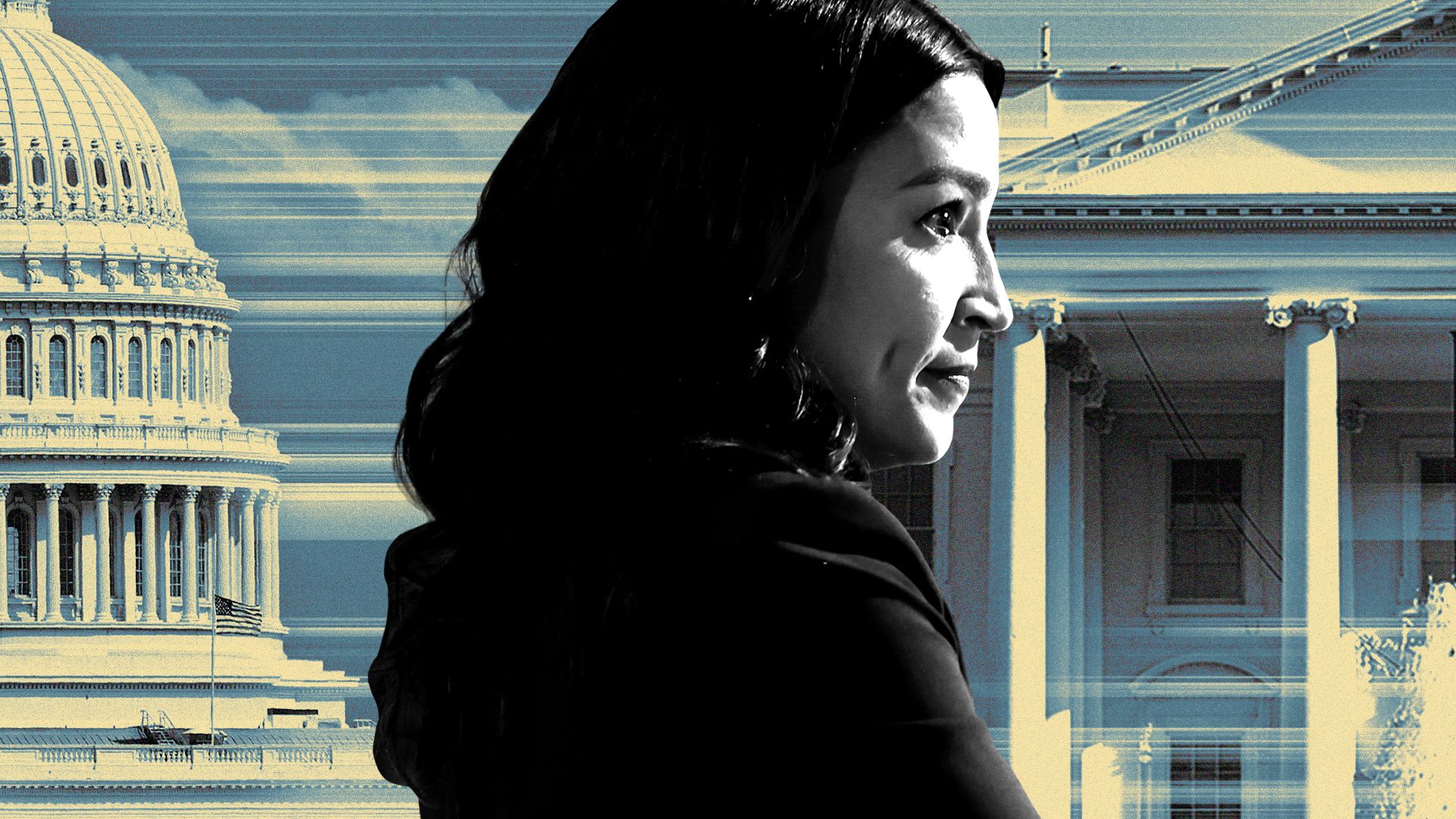
Rep. Alexandria Ocasio-Cortez (D-N.Y.) is shaking up her team with several departures and new aides, sources tell Axios' Alex Thompson and Holly Otterbein.
- Why it matters: The personnel changes come months before the progressive leader will decide whether to launch a presidential campaign. She's also weighing a run for Senate Minority Leader Chuck Schumer's seat, which is up in 2028.
β‘ Driving the news: Oliver Hidalgo-Wohlleben, AOC's campaign manager and senior adviser for the past three years, is departing in September, according to two people familiar with the matter.
- Fiorella Bini, a longtime aide to AOC, took over as interim campaign manager this month.
- Aya Saed, Ocasio-Cortez's former legislative director, returned to her operation this spring as a deputy chief of staff in her House office and an adviser to her campaign.
- Tanushri Shankar-Ross, who left AOC's team in 2023, has come back as a senior adviser, Puck first reported.
- Tyler Evans, AOC's creative director who had been with her since 2021 β sometimes in a freelance role β also left this summer, according to his LinkedIn page.
The intrigue: The moves coincide with the expansion of the portfolio of AOC's chief of staff Mike Casca, people familiar with her operation said.
- Casca was senior communications adviser for Sen. Bernie Sanders' (I-Vt.) 2020 presidential campaign, and then deputy chief of staff in Sanders' Senate office before joining Ocasio-Cortez's team in late 2023.
3. π’οΈ 65 billion-barrel deal
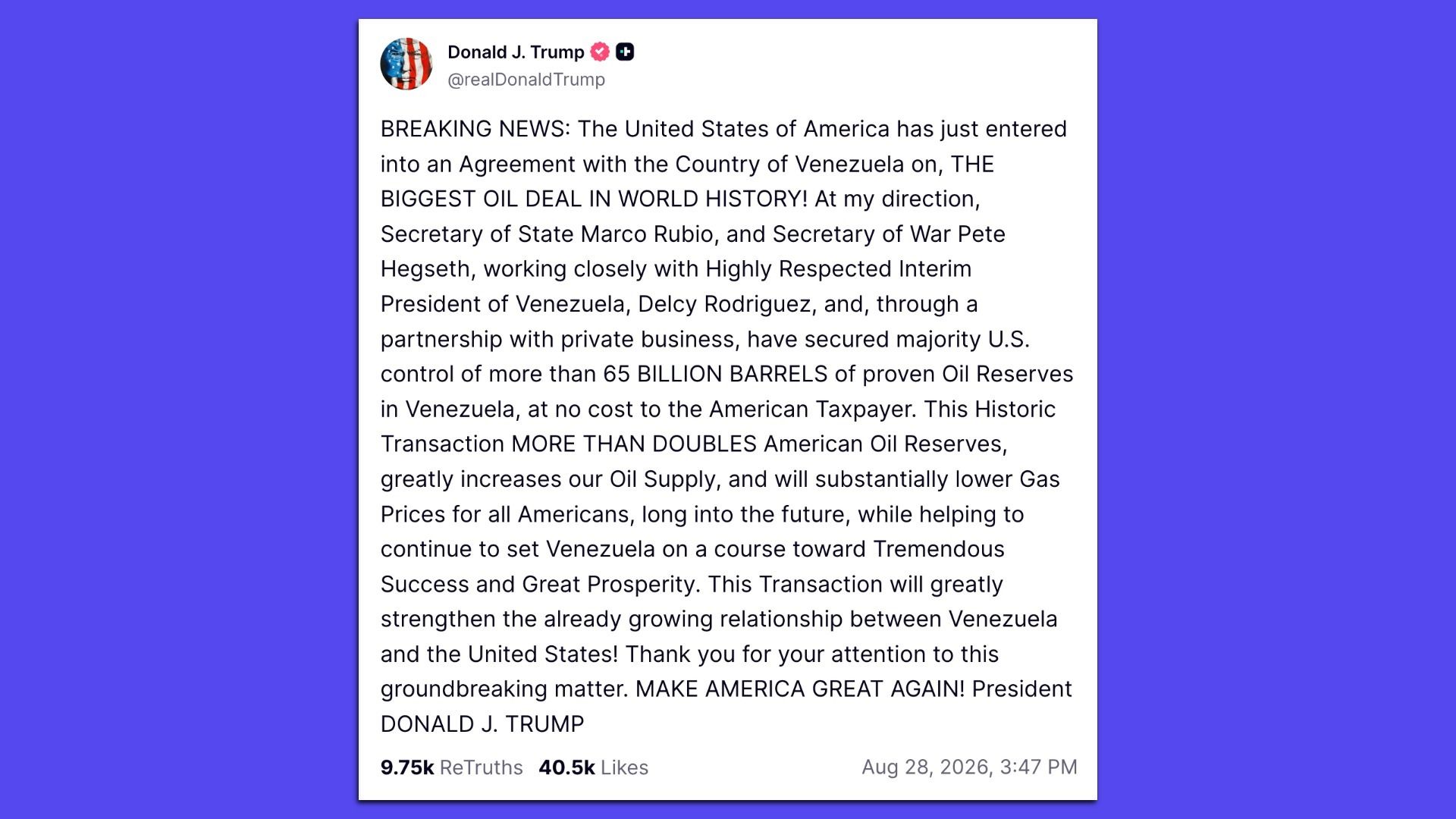
The U.S. has struck a deal with Venezuela to take control of oil fields with 65 billion barrels of reserves, President Trump said on Truth Social yesterday.
- Why it matters: The unprecedented deal vastly increases U.S. energy security and dominance in the Western Hemisphere, reports Axios' Marc Caputo, who scooped Thursday that the deal was likely.
π Zoom in: The details have yet to be released. But a source described the unorthodox arrangement as a type of "public-private partnership" between the U.S., private companies and Venezuela.
- "It's not a purchase," a U.S. government source said. "They're giving us equity. It's a type of corporate transaction where the U.S. has equity in the companies." The U.S. would have access to what's called "off-take oil," a guaranteed amount of crude that would be exchanged at cost, the source said.
4. π‘ Teetering housing market


The housing market has been in a low-boil recession for four years now, with anemic sales and the appearance of high prices, somehow without tanking the overall economy, Axios' Emily Peck reports.
- Why it matters: Homeownership is the bedrock of the economy β it's how most Americans build wealth β and changes in the residential real estate market ripple out into things like consumer spending, the job market and inflation.
Zoom in: Home sales are at levels last seen when the country was crawling out of a housing crisis more than a decade ago.
- Many homeowners don't want to give up their low mortgage rates and buy something else. Others are discouraged by the prospect of high mortgage rates and house prices that, in many markets, still hover at record highs.
5. ποΈ Warsh's big reset
With markets wobbling and the world watching, Federal Reserve chairman Kevin Warsh went back to basics yesterday morning:
- He affirmed that the Fed is determined to get inflation down and may have to raise interest rates to get there, Axios' Neil Irwin writes from Jackson Hole, Wyoming.
Why it matters: If the Warsh Fed follows through with rate hikes, it would increase borrowing costs for Americans and potentially put him in the crosshairs of the rate-cut-loving president who appointed him.
π While this summer's inflation readings "were better than expected, they do not tell me that underlying trends have meaningfully improved," Warsh said.
- Capital spending, corporate profits and lending activity are all buoyant β which means he "would be hard-pressed to describe broad financial conditions as restrictive."
6. π³π΅ Struck without warning

Nepal's catastrophic flood is exposing gaps in the warning systems designed to watch out for extreme rain and rivers β not for sudden collapses high in the mountains during good weather, Axios' Herb Scribner reports.
- Wednesday's flash floods didn't come with any of the typical red flags β no thunderstorms, no rainfall, no rise in the river, no earthquakes.
The big picture: Such glacier-driven floods under clear skies β sometimes called "blue-sky floods" β can happen in the U.S. too, especially in Alaska and the Pacific Northwest, where sudden releases of glacial water can send floods and debris racing down mountain valleys.
The latest: Rescue operations entered the fourth day today.
- Nearly 3,000 people are still missing and almost 700 have died, according to Nepali officials' updated count.
7. π° America's tariff map

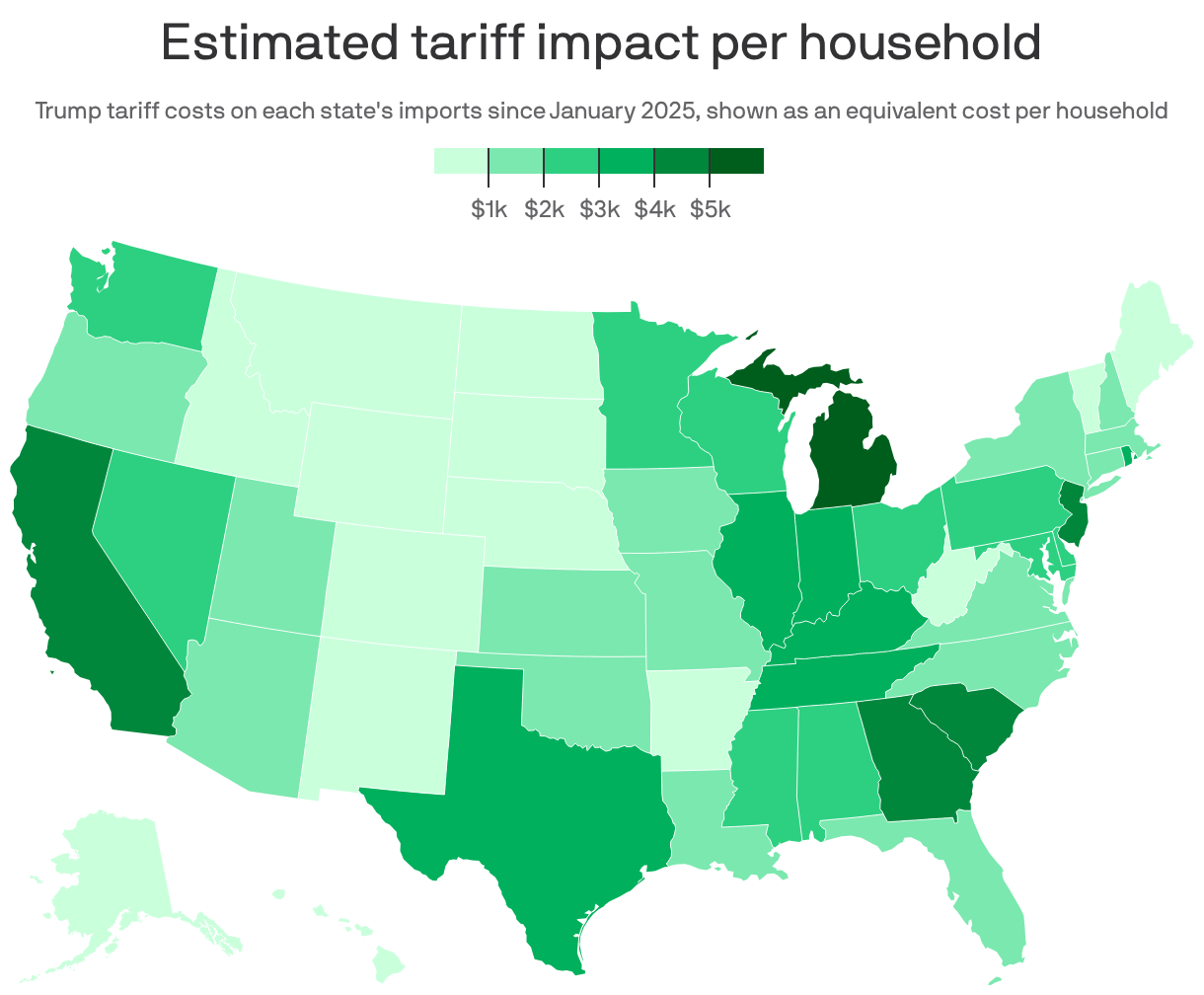
The tariff blow varies wildly by state, Axios' Brad Jennings reports:
- California has absorbed the biggest chunk of the overall $342 billion estimated tab, with $62.8 billion, according to National Taxpayers Union Foundation data.
- Wyoming has shouldered just $107 million.
π Zoom in: Vehicles dominate tariffs in Michigan, while auto parts lead in neighboring Indiana and Ohio.
- Toys and games were the leading tariff target in Minnesota, home to Target and several game companies.
- In Florida, food β think imported winter produce β is the biggest tariff-hit category.
8. π¦ 1 for the road: Dolly International

A push by fans to rename Nashville's airport for Dolly Parton is taking off.
- Tennessee Gov. Bill Lee and the CEO of the Metropolitan Nashville Airport Authority both came out in favor of the name change yesterday. It's expected to come up at the authority's meeting next month, AP reports.
Catch up quick: Long before 80-year-old Parton died Tuesday, fans in January 2025 started an online petition calling for officials to rename Nashville International Airport in her honor. It got renewed attention following Parton's death, jumping to more than 164,000 signatures and counting.
- The change would make Parton the first woman whose name adorns one of America's 50 busiest airports.
π¬ Thanks for reading! Please invite your friends to join AM.
Sign up for Axios AM