Axios AM

March 28, 2017

Good Tuesday morning. I'd love if you'd be kind to take this quick, 10-question reader survey to help us serve you better, with an invitation at #10 to join the Axios Reader Advisory Board. Thank you if you took it yesterday!
1 big thing: Trump quest for a quick win
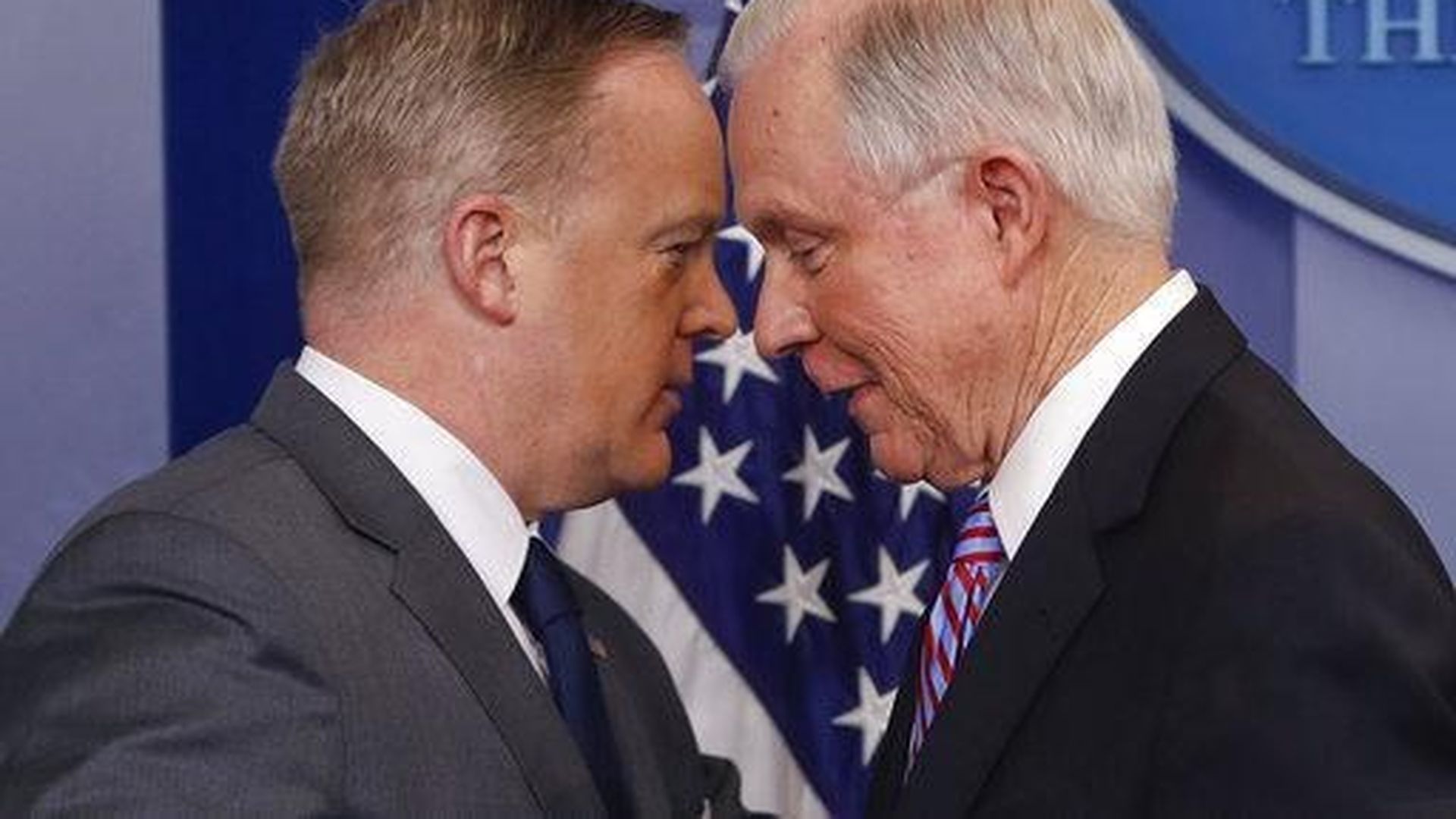
As Republicans frantically look for a roadmap after Friday's collapse, the White House is talking about moving to a novel, risky strategy: tackling tax reform and infrastructure at the same time (not necessarily in the same bill). Axios' Jonathan Swan broke the story last night:
- It's a major strategic shift — infrastructure was likely to be parked until next year.
- Trump needs fast victories. Infrastructure is big, flashy, and potentially bipartisan.
- Trump feels burned by the conservative House Freedom Caucus and is ready to deal with Dems. Dangling infrastructure spending is an obvious way to buy support of potentially dozens of Dems, meaning he wouldn't be hostage to hardliners.
- House Transportation and Infrastructure Chairman Bill Shuster (R-Pa.), who would steer Trump's construction package through the House, tells Swan he's optimistic Trump could get it done this year.
- Shuster was an early Trump supporter and has been chatting with the billionaire about roads and airports long before he ran for President.
What we're hearing ... A well-wired Republican tells me the party can't risk "looking like a clown car." So leaders are desperate to head off a government shutdown at the end of April, and to put together a plausible path to victory on tax reform.
Top officials at both ends of Pennsylvania Avenue tell me they don't see how they can change the House Republican math that killed health reform. The new sequencing being debated is an effort to disrupt a losing calculus — to avoid, as one official told me, "the definition of insanity."
Chaser ... David Brooks column, "Can Elephants Learn From Failure?": "Republicans ... are massively underestimating how hard tax reform is going to be. ... Tax reform will probably only pass with bipartisan buy-in, if there are enough potential yes votes that you can afford to lose some off on the extremes."
2. Trump's big climate change splash
At 2 p.m., Trump will visit EPA HQ to sign a long-awaited executive order that aims to unwind huge swaths of Obama-era climate change policy. Axios' Ben Geman breaks it down:
- Why it matters: The order is the clearest sign yet of how aggressively Trump wants to attack his predecessor's regulations on fossil fuel development and coal-fired power generation, which Republicans call economically burdensome.
- The order will withdraw Obama-era interagency calculations of the "social cost of carbon," a metric regulators use to weigh the damage from increased carbon emissions.
- What's next: A fierce messaging battle to shape public perception of Trump's actions. A senior White House official told reporters the administration is committed to "twin goals" of environmental protection and energy development.
- Gina McCarthy, Obama's EPA chief, called it dangerous to air quality and drinking water.
See what else the executive order does. And read Ben Geman's lookahead.
3. Great window into covering this White House
CNN Justice Correspondent Evan Perez, to anchor Don Lemon, about Jared Kushner volunteering to testify before the Senate Intelligence Committee, and the revelation that he met with the head of a Russian state-owned development bank that's under sanctions, and close to Kremlin security services:
"[K]eep in mind: The only reason why this is a story is because these guys won't tell the full story when they're asked. I mean, this is something that they keep making the same mistake over and over with: Drip, drip, drip."
"This is something we've asked before. And even today: I asked them: 'Is this it? Is this the final story?" And they said: ... 'We don't have an obligation to disclose anything else. Go and find something else, and we'll tell you if it's true.'"
4. Guilty as charged
This column makes a great point — we think too little about what has gone before (and even the nonsense that we personally have written before).
When Dana Milbank and I covered George W. Bush for the WashPost, I remember Dana jokingly tossing off this journalistic truism: "There are no new stories — just new reporters!"
"The Three Lame Stories the Press Writes About Every President," by Politico's Jack Shafer:
- "Usually up first in their rotation is a breathless beat-sweetener about the incoming vice president. Thanks to his unusual closeness to the boss, ... the new veep is the most powerful in history.
- "The second inevitable wave of stories claims that the administration is rebooting.'"
- "Monday's Washington Post brings us ... the third classic of the first 100 days of reporting: A story about the coming 'reorganization' of government — this time by Prince Jared, the president's son-in-law."
5. Trump's America: The religious left
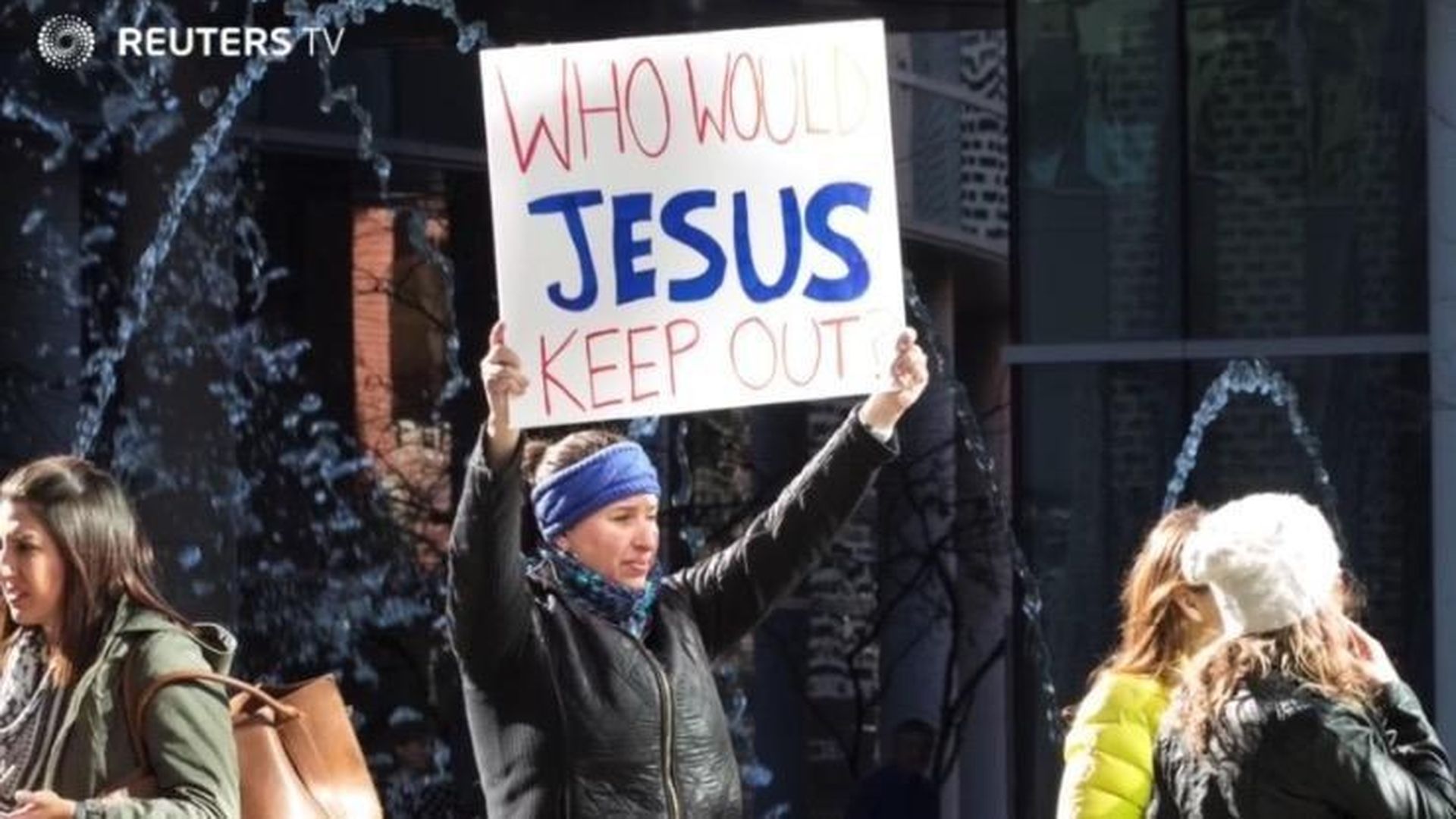
"'Religious left' emerging as U.S. political force in Trump era," by Reuters' Scott Malone:
- "This disparate group ... has been propelled into political activism by Trump's policies on immigration, healthcare and social welfare ... A key test will be how well it will be able to translate its mobilization into votes in the 2018 midterm congressional elections."
- "Religious progressive activism has been part of American history. Religious leaders and their followers played key roles in campaigns to abolish slavery, promote civil rights and end the Vietnam War."
- "Some in the religious left are inspired by Pope Francis."
- "[L]eaders point to ... a surge of congregations offering to provide sanctuary to immigrants seeking asylum, churches urging Republicans to reconsider repealing the Obamacare health law and calls to preserve federal spending on foreign aid."
- "The number of churches volunteering to offer sanctuary to asylum seekers doubled to 800 in 45 of the 50 U.S. states after the election."
6. The future of work
The U.S. lost between 360,000 and 670,000 jobs jobs to robots since 1990, according to research published yesterday by economists Daron Acemoglu and Pascual Restrepo. Axios' Chris Matthews reads between the lines:
- A growing problem: The pace of displacement is set to accelerate from here. Acemoglu and Restrepo say that if automation proceeds at predicted rates, millions of jobs could be lost while wage growth is reduced by up to 2.6% between 2015 and 2025.
- Compounding inequality: The rise of automation has occurred at a time when more income is going towards ownership relative to labor than at any time since economists began widely collecting such data. If automation is partially to blame for this shift, the increasing use of robots will only worsen the problem.
7. Global trends: Key populist leader
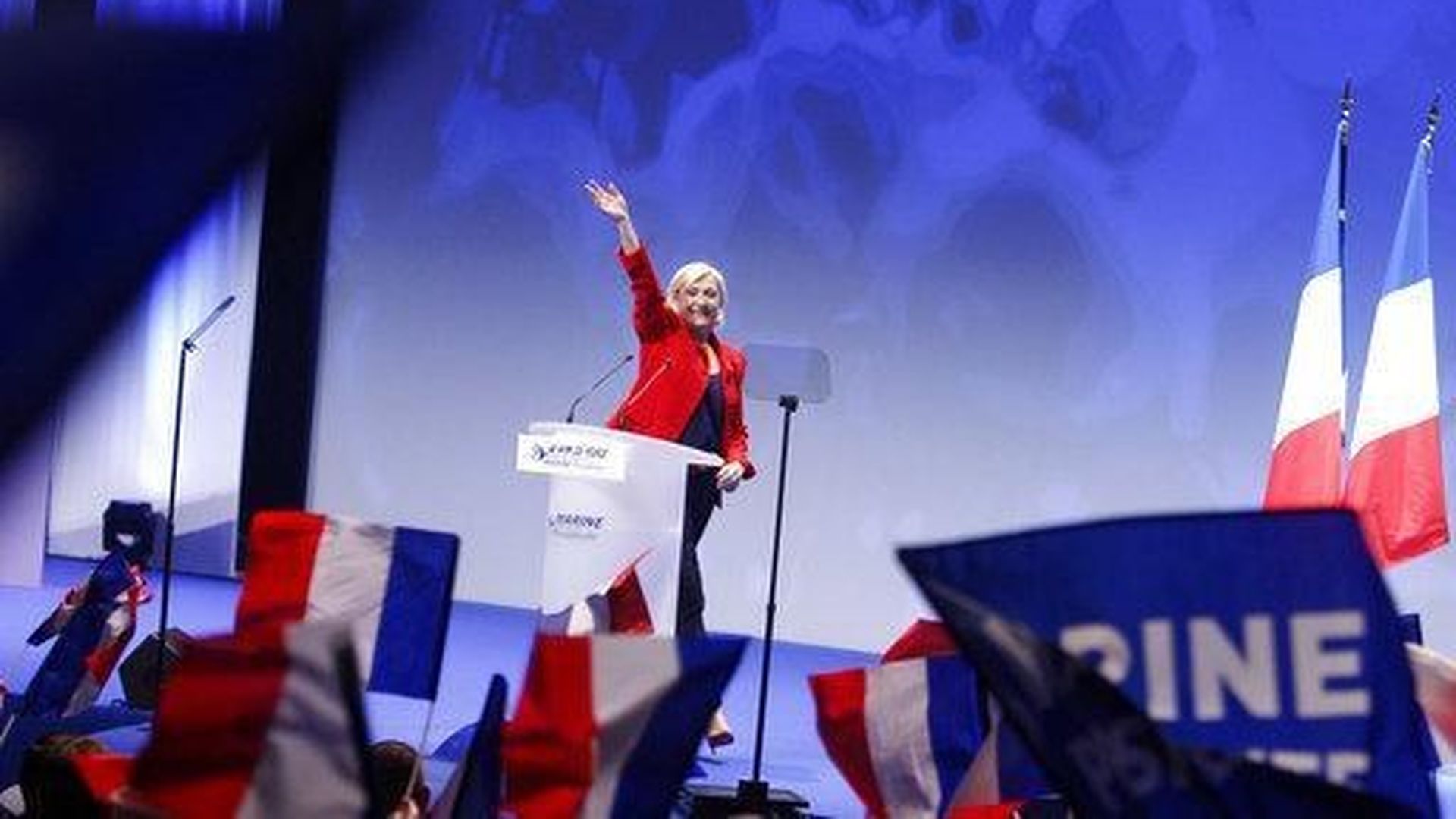
A thoughtful piece that's worthy of your time — and good baseline for all the coming fragmentary coverage heading into the first round of voting April 23. The White House thinks she can be elected as part of a Trumpy global wave. And she's an iconic face of a key trend of our time ...
Wall Street Journal front-pager from Paris, "France's Fiery Populist Courts the Elite: Marine Le Pen seeks advice from same establishment she rails against":
- "French presidential candidate Marine Le Pen, representing the once-ostracized National Front, met with influential bankers, corporate executives and government officials to get advice on the radical changes vowed by her campaign. Now the group is helping plan what she hopes will be her first 100 days in office."
- "National Front's goal is to move from a xenophobic protest movement founded by her father into a mainstream party espousing economic nationalism."
- "Ms. Le Pen, 48 years old, ... blames the common currency for France's chronically high unemployment and has said she would bring back the franc if elected."
- Why it matters: "That could be a devastating blow to the EU, which already is wrestling with the exit of the United Kingdom."
- "Polls suggest Ms. Le Pen will make it through the first round of voting April 23. Winning the second-round runoff [May 7] looks harder because supporters of candidates knocked out in the first round are likely to coalesce against her."
8. Media trends: Study of the day
"Ad trust rises as news trust sinks," by Axios' Sara Fischer: "A new survey finds that 61% of people trust the advertising they see, an 11% jump from March 2014, according to eMarketer. In addition, 72% of respondents also said the ads are 'honest,' a 16% increase over the past two years."
- Why it matters: The most recent Gallup poll on trust in media shows that 68% of Americans don't trust the news — the lowest rate ever measured. The shift shows that as people trust established media brands less, they are turning towards unconventional sources of information.
9. The talk of Hollywood
"Studios pushing earlier movie rentals amid growing pressures," by L.A. Times' Ryan Faughnder:
- "[M]ost of the studios agree that they must come up with new ways to shorten the gap between a movie's theatrical release and its home video debut ... Such moves have previously sparked massive resistance from cinema operators, who feared that consumers would avoid watching movies on the big screen."
- [M]ajor chains such as AMC and Regal are open to shrinking the so-called theatrical window. ... Such deals with the cinema giants are expected to come by the end of the year or in early 2018."
- Why it matters: "The change would represent a significant departure from the way Hollywood has done business and highlights how rapidly shifting consumer viewing habits are forcing studios and theaters to rethink how they've operated for decades."
- "The main studios pushing the initiative — Warner Bros., Universal Pictures and 20th Century Fox — want customers to be able to watch select movies in their homes 30 to 45 days after they hit the multiplex, less than half the time it usually takes."
- "Consumers would pay $30 to $50 to watch the movies, and theaters would get a cut of the revenue from the premium video-on-demand offerings."
10. 1 fun thing: Slugging Uber
A curiosity of D.C. commuting meets the app age ... WashPost Metro front, "Will Northern Va. pay to slug? Uber bets on it," by Faiz Siddiqui:
- "Uber will use Northern Virginia as a testing ground for a new carpooling feature, described by the company as 'digital slug lines.' ... [S]luggers [are] a dedicated group of commuters who [line up at commuter lots, and get in strangers' cars] to use HOV lanes to save time and money."
- "The new Uber service, called Commute, will initially be available in Tysons, Fairfax City and Alexandria, targeting the Interstate 66 and Interstate 395 corridors along with the George Washington Parkway."
- "Drivers will net $5 to $10 per ride ... Uber is advertising Commute as a lower-cost alternative to uberPool, the app's cheapest option, where riders headed in the same direction split the cost of a trip. An uberPool trip costing $15 to upward of $25 would cost $5 to $10 with Commute."
P. S. Bracketology ... "South Carolina becomes 10th school to make men's, women's Final Four in same year." Others in Women's Final Four, which tips Friday in Dallas: UConn, Stanford and Mississippi State.
Sign up for Axios AM
Catch up with the most important news of the day