Axios AM

September 16, 2024

1 big thing: Again

Two assassination attempts in just over two months have turned two of former President Trump's favorite places — the rally stage and now his West Palm Beach golf club — into infamous scenes of near-national nightmares.
- Why it matters: Once again, this unhinged and without-precedent presidential election took a turn for the worst.
The big picture: Trump is safe. But this latest attempt at his life — the second in 65 days — will be another test for America, its people, its institutions and its democracy.
- This election year has been home to America's worst political violence in roughly a half-century — and it's only mid-September. The danger of more wannabe assassins or another Jan. 6 is real.
- In an ominous warning at a press conference yesterday, a Secret Service official declared: "We live in dangerous times."
The nation's top four Democratic leaders — President Biden, Vice President Harris, Senate Majority Leader Chuck Schumer and House Minority Leader Hakeem Jeffries — each released a statement condemning political violence.
- Biden added: "I have directed my team to continue to ensure that Secret Service has every resource, capability and protective measure necessary to ensure the former President's continued safety."
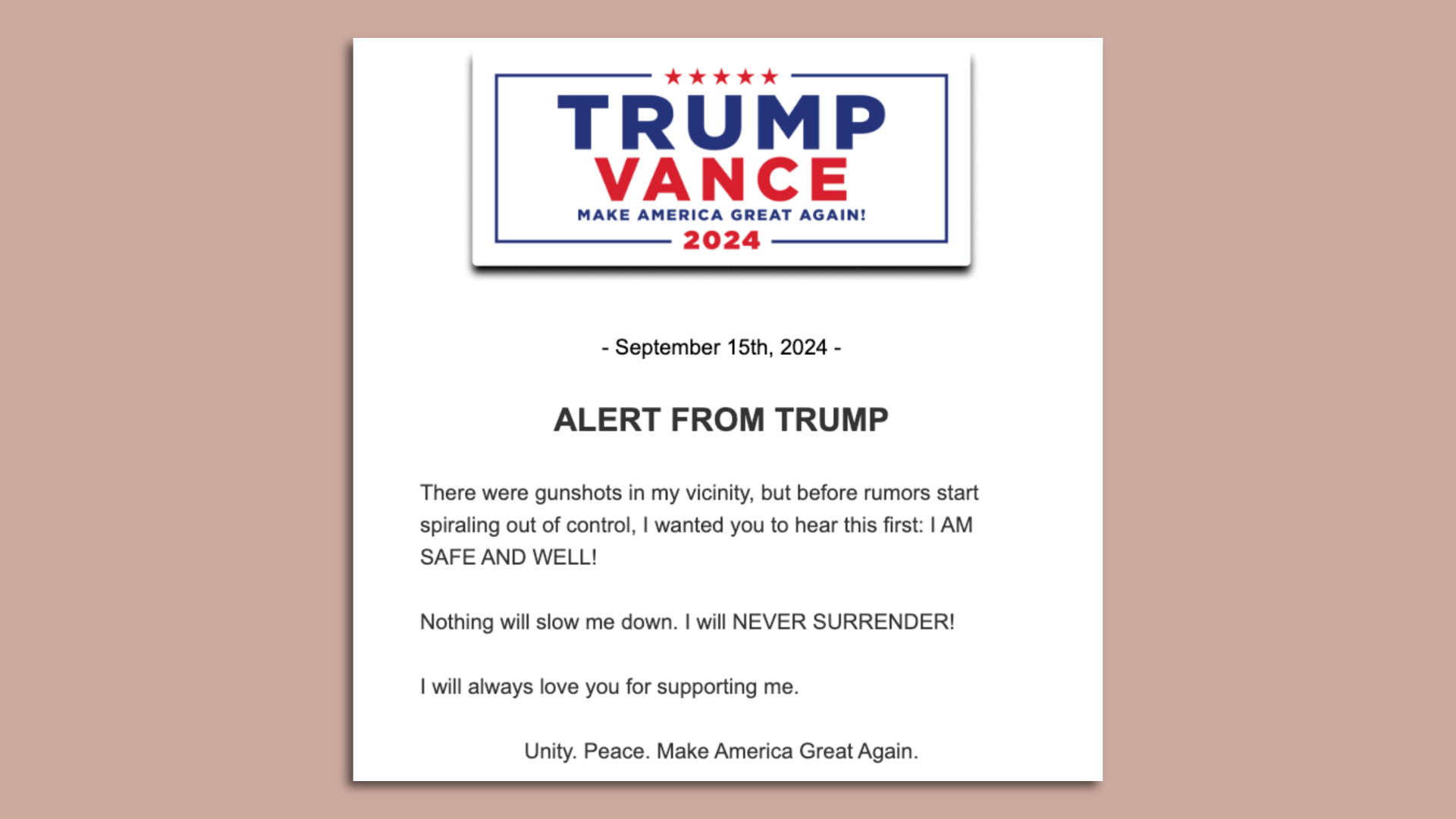
What happened: An apparent assailant armed with an AK-style gun was spotted sticking his rifle through a chain-link fence a few holes ahead of where Trump was playing.
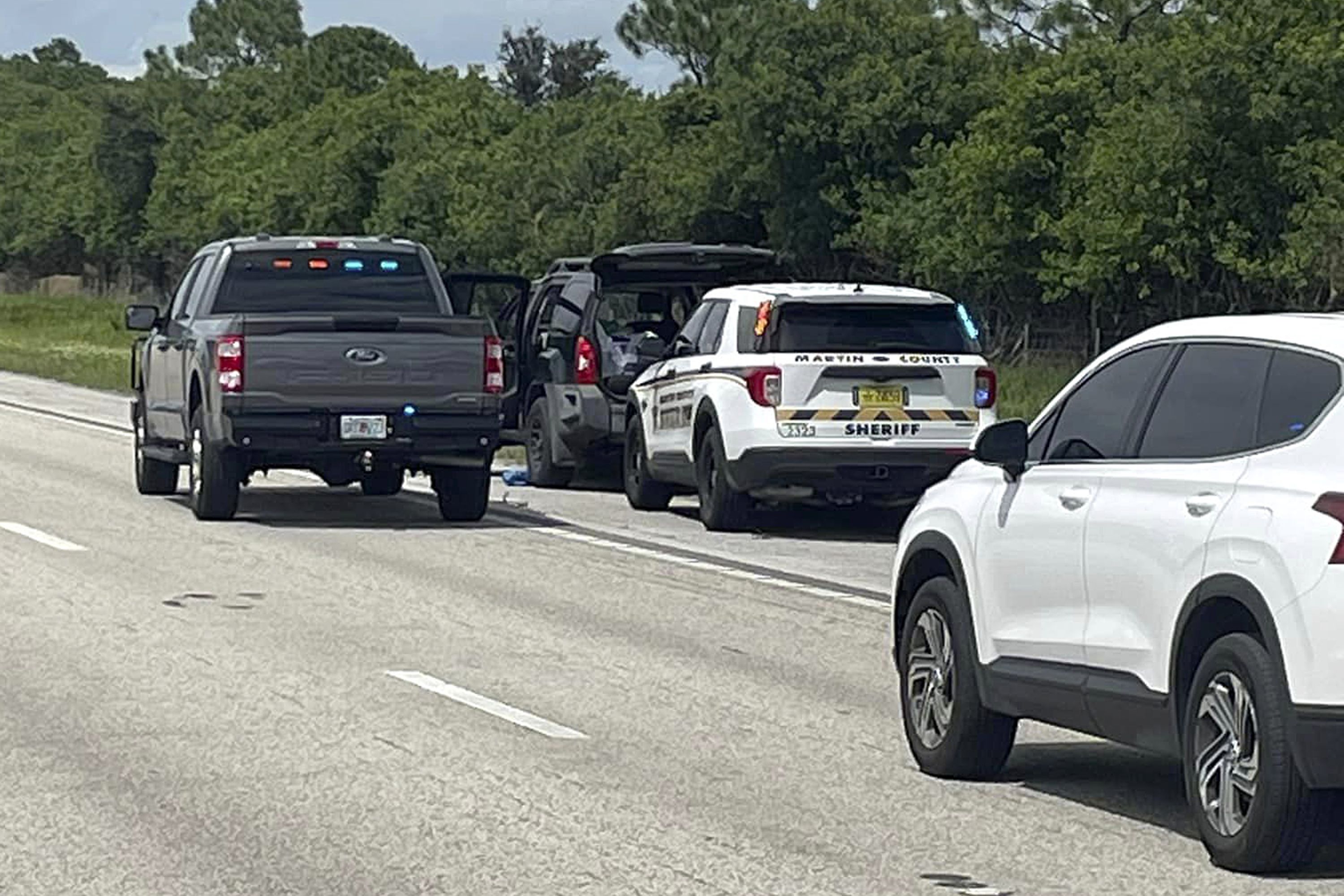
- Secret Service agents opened fire as the suspect fled, leaving behind two backpacks, the gun, a scope and a GoPro camera. It's unclear if the assailant fired any shots.
The suspect, identified as Ryan Wesley Routh, was taken into custody on I-95 about 45 miles north of Trump International Golf Club.
- A witness who took a picture of the suspect's vehicle and license plate number outside the club provided it to law enforcement officers.
Between the lines: Both scenes of the recent assassination attempts posed massive protection challenges for the Secret Service, which boosted Trump's security after the Butler shooting.
- News photographers had found several areas around the club's fence line where Trump is sometimes visible while golfing.
- Both presidential candidates started speaking behind bulletproof glass enclosures at outdoor rallies after Trump was shot in July.
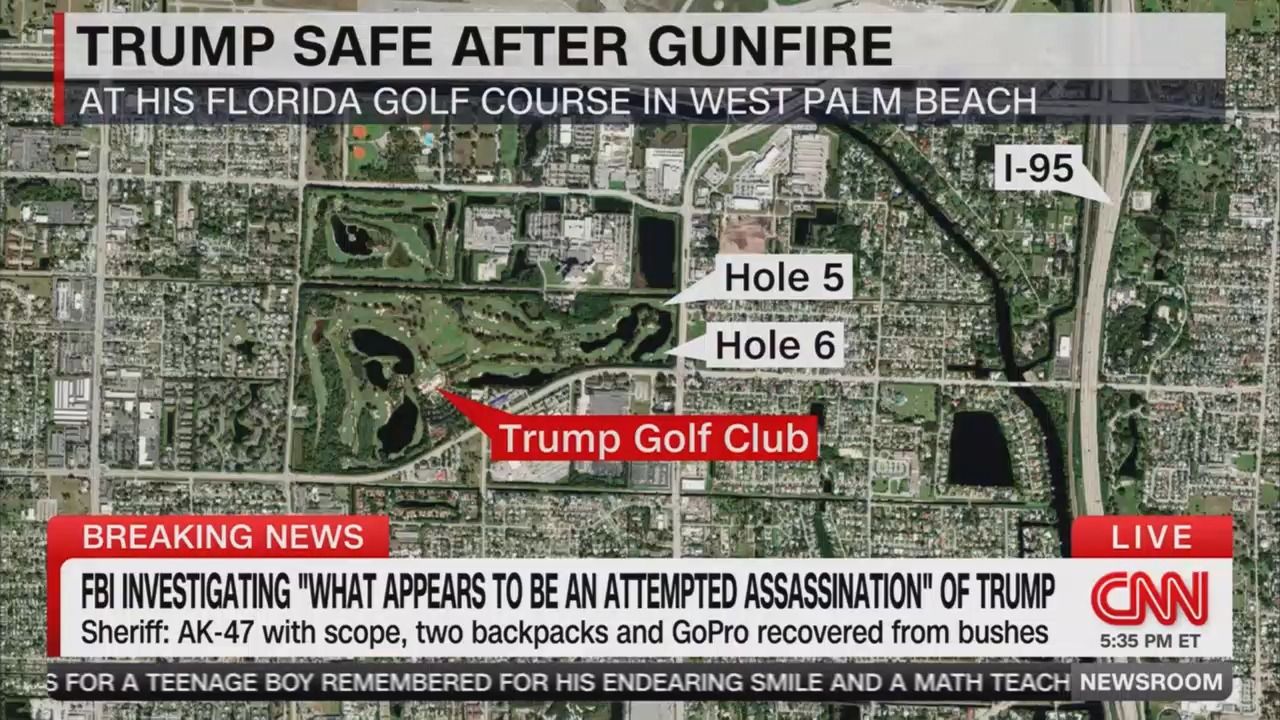
⛳ Where it happened: Palm Beach County Sheriff Ric Bradshaw said at a briefing that Trump's "golf course is surrounded by shrubbery. So when somebody gets into the shrubbery, they're pretty much out of sight."
- Trump is "not the sitting president," Bradshaw continued. "If he was, we would have had this entire golf course surrounded. But because he's not, the security is limited to the areas that the Secret Service deems possible."
- "So I would imagine that the next time he comes [to] the golf course, there'll probably be a little more people around the perimeter. But the Secret Service did exactly what they should have done."
About the golf course layout, Bradshaw said: "You've got three holes — five, six and seven ... One of them runs parallel to Summit Boulevard; one of them runs parallel to Congress [Avenue ... The suspect] was in the area in the shrubbery where he could see both holes."
- "So the president was on another hole back, which means he's about between 400-500 yards away. ... He's on the golf course ... but he's back a ways."
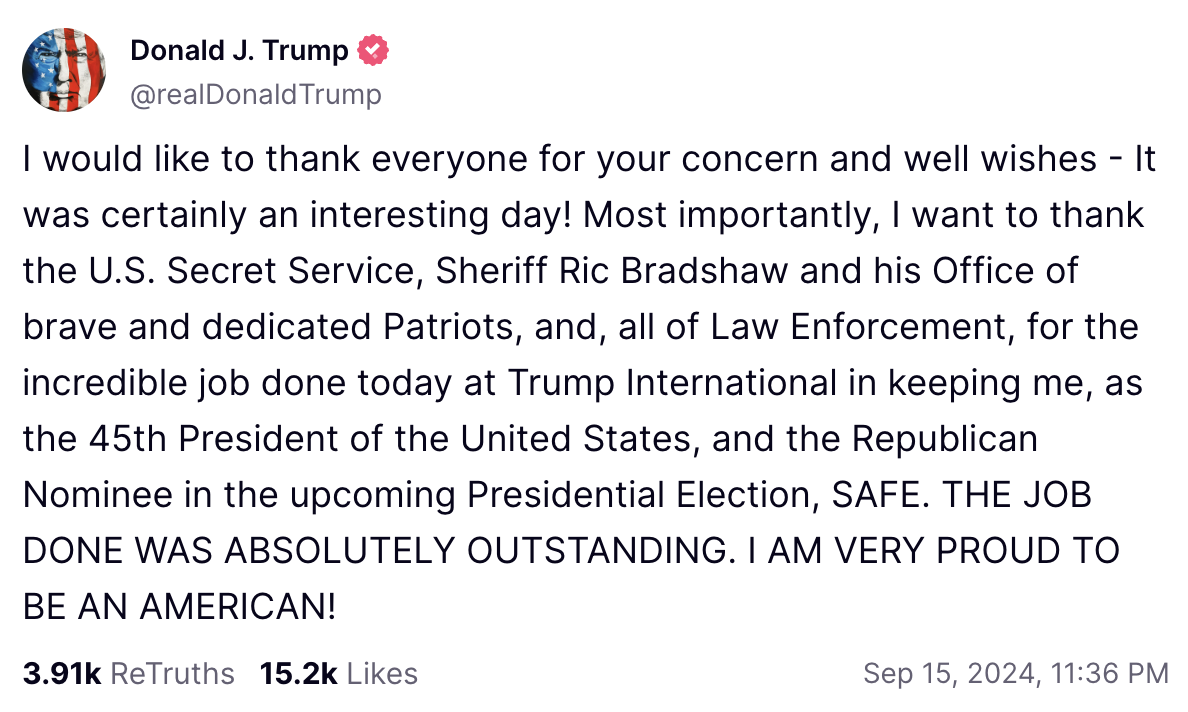
🔮 What's next: Expect the Secret Service to face more intense questioning about its ability to safeguard Trump — and all others under its protection.
- The bipartisan House committee investigating the last assassination attempt is already seeking a briefing.
2. ⚖️ Suspect's rap sheet
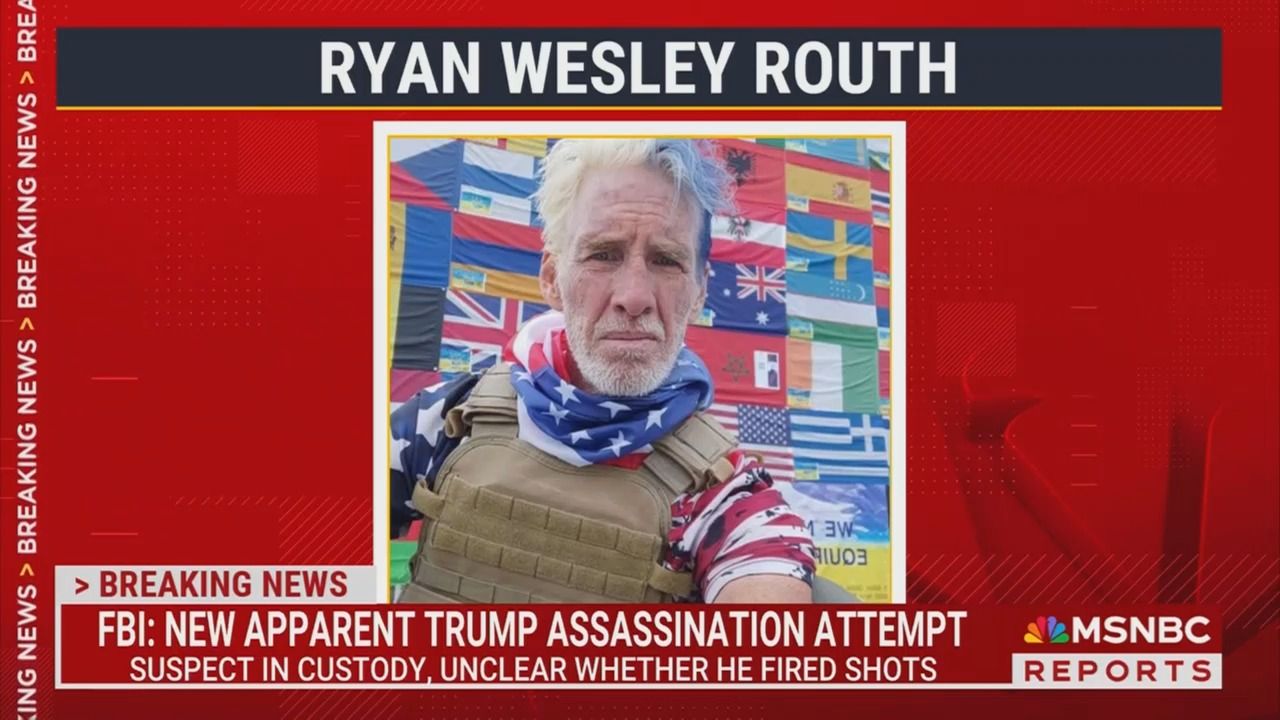
Ryan Wesley Routh — the man in custody after yesterday's assassination attempt — has a lengthy criminal record and was critical of former President Trump on X.
- Routh, 58, spent most of his life in North Carolina but had moved to Hawaii.
Zoom in: In 2002, Routh was convicted of possessing a weapon of mass destruction — a machine gun — after a three-hour standoff with police in which he barricaded himself in a roofing business, according to local reports.
- NBC News found records of more than 100 criminal counts against Routh in North Carolina.
🇺🇦 Routh often posted about the war in Ukraine and attempted to find volunteers to fight against Russia.
- Last year, he was interviewed by both Semafor and The New York Times, which described him as a former construction worker.
- Routh told The Times he had spent several months in Ukraine after Russia's invasion in 2022 and was looking to recruit Afghan soldiers who fled the Taliban.
🐦 On X, which suspended his account yesterday, Routh posted unfiltered and sometimes bizarre political statements that changed drastically.
- He appears to have been a Trump supporter in 2016 before turning against the former president by 2020. He posted earlier this year that his slogan should be "Make Americans slaves again."
- Routh more recently indicated support for a political ticket that would've united Vivek Ramaswamy and Nikki Haley.
🗳️ Records from North Carolina's Board of Elections show he voted in the state's Democratic primary earlier this year.
- He's also contributed about $140 to ActBlue, which handles donations for Democratic candidates and causes.
3. 💵 End of an economic era
4. 💰 Charted: Stubborn high prices


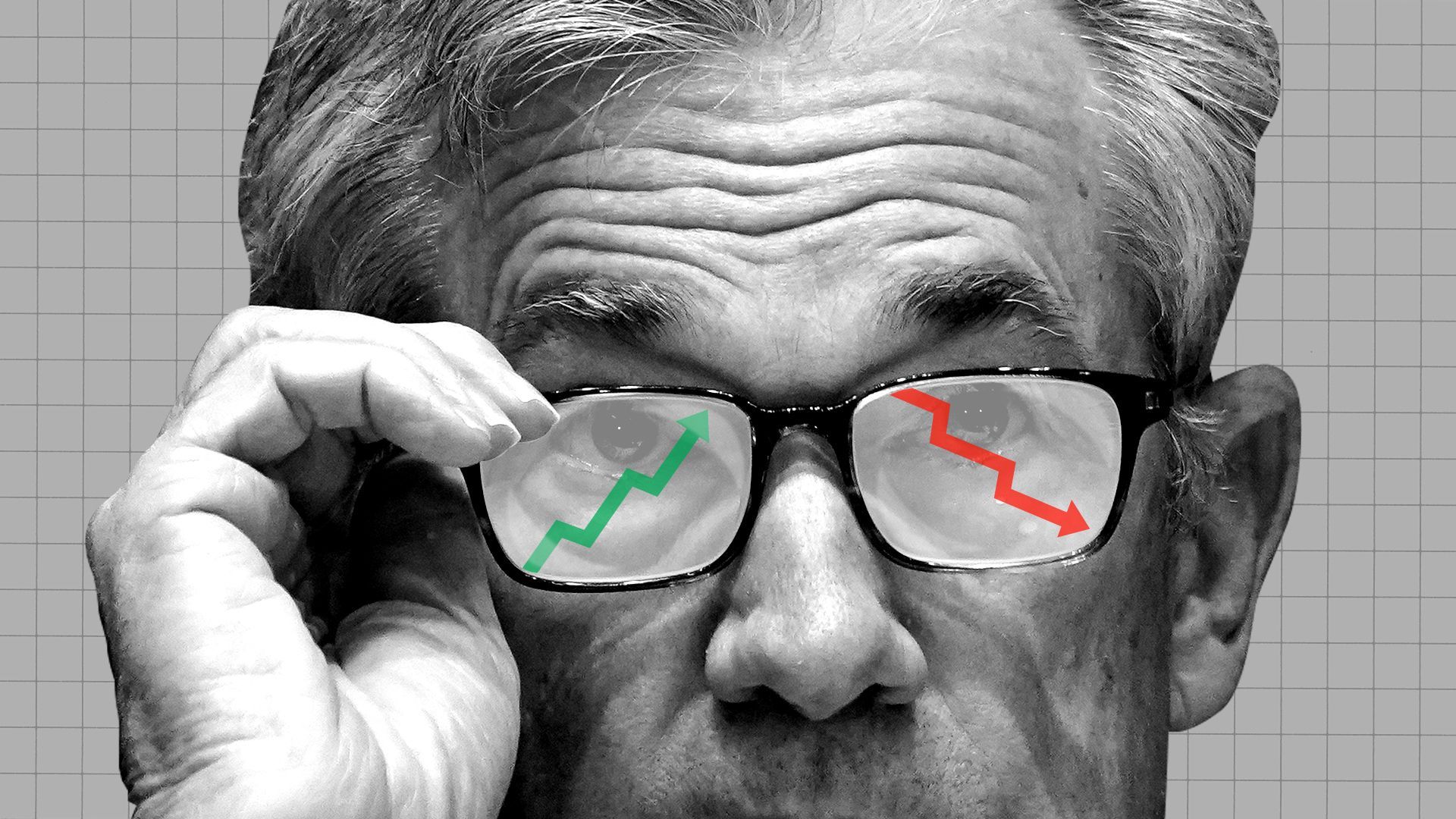
The era of rapid inflation may be over, but that doesn't mean 2019 prices will return, Axios' Neil Irwin writes.
- The victory in taming inflation only means that prices are no longer rising rapidly, as they did in 2021 and 2022.
- It doesn't mean that prices are returning to their pre-pandemic levels.
💡 How it works: The Fed and other central banks seek 2% annual inflation — which means that if they achieve their goal, prices will continue going up by about 0.17% each month, over and above the price surge of the recent past.
- There are good reasons for that. Periods of broadly falling prices, known as deflation, tend only to happen in painful downturns — most famously the Great Depression.
5. 🔋Ford's new EV fear: China

Ford CEO Jim Farley is changing his EV strategy to combat an "existential threat" from China's electric carmakers, The Wall Street Journal reports in "What Scared Ford's CEO in China."
- Farley is narrowing "Ford's focus in China to commercial vehicles, rather than trying to compete with local manufacturers in its consumer market, and "racing to fend off the threat of Chinese EVs elsewhere — in part by borrowing from them," The Journal adds.
Why it matters: Ford's target is no longer Tesla. Even Musk is afraid of China. China has all the leverage because so much of the EV supply chain is still there, despite all the Biden-funded manufacturing incentives, Axios transportation correspondent Joann Muller tells me.
Behind the scenes: Shortly after a May trip to China, Farley "arranged to have Chinese EVs shipped to Michigan for executives and directors to check out and sit in. The models were displayed in a Ford conference center near its headquarters. During board-meeting coffee breaks, directors took turns fiddling with cars," The Journal writes.
- "Farley often reminds his executive team of how Toyota and other Japanese car companies grabbed market share from the U.S. automakers in the 1980s and 1990s, followed in recent decades by Korea's Hyundai and Kia, which have found success with EVs. 'I've seen this movie before.'"
The bottom line: "Farley sees Chinese EVs as an immediate threat in Europe and other overseas markets, and a long-term risk in Ford's profit engine of North America, regardless of protectionist measures."
- Keep reading (gift link — no paywall).
6. 💊 Patients turn to DIY drugs
7. 📚 50 years ago today
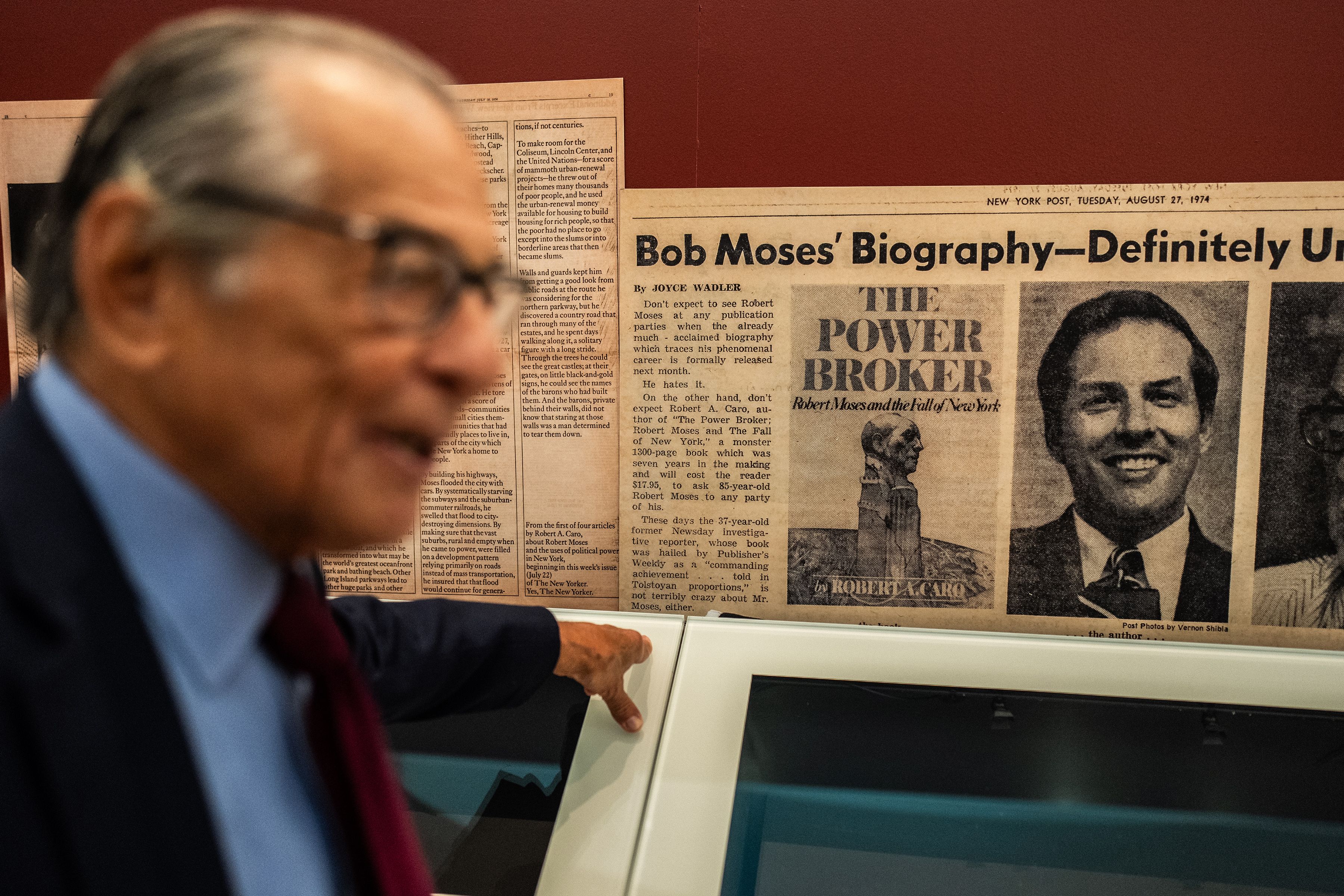
Robert Caro's "The Power Broker" — the monumental biography of New York urban planning potentate Robert Moses, published on Sept. 16, 1974 — was hailed by David Halberstam as "the greatest book ever written about a city."
- Why it matters: Caro, now 88, has seen "The Power Broker," with its blunt lessons on the uses and abuses of political power, become "more popular and relevant than ever," the N.Y. Times' Alexandra Alter writes.
A favorite prop in COVID-era home studios, the 1,286-pager has sold hundreds of thousands of copies (40,000 so far this year!), and is in its 74th printing for collective hardcover and paperback editions.
- Out today: The book's first-ever digital edition. Caro long resisted an ebook, partly because he reveres the spacing in the physical book. But he loves that the latest technology lets you link his wonderfully nuanced notes.
Open through Feb. 2: A special installation at the New-York Historical Society, "Robert Caro's The Power Broker at 50," which promises "the story behind the book: how Caro uncovered the falseness behind the image that Moses had so carefully cultivated, and that the press and public believed, to reveal the extent of Moses' power and the heartbreaking human cost behind his public works."
- Keep reading (gift link — no paywall).
8. 🎬 1 fun thing: New Emmys record
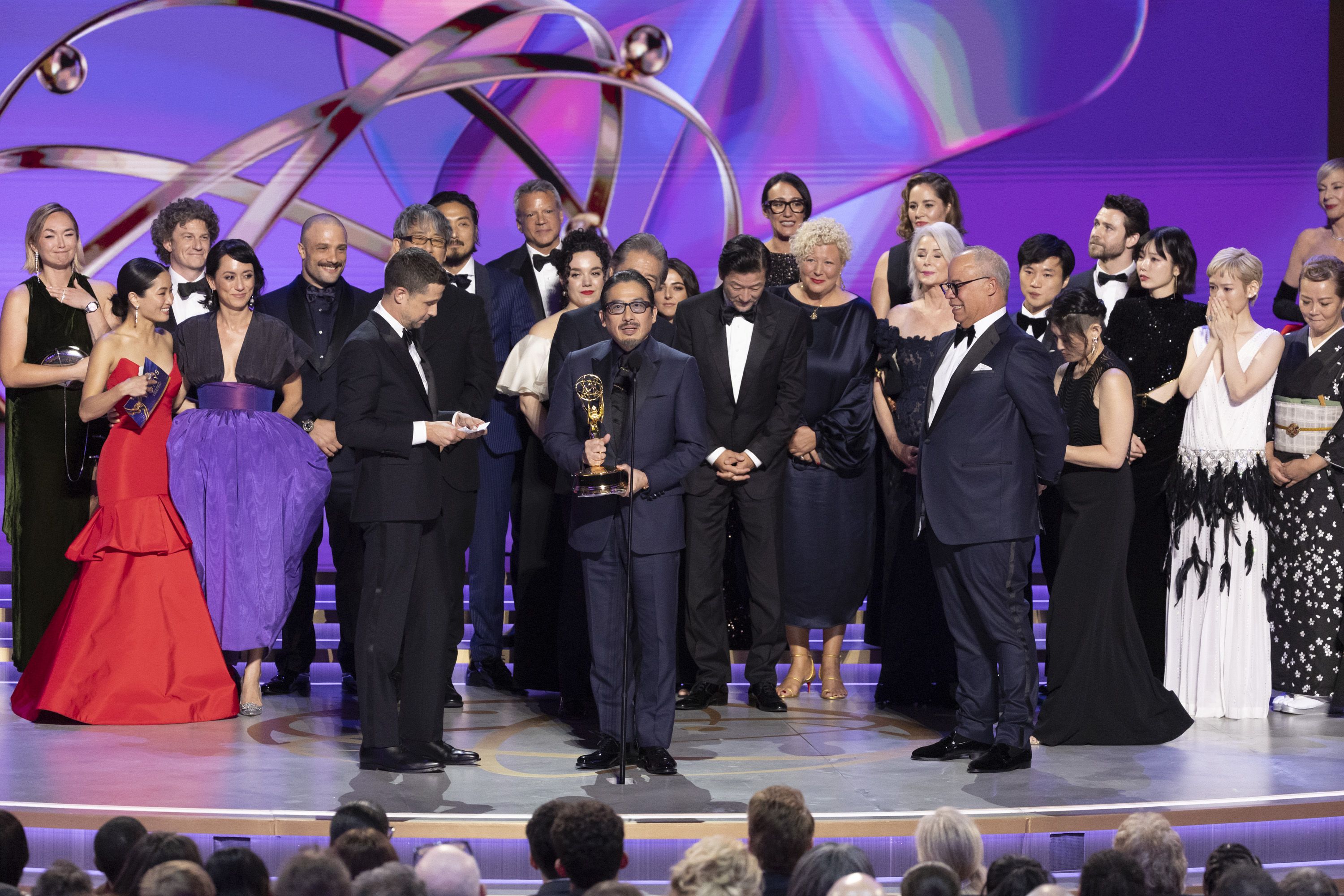
"Shōgun" — an FX drama about 17th-century Japan — shattered a record for most Emmys won for a single season last night.
- The show won 18 awards, including best drama series.
"Hacks" won best comedy series, beating "The Bear," which also took home several honors.
Axios AM