Axios AM

May 06, 2025

1 big thing: Trump's new nationalism
President Trump's grand economic vision relies on a simple tradeoff:
- Americans will accept short-term personal sacrifice — higher prices, fewer options, slimmer profits — to gain long-term national strength, Axios' Zachary Basu writes.
Why it matters: Trump is breaking sharply from free-market orthodoxy in his second term, blending bursts of anti-capitalism with a top-down, nationalist agenda for American dominance.
Critics on the left and right are labeling this "MAGA Maoism" — a movement that demands ideological purity, glorifies economic sacrifice, and embraces state power as a means to reshape society.
- Trump's strongman instincts, and his deep skepticism of cultural elites and bureaucrats, have only intensified comparisons to China's revolutionary leader.
🗯️ What they're saying: "MAGA Maoism is spreading through the populist right," former congressional speechwriter Rotimi Adeoye wrote for The Washington Post last month.
- James Surowiecki, the first journalist to deduce that the White House used trade deficits to calculate its reciprocal tariffs, argued Monday that Trumpism is "becoming perversely, farcically Maoist."
- Drew Pavlou, an Australian anti-communism activist, wrote on Substack that "the entire world is now held hostage to Trump and his primitive, strangely Maoist worldview."
🥊 Reality check: Trump's worldview is driven not by Marxist theory, but by a deeply held belief that America has been getting ripped off for decades.
- He's constrained by the rule of law, unlike China's totalitarian state — and there's no comparison to the mass death and violence committed by Mao Zedong's communist regime.
Plus, much of Trump's agenda remains pro-capitalist: He champions private industry, not state ownership. His appeals to sacrifice are rooted in geopolitical competition, not class struggle.
But listen to recent rhetoric from Trump, and it's clear why the analogy has gained traction.
- "We are a department store, and we set the price," Trump told TIME when asked about tariff rates. "I meet with the companies, and then I set a fair price ... and they can pay it, or they don't have to pay it."
🖼️ The big picture: Trump's embrace of centralized economic power is one piece of a governing style that borrows heavily from strongman traditions.
- Ritualistic praise: Trump's televised Cabinet meetings always begin with his secretaries showering him in praise — casting the president as the only leader capable of restoring America's greatness.
- Loyalty tests: Trump and his aides have carried out mass purges of career officials deemed insufficiently loyal, including at the Justice Department and Pentagon, and in the U.S. intelligence community.
- Civil society: Trump has sought retribution against the media, law firms, nonprofits and political opponents. Some Chinese see echoes of the Cultural Revolution, when nearly all of society's institutions were destroyed.
- War on academia: The Trump administration has cracked down on dozens of universities over alleged antisemitism and DEI programs, moving to weaken elite liberal institutions seen as hostile to MAGA.
- Military spectacle: The Pentagon plans to host a massive military parade in D.C. on Trump's birthday in June, coinciding with the Army's 250th anniversary. AP says plans show the parade could include 6,600 soldiers, 150 vehicles and 50 helicopters, and could cost tens of millions of dollars.
2. 🤖 OpenAI switcheroo

3. 🎞️ Hollywood's hell scenario
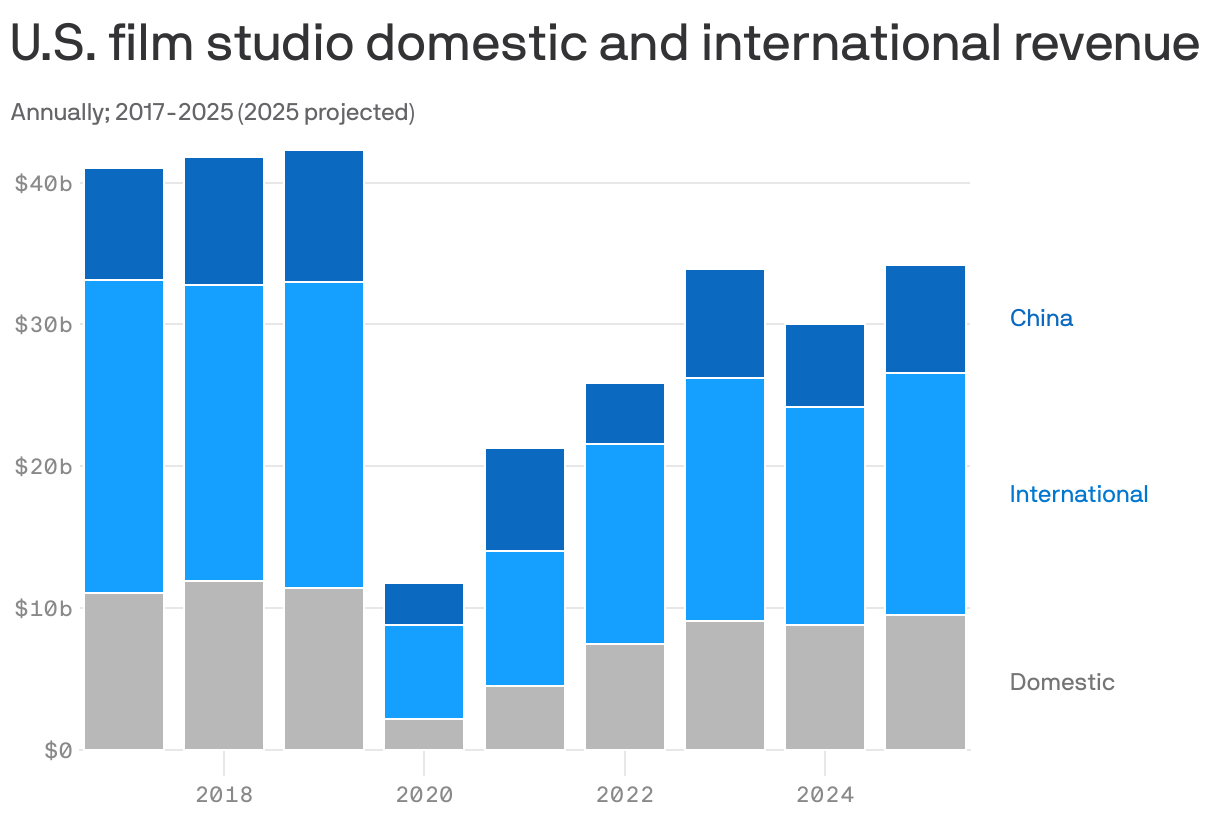
President Trump's threat to impose tariffs on film imports to the U.S. could risk retaliatory actions in international markets, where American film studios make the bulk of their box office revenue, Axios Media Trends author Sara Fischer writes.
- Why it matters: Studios are already reeling from a weakened box office following the pandemic. Tariffs could send the industry into a tailspin.
🍿 How it works: The U.S. is the top exporter of films globally by far, with export value running at three times imports, according to the Motion Picture Association.
- U.S. movie studios typically drive the bulk of global box office sales. The majority of their revenue tends to come from distribution outside of the U.S., which is why any sort of retaliatory tariffs on U.S. film exports would be disastrous for Hollywood.
Case in point: The top-grossing movie globally last year, "Inside Out 2," was produced by U.S.-based entertainment giant Disney. But the bulk (61.6%) of its $1.7 billion in box office revenue was made abroad.
- Similarly, 56% of global ticket sales to Warner Bros. Pictures' "Barbie," the top-grossing film the year before, came from international distribution.
4. 🎤 Later today: Briefing with Mike, Caputo
5. 🕶️ Bessent makes CEO inroads for Trump
6. ✂️ Trump cuts off Harvard
7. ✈️ Mapped: Real ID crunch time
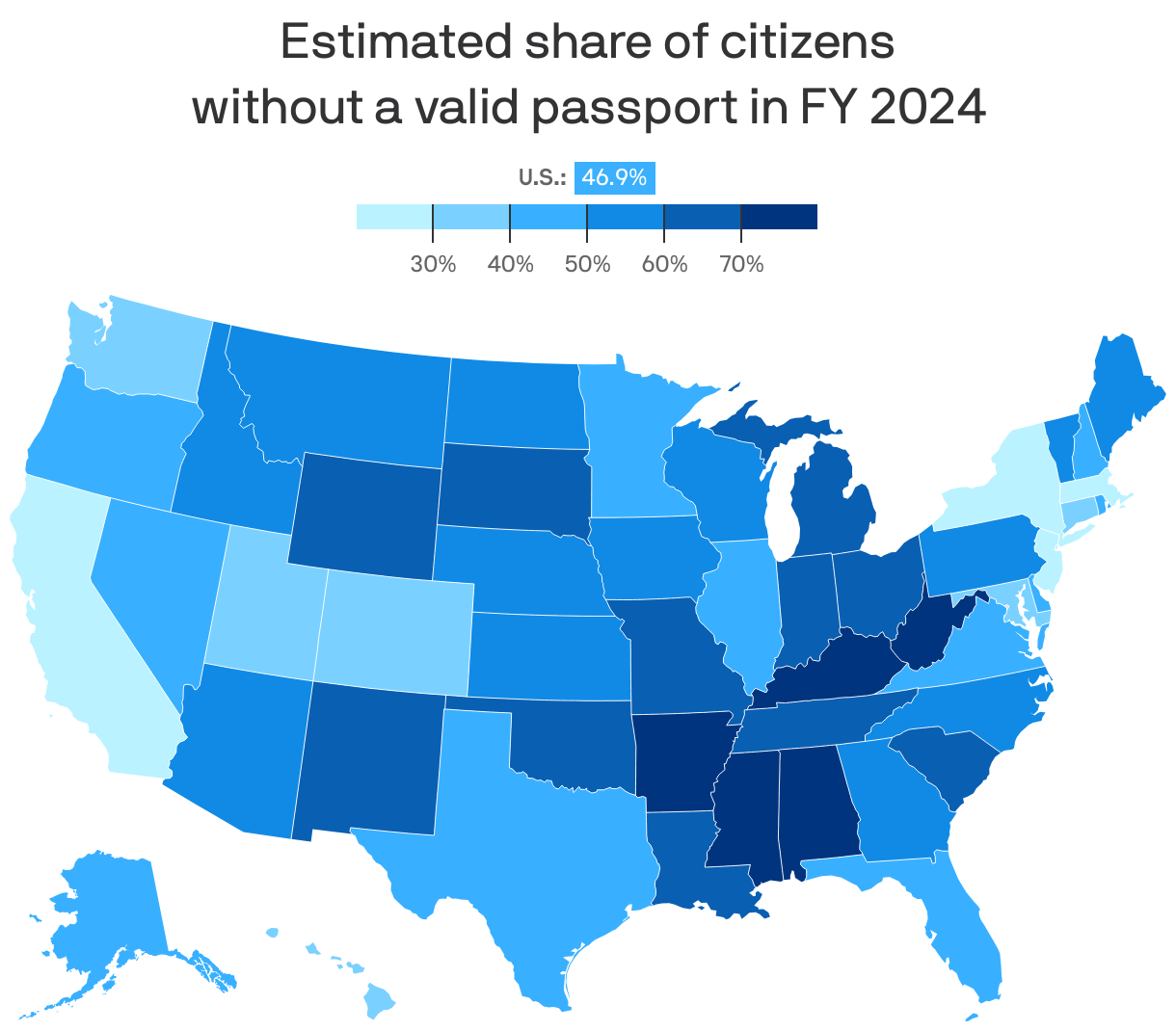
Nearly half the country may need Real IDs to board domestic flights starting tomorrow, Axios' Alex Fitzpatrick writes.
- Why it matters: After years of delays, the Real ID deadline looks set to be finally, actually happening — and could cause chaos at airports despite tons of warnings from the government and airlines.
By the numbers: Nearly 47% of Americans lack a valid passport as of fiscal 2024, according to estimates from the Center for American Progress.
- That's a decent measure of potential demand for Real IDs. Alternatives include "enhanced" driver's licenses meant for international land or sea crossings.
🔬 Zoom in: West Virginia (79.3%), Mississippi (77.9%) and Alabama (72.3%) have the greatest shares of citizens lacking a passport.
- New Jersey (20.1%), California (28.2%) and Massachusetts (28.8%) have the smallest.
8. 🏔️ 1 fun thing: America's top state

For the third straight year, Utah was named the nation's No. 1 state, Axios Salt Lake City's Kim Bojórquez writes from a U.S. News & World Report ranking.
- Researchers used 71 metrics across eight categories (including education, economy and crime) to gauge how well states are performing for their citizens.
🐝 Utah ranked No. 1 in fiscal stability and third in both economy and infrastructure.
- New Hampshire, Idaho, Minnesota and Nebraska rounded out the top five.
- Louisiana, Alaska, Mississippi, New Mexico and West Virginia were the bottom five.
Keep reading ... Get Axios Local: Daily newsletters in 32 cities and counting.
Axios AM