Axios AM

December 12, 2024

Good Thursday morning. Smart Brevity™ count: 1,579 words ... 6 mins. Thanks to Sam Baker for orchestrating. Copy edited by Bryan McBournie.
⚡ Breaking: President Biden is commuting the sentences of roughly 1,500 people who were released from prison and placed on home confinement during COVID and is pardoning 39 Americans convicted of nonviolent crimes. It's the largest single-day act of clemency in modern history.
- The previous record for a single-day act of clemency was by President Obama, with 330, shortly before leaving office in 2017. White House fact sheet.
1 big thing: The Great Upheaval
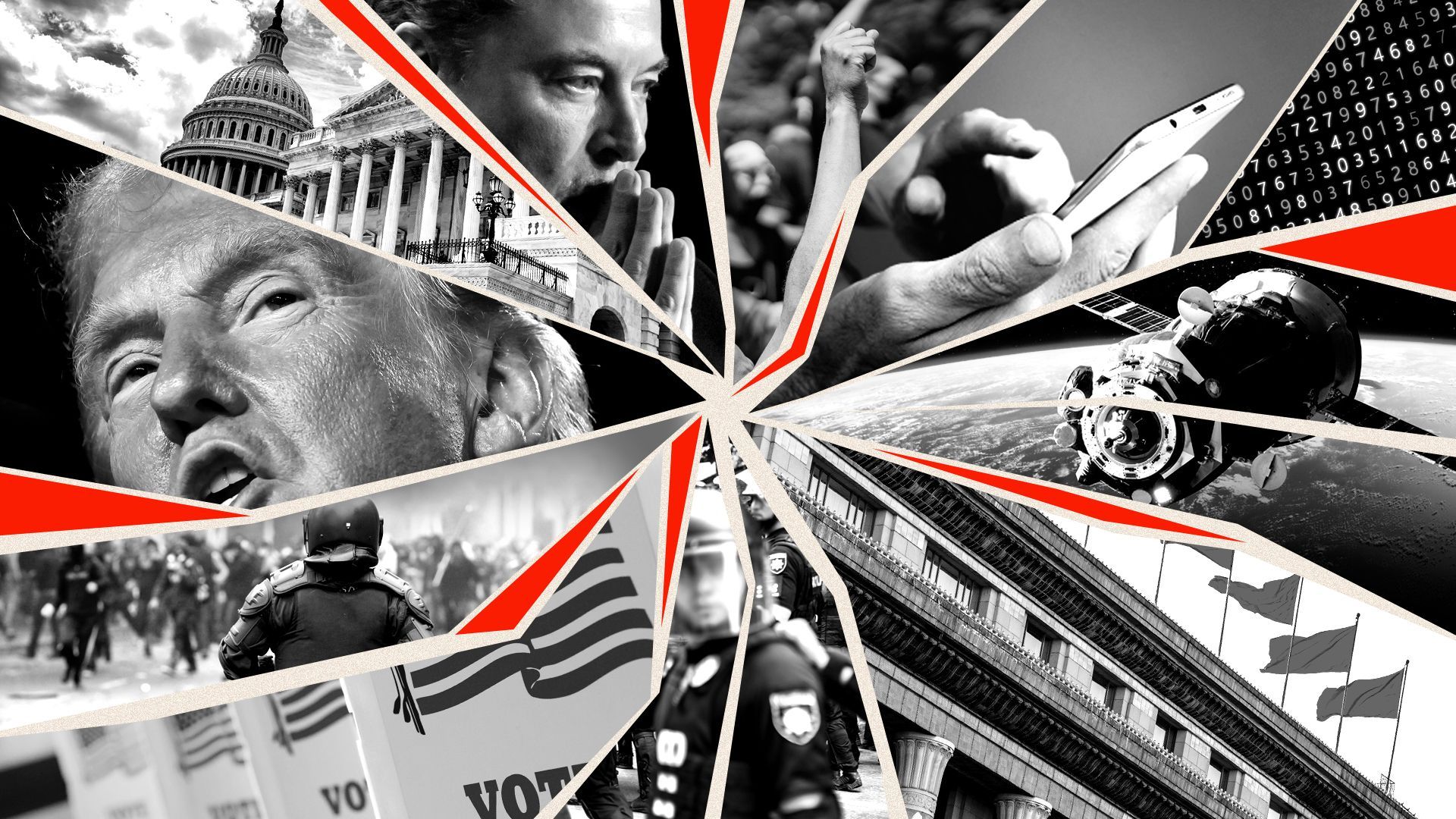
Governance, media, business and global geopolitics are all being reordered at breakneck speed — all simultaneously.
- It's the Great Upheaval, Jim VandeHei and Mike Allen write in a "Behind the Curtain" column.
Why it matters: We're witnessing more change ... across more parts of life ... at more speed ... than ever before.
This means opportunity — and new threats or surprising shifts — pop up faster and faster. Anticipating change is tougher than ever, CEOs tell us.
- There are several causes: a global populist surge, an AI arms race, shifting political alliances globally and domestically, and radical changes in how people worldwide get and share information.
🔋 President-elect Trump's governing plans are designed to exploit this emerging phenomenon — and speed it up, his advisers tell us. Elon Musk routinely tells Trump this will be the most dramatic transformation of business, governance and culture since the nation's founding. It's classic Musk salesmanship, as we've seen with cars: Promise vast, immediate change — regardless of feasibility.
- Musk, newly appointed White House AI and crypto czar David Sacks, and many others see explosive change hitting energy, space, new technologies, crypto and tangential businesses.
The new Trump team believes government needs to be an accelerant, not a deterrent. This means making agencies leaner, at least in decision-making, and more biased toward pro-business action.
- The risk: The shifts benefit the architects more than the general public. Musk, Sacks, the Trumps and many incoming leaders are super-wealthy, and deeply invested in the areas set to take flight.
🔭 The big picture: This upheaval benefited Trump, but it very much transcends him and the coming four years of governance. The forces set in motion are bigger than one moment, or one man, or one nation.
💬 Eric Schmidt, the former chairman and CEO of Google, told us: "I think the most important thing people don't know is that tech is now working at mega scale — 'everything everywhere all at once.'"
- Schmidt, who just released a book on AI, "Genesis," with Craig Mundie and the late Henry Kissinger, added: "This is largely due to scale computing (huge computational and network resources) and the application of AI to everything."
For instance, Schmidt is the lead investor in Samaya AI, which is building a financial AI platform designed to leverage AI agents for complex, high-value tasks. "Businesses will make more money and be more efficient if they move quickly to adopt these AI agents," he said.
- Column continues below ...
2. 🌐 Part 2: Shifting tectonic plates
This is a global phenomenon and intensifies — and raises — the stakes of the U.S. vs. China cold war for international dominance, Jim and Mike write.
- "China and the United States are winners," says geopolitical strategist Ian Bremmer, president and founder of Eurasia Group and GZERO Media, "since they're the countries most dominating the new technologies and relevant supply chains."
But there's broad agreement the Great Upheaval is hitting everyone, everywhere. This is just a small snapshot of the tectonic plates shifting at once:
- 🤖 AI arms race. This is the fixation of the most powerful people at the most powerful companies in the most powerful nations. The sheer magnitude of intellectual and financial investment guarantees massive disruption, even if it never meets the epic expectations. Bremmer tells us this is making tech leaders "geopolitical actors in their own right."
- 🔌 AI-adjacent surge. These technologies eat up unfathomable energy and data, driving everyone from Musk to Meta to invest billions in new sources of both. Much of this is U.S. investment, which will impact state economies and politics. "We need much more electricity in the U.S. to power these data centers," Schmidt says. "We can use foreign data centers but they are less secure."
- 🚀 Space war. Another AI adjacent boom. The future of warfare is robots, drones and satellites — not boots on the ground. The nearly trillion-dollar defense budget will shift in this direction. Think about the consequences: Oceans will no longer protect against invasion. A nation's tech will matter more than its conventional military might.
- 📱 Information wars. We used to get most of our information from "the news." Now, the information in our life pours in from a host of random inputs: a podcast ... someone tweeting ... a Substack ... a snippet of video — the sum of all the noise in our day and on our phone.
What to watch: Pay attention to the info flows to particular populations. Our new information cascade is easier to manipulate than the traditional sources of rigorous reporting we all grew up on.
- Our information diet is blowing up before our eyes, as attention shatters into scores of pieces based on location, job, wealth and politics. This dynamic is true around the globe, and is enhancing the power of authoritarian regimes.
3. 📉 Health insurer stocks fall

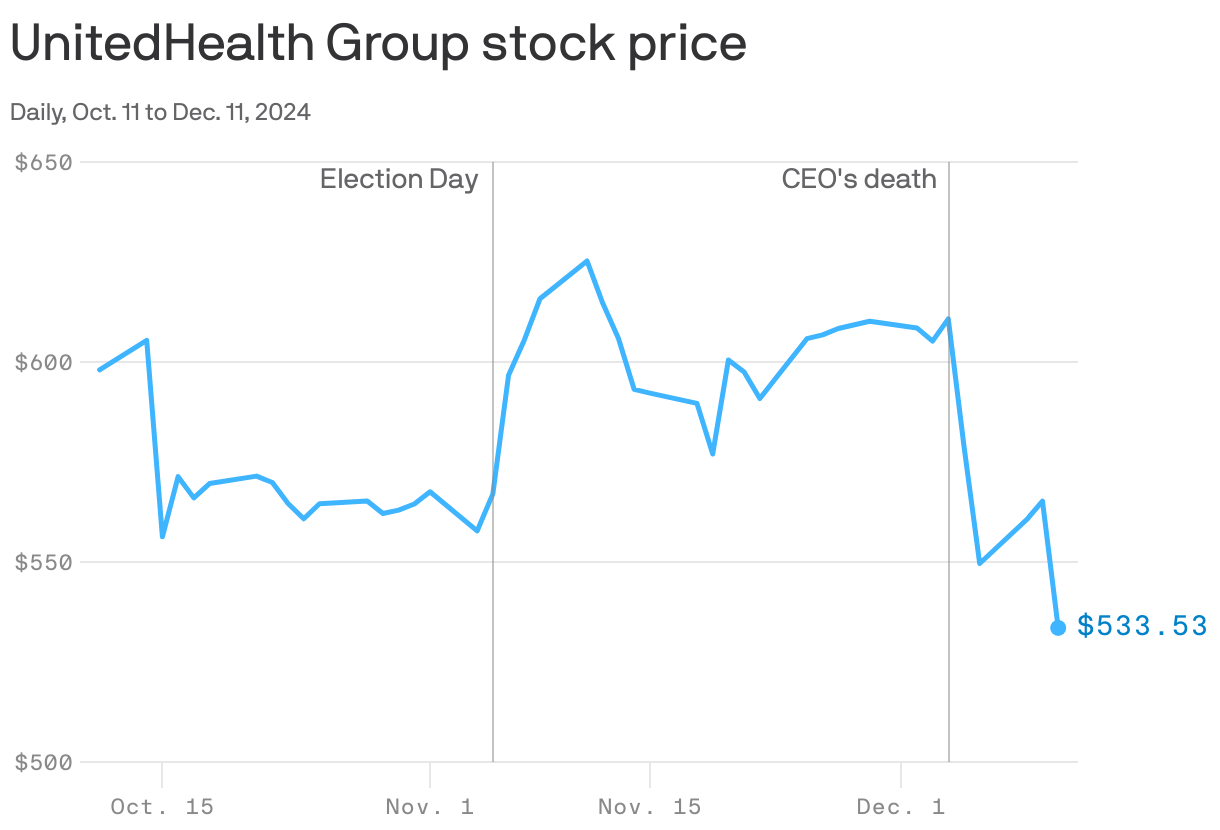
The vitriol directed at health insurers following the killing of UnitedHealthcare CEO Brian Thompson appears to be dampening the industry's once-sunny outlook for the second Trump administration.
- Shares of UnitedHealth Group have slid more than 12% in the last five days, Axios' Maya Goldman reports.
- Other insurers, including Cigna and Humana, also saw their stock prices slide this week.
🏥 Context: UnitedHealth Group's stock surged following Trump's victory.
- Republicans are generally friendlier to the industry than Democrats — and are especially fond of the private Medicare plans through which United makes a ton of money.
But "with public sentiment apparently so low, it is possible that regulators may feel emboldened to make bigger changes than they would have prior to this event," said Julie Utterback, a senior equity analyst at Morningstar.
4. 🔥 Malibu fire tops 4,000 acres

The fast-moving wildfire, which has forced 20,000 to evacuate in and around Malibu, Calif., is still growing, Axios' Andrew Freedman reports.
- Flames reached Pacific Coast Highway, shutting down parts of the road. Malibu schools remain closed today.

🚒 By the numbers: The Franklin Fire has swelled to more than 4,000 acres.
- A long stretch of dry, windy conditions means there's a heightened risk that new ignitions could spread quickly.
5. 🦾 CEO of the Year
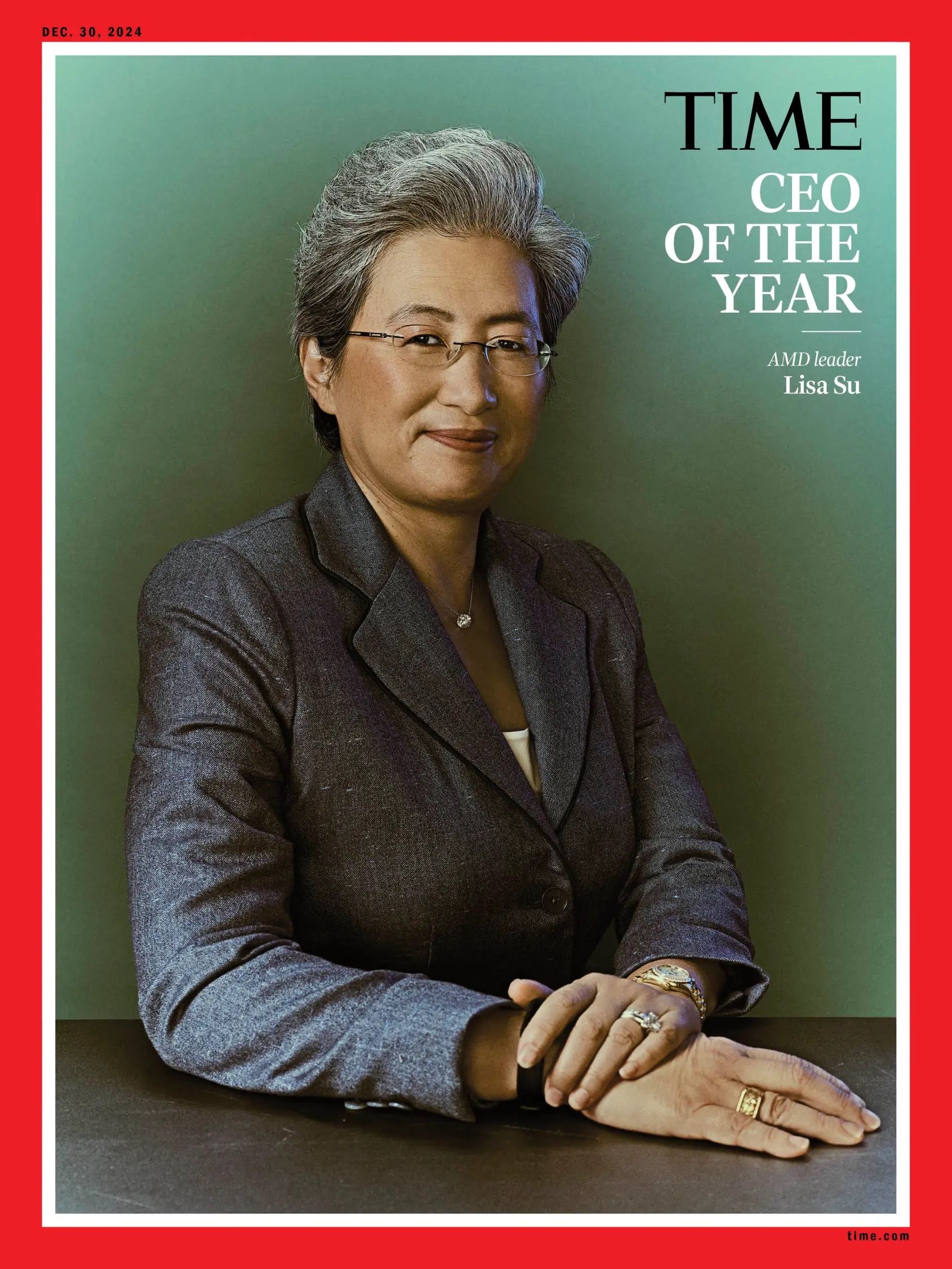
Lisa Su — chief executive of chipmaker AMD — is TIME's "CEO of the Year."
- AMD's stock price has increased 50x since Su took over a decade ago, fueled by AI — as well as smart planning that put the company in a position to benefit when some of its rivals, like Intel, have faltered.
- "It really is one of the great turnaround stories of modern American business history," Chris Miller, a historian of the semiconductor industry, told TIME.
TIME's Person of the Year — President-elect Trump — will be unveiled today.
6. 🧁 Willing to wait


For younger Americans, the way to transform an everyday food item into a memorable experience is to wait in line for it, Axios' Felix Salmon writes.
- 60% of Gen Z Americans have stood in line for 30 minutes or more, within the past year, to eat a specific food or at a specific restaurant, according to a survey from The New Consumer, in collaboration with Coefficient Capital.
- Was it worth it? 92% of them said yes. 74% said they'd do it again.
📸 "There's a performative element to this," Dan Frommer, publisher of The New Consumer, tells Axios. "You do it for the 'gram, and also to be part of some sort of cultural moment."
7. 🚇 D.C.-area CEOs push Trump on in-person work
An influential group of CEOs in the D.C. region is urging President-elect Trump to push to get more federal workers back to the office.
- The Greater Washington Partnership — a group of the largest CEOs between Richmond and Baltimore, including global defense, technology, energy and financial service companies — cites "the importance of in-person collaboration to deliver results for taxpayers."
🔎 Between the lines: Elon Musk — Trump's close adviser, and co-head of Trump's Department of Government Efficiency (DOGE) — is a huge proponent of in-office work.
"Our organizations continue to believe that the advantages of being together in-office are significant," the Partnership says in the letter to Trump and incoming White House chief of staff Susie Wiles.
- "This proximity delivers critical results in service of the nation, benefits American taxpayers and bolsters productivity and efficiencies for both the public and private sector."
8. 🍳 1 food thing: What we cooked in '24

Microwave chocolate pudding cake was New York Times Cooking's most popular dish of the year.
🐔 One-pot chicken and rice with caramelized lemon (pictured above) was No. 2.
- Cooking everything in one pot allows the whole dish to get a little extra help from the fat on the chicken, Axios editor and NYT Cooking superfan Sam Baker tells me. That's also an advantage of some of the NYT's popular sheet-pan recipes — that, plus easy cleanup.
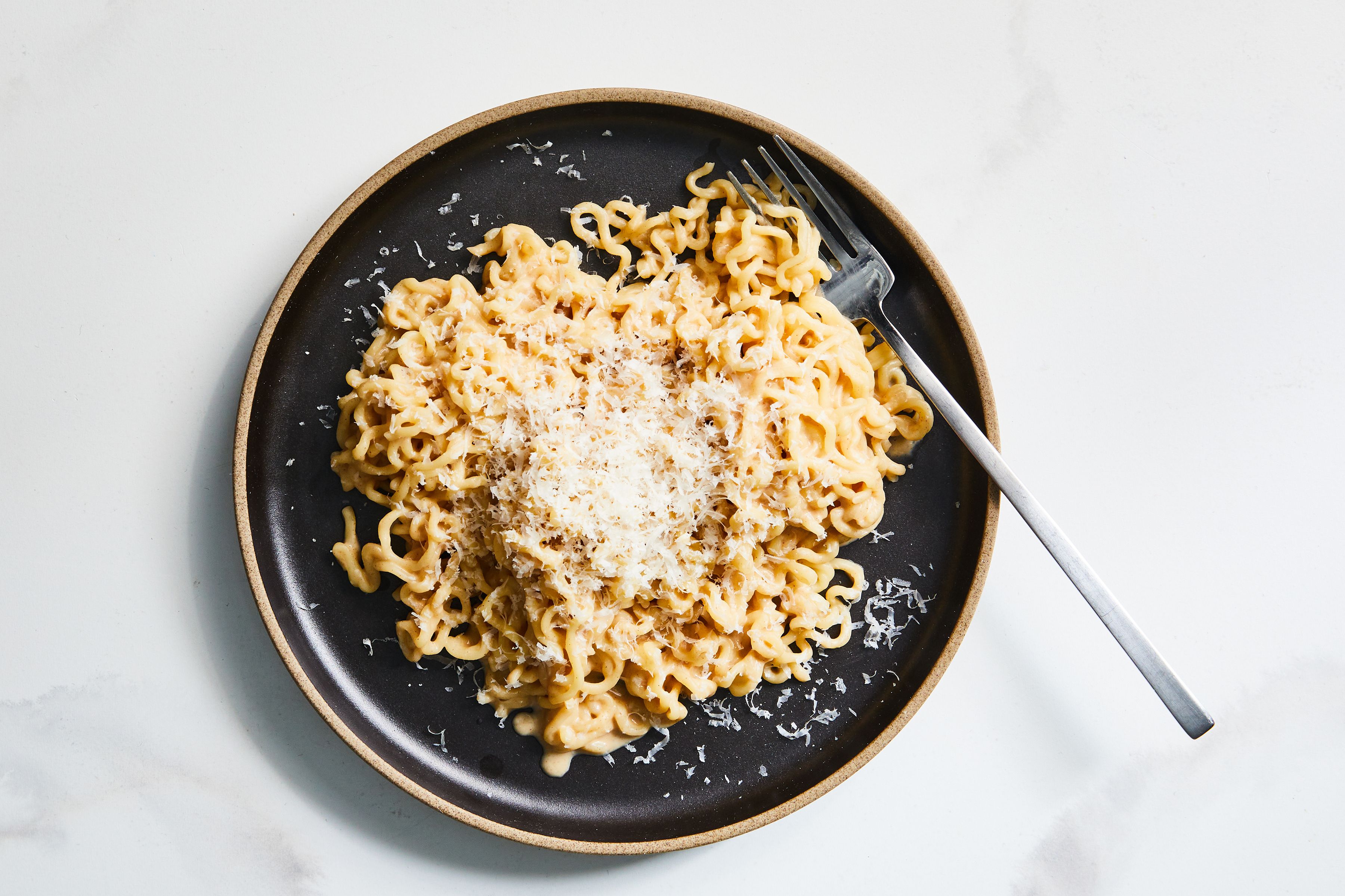
Peanut Butter Noodles: This bowl of noodles fuses Parmesan and peanut butter into a salty, smooth and satisfying sauce for ramen or spaghetti.
See the 25 most popular dishes of the year (gift link).
📬 Please invite your friends to join AM.
Sign up for Axios AM


/2024/12/12/1733971711879.gif?w=3840)
/2024/12/12/1734001614325.gif?w=3840)