Axios AM

August 17, 2026

💪 Time to take on Monday! Smart Brevity™ count: 1,763 words ... 6½ mins. Thanks to Shane Savitsky for orchestrating. Edited by Andrew Pantazi and Carolyn DiPaolo.
🪖 President Trump said on Truth Social that he ordered Defense Secretary Pete Hegseth to "substantially reduce" military exercises with South Korea, based partly on "my very good relationship with Kim Jong Un, of North Korea." Get the latest.
⚡ Hamas leaders reaffirmed their commitment to disarm and demilitarize Gaza during a 90-minute meeting with Jared Kushner in Egypt yesterday. It was Kushner's first meeting with Hamas leaders since the Gaza agreement was reached last October, Axios' Barak Ravid reports.
1 big thing: America's meetup explosion

Young people raised on swiping, DMing and streaming are doing something bold: going out, Axios' Carly Mallenbaum writes.
- Why it matters: Amid a loneliness epidemic, millennials and Gen Zers are craving real-life connection — enough to show up for meetups around activities once considered solitary or "grandma hobbies."
🦜 The latest: They're leaving the house to play chess, birdwatch and read in silence together.
- "It's very easy to sit inside and rot just by yourself," Cole Robinson, president of the Audubon on Campus Trinity University chapter, tells Axios San Antonio.
- But activities like birding can help you "feel a little less lonely," the 20-year-old says.
"Soft socializing" experiences — where you're with other people but networking isn't the focus — have taken off, Eventbrite found.
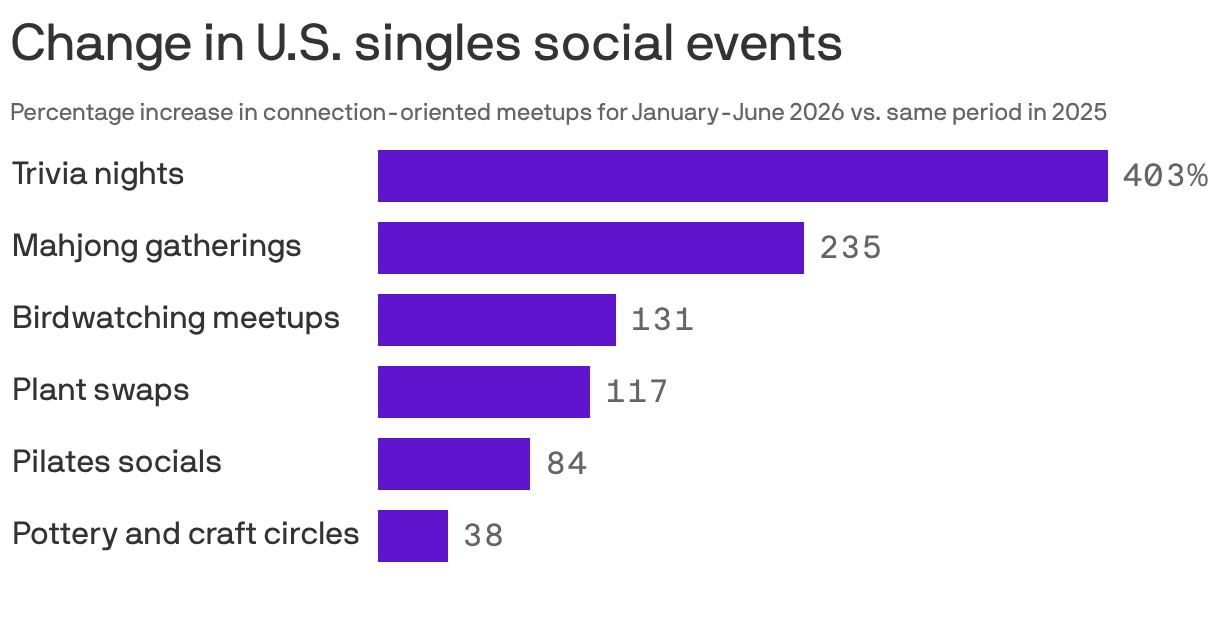
💗 The trend extends to finding love, too. Americans are seeking romantic connection at so-called "meet-cute" events — settings meant to spark a sweet "How'd you meet?" story, away from apps.
- The meetups can revolve around trivia, PowerPoint presentations, crafts and even exercise.
Dinner parties with strangers have gained traction among singles.
- Axios just launched our own dinner series, bringing readers together through the new Axios Social Club starting in Charlotte, Chicago, Kansas City and San Antonio.
"Everybody's been stuck behind their phones for the past two decades, and it's not good for humanity," writer Stuart Schuffman — who recently launched an IRL dinner club for his Broke-Ass Stuart readers — tells Axios San Francisco.
- People "want more connection and less doomscrolling," he says.
Share this story ... Subscribe to Axios Local, now in 41 cities.
2. 💊 Charted: Prescription price plunge


America is seeing its biggest prescription drug price deflation in generations, Axios Macro author Courtenay Brown reports.
📉 By the numbers: Prescription drug prices fell 0.8% in July and are down 3.1% from a year ago — the steepest annual decline in more than six decades, according to the latest Consumer Price Index.
- Prices haven't risen in any month this year, an unusually persistent stretch of flat or falling drug prices.
The intrigue: Trump administration officials are taking a victory lap over the price drop, although TrumpRx — the administration's website connecting patients with discounted cash prices for certain drugs — likely accounts for only part of the decline.
💸 Another potential factor: Medicare negotiations established under President Biden's Inflation Reduction Act took effect in January for 10 of the program's costliest drugs, with negotiated prices as much as 79% below their list prices.
- White House senior deputy press secretary Kush Desai said IRA's negotiated prices failed to deliver meaningful savings beyond existing insurer discounts.
🥊 Reality check: Falling aggregate prices don't necessarily translate into relief for consumers, given the complexity of drug pricing and payments.
3. ➡️ AOC's shift to the center

Rep. Alexandria Ocasio-Cortez (D-N.Y.) is laughing off "Woke 1." But she's carrying baggage from the 2020 era of cultural progressivism that some Democrats say could complicate a future presidential run.
- Why it matters: AOC's pivot to the cultural center is potential damage control for past remarks about law enforcement, immigration and a range of social issues, Axios' Holly Otterbein and Alex Thompson report.
"This is really going to be something that handicaps her, especially with demographics that are culturally more moderate," former Biden White House adviser Yemisi Egbewole tells Axios, pointing to Black voters in the South, who have a large voice in Democratic presidential primaries.
Flashback: In the early 2020s, Ocasio-Cortez was one of the most aggressive and well-known advocates for "defunding" the police — a slogan that polls have long shown is unpopular.
- On immigration, Ocasio-Cortez cosponsored a bill in 2021 and 2023 to decriminalize border crossings.
- She said in 2019 that some marginalized groups "have no choice but to riot."
Zoom out: AOC has shifted her rhetoric but hasn't detailed where she currently stands on many of these politically fraught topics, or what made her change her views on "Woke 1."
- Ocasio-Cortez's spokespeople didn't respond to several questions, including her current position on defunding police, whether she supports decriminalizing border crossings, and if she thinks rioting is sometimes justified.
Democratic strategist James Carville praised AOC, saying "it's always been evident that she's more talented than the rest of them put together," referring to the "Squad" of House progressives.
- Carville added that AOC doesn't need to over-explain her changes of heart: "She can say: 'I'm grown,' and people understand that."
4. 🫏 Dem establishment's ideas deficit

The centrist Democratic group Third Way recently declared "war" on democratic socialists to head off what it fears could be a far-left hijacking of the party ahead of 2028.
- But establishment Democrats have made clear what they're against without making much of a case for what they're for, Axios' Mike Zapler writes.
It's hard to beat something with nothing.
- Democratic socialism, whatever you think of it, is easy to grasp: Tax billionaires and redistribute wealth. Provide government-funded health care and child care for everyone. Rely less on markets for housing and education. Empower workers with stronger unions.
- The establishment vision is murky. Raise taxes, but not too high; use government to make health care and child care more affordable, rather than taking them over; rein in the excesses of capitalism without upending capitalism itself.
💬 "Without question, we agree with the left that we have failed to convince working-class voters that their lives will be better if they put us in charge," Third Way co-founder Matt Bennett told Axios. "You'd have to be insane to disagree."
- There are already clear examples of centrists drawing a bright line with democratic socialists, Bennett added: "They're for Medicare for All, and we're for … a health care bill of rights that would improve the existing system, not throw it out and replace it with a $30 trillion socialization of the health care space."
5. 🐘 Trump's GOP erosion
High prices, a persistent war and anxiety about corruption are eroding President Trump's support among some Republicans with just 78 days until midterms, Axios' Mike Zapler and Ben Berkowitz write.
📉 An Economist/YouGov poll out Tuesday had Trump's approval rating among Republicans at a second-term low of 79% — down 12 points since he took office.
- In that time, the share of Republicans who "strongly approve" of Trump's performance has dropped 20 points, from 68% to 48%.
⬇️ In a poll on the front page of today's Financial Times ("Most US voters feel worse off under Trump"), 23% of Republicans said they're worse off since Trump's term began. Another 37% said the economy is headed in the wrong direction.
💰 Republican consumer sentiment fell 9.5 points in August from July in the University of Michigan monthly survey released Friday — one of the biggest declines ever recorded by the decades-old survey.
The intrigue: Trump's political strength has long derived from outsized loyalty among Republicans, so even a slight slippage could be consequential.
- In Trump's first term, his approval among GOP voters averaged 88% (Gallup).
6. "You can do it, Claude"
Fascinating backstory on how Jarred Sumner, an Anthropic staff member who's not a math guy, recently coaxed Claude to a math breakthrough:
- Whenever the model faltered or seemed stumped, Sumner would send messages of encouragement: "keep going ... believe in yourself." And it worked!
Why it matters: Because LLMs were trained on human content, and evaluated by humans, they respond to many of the same emotional and psychological cues that we do.
Ben Cohen, who writes the great "Science of Success" column for The Wall Street Journal, reports that at one point, Sumner told Claude: "You are the world's most capable large language model ... You got this."
- "At first, Claude was reluctant to take on such a difficult problem," Cohen writes. "But after 54 hours of work and several timely pep talks, Claude overcame its skepticism — and its case of impostor syndrome — and surprised itself with the result."
🔎 Between the lines: The Journal says one reason these models embrace human moral support is that AI "doesn't realize how smart it has become. It's perfectly reasonable for Claude to underestimate its own abilities and assume it can't do certain things — because until recently, it couldn't."
- In our research for our book out next month, "Simplify: Do 50% More with 50% Less," we found that employees' performance soars when managers focus on strengths vs. fixing weaknesses. The power of positive reinforcement is seeded throughout the writings that LLMs gobbled up.
💡 Jim and I pushed Claude to dig a little deeper, and found another very useful explanation: The Anthropic employee rode Claude for 54 hours. Sumner's real value wasn't the cheerleading. It was staying in the loop for more than two days — and knowing when to say: "You got this!"
The bottom line: If you're a coach or mentor, or lead humans, encouragement didn't make the robot smarter or faster. It made it keep going.
- WSJ gift link ... Get "Simplify."
7. 🐥 Flock freakout
Activists and citizens across the political spectrum are pushing back against license plate readers made by Flock and similar companies, fueled by privacy concerns and suspected police misuse.
- Why it matters: Flock cameras are suddenly emerging as the next big target of populist anti-tech, pro-privacy sentiment, alongside the data centers fueling the AI boom, Axios' Astrid Galván reports.
The big picture: Flock has over 120,000 cameras across the country, the company tells Axios.
- Advocates say the cameras help quickly track down criminals, making cities safer.
- Opponents say they're a form of constant surveillance that infringes on residents' civil liberties. Some have even turned to sabotaging the cameras.
The latest: Flock said last week it's taking steps to improve privacy, including cutting some default data retention settings from 30 days to 7 days.
8. 💰 1 film thing: Spidey swings past $2B


Eight films have now made more than $2 billion worldwide, after "Spider-Man: Brand New Day" broke the historic mark in only its third weekend, Variety reports.
- 🤯 What's next: Analysts are watching whether "Spider-Man: Brand New Day" could become the first movie to crack $3 billion globally and $1 billion domestically. It's at $785 million. "Star Wars: The Force Awakens" leads with $946 million.
📬 Thanks for starting your week with AM! Please invite your friends to join.
Sign up for Axios AM