Axios AM

March 19, 2025

🐫 Hello, Wednesday! Smart Brevity™ count: 1,994 words ... 7½ mins. Thanks to Noah Bressner for orchestrating. Copy edited by Bryan McBournie.
⚖️ Situational awareness: Federal judges handed the Trump administration a trio of setbacks yesterday.
- Ruling that DOGE likely violated the Constitution "in multiple ways" with its dismantling of USAID. Go deeper.
- Blocking enforcement of Trump's executive order banning transgender people from military service. Go deeper.
- Stopping the administration from terminating $14 billion in grants to climate groups. Go deeper.
1 big thing: Trump's Supreme plot on immigration
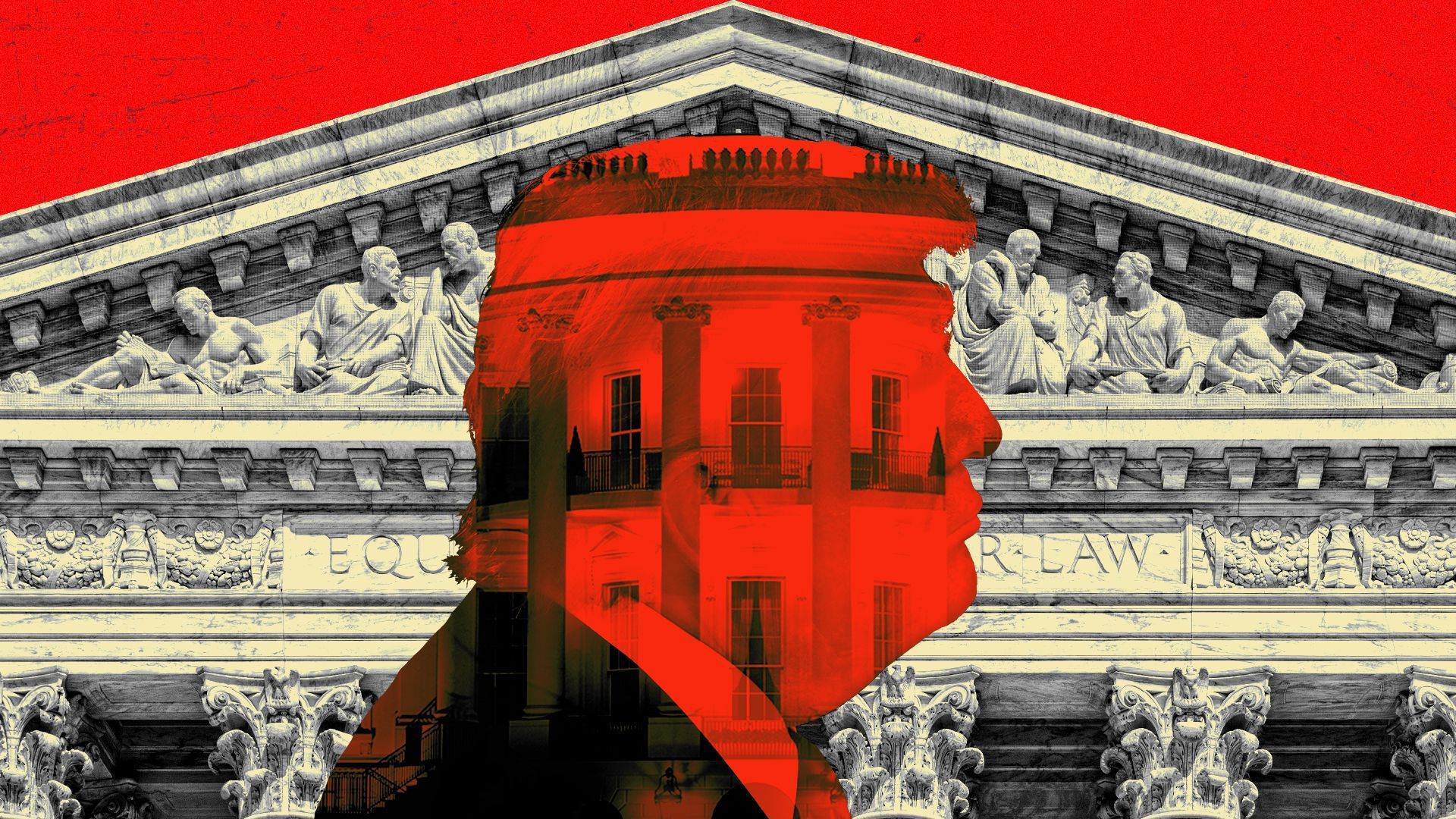
President Trump has accelerated a multipronged, methodically planned strategy to push the Supreme Court to bless his power to deport vastly more people with vastly fewer judicial restraints, Axios' Marc Caputo reports.
- Trump officials see at least five questions, detailed below, that they hope the Supreme Court will answer.
Why it matters: Trump's plan revolves around two cases and obscure laws that have ignited lawsuits and sent shockwaves through the immigration system over successive weekends:
- Invoking the Alien Enemies Act of 1798 to deport accused Venezuelan gang members without immigration hearings. Nearly 140 were flown out of the U.S. on Saturday in a controversial operation that left a federal district judge fuming that his order to turn the plane around had been ignored.
- Using the Immigration and Nationality Act of 1952 to detain pro-Palestinian activist Mahmoud Khalil, who helped lead protests at Columbia University. The administration says the courts have little say over Secretary of State Marco Rubio's determination that Khalil should be deported as a national security risk for protesting against U.S. foreign policy.
🔬 Zoom in: Between the two cases, Trump administration officials and their allies see five major questions they'd like to put before the Supreme Court.
- Does a peacetime president have the right to deport noncitizens under the war-time Alien Enemies Act — even if there's no declared war against a foreign adversary?
- Should a single federal judge in a district court have the power to block a president's deportation program nationwide?
- Can that federal judge's order extend to international waters and demand that a plane full of deportees turn around mid-flight?
- Does a green card holder like Khalil have speech rights that protect him from deportation? Or can the secretary of state unilaterally declare his speech "adverse" to U.S. foreign policy interests because the government alleges it aligns with the terror group Hamas?
- Can the secretary of state's power to deport immigrants based on foreign-policy concerns extend to so many student visa holders that some colleges won't be able to admit foreign-exchange students?
🔭 Zoom out: "When you broaden that concept," a senior Justice Department official told Axios, "every single noncitizen who actively supports Hamas is subject to a determination by Secretary Rubio that they lose their status — and become exactly like Khalil and are immediately deportable."
- "Our end game is all hands on deck, trying everything," the official said. "Everything we're doing, we're gaming out how the Supreme Court gets to decide."
💡 The DOJ official summarized the Trump administration's legal attack plan this way:
- "We really do want to push the court — ultimately the Supreme Court — to take a stand. ... We're trying to get clarity. And we're not putting all eggs in one basket. It's why we're seeing all efforts to remove people."
- And, the official said, "We have other plans."
One of those other plans could be a doozy: stripping U.S. citizenship from naturalized Americans.
- "What's going to be on the horizon are denaturalization cases," said Mike Davis, a close White House ally and founder of the conservative Article III Project.
- "You're going to have Hamas supporters who have been naturalized within the last 10 years, and they are eligible to lose their status as citizens and get deported," Davis said. "It's worth it."
The other side: Civil libertarians are horrified by what they see as a large-scale assault on free speech and due process by an administration that's bent on granting authoritarian-like powers to Trump.
- "The government's action constitutes a profound threat to free speech on university campuses and beyond," law professors Ahilan Arulanantham and Adam Cox wrote last week in Just Security, a law and policy journal.
- They wrote that freedom of speech on campuses was "already on life support after aggressive measures universities had taken to discipline and discourage pro-Palestine protest activity since shortly after October 7, 2023."
🔎 Behind the scenes: Trump's effort is spearheaded by deputy chief of staff Stephen Miller, the president's top domestic policy adviser.
- Unlike Trump's first administration, there's close coordination on immigration policy among the White House and the departments of Homeland Security, Justice and State.
Between the lines: Trump's administration is counting on a Supreme Court on which six of the nine members were appointed by Republicans — three by Trump.
- This high court typically has tried to avoid immigration disputes, but Trump's team aims to force its hand. "We have the law, and we have the numbers on the court," a Trump adviser said. "We've always known this is where all this ends up."
2. 🤔 March Madness stumps AI
AI chatbots aren't quite ready to pick your March Madness brackets, Axios chief tech correspondent Ina Fried writes.
- Why it matters: Tech companies tout AI as semi-autonomous agents. But Ina's testing shows that plenty of tasks are still beyond its capabilities.
🦾 The big picture: March Madness has long been a tech proving ground, from video streaming to picture-in-picture. Plus, companies are always competing to be your second screen while you watch the games.
- Perplexity, a top AI startup, is incorporating odds from prediction market Kalshi.
Ina's first-person account: OpenAI says ChatGPT is better at analyzing matchups or strategy than building full brackets. That holds true for others, too. I thought AI might struggle as much as humans to pick the correct winners.
- But I didn't anticipate how much trouble the chatbots had with the brackets themselves.
Chatbots confidently offered picks that were impossible.
- Keep reading to see how leading chatbots tackled Ina's bracket — and where and how things went awry.
3. 🎢 Federal workers ride layoff roller coaster
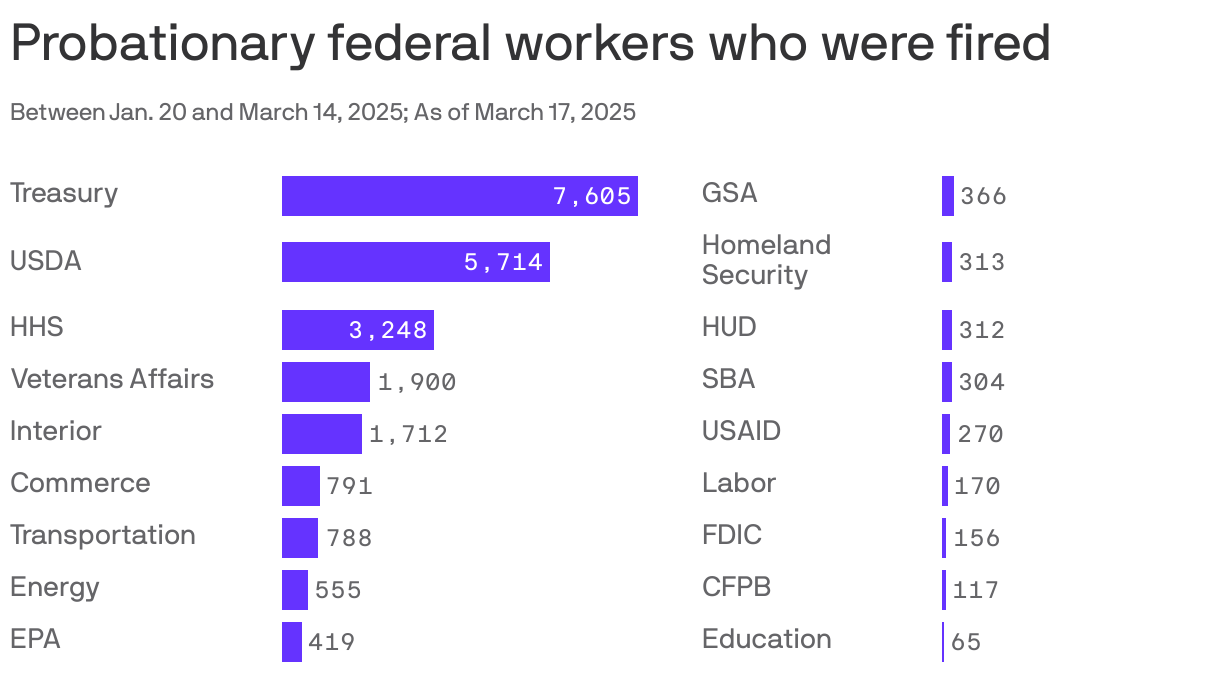
All over the country, fired federal workers got a bit of good news this week — they're getting their jobs back— for now, anyway, Axios' Emily Peck writes.
- Why it matters: The recently rehired could soon become the newly re-fired, and the productivity of the entire federal workforce is taking another hit.
Two federal judges have ordered agencies to reinstate the tens of thousands of probationary workers they've terminated over the past month. But the White House is appealing those orders.
- The administration has also told agencies to do even more layoffs — this time through the more formal process of reductions in force, or RIFs.
🖼️ The big picture: In other words, people were fired, now they're being rehired and it's quite possible they'll lose their jobs again — either via a court ruling or another round of layoffs.
- More than 24,000 probationary workers who were fired across 18 agencies are in the process of being reinstated, according to data provided to the U.S. District Court in Maryland by the agencies Monday night.
4. 📉 Charted: Not-so-Magnificent 7


A further sell-off yesterday took the market into unusual territory: All of the Magnificent 7 stocks are now down for the year, Axios' Ben Berkowitz writes.
- Why it matters: The so-called Mag 7 led the market for the past two years. Their weakness in 2025 isn't helping with the broader correction in stocks.
🧮 By the numbers: Of the seven — Alphabet, Amazon, Apple, Meta, Microsoft, Nvidia and Tesla — Meta was the last holdout.
- It's now down 0.5% for the year, with most of the rest down about 10% to 15% — except for Tesla.
- Elon Musk's EV maker is off 44% in 2025 with unique issues of its own.
5. 🚘 3 trends shaping future of mobility

Axios transportation correspondent Joann Muller launches a weekly newsletter today, Future of Mobility, on trends upending the automotive industry. Sign up here.
Joann lays out three trends that will define the future:
🔌 1. Electric vehicles have grown to about 9% of all new cars sold in the U.S., but charging and affordability are still a hindrance.
- Even market leader Tesla is struggling. Sales have plummeted worldwide as controversy grows over Elon Musk's political activity.
- China's BYD might have changed the game, unveiling a new EV platform that can recharge in five minutes — about the time it takes to fill a gas tank.
🤖 2. Autonomous vehicles have had years of frustration and slow progress; only one company, Waymo, operates a real commercial robotaxi service today.
💻 3. Software-defined vehicles started with Tesla, which pioneered the "computer on wheels" in 2012. The rest of the industry is taking a long time to catch up.
- Between the lines: Automakers lack systems expertise, which is why they're recruiting talent from Apple, Google and other tech giants.
6. 👂 Leaked audio: Trump's Kennedy Center remake
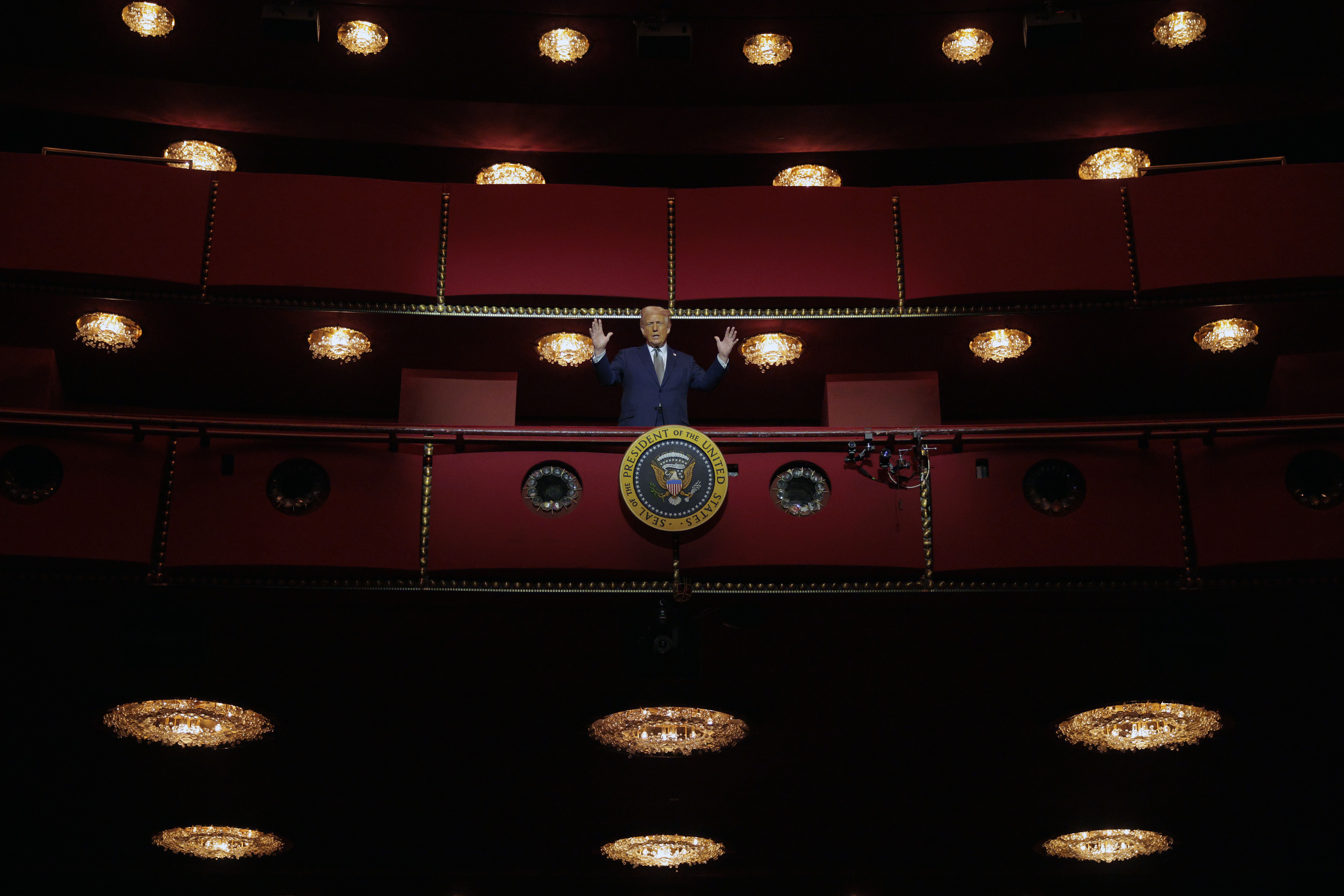
President Trump is picturing a complete remake of the Kennedy Center Honors — perhaps with him as host, according to audio from Monday's board meeting, obtained by the N.Y. Times.
- "Believe me, I don't wanna do it. I don't wanna do it! They get lousy ratings. And I will agree for zero [dollars] to be the host. I don't wanna do it — I have enough publicity."
- "They'll say: 'Trump wants to be the host.' I don't want to! But I want this thing to be successful."
- He referred to himself as "the king of ratings, right? Whether we like it or not, the king of ratings."
👓 Between the lines: Trump told the Kennedy Center's new board members — all appointed by him — on Monday that he wants honorees to be "slightly more conservative."
- "You could do a guy like Steve Wynn," he said, referring to the casino mogul and Trump megadonor. "You could do entrepreneurs. You could do people that, you know, that were really in charge of show business. ... You could do politicians. You could do sports stars."
Keep reading + listen to the audio (gift link).
7. 📚 Coming attractions: Inside Condé

A book four years in the making: New York Times media correspondent Michael Grynbaum will be out July 15 with "Empire of the Elite: Inside Condé Nast, the Media Dynasty that Reshaped America."
- Why it matters: It's billed as a cultural history of Condé Nast — publisher of The New Yorker, Vanity Fair, Vogue and GQ — as titan of the "once-glamorous magazine world," and "the profound influence of its magazines on the last half-century of American life."
🕶️ "The book, which started as a pandemic project, reveals how powerful editors including Graydon Carter, Anna Wintour and Tina Brown [cover photos, from left] "indelibly shaped our modern ideas of celebrity, fashion, class, and what it meant for Americans to aspire to 'the good life,'" Grynbaum tells me.
- Grynbaum, who joined The Times as an intern after Harvard, adds: "Condé was a lot like a movie studio in the Golden Age of Hollywood: a dream factory of artistic all-stars, overseen by a mercurial and sometimes brutal benefactor, whose creative output defined the nation's aspirations and tastes. It was the ultimate media gatekeeper — until the internet happened."
8. 🧑🚀 Pic to go: Stuck astronauts return home

NASA astronauts Suni Williams and Butch Wilmore splashed down off the Gulf Coast of Florida yesterday after unexpectedly spending nine months on the International Space Station.
- Russia's Aleksandr Gorbunov and NASA's Nick Hague, who arrived at the ISS last fall, were also on the capsule.
The two expected to be gone just a week after launching on Boeing's new Starliner crew capsule in June.
- So many problems cropped up on the way to the space station that NASA eventually sent the Starliner back empty and transferred the test pilots to SpaceX.
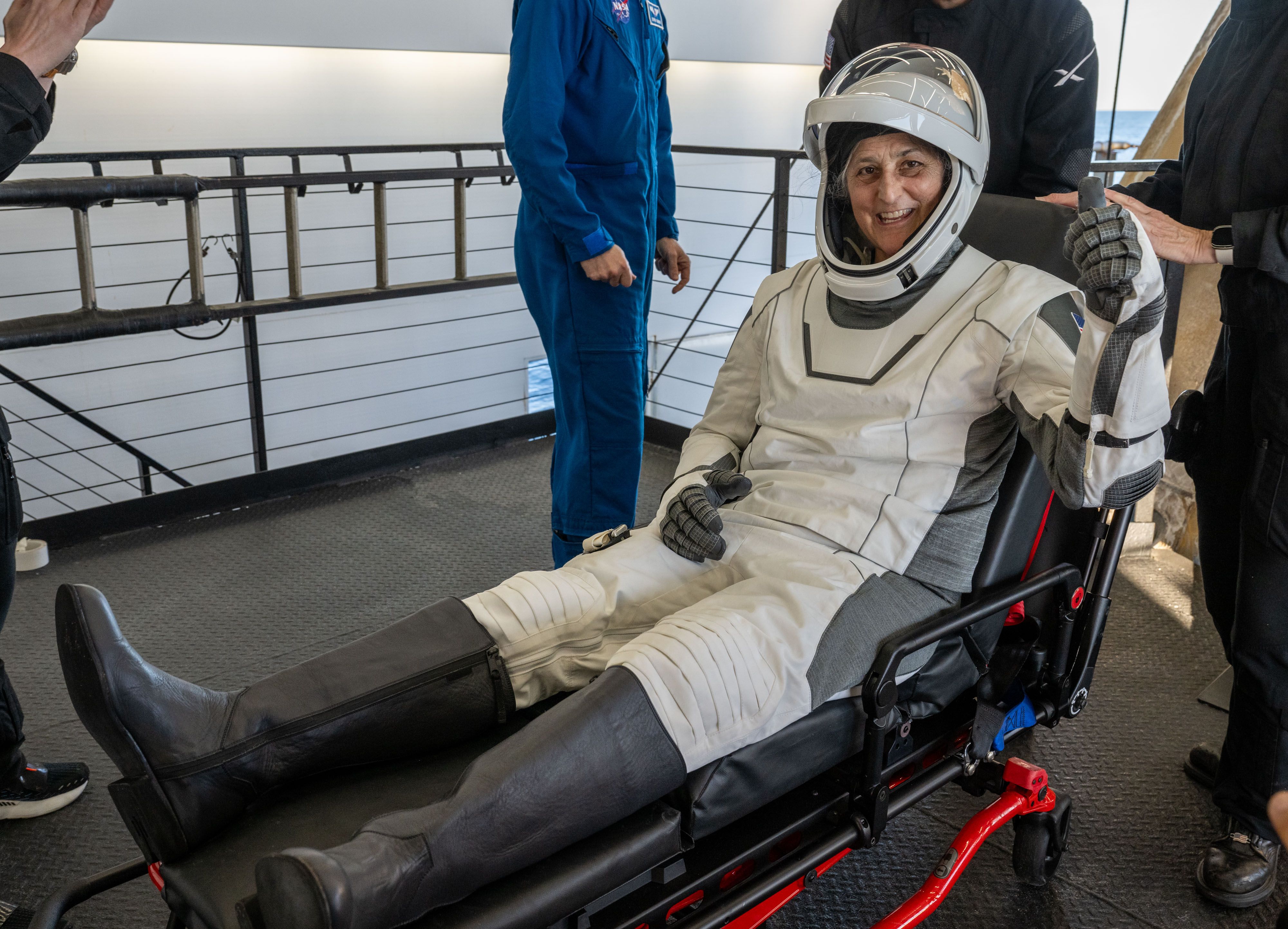
🚀 By the numbers: Wilmore and Williams ended up spending 286 days in space — 278 days longer than expected.
- They circled Earth 4,576 times and traveled 121 million miles by the time of splashdown.
📬 Thanks for reading! Please invite your friends to join AM.
Sign up for Axios AM