Axios AM

July 10, 2026

🕶️ It's Friday! Smart Brevity™ count: 1,362 words ... 5 mins. Thanks to Erica Pandey for orchestrating. Edited by Bill Kole.
1 big thing: AI have-nots and know-nots
A staggering class divide now separates how Americans experience artificial intelligence, Axios' Zachary Basu reports:
- For frontier power-users, AI feels like a revolution: a force capable of conjuring companies, building software and solving complex problems at warp speed.
- For the average person, it feels more like an evolution: a smarter search bar, a faster inbox, an ambient tech layer that saves time — but not much else.
Why it matters: Trillions of dollars in economic value — and the livelihoods of millions of workers — are being staked on a technology that most Americans neither trust nor fully understand.
- It's a new chapter in America's digital divide — the AI "haves," "have-nots" and "know-nots" — with profound implications for the future of wealth, work and power.
🤖 Zoom in: The newest frontier models are designed for an agentic world of coding, research and cybersecurity that most Americans will never see, let alone operate.
- OpenAI's Sol and Anthropic's Fable now sit atop the pyramid of elite AI obsession, prized for running long coding and research loops with minimal human intervention.
Prominent developers have spent the week personifying the two models — debating their temperaments, work ethics, even their personalities, the way sports fans argue over rival athletes.
- "My overall feel is that Fable is a 'wise owl' who is very thoughtful and very well spoken," tweeted AI researcher Peter Gostev. "GPT-5.6-Sol is like a rottweiler who will grab the problem by the throat and not let go until it is done."
Reality check: The people fluent enough to judge Sol against Fable on a coding benchmark are a tiny slice of the country. For most Americans, those names and metrics mean nothing.
- Millions of people encounter AI passively or unknowingly — through search summaries, AI-generated content, customer-service bots and invisible features inside apps.
- Nearly half of U.S. adults now use AI chatbots. But the most common use is basic information search — the same job Google has done for two decades, a world away from autonomous coding agents.
- OpenAI counts more than 50 million paying subscribers in its weekly ChatGPT user base of more than 900 million. The population running agentic coding tools is a fraction of that fraction.
👀 Between the lines: Even among the elites living the frontier AI revolution, there's a pecking order.
- Sol began as a restricted preview for OpenAI's trusted partners and select organizations before broader rollout, making early access itself a status marker inside AI circles.
- Fable was pulled offline globally for nearly three weeks in June under U.S. export controls. Its more powerful sibling, Mythos, remains restricted to a small number of trusted organizations.
- The result is a hierarchy inside the hierarchy: free users, paid users, power users, preview users and an insider class testing capabilities the rest of the world can only read about.
Zoom out: The AI industry ultimately needs broad social permission for the transformation it's selling — more data centers, deeper workplace automation, and AI embedded in schools, government and daily life.
- Yet as AI adoption has climbed, trust has fallen: 63% of Americans say AI is advancing too quickly, and just 16% expect it to benefit society over the next 20 years, according to Pew Research.
- The clearest gains are being captured by investors, tech giants and power users, while ordinary Americans are being asked to absorb the disruption to jobs, energy and information feeds.
👓 What to watch: The Trump administration's Labor Department published a national AI literacy framework in February, aimed at helping workers "share in the prosperity that AI will create."
- OpenAI, Anthropic, Microsoft and Amazon helped pool $500 million in June for RAISE US, a workforce retraining initiative led by former Commerce Secretary Gina Raimondo and former Indiana Gov. Eric Holcomb.
But basic literacy efforts can only go so far: Frontier users have better tools, earlier access, deeper technical context and hundreds of hours of trial-and-error with systems that change every few weeks.
2. 🇨🇳 Pharma's China tradeoff

The life sciences world is split over how the U.S. should respond to China's quick biotech advances — specifically over whether Washington needs a more protectionist playbook to preserve American dominance, Axios' Caitlin Owens reports.
- It's both cheaper and faster to do early-stage drug development in China than in the U.S. That reality is now being reflected in the places pharma giants like Bristol Myers Squibb and Pfizer are spending their money.
Zoom in: Skeptics warn that the strategy of rapidly snapping up Chinese-developed experimental drugs is shortsighted or even dangerous. It risks hollowing out the American biotech base, and it won't stop China from eventually competing directly with large pharmaceutical companies.
- Others take the view that the China work will yield another source of high-quality drugs. "American patients deserve access to groundbreaking new drugs," Atlas Venture partner Bruce Booth wrote in a blog post. "The origins of drugs have never really mattered, nor should they."
Get Axios Vitals for daily reporting on industry, policy and the future of health.
3. 🏛️ MAGA figures flock to Charlie Kirk murder hearing

Prominent MAGA and conservative figures are descending on a Utah courthouse this week to attend the preliminary hearing for the man accused of murdering Turning Point USA founder Charlie Kirk, Axios' Alex Isenstadt and Marc Caputo report.
- Why it matters: The show of support in Provo underscores that, nearly a year after his assassination, Kirk remains a unifying figure across the Republican Party and the MAGA movement.
Among those who have joined Kirk's family members this week in attending hearings for accused killer Tyler Robinson are:
- Donald Trump Jr.
- Utah Sen. Mike Lee (R).
- Conservative influencers Jack Posobiec and Graham Allen.
- Rush Limbaugh's widow, Kathryn Adams Limbaugh.
The latest: Prosecutors are using this week's preliminary hearing to try to persuade a Utah judge there is sufficient evidence to send Robinson to trial on aggravated murder charges, which could lead to the death penalty.
4. 💊 Stat du jour: GLP-1 boom

The percentage of U.S. adults who currently take GLP-1 medications for weight loss has nearly quadrupled since 2024, from 3% to 11%, a new Gallup poll finds.
- 15% say they've used the drugs for weight loss at some point, up from close to 6% two years ago.
America's obesity rate has also ticked down, from 39.9% in 2022 to 36.4% this year.
5. 🦾 AI chip rush
Nearly every major AI company is either making or considering making homegrown chips to reduce reliance on Nvidia and cut costs.
- Reality check: Designing a chip is one thing. Securing the manufacturing capacity, memory and packaging needed to produce it at scale is much harder, Axios' Ina Fried and Madison Mills write.
6. 🚲 E-bike injuries surge
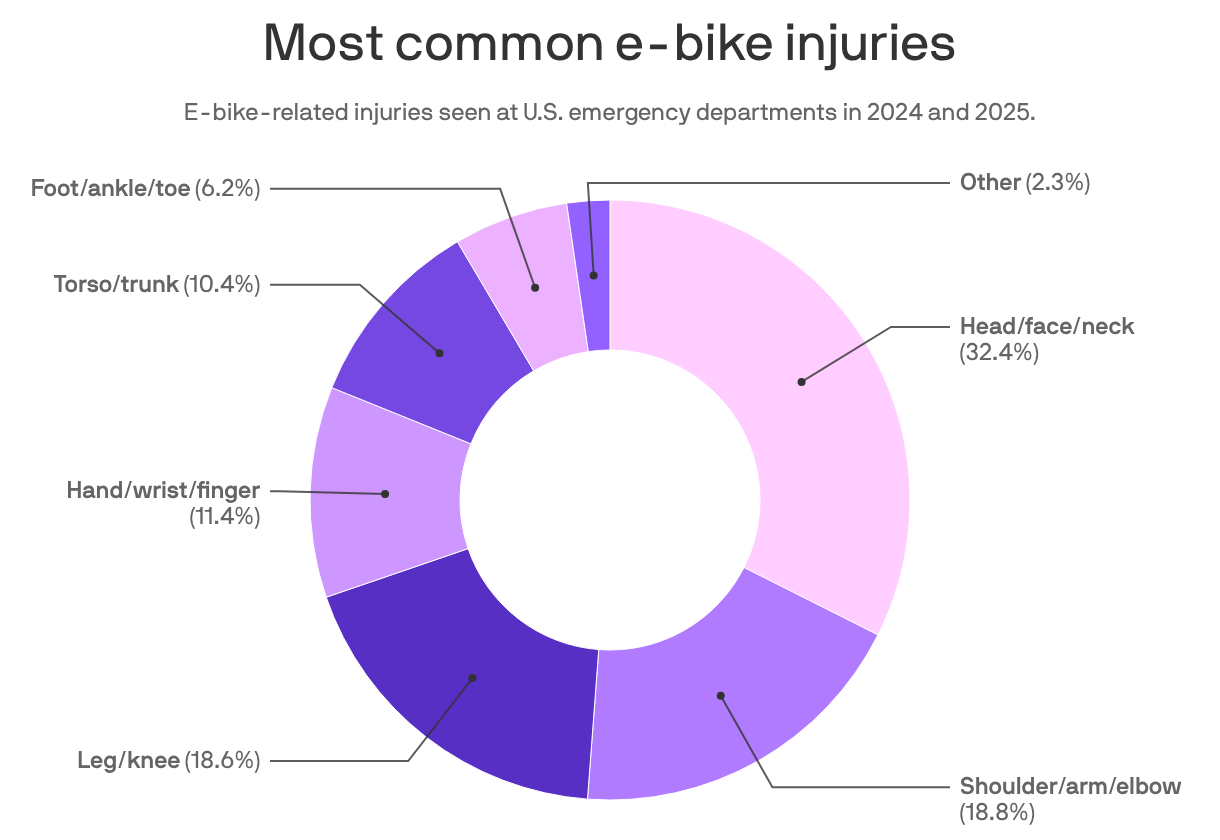
Open embedded content from datawrapper.dwcdn.netE-bike sales in the U.S. have more than quadrupled over the past five years, but a spike in ownership has also meant a spike in injuries — especially among young people.
- About 41% of all emergency visits for e-bike injuries in 2024 and 2025 involved patients ages 10 to 19, Axios' Brad Jennings reports from National Electronic Injury Surveillance System estimates.
7. ⚖️ Indictments: Plot targeted UFC

In Ohio, eight men were indicted on terrorism and conspiracy charges yesterday in an alleged plot to target President Trump's UFC cage-fighting show at the White House last month with drones and snipers. Get the latest.
8. 🏗️ 1 for the road: Construction surrounds White House

On the South Lawn, a helipad is being built for Marine One, which has been scorching the grass.
- "It's got the seal of the White House on it ... in carved granite," President Trump told reporters Monday. "It's really a beautiful thing."
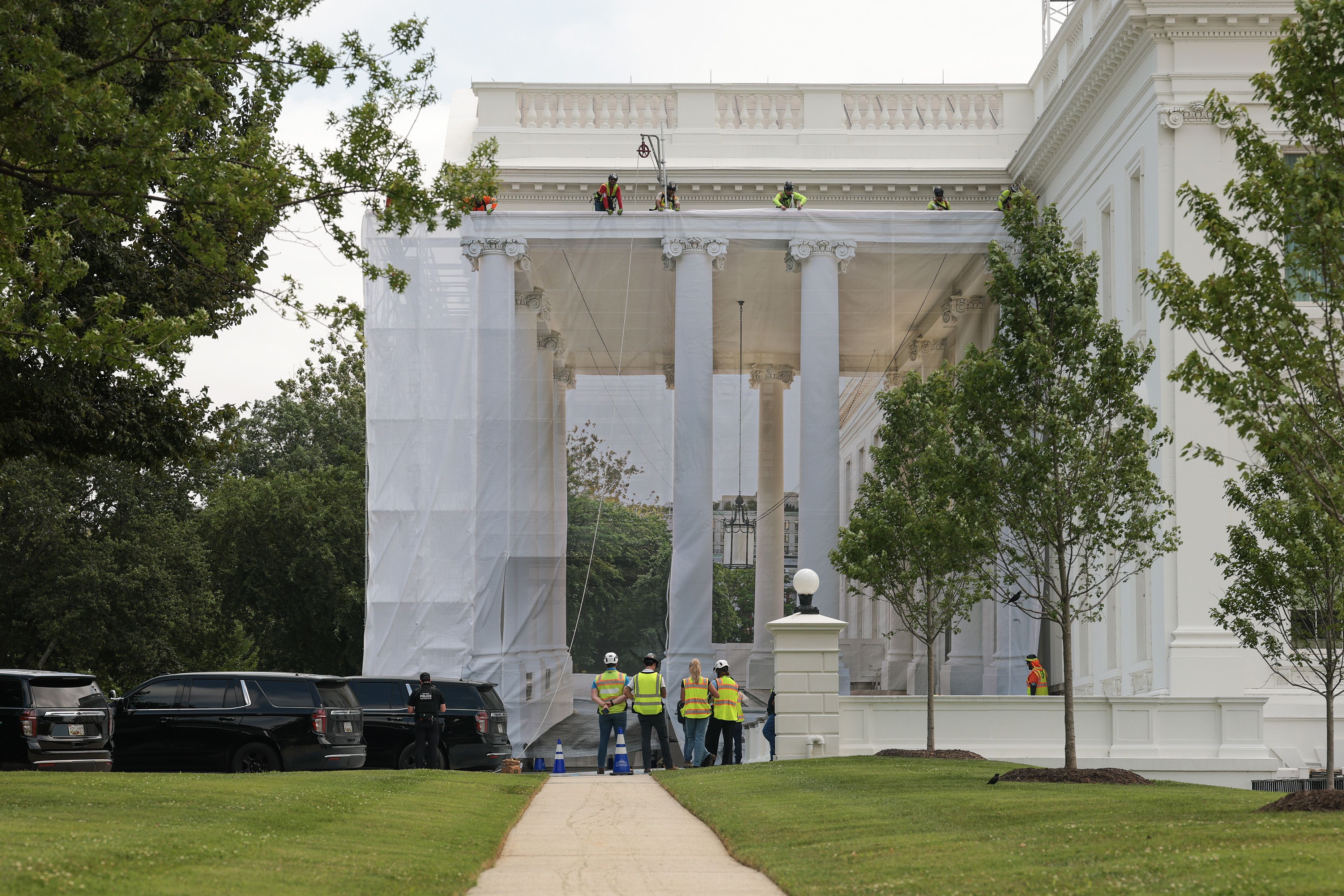
On the North Portico, workers yesterday draped tarps around scaffolding on the towering stone columns. The tarps, partially see-through, evoke the ornate stone columns beneath.
- Trump said on Monday: "We've taken about 150 years of paint off of the columns ... If you don't strip the paint off, it gets worse and worse and worse." (AP)

The ballroom, seen here from the Washington Monument, is going up fast.
- Trump's plans to build a 250-foot-high "Triumphal Arch" in the nation's capital won initial approval yesterday from the National Capital Planning Commission. Members put off a decision on whether a federal law that limits building heights should be applied. Keep reading.
📬 Thanks for reading! Please invite your friends to join AM.
Sign up for Axios AM