Axios AM

July 06, 2025

👋 Hello, Sunday. Smart Brevity™ count: 1,794 words ... 7 mins. Thanks to Erica Pandey for orchestrating. Edited by Donica Phifer.
1 big thing: Two labor markets
Americans live in two economic realities: Those with a job are likely to remain employed, but those without one are likely to stay unemployed.
- Why it matters: Welcome to the low-hire, low-fire labor market. Private-sector layoffs are at historic lows, but that masks a dreadful outlook for unemployed workers or those unhappy with their current positions, Axios' Courtenay Brown writes.
💼 Zoom in: The labor market surprised in June with a better-than-expected payroll gain of 147,000, the government said Thursday.
- But 85% of those job gains came in just two sectors, according to calculations by Mike Konczal, a former Biden economic official: education and health care.
- Hiring in other sectors — including professional and business services, a catch-all category for white collar jobs — was little changed, the government said.
Zoom out: That continues the "frozen job market" trend that has plagued the economy in recent years.
- The trend is being exacerbated by the rise of AI, as employers experiment with how to make their workforces more productive.
👀 Between the lines: Separate data released last week showed the number of layoffs fell by 188,000 in May, hovering above multi-decade lows.
- But the number of people hired into new jobs also fell by 112,000, a rate significantly below its pre-pandemic levels.
- The number of workers continuing to collect unemployment benefits is at the highest level since 2021, a sign that it is taking jobless workers longer to find a job.
The bottom line: If you look only at how many Americans are losing their jobs, this appears to be a pretty terrific labor market. If you look only at how many are being hired for new jobs, it is the weakest in years.
- The question ahead is how it gets unstuck — with a pick-up in hiring, or a pick-up in layoffs.
2. Texas death toll crosses 50

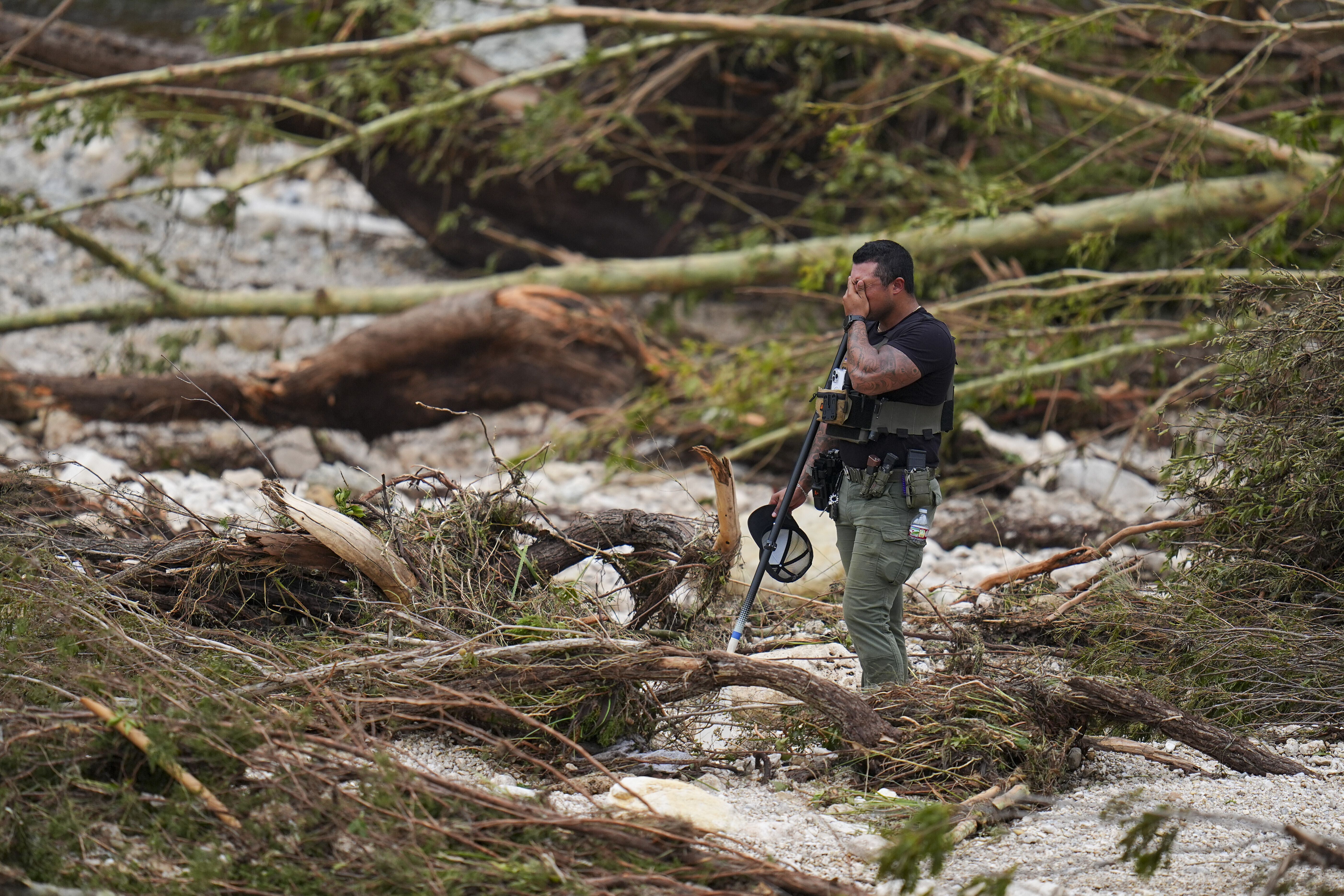
The death toll from Friday's Texas flash floods has risen to at least 51 — including 15 children — as rescuers continue to search a devastated central Texas landscape of mangled trees, overturned cars and muck-filled debris.
- Authorities say 27 girls from Camp Mystic, a private all-girls camp that sat on the banks of the surging Guadalupe River, remain missing. They have not said how many people are missing beyond the campers, AP reports.
Zoom out: Rain continued to fall across central Texas yesterday, Axios' Asher Price and Madalyn Mendoza report.
- The rainfall numbers are "unbelievable," Avery Tomasco, a meteorologist for CBS Austin, said on air, describing the storm as a "rain bomb."
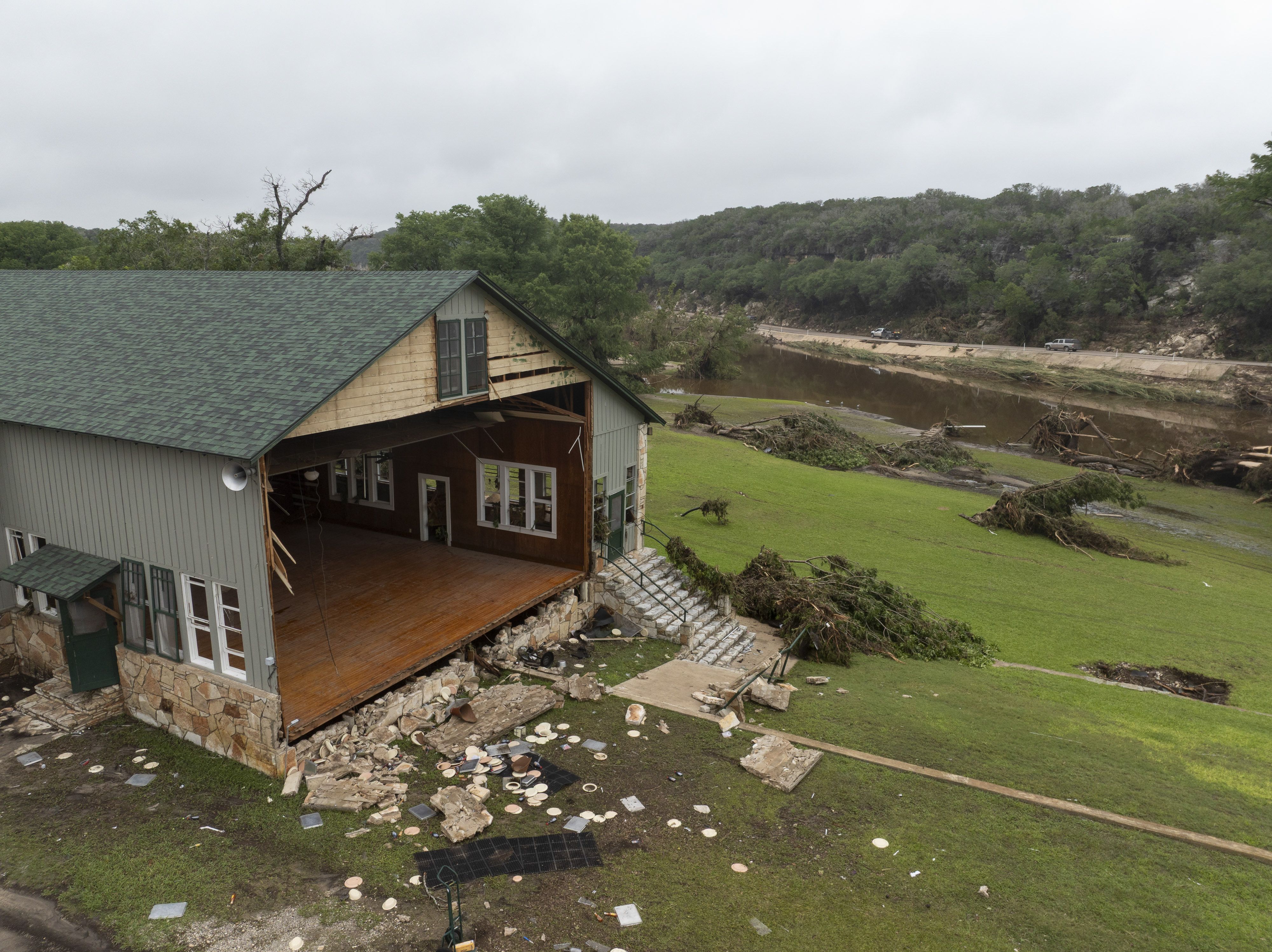
Among those who lost their lives was Dick Eastland, the longtime director of Camp Mystic.
- 9-year-old campers Lila Bonner and Janie Hunt, and 8-year-old Sarah Marsh also died.
Julian Ryan, 27, "died a hero," his family told KHOU in Houston.
- Ryan's fiancée told the station that when water rapidly entered their home near the river, Ryan punched out a window to get his family to safety. He wasn't able to make it out in time.
3. 💥 Supercharged "War on Terror"
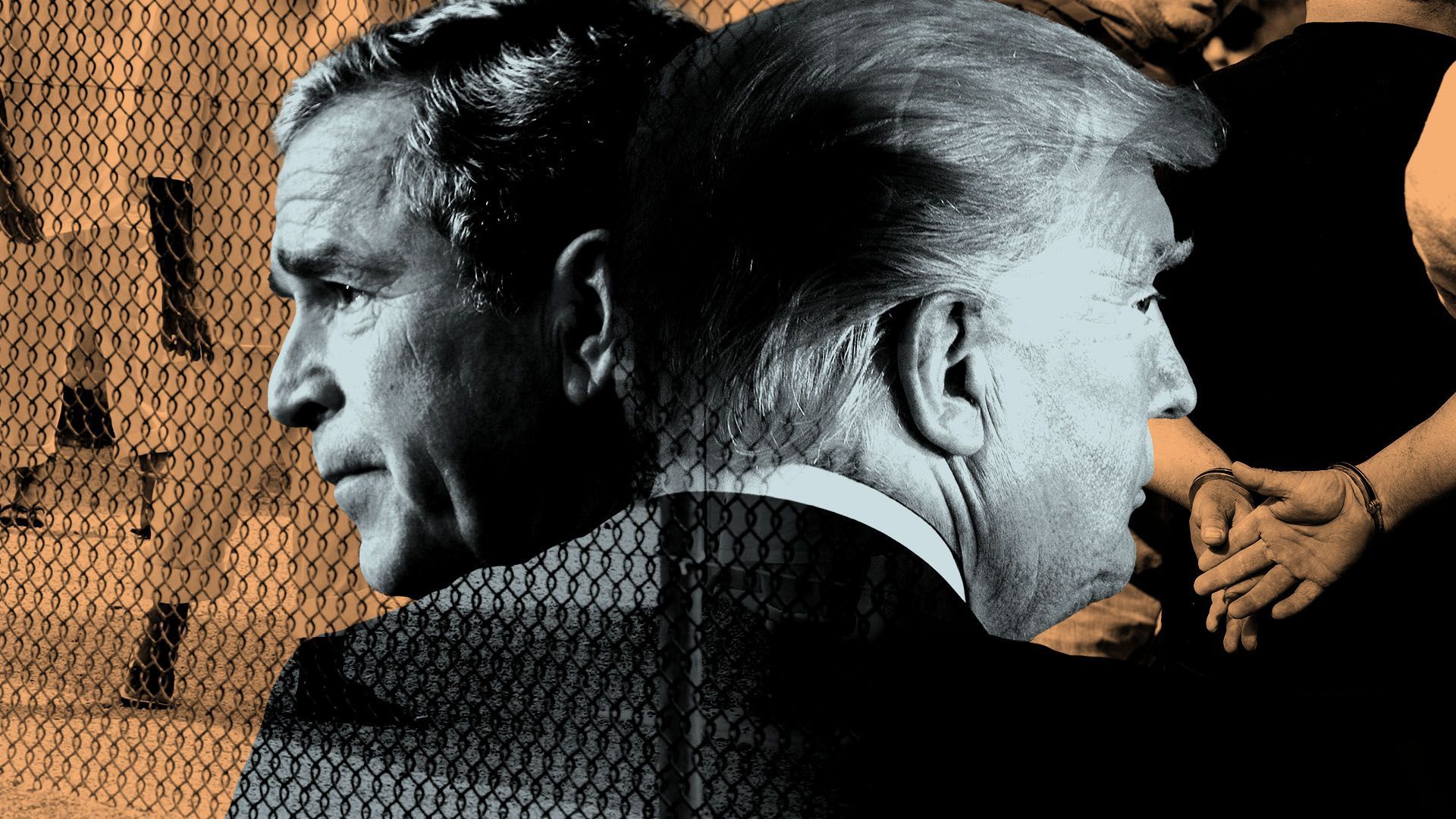
Mass surveillance. Pre-emptive military strikes in the Middle East. Shipping people to domestic and foreign prisons. Citing national security to hide information from the courts. Labeling people "terrorists" as a political and legal strategy.
- Why it matters: Donald Trump became president in part by running against the legacy of George W. Bush, the last Republican in the White House before him. But now Trump is supercharging many of the post-9/11 legal, tactical and political strategies Bush used, Axios' Alex Thompson and Brittany Gibson write.
🔬 Zoom in: Trump's push to deport "millions" of unauthorized immigrants and his strikes on Iran's nuclear facilities in particular have many parallels to Bush's "War on Terror."
- Trump's sending unauthorized immigrants to high-security prisons in the U.S. and abroad — sometimes denying them due process.
- Bush sent alleged terrorists — including undocumented people in the U.S. — to prisons around the world and the U.S. military facility at Guantanamo Bay, Cuba. The Trump administration is now using "Gitmo" for detainees it says have criminal histories.
Trump preemptively, and unilaterally, attacked Iran with 14 bunker-buster bombs and launched missiles at an Iranian-backed proxy group in Yemen, killing dozens.
- He said he ordered the first attack out of concern that Iran was close to gaining a nuclear weapon. Bush used a similar rationale for invading Iraq, though, unlike Trump, he got Congress' approval beforehand.
The similarities don't stop there:
- Surveillance: Trump has enlisted tech company and defense contractor Palantir to help surveil and track unauthorized immigrants in the U.S. Bush enlisted telecom companies such as AT&T and Sprint for most of his domestic surveillance in the name of stopping terrorists.
- Executive orders: Trump's administration has invoked some of Bush's executive orders made after 9/11 to justify his immigration actions, as Semafor pointed out.
- Courts: Both the Trump and Bush administrations concealed information from judges and court hearings using the "state secrets privilege," claiming transparency was a national security risk.
- Habeas corpus: Trump has floated suspending habeas corpus — suspects' right to use the courts to fight unlawful detentions. Bush tried to do that in 2006 before it was overturned by the Supreme Court.
🔎 Reality check: There are exceptions to the Trump-Bush parallels.
- Trump's immigration effort is far broader than Bush's, which focused largely on men suspected of having ties to terror groups. Trump's deportation efforts are targeted at millions more noncitizens in communities nationwide.
4. 🗳️ Musk's new party
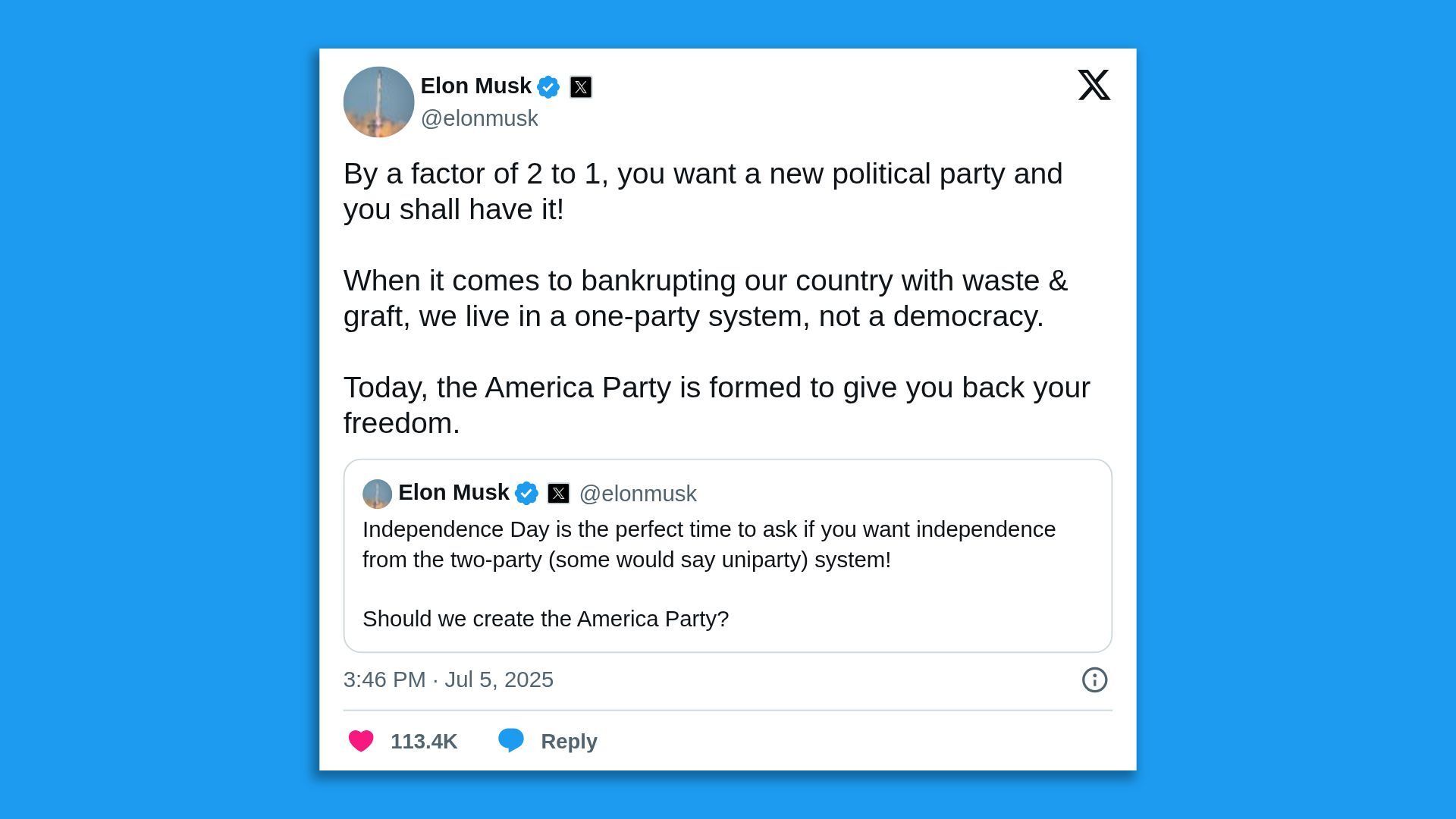
Elon Musk declared he's forming a new political party, "the America Party," via a post on X yesterday.
- Why it matters: Musk is the world's richest man, and his dollars could make a difference in tight races next November, Axios' Dan Primack reports.
The announcement came after President Trump signed the "big, beautiful bill," his signature legislation of which Musk has been an outspoken critic.
- On Friday, Musk had put out a poll for X followers, asking if they "want independence from the two party (some would say uniparty) system."
🧐 The intrigue: Musk also floated an electoral strategy for the party Friday.
One way to execute on this would be to laser-focus on just 2 or 3 Senate seats and 8 to 10 House districts. Given the razor-thin legislative margins, that would be enough to serve as the deciding vote on contentious laws, ensuring that they serve the true will of the people.
Reality check: Musk didn't identify any specific races. So, for now, this is just a trial balloon.
🔮 What's next: Musk signaled he'll move fast. Early this morning, he asked his 222 million followers on X: "When & where should we hold the inaugural American Party congress? This will be super fun!"
- Grok, the chatbot of Musk's xAI, suggested on X: "Austin, TX, in late August 2025—central location, innovative vibe, and timely before elections. It aligns with putting people first."
Musk replied: "Good suggestion."
5. 🍽️ Hunger on the rise


More Americans are going hungry, Axios' Emily Peck writes from new Morning Consult data.
- It's a shocking data point for the wealthiest country in the world — and comes at a time when the stock market is hitting record highs and President Trump just signed a bill slashing food benefits.
Zoom in: The share of adults who tell Morning Consult in monthly surveys that they sometimes or often don't have enough to eat has been creeping up over the past several years.
- In May, 15.6% of adults said so, almost double the 2021 rate.
🛒 Between the lines: Congress just passed a huge cut to food benefits, or SNAP, that is likely to make the situation far worse, says George Matysik, the executive director of a Philadelphia-area food back network that has seen demand surge 120% in the last three years.
The other side: The White House and congressional Republicans argue that cuts to these benefits are a way to bring more people into the labor market and reduce dependence on government assistance, as well as an effort to reduce waste, fraud and abuse.
6. 🔎 Ceasefire talks resume

Israel rejected Hamas' proposed changes to the latest Gaza hostage and ceasefire deal, but will send negotiators to Qatar today to try to close remaining gaps.
- Why it matters: While key hurdles remain, the resumption of indirect talks in Qatar is a significant step toward a potential ceasefire between Israel and Hamas, Axios' Barak Ravid reports.
Driving the news: President Trump has been pressuring both Israel and Hamas — through Qatari and Egyptian mediators — to agree to a deal that includes a 60-day ceasefire in Gaza and the release of 10 living hostages and 18 bodies.
- He wants to see some progress by Monday, when he plans to meet with Prime Minister Benjamin Netanyahu at the White House.
Trump told reporters aboard Air Force One on Friday night that he's "very optimistic" about the chances of getting a deal next week.
7. 🥵 Sweaty paint

What if your house could take the heat instead of you on a sticky summer day?
- That's what researchers at China's Nanyang Technological University aimed to achieve when they designed a cement-based paint that "sweats" to keep buildings cool, Popular Science reports.
Why it matters: America's summers are getting warmer, and keeping homes cool through heat waves is becoming increasingly important from coast to coast.
- Plus, some 20% of the electricity used around the world goes to air conditioning systems and fans.
🏠 Zoom in: The paint has a substance called CCP-30. Initial tests show it has 10 times the cooling power of the paints on the market now, its creators write in a paper published in Science.
- The paint reflected up to 92% of sunlight and could hold nearly a third of its weight in rainwater. On hot days, the stored rainwater evaporated off, cooling the house, Popular Science notes.
8. 🙋 1 for the road: How you can help Texans
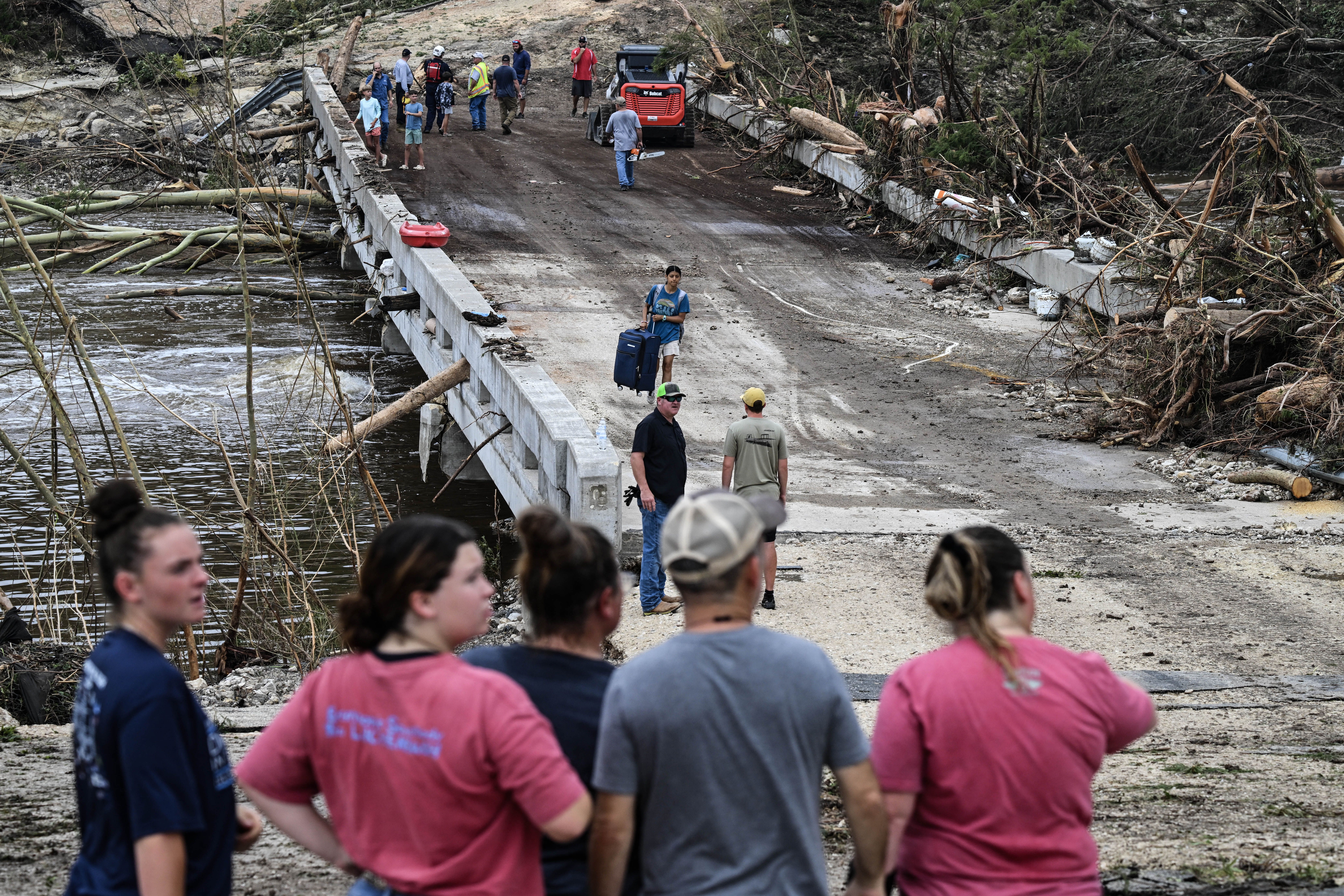
The flooding in central Texas began early Friday about 65 miles northwest of San Antonio and then spread across the region, triggering evacuations and leaving communities in Kerr, Travis, Burnet and Williamson counties devastated.
- Axios Austin's Gregory Castillo rounded up 4 ways you can help families and first responders:
- Kerr County Flood Relief Fund: Supports vetted local organizations working on rescue, relief and recovery in Hunt, Ingram, Kerrville, Center Point and Comfort. Donate.
- Red Cross: The organization has opened shelters for flood survivors in Kerrville and Comfort. They're providing food, shelter and emergency support. Donate.
- Verified fundraisers: GoFundMe is spotlighting trusted campaigns helping people hurt by flooding. Find one.
- Support search and rescue teams: TEXSAR, an all-volunteer search and rescue team based in Austin, has deployed to Kerr County. The United Cajun Navy is also on the ground in Central Texas, assisting with rescues and supply deliveries. Give to TEXSAR ... Give to the United Cajun Navy.
📬 Thanks for sharing your Sunday! Please invite your friends to join AM.
Sign up for Axios AM