Axios AM

November 05, 2026

☀️ Happy almost Friday! Smart Brevity™ count: 1,939 words ... 7½ mins. Thanks to Noah Bressner for orchestrating. Edited by Bill Kole.
1 big thing: Vance's MAGA power play
Vice President Vance stepped out of President Trump's shadow yesterday, seizing on the GOP's midterm catastrophe to begin the explosive task of claiming MAGA as his own, Axios' Zachary Basu, Marc Caputo and Alex Isenstadt write.
- "The reason we lost is the war," Vance wrote in an extraordinary 600-word postmortem on X, blaming Trump's Iran campaign for Republicans' historic collapse.
Why it matters: Vance's presidential ambitions are entangled in the wreckage of a war he privately opposed but publicly defended. His path to 2028 demands a delicate political calculation.
Vance must convince MAGA's disillusioned voters that he understands their sense of betrayal, even as he remains a central figure in the administration responsible for the Iran war.
- "Today, JD Vance became president — or acted like he wanted to become one," a source close to the administration told Axios.
🥊 Vance argued that defections from Trump's 2024 coalition — not lack of turnout — drove the GOP's collapse in Tuesday's midterms. Citing polling of disaffected Trump voters, he identified four demands:
- "End the war."
- "Focus on cost of living/inflation."
- "Put America First."
- "Change our relationship to Israel."
💡 Between the lines: Those happen to be the four hottest topics among top MAGA podcasters and activists. So Vance is aligning with those leaders on topics where MAGA anger with Trump is raging.
Behind the scenes: Vance's commentary caught some in the White House by surprise. But insiders said the vice president worked with senior administration officials on the post.
- "These were his words and thoughts," one insider said. "He's leading."
- Said another: "It pains me to say this, but Tuesday showed the emperor had no clothes, and Vance knew he should just state the obvious. There are going to be a lot of other Republicans putting a lot more distance between them and the president."
- One Republican consultant representing a potential rival in the 2028 presidential race offered a blunter assessment: "The VP had to show he's not a dead man walking out there."


Zoom out: Trump's second term has been riven by a bitter ideological feud between MAGA's anti-interventionist wing and the pro-Israel hawks who championed the Iran war.
- Vance privately questioned the war's objectives and duration, then publicly defended the campaign and led peace negotiations with Iran. His postmortem now puts him squarely in the anti-interventionists' camp.
- It also gives Vance an opening against more hawkish Republicans, particularly Texas Sen. Ted Cruz. If Cruz runs in 2028, as many expect, and argues that it's time for the party to move on from Trump administration figures, Vance could try to argue that Cruz was on the wrong side of the issue that helped cost Republicans the midterms.
👀 What to watch: Trump has yet to anoint Vance as his successor, and the Republican collapse is already exposing the contours of a potential succession fight.
- Asked yesterday whether he had discussed a presidential run with Vance, Trump said the two talk about "a lot of things," before adding: "Maybe he won't run. I don't know who's going to run."
2. 🧊 Hegseth on "thin ice"

It's a de facto motto in the Trump White House: "Somebody's gotta take the fall." Lately, that person looks like Secretary of Defense Pete Hegseth, Axios' Marc Caputo and Alex Isenstadt write.
- Why it matters: From the unpopular war in Iran to his bad bipartisan relations with members of Congress, Hegseth's record has made him the most vulnerable member of Trump's Cabinet after Tuesday night's midterm shellacking.
"Hegseth is definitely on thin ice," a Trump adviser told Axios. "It doesn't mean the president forces him out. But there are complications."
- As early as next week, the House could impeach Hegseth for allegedly defying Congress and illegally continuing the U.S. war in Iran.
- The measure is sponsored by Rep. Thomas Massie (R-Ky.), a vociferous critic of Israel and foreign wars.
🔭 Zoom in: Iran is at the center of both Hegseth's possible impeachment and Republicans' midterm collapse.
- Before Trump attacked Iran on Feb. 28, Hegseth was the most gung-ho about the conflict. Hegseth gave the rosiest projections about how quickly and easily it would be resolved, according to sources familiar with the discussions.
By August, a senior administration official said, U.S. Central Command was reportedly soliciting new approaches to pressure Iran, suggesting that military leaders were still reassessing how to achieve strategic results.
- Trump stood by Hegseth yesterday, telling reporters the secretary is "doing a very good job."
👓 Between the lines: Trump has been known to praise an embattled Cabinet secretary, only to seek their ouster shortly thereafter.
- Go deeper: 4 factors weighing on Trump.
3. 🚨 Dem gains could sideline Electoral College

Democrats' sweeping statehouse gains have opened a path to effectively replacing the Electoral College with a national popular vote in time for the 2028 presidential election — without needing to amend the Constitution.
- Why it matters: The results could give Democrats the legislative power to fundamentally change how America picks its president, potentially ending the possibility of winning the White House while losing the national popular vote, Axios' Andrew Pantazi writes.
Democrats have won control of the governorship and both legislative chambers in Pennsylvania, Michigan, Arizona, Wisconsin and Nevada — enough to push an agreement called the National Popular Vote Interstate Compact beyond the 270-vote threshold required to take effect.
- The compact has been enacted by 18 states and D.C. since launching in 2006, representing 222 electoral votes so far.
- The agreement only kicks in when participating states collectively control at least 270 electoral votes. The five new Democratic trifectas could bring the total to 283.
🔧 How it works: Americans don't directly elect the president. Instead, they actually cast ballots to choose electors, whose votes determine the winner every four years.
- Nearly every state awards all its electoral votes to the statewide winner. Maine and Nebraska also award electors based on congressional district results.
- But the Constitution explicitly gives states power to appoint electors "in such Manner as the Legislature thereof may direct."
- Under the compact, participating states would instead award their electoral votes to the national popular-vote winner once the agreement reaches 270 electoral votes.
Yes, but: The five states would still need to enact the compact. It's unclear whether it will be a priority for the new Democratic states.
- The Electoral College would formally remain in place, and the compact could face constitutional challenges, including over whether congressional approval is required.
- Michigan failed to enact it during its previous Democratic trifecta from 2023 to 2024, and Nevada's then-Democratic governor vetoed the compact in 2019, warning it could diminish his state's influence over presidential elections.
- Notre Dame law professor Derek Muller has argued that the compact would be unconstitutional without congressional approval, which he contends is required under the Constitution's Compact Clause.
🔮 What to watch: Whether and how legislators in the new trifecta states move forward.
- Lawmakers in all five states have previously introduced legislation to join the compact.
4. 📈 Surprise election rally
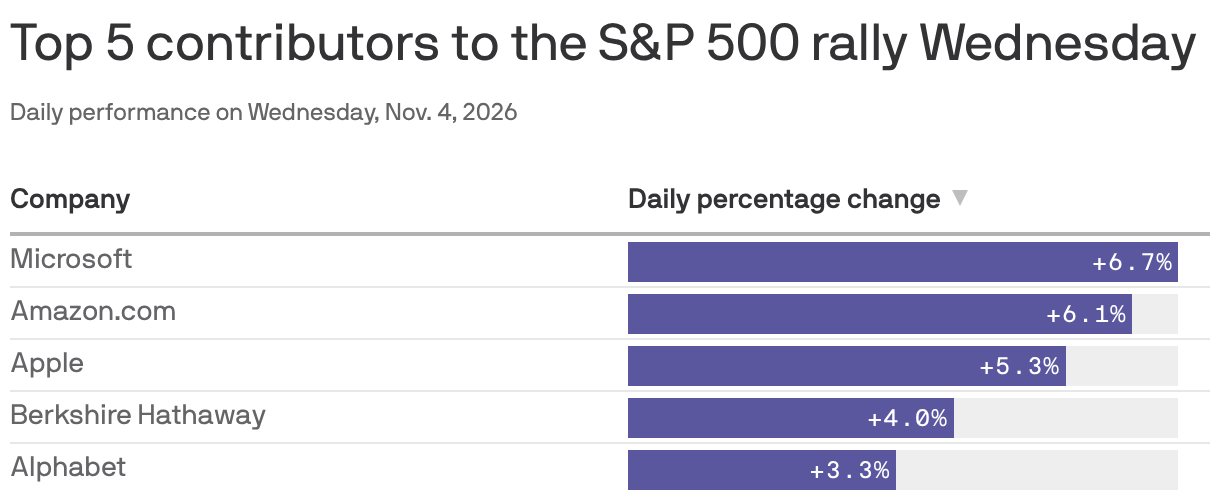
Some of the largest data center operators led a post-election stock rally yesterday — the day after voters delivered a resounding rebuke to data centers themselves, Axios' Emily Peck and Matt Phillips write.
- Microsoft rose 6.7%, Amazon 6.1%, and Alphabet 3.3%.
The big picture: Wall Street is increasingly betting that a slower AI race — and a forced slowdown in spending on the data center buildout — could be good for Big Tech.
5. 🤖 AI's new charm offensive

The AI industry is scrambling to repackage a $10 trillion infrastructure buildout to appease a hostile electorate that overwhelmingly voted to restrict data center construction in ballot measures across the country, Axios' Maria Curi writes.
- Why it matters: Tuesday's election made clear voters won't tolerate unchecked data center growth. To prevent an existential threat, the world's biggest companies are working on a rebrand.
Restrictive ballot measures went 43-1 across 10 states, with an average of 75% of voters favoring limits.
- Analysts expect the backlash to slow — but not stop — the buildout.
🔬 Zoom in: Beyond OpenAI's attempt to rebrand AI data centers as "compute campuses," companies are offering communities real money, including dividends, benefits for schools or cities, environmental concessions and labor protections.
- Amazon allocated $1 billion to invest in data center communities over five years. Microsoft has a Datacenter Community Pledge.
- OpenAI today unveiled a Compute Campus Policy Blueprint and outlined tens of millions of dollars in commitments for free school lunches, parks, first responders and other priorities.
See OpenAI's new plan ... Share this story ... Get Axios AI+.
6. 🫏 2028 floodgates open
Democrats of all political stripes won so big on Tuesday that the party didn't settle its long-running civil war between moderates and progressives, Axios' Holly Otterbein and Alex Thompson write.
- Instead, the party's historic victories gave each faction some reasons to claim that its brand of Democrats can defeat the GOP in 2028.
Why it matters: Democratic operatives are sure of one thing, though: Tuesday's blowout wins mean that more party leaders will be willing to run for the White House than if the midterms hadn't gone so well.
- Barack Obama's 2012 campaign manager, Jim Messina, told Bloomberg this week that he's already met with 29 potential candidates.
🌊 Zoom in: Every wing of the party has a win to point to.
- Progressive Abdul El-Sayed ran on Medicare for All and won Michigan's Senate race by 7 points — a boost for Rep. Alexandria Ocasio-Cortez, who went all-in for him.
- Faith-forward moderates like James Talarico in Texas and Adam Hamilton in Kansas pulled off huge upsets in deep-red states.
- Pennsylvania Gov. Josh Shapiro, a centrist technocrat who campaigned on "getting sh*t done," won reelection by 22 points.
7. 🇮🇷 Trump's bad options in Iran
Post-election, President Trump must decide whether to cut his losses on the Iran war and get a deal — or double down and go back to bombing, Axios' Barak Ravid reports.
- Why it matters: His options are bad. Going back to war would be highly unpopular, exacerbating the energy crisis while probably not yielding a better military result.
But a deal with Iran remains elusive. If the Iranians refuse to make concessions — or, sensing weakness after the president's political loss, even toughen their demands — Trump will have a hard time reaching an agreement.
- One of his former advisers told Axios: "It's one thing to lose the midterms. But Trump doesn't want to look like a loser twice."
- That's why some Trump advisers think he could ultimately decide to strike Iran again.
- Keep reading.
8. 📊 Polls underestimated the wave
Democrats' midterm tsunami obscured a major polling miss: Surveys correctly anticipated a blue wave, but failed to capture its full force, Axios' Neal Rothschild writes.
- Why it matters: Pollsters appear to have underestimated Democrats by a wider margin than they underestimated Republicans in 2016 or 2024 — even if they got the headline outcome right this time.
🧮 By the numbers: Democrats are on track to win the national House popular vote by roughly 13 points, compared with a final Silver Bulletin polling average of 8.9 points, according to an initial analysis by The Argument's Lakshya Jain.
- That roughly 4-point gap is similar to the 2020 polling miss that underestimated Republicans.
- It's larger than the average errors in 2016 and 2024, though comparisons to presidential years are imperfect.
9. 😮 How Senate votes moved from '24
The blue arrows in these New York Times maps show how counties shifted toward Democrats on Tuesday compared with the 2024 presidential election:

More graphics (gift link).
10. 🏗️ 1 for the road: Inside the ballroom

Roughly 12 hours after a devastating midterm loss, President Trump toured the new White House ballroom and signed the final steel beam before it was raised into place.

Above: The new East Colonnade under construction at the White House.
📬 Thanks for reading! Please invite your friends to join AM.
Sign up for Axios AM