Axios AM

August 22, 2025

🍹 Happy Friday! Smart Brevity™ count: 1,495 words ... 5½ mins. Thanks to Noah Bressner for orchestrating. Copy edited by Bryan McBournie.
🐊 Situational awareness: A federal judge prohibited officials from bringing new detainees to Alligator Alcatraz, and ordered Florida to begin dismantling parts of the facility, Axios Miami's Sommer Brugal and Jeff Weiner write.
1 big thing: Bot vs. bot future
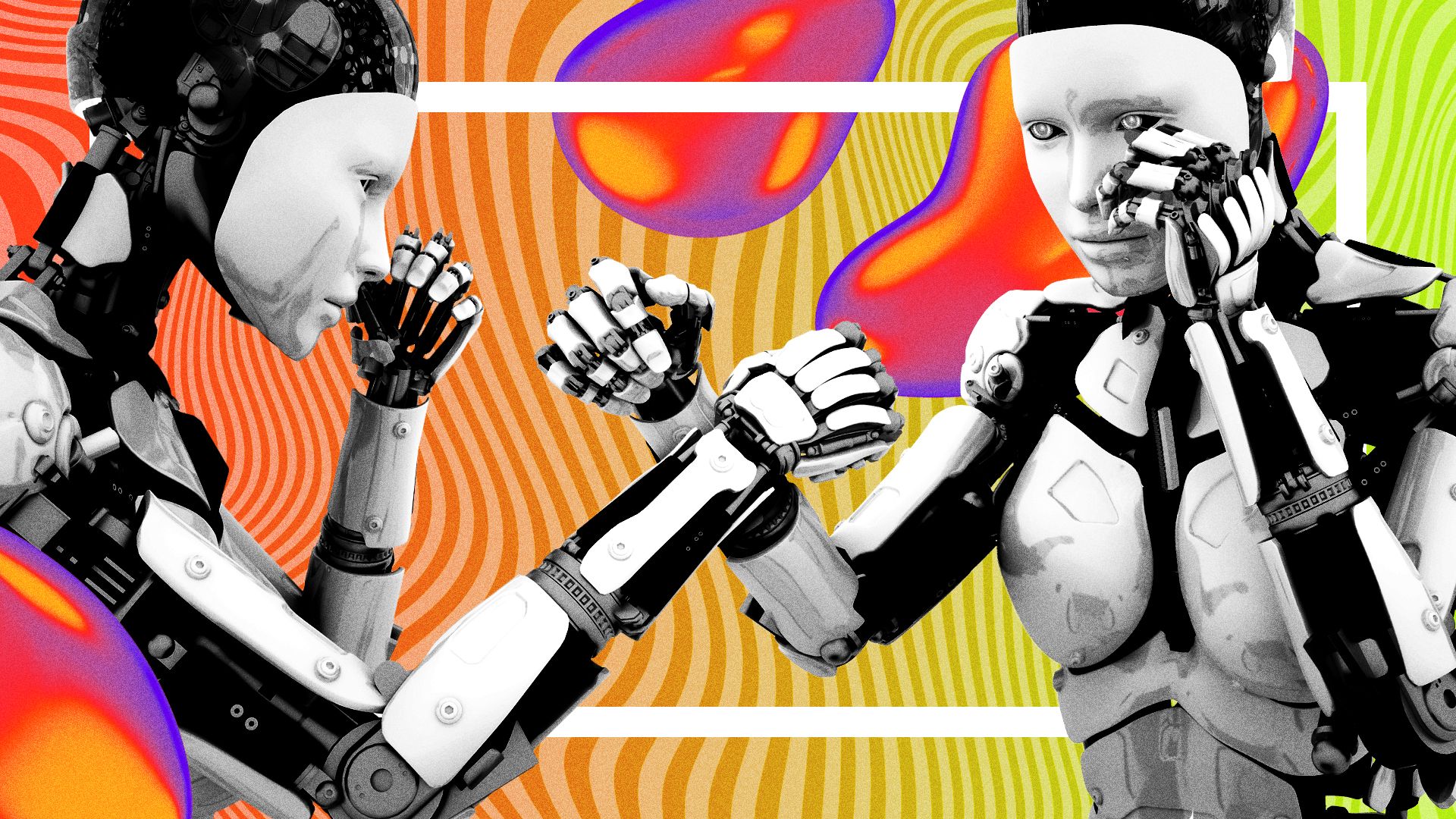
Bots will overrun humans on the internet in generative AI's next massive disruption, Axios managing editor for tech Scott Rosenberg writes.
- Why it matters: The internet connected humanity. But an AI-driven shift to a machine-first world will force us to rewrite 30 years of habits.
🖼️ The big picture: As AI agents improve and multiply, bots representing individuals will interact with bots representing companies. Human use of the open web will decline.
- My bot will talk to your bot — but you and I will probably talk a lot less.
Zoom out: In the early '90s, the World Wide Web introduced a people-to-people network.
- As websites got more elaborate and apps proliferated, the network evolved into a people-to-machines space, as our interactions with other people became heavily mediated by software (think: social feeds or travel apps).
- Next up: an online world where interactions take place primarily among bots and AI "agents," with people largely relegated to the sidelines.
Zoom in: Take one of the most basic things we do today — buying stuff online.
- We're used to a world in which you click around, check products and prices. While prices can fluctuate and algorithms sometimes play a role, as on Amazon or Uber, the purchase decision remains firmly in human hands.
- AI-driven e-commerce means that vendors are going to start rapidly changing their prices based on your identity and other variables — by the microsecond, and differently for each customer.
- Delta Airlines is already experimenting with one AI ticket-pricing tool.
🔎 Between the lines: These pricing systems can rapidly become complex "beyond human cognitive limits," as one study found.
- To cope with that, AI makers will respond by offering buyers their own AI-based tool to represent their interests in transactions with AI pricing bots.
- Then we'll all sit back and watch as AIs representing both sellers and buyers have at it.
The bottom line: This kind of spiraling digital arms race is most familiar today in the realms of electronic trading and cybersecurity, where offense and defense have long played a "see if you can top this" game.
- The same brutal competitive dynamics are about to spread everywhere — to job applications and classrooms, dating apps and customer service, coding helpers and scientific research.
Go deeper: Signs to confirm bot hegemony has arrived.
2. 👀 Europe far-right's march
Vice President JD Vance, Elon Musk and other MAGA voices horrified Europe's leaders by embracing Germany's AfD and other far-right parties early in the Trump administration.
- Six months later, those parties are smashing their establishment rivals in poll after poll, Axios' Zachary Basu writes.
Why it matters: The populist wave that formed in the wake of the 2015 migrant crisis has not crested. It's surging — and spreading — across Europe, cheered on by a U.S. government eager to see MAGA go global.
Zoom in: For the first time in modern history, far-right parties are leading opinion polls in Europe's four largest economies.
- 🇩🇪 In Germany, a new poll last week found the AfD — dogged by Nazi scandals and surveilled by German intelligence for suspected extremism — is narrowly the most popular party in the country.
- 🇬🇧 In the U.K., Nigel Farage's Reform Party has a double-digit lead over both the ruling Labour Party and the Conservatives, which have dominated British politics for a century.
- 🇫🇷 In France, the far-right National Rally is comfortably polling first, even with its leader, Marine Le Pen, banned from running for president in 2027 for embezzling EU funds.
- 🇮🇹 In Italy, Prime Minister Giorgia Meloni — leader of the country's first far-right government since World War II — has defied political gravity by remaining relatively popular three years after sweeping to power, though she has governed more pragmatically than many expected.
🥊 Reality check: None of these countries has elections anytime soon, meaning the polls — for now — reflect momentum rather than an imminent transfer of power.
- Keep reading ... Tal Axelrod contributed.
3. 💰 Trump's pay-me capitalism
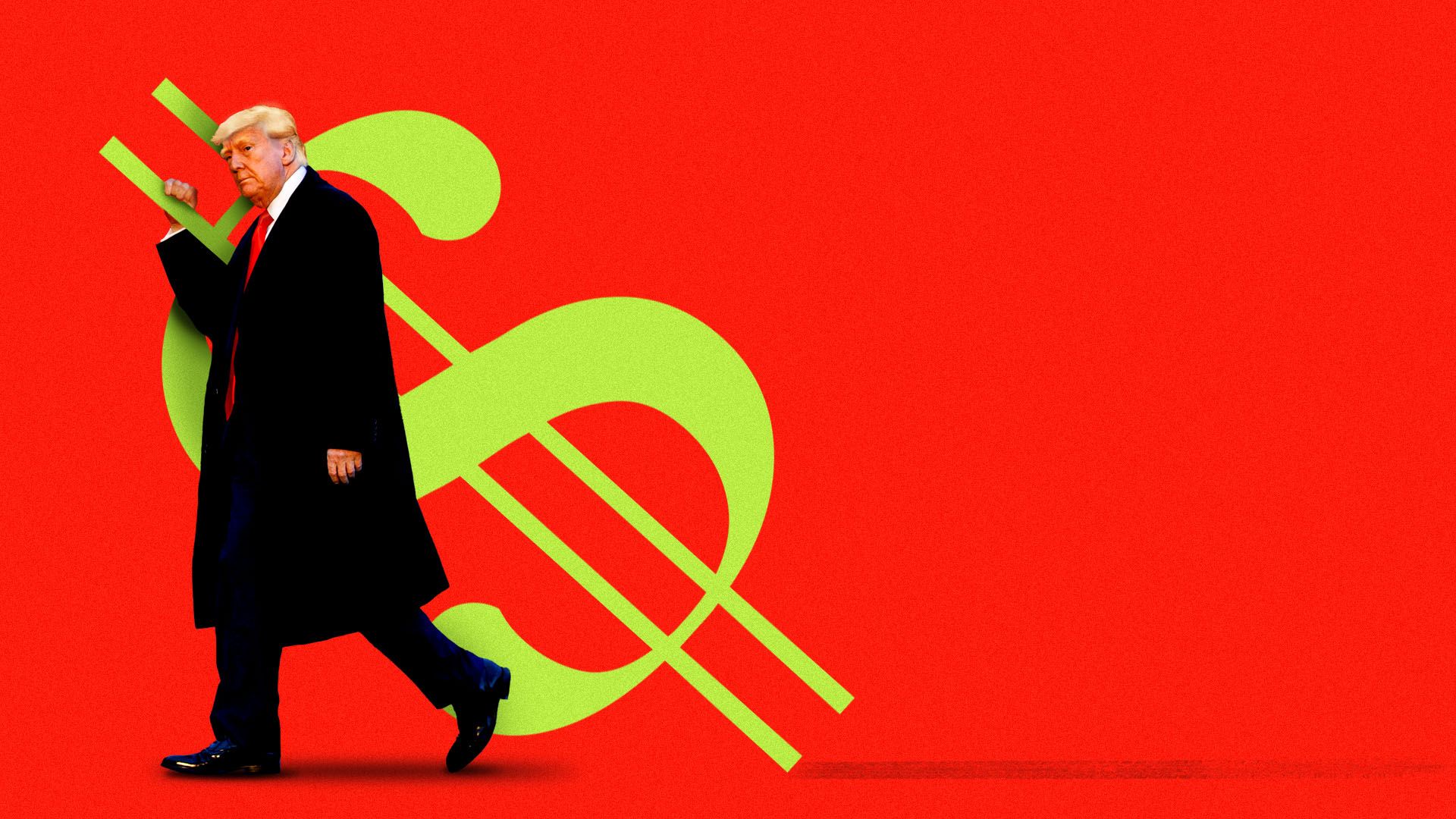
The era of pay-me capitalism has arrived: Companies are quickly learning lessons about what happens if they don't comply, Axios managing editor for business Ben Berkowitz writes.
- Why it matters: Just seven months into his second presidency, Trump has broken with more than a century of conservative orthodoxy and taken a maximalist view of presidential intervention in the economy.
🎨 The big picture: Businesses wanted a pro-management, low-regulation, bigger-is-better administration. By and large, they're getting that.
- The price? Adhering to Trump's priorities, paying whatever tariffs and cuts off the top he dictates, moving their operations where he wants them to, and toeing the line on his social priorities.
The list of examples grows by the day. Most recently, it was the administration seeking to convert grants to Intel into partial government ownership. But beyond that:
- Companies are being scored on their loyalty to Trump's platform.
- Treasury Secretary Scott Bessent says it's appropriate for corporate margins to come down (in other words, they should absorb more tariff costs, even if that means making less money).
- The government is taking a cut of Nvidia's and AMD's foreign sales.
- The administration is demanding drugmakers change the way they sell products, and telling automakers to move plants back to America.
4. 📉 Stat du jour: 1.4 million immigrants
About 1.4 million immigrants have left the U.S. amid President Trump's crackdown, Axios' Emily Peck writes from a new tally by Pew Research.
- Why it matters: It's the first time America's immigrant population has fallen in decades.
The U.S. Census Bureau's Current Population Survey finds that in June, the foreign-born population was 51.9 million — down from the peak in January (53.3 million), when immigrants were a record 16% of the population.
- Most of the drop "is likely due to a fall in the unauthorized immigrant population," Pew says.
5. 🤖 Foreign disinformation's AI surge

The world of AI-generated, adversarial disinformation is growing rapidly — and it's already indistinguishable from run-of-the-mill social posts, Axios Future of Cybersecurity author Sam Sabin writes.
- Why it matters: Foreign disinformation has become a highly disruptive force in the U.S., with Russia and other foreign powers seeking to influence elections and inflame discord.
Generative AI is now making it far more effective and harder for average users to detect.
- "We are seeing now an ability to both develop and deliver at an efficiency, at a speed, at a scale that we've never seen before," Gen. Paul Nakasone, former head of the NSA and now director of the Vanderbilt Institute, told reporters at the DEF CON hacker conference earlier this month.
🔬 Zoom in: At least one China-based technology company, GoLaxy, seems to be using generative AI to build influence operations in Taiwan and Hong Kong, according to internal documents leaked to researchers at Vanderbilt University's Institute of National Security.
- Documents show that GoLaxy has created profiles for at least 117 members of Congress and over 2,000 American political figures and thought leaders.
6. 🥊 Newsom punches back

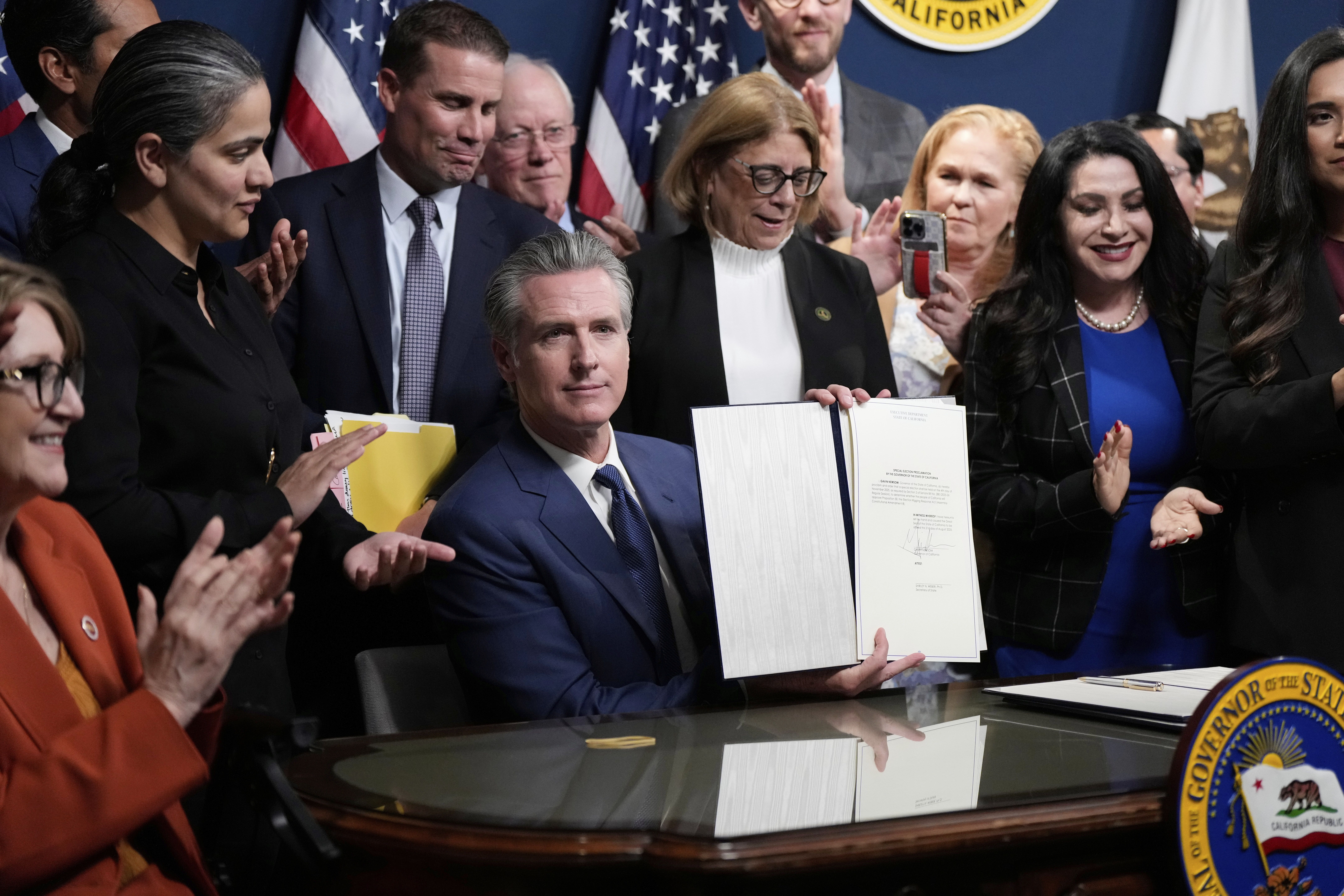
California voters will decide in November whether to approve a redrawn congressional map designed to help Democrats win five more House seats next year. (AP)
- Why it matters: Gov. Gavin Newsom's (D) push to redo the state's districts is the latest step in a tit-for-tat gerrymandering battle with Texas Republicans, who are redrawing their state's map at President Trump's urging.
California lawmakers voted mostly along party lines yesterday to approve legislation calling for the special election. Newsom then quickly signed it.
- "This is not something six weeks ago that I ever imagined that I'd be doing," Newsom said.
7. 🍕 Pic du jour

President Trump addressed the National Guard, police and federal agents at an operations center for the U.S. Park Police in D.C. — handing out pizza from a local chain and burgers he said were made at the White House.
- Read the WashPost story (gift link).
8. 🍽️ 1 for the road: Cracker Barrel crackup

Cracker Barrel's modernized logo was quickly and widely disparaged by MAGA figures who decried the switch as "woke," Axios' Jason Lalljee writes.
- The new logo for the beloved roadside chain (formally Cracker Barrel Old Country Store Inc.) jettisons an illustration of a mostly silhouetted man in overalls leaning on the eponymous barrel.
The remaining part of the logo is similar, with the name of the chain against a yellow background (or a "Barrel graphic device," as the corporate poets at Cracker Barrel call it).
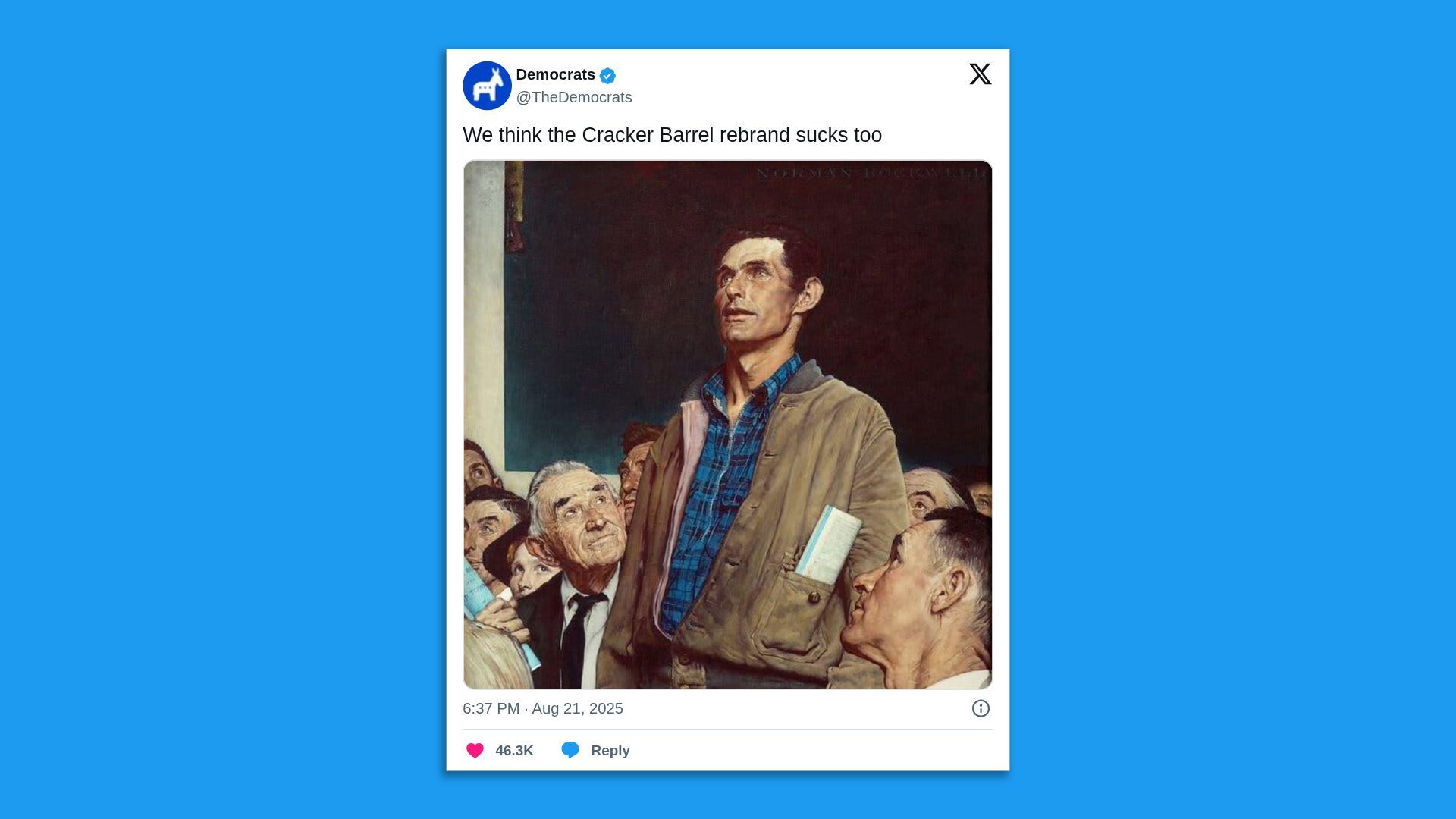
Cracker Barrel is bringing us together:
- Fox News' Laura Ingraham called it a "bland rebrand" and closed her show with the chyron: "CRACKER BARREL REBRAND SPARKS OUTRAGE."
- Four hours later, CNN's Laura Coates ended her show with: "CRITICS CALL CRACKER BARREL'S NEW LOGO 'SOULLESS' & 'WOKE.'"
Yes, it's sad that Mike is consuming that much cable news. He's stuck in a hotel room.
- In other Cracker Barrel news, the homepage announces: "SHEPHERD'S PIE RETURNS."
📬 Thanks for reading! Please invite your friends to join AM.
Sign up for Axios AM