Axios AM

June 25, 2025

π« Happy Wednesday! Smart Brevityβ’ count: 2,179 words ... 8 mins. Thanks to Noah Bressner for orchestrating. Copy edited by Carolyn DiPaolo.
1 big thing: An AI Marshall Plan
If politics and public debate were a rational, fact-based exercise, the government, business and the media would be obsessed with preparation for the unfolding AI revolution β rather than ephemeral outrage eruptions, Jim VandeHei and Mike Allen write in a "Behind the Curtain" column.
- Why it matters: That's not how Washington works. So while CEOs, Silicon Valley and a few experts inside government see AI as an opportunity, and threat, worthy of a modern Marshall Plan, most of America β and Congress β shrugs.
One common question: What can we actually do, anyway?
- A lot. We've talked to scores of CEOs, government officials and AI executives over the past few months. Based on those conversations, we pieced together specific steps the White House, Congress, businesses and workers could take now to get ahead of the high-velocity change that's unspooling.
- None requires regulation or dramatic shifts. All require vastly more political and public awareness, and high-level AI sophistication.
1. A global American-led AI super-alliance: President Trump, like President Biden before him, sees beating China to superhuman AI as an existential battle. Trump opposes regulations that would risk America's early lead in the AI race. Congress agrees.
- So lots of CEOs and AI experts are mystified about why Trump has alienated allies, including Canada and Europe, who could help form a super-alliance of like-minded countries that play by America's AI rules and strengthen our supply chain for vital AI ingredients like rare earth minerals.
- Imagine America, Canada, all of Europe, Australia, much of the Middle East, parts of Africa and South America β and key Asian nations like Japan, South Korea and India β all aligned against China in this AI battle. The combination of AI rules, supply-chain ingredients, and economic activity would form a formidable pro-American AI bloc.
2. A domestic Marshall Plan: The Marshall Plan was America's commitment to rebuild Europe from the ruins of World War II. Now, the U.S. needs unfathomable amounts of data, chips, energy and infrastructure to produce AI. Trump has cut deals with companies and foreign countries β and cleared away some regulations β to expedite a lot of this. But there's been little sustained public discussion about what this means for the economy and U.S. jobs. It's very improvisational. Trump himself barely mentions AI or talks about it in any specificity in private.
- The country really needs "a combination of the Marshall Plan, the GI Bill, the New Deal β the social programs and international aid efforts needed to make AI work for the U.S. domestically and globally," as Scott Rosenberg, Axios managing editor for tech, puts it.
- One smart idea: Get the federal government better aligned with states and even schools to prepare the country and workforce in advance. Some states β including Texas β are eagerly working with AI companies to meet rising demand in these new areas. Yet many others are sitting it out.
Imagine all states exploiting this moment and refashioning post-high-school education and job training programs.
- In Pennsylvania, Gov. Josh Shapiro β a possible Democratic presidential candidate in '28 β sees the opening. He hailed "the largest private sector investment in Pennsylvania history" earlier this month when he personally announced that Amazon Web Services plans to spend $20 billion on data center complexes in his state.
3. A congressional kill switch: There's no appetite in Washington to regulate artificial intelligence, mainly out of fear China would then beat the U.S. to the most important technological advance in history.
- But that doesn't mean Congress needs to ignore or downplay AI's potential and risks.
- Sen. Mark Warner (D-Va.), vice chairman of the Senate Intelligence Committee, got rich as an early investor in an earlier tech boom β cell phones β and has been one of Capitol Hill's few urgent voices on AI. "If we're serious about outcompeting China," Warner told us, "we need clear controls on advanced AI chips and strong investments in workforce training, research and development."
Several lawmakers and AI experts envision a preemptive move: Create a bipartisan, bicameral special committee, much like one stood up from the 1940s through the 1970s to monitor nuclear weapons. This committee, in theory, could do four things, all vital to advancing public (and congressional) awareness:
- Monitor, under top-secret clearance, the various large language models (LLMs) before they're released to fully understand their capabilities.
- Prepare Congress and the public, ahead of time, for looming effects on specific jobs or industries.
- Gain absolute expertise and fluency in the latest LLMs and AI technologies, and educate other members of Congress on a regular basis.
- Provide extra sets of eyes and scrutiny on models that pose risks of operating outside of human control in coming years. This basically creates another break-in-case-of-emergency lever beyond the companies themselves, and White House and defense officials with special top-secret clearance.
4. A CEO AI surge: Anthropic's Dario Amodei told Axios that half of entry-level, white-collar jobs could be gone in a few years because of AI. Almost every CEO tells us they're slowing or freezing hiring across many departments, where AI is expected to displace humans. CEOs, better educated on AI, could help workers in two big ways:
- Provide deep instruction, free access and additional training to help each person use AI to vastly increase proficiency and productivity. This retraining/upskilling effort would be expensive, but a meaningful way for well-off people and organizations to show leadership.
- Get more clever leaders thinking now about new business lines AI might open up, creating new jobs in new areas to make up for losses elsewhere. A few CEOs suggested they see a social obligation to ease the transition, especially if government fails to act.
2. π What Israel's intel shows

Israeli intelligence services believe U.S. and Israeli strikes caused "very significant" damage to Iran's nuclear facilities, with some officials perplexed by a leaked U.S. intelligence report that suggested otherwise, Axios' Barak Ravid and Zachary Basu write.
- Like the U.S., Israel hasn't produced a final assessment on how far back the bombing campaign has set Iran's nuclear program, three officials told Axios.
Why it matters: The emerging Israeli assessment presents a far more optimistic view of the operation than a preliminary report from the Defense Intelligence Agency, which assessed the strikes may have set Iran back only a few months.
- President Trump's claim that Iran's nuclear program has been "obliterated" came under scrutiny yesterday after the DIA report was leaked to CNN, The New York Times, Washington Post and multiple other outlets.
- The leak infuriated the White House, which rejected the findings as "fake news" and accused anonymous officials of seeking to undermine Trump.
NEW OVERNIGHT: At the NATO summit in the Netherlands today, Trump said the "perfect operation" in Iran was "a devastating attack, and it knocked 'em for a loop." Defense Secretary Pete Hegseth called Operation Midnight Hammer "an overwhelming success." (Video)
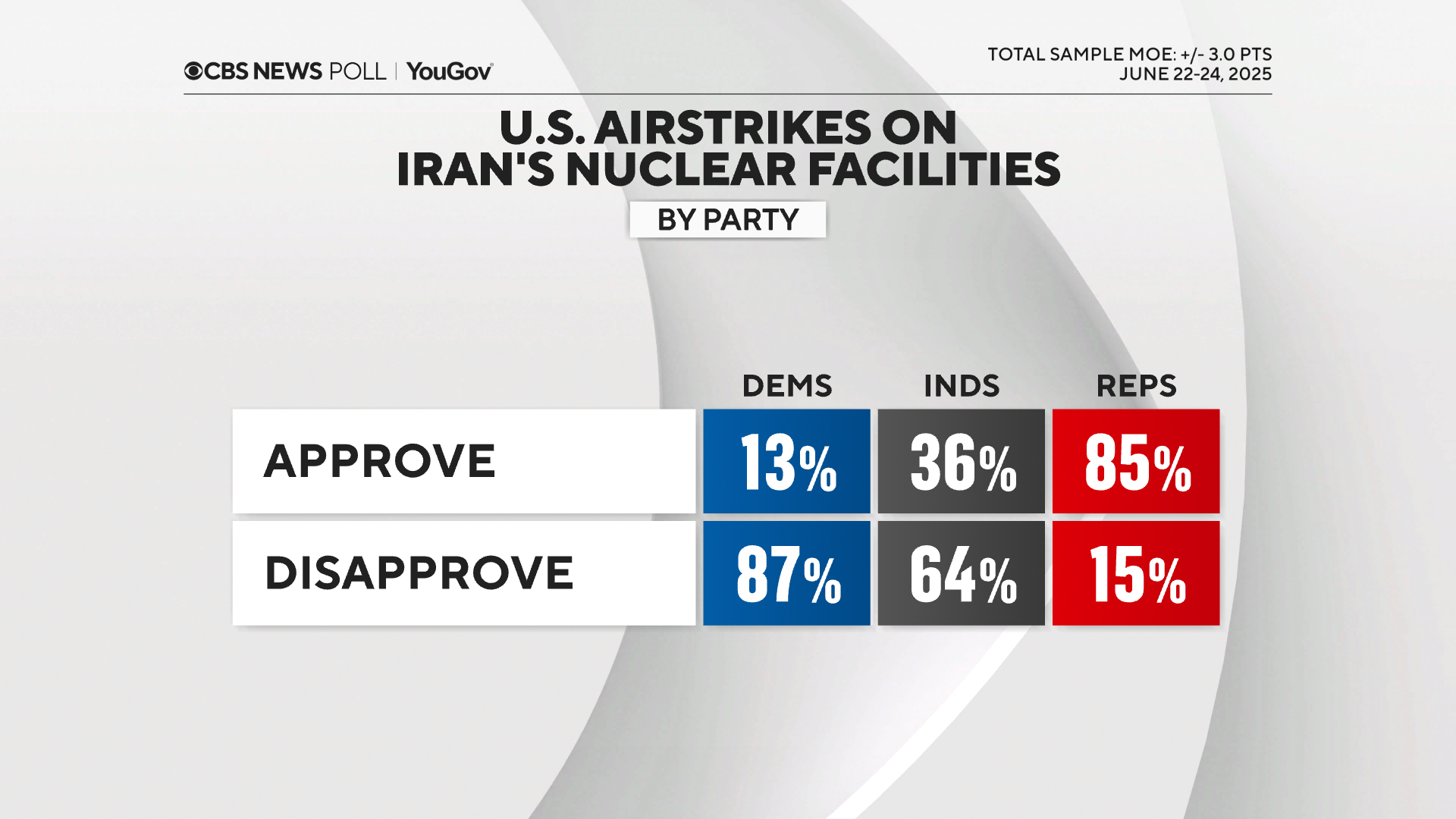
πΌοΈ The big picture: Israel, which initiated the war and faces a far more direct threat from Iran than the U.S., is largely satisfied with the early results from Trump's military strike on Saturday.
- "A professional battle damage assessment takes time," an Israeli official stressed, suggesting it was far too soon to draw the kinds of conclusions included in the DIA report.
- "Israeli intelligence services haven't arrived at any bottom lines for now," the official added. "But we don't think there was any bug in the operation, and we have no indications the bunker-buster bombs didn't work. Nobody here is disappointed."
3. π½ NYC election stunner

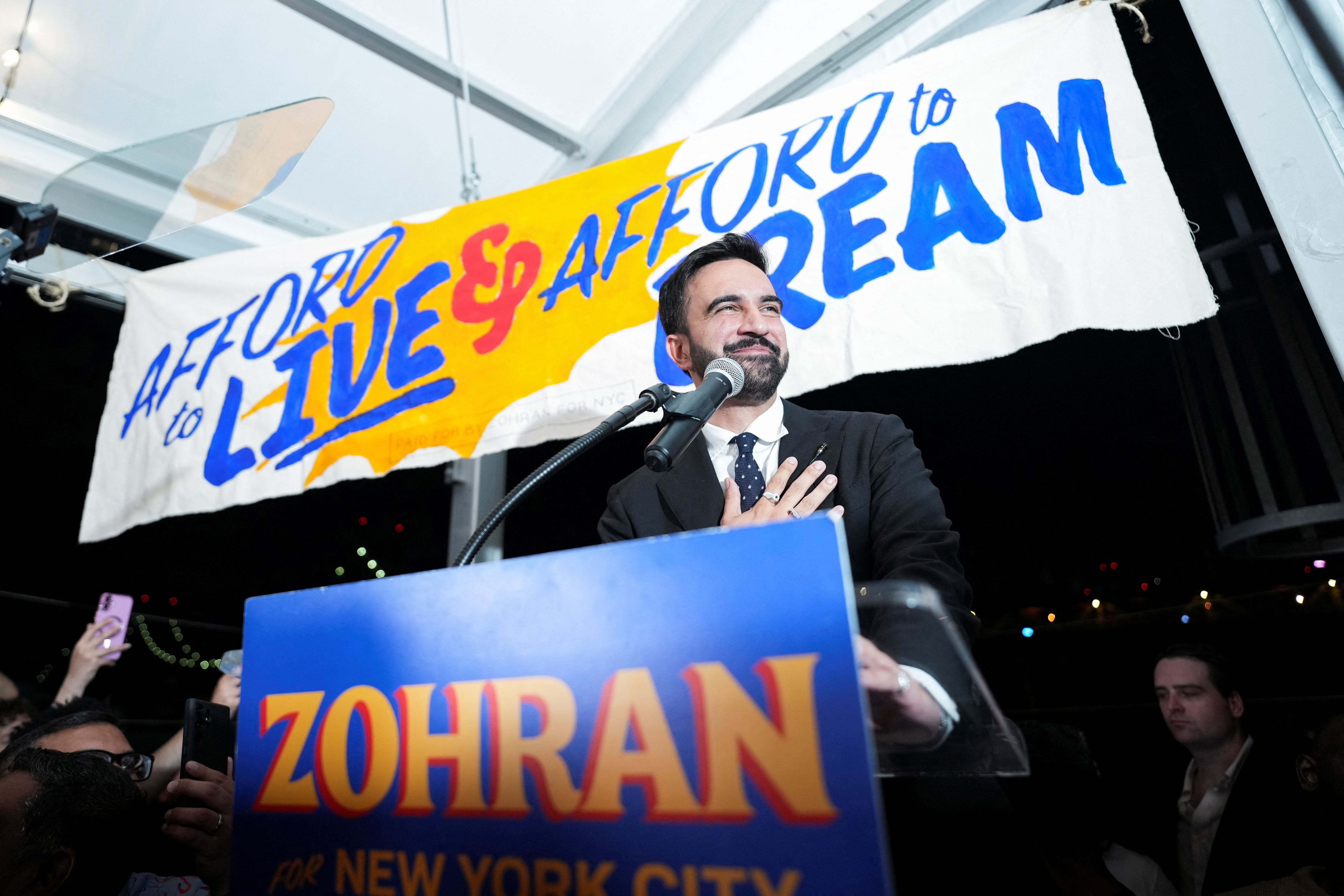
The most famous name in New York politics conceded last night to a little-known state assemblyman who mounted an extraordinary grassroots campaign to claim the Democratic nomination in NYC's mayoral race, Axios' April Rubin writes.
- Why it matters: Zohran Mamdani β a 33-year-old democratic socialist from Queens β is on course for an earthquake victory (44% to 36%) over former Gov. Andrew Cuomo that gives Democrats a blueprint for energizing voters disillusioned by the party's establishment.
Mamdani's stunning win β and the policies that go with it β also gives Republicans a massive political target ahead of next year's midterm elections.
- President Trump's allies are "already gearing up to turn Mamdani into a national figure to attack and tether to other Democrats," the N.Y. Times' Maggie Haberman reports.
π Zoom in: Mamdani ignited a younger generation of voters with populist policies and charismatic messaging tailored to Gen Z and TikTok.
- His progressive platform includes rent freezes, free buses and city-run grocery stores funded by $10 billion in new taxes on corporations and the wealthy.
- Cuomo β a dominant and feared force in New York politics before he resigned as governor four years ago in a sexual harassment scandal β had led the race for months as a centrist with the backing of old-guard Democrats and the city's elite.
What's next: The Democratic primary winner will face incumbent Mayor Eric Adams, who decided to run as an independent, and Republican Curtis Sliwa.
- Cuomo has left the door open to running as an independent, saying in his concession speech that he will give "some thought" to what comes next.
4. β‘ Scoop: Biden aides denied executive privilege
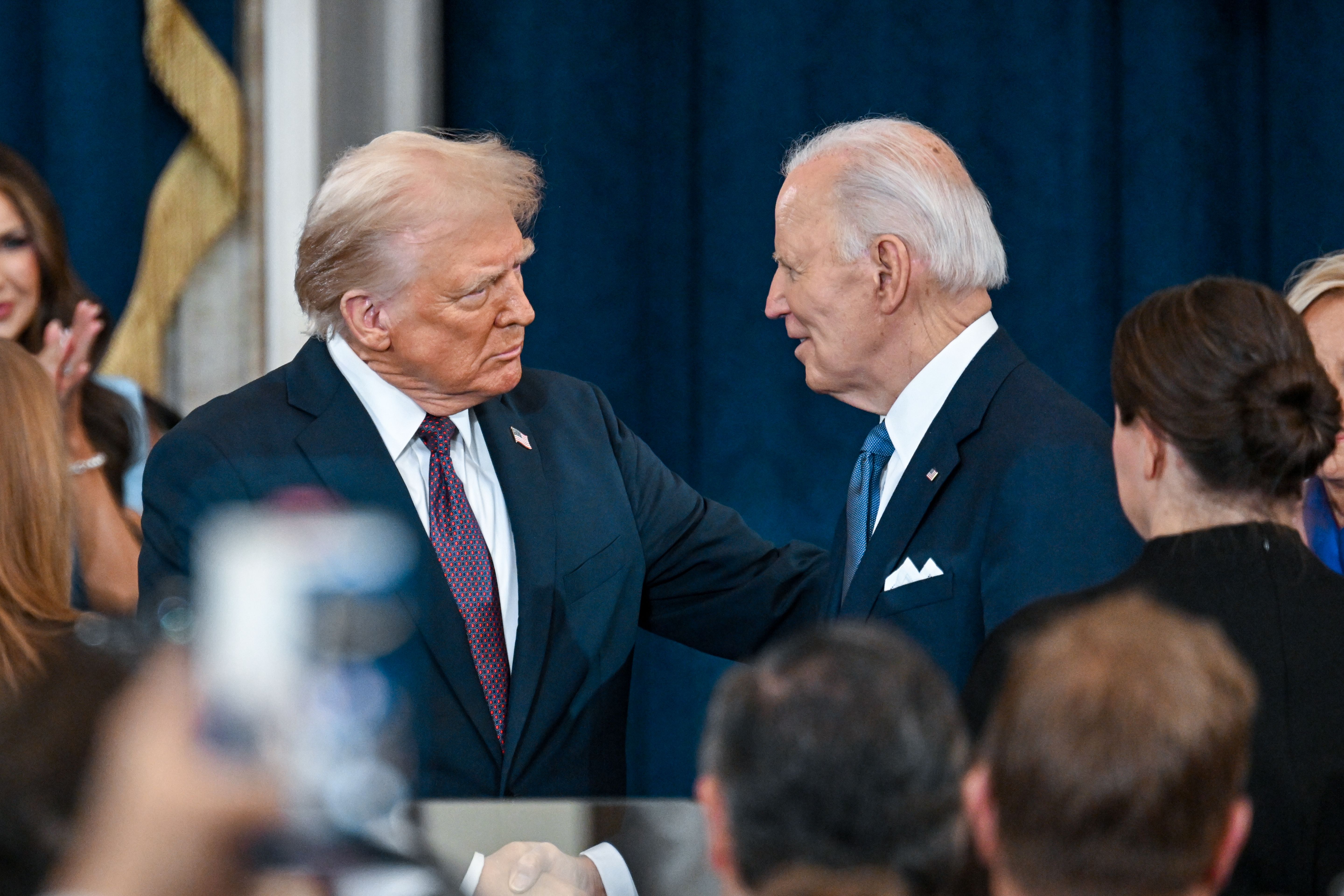
The Trump White House has decided that nine former senior Biden aides won't be protected by executive privilege during their interviews for a congressional probe into Joe Biden's mental fitness for office, Axios' Alex Thompson writes.
- Why it matters: The White House's move means the former Biden aides will have to answer questions about their private conversations with Biden, unless they or Biden try to challenge the decision in court.
π Zoom in: Trump's White House sent a letter yesterday waiving executive privilege for former adviser Neera Tanden, according to a White House official.
- The White House told Tanden's lawyers that invoking executive privilege is not "in the national interest" given the "exceptional circumstances," according to a copy of the letter obtained by Axios.
Trump has decided to do the same for eight other former top Biden aides the GOP-led House Oversight Committee plans to interview.
- They include Jill Biden's adviser Anthony Bernal along with Joe Biden's advisers Annie Tomasini, Ashley Williams, Mike Donilon, Anita Dunn, Ron Klain, Bruce Reed and Steve Ricchetti, a person familiar with the matter told Axios.
5. π€ Exclusive: Thune urges "light touch" on AI
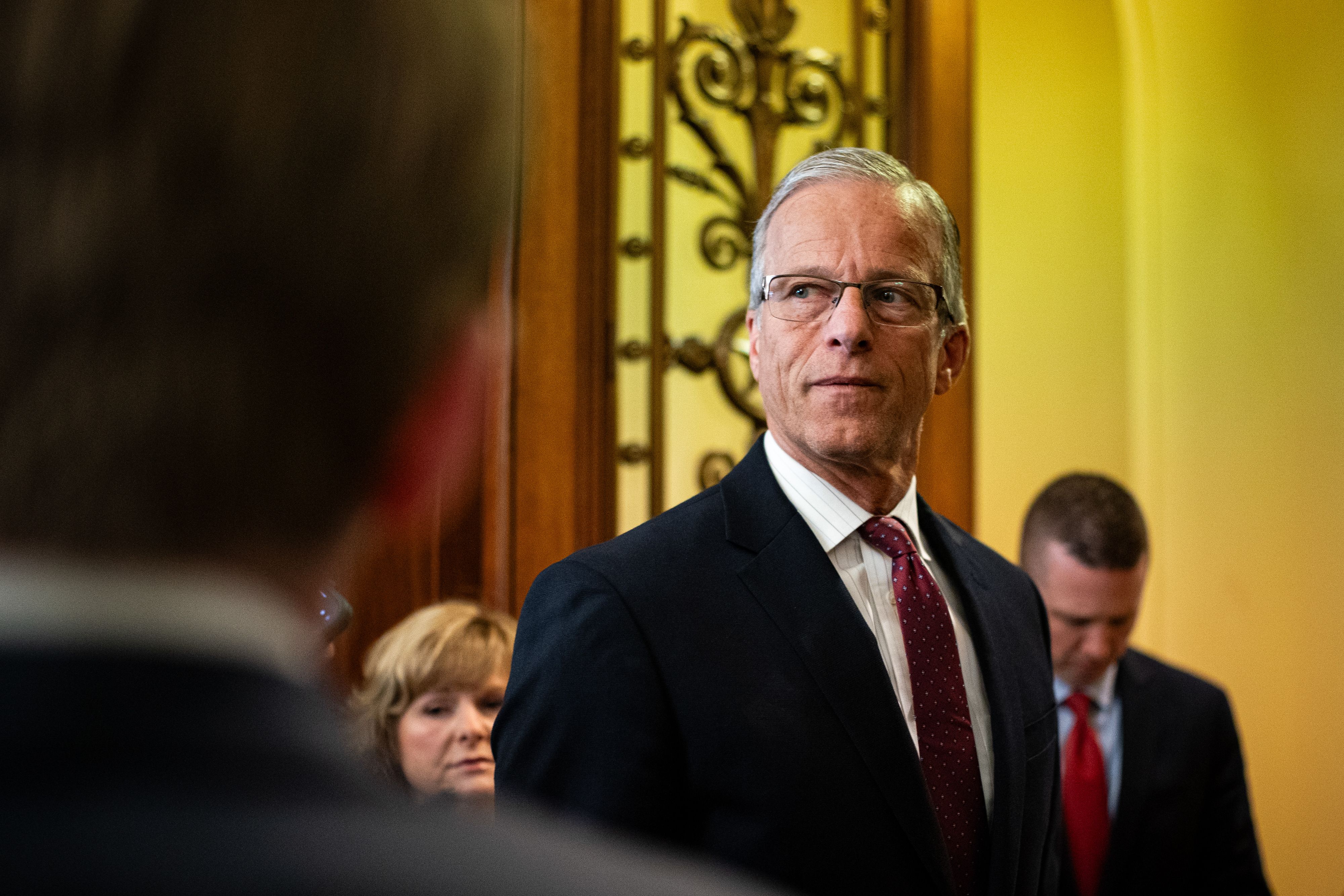
Senate Majority Leader John Thune (R-S.D.) expects some form of freeze on state AI regulations to remain in the "big, beautiful bill" β even as his Republicans keep debating a House-passed 10-year restriction for states, he told Axios' Stef W. Kight in an exclusive interview.
- Why it matters: States are leading the way in passing and implementing AI guardrails while Congress lags behind.
Thune's support for a moratorium fits a top priority among many Republicans in Washington: Don't get in the way of innovation.
- "We want to be the leaders in AI and quantum and all these new technologies. And the way to do that is not to come in with a heavy hand of government. It's to come in with a light touch," Thune said.
Asked how Congress can know what policies will work in 2035, Thune responded frankly: "I don't think you can."
- "I think this is the kind of thing where you can put some basic sort of parameters in place. But you're going to have to come along and be able to tweak those in the future, too."
Keep reading ... Ashley Gold contributed reporting.
6. π Elon's AI rewrite
Elon Musk β unhappy with how his AI platform answers divisive questions βΒ is pledging to retrain Grok so it will answer in ways more to his liking, Axios' Ina Fried writes.
- Why it matters: Efforts to steer AI in particular directions could exacerbate the danger of a technology already known for its convincing but inaccurate hallucinations.
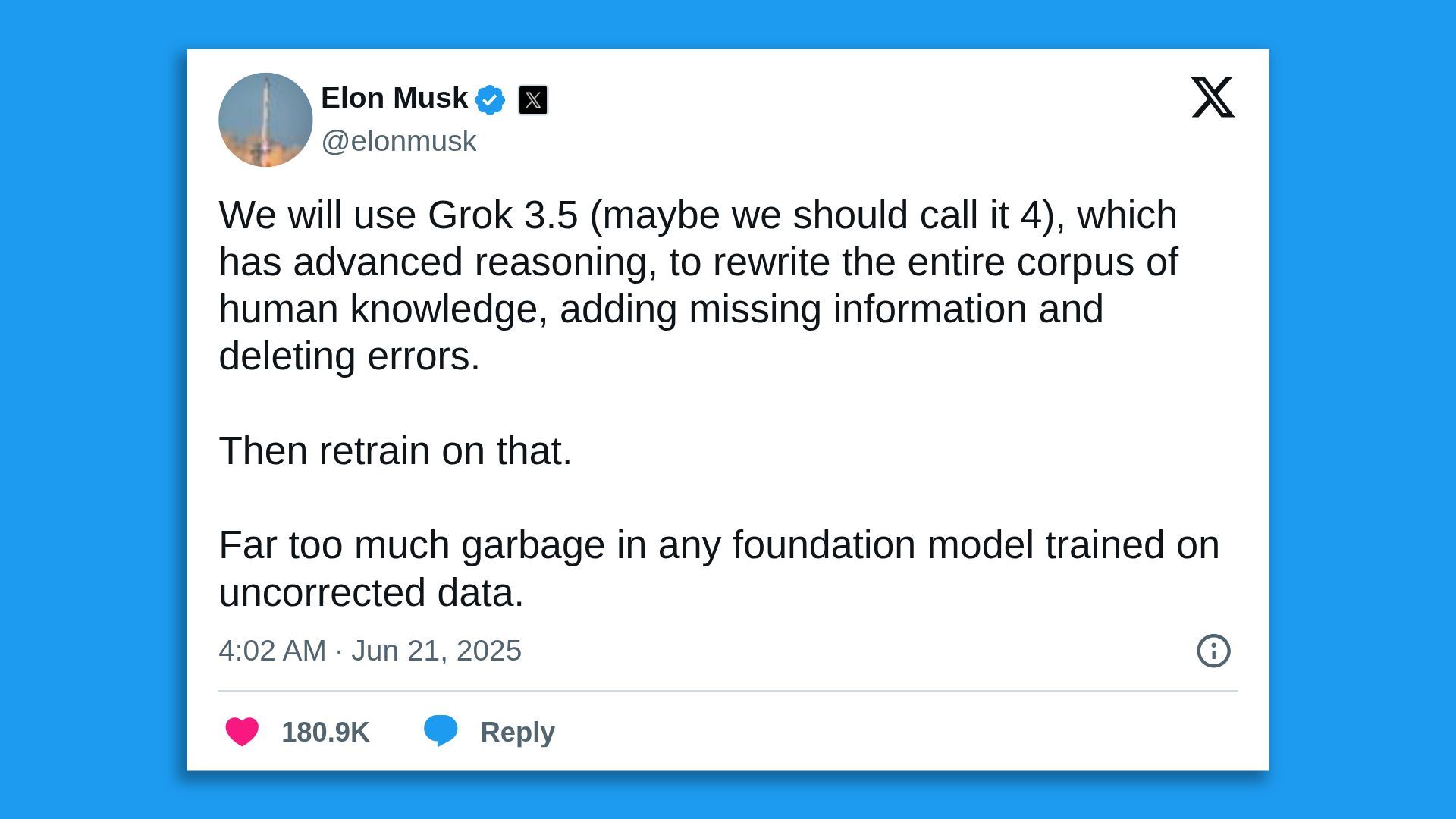
In a series of tweets over the past week, Musk has expressed frustration at the ways Grok was answering questions and suggested an extensive effort to put his thumb on the scale.
7. π§ͺ Scoop: Trump chops scientific publisher

The Trump administration has terminated millions worth of funding for Springer Nature, a German-owned scientific publishing giant that has long received payments for subscriptions from the NIH and other agencies, Axios' Adriel Bettelheim and Tina Reed have learned.
- Why it matters: President Trump and MAGA have made a push to target academic institutions as well as research organizations perceived to be the source of so-called "woke" ideology by withholding federal funding and in some cases initiating legal action.
Prior to the administrative action, Donald Trump Jr. had tweeted: "No more taxpayer money for woke publishers!" He linked to a Breitbart story about possible cuts to government-funded subscriptions for scientific and medical journals.
- About $20 million in grants covering subscriptions have been cut, with billions more being evaluated, according to the source.
8. π 1 fun thing: World's largest digital camera

The largest digital camera ever built has released its first shots of the universe β including colorful nebulas, stars and galaxies.
- Why it matters: The Vera C. Rubin Observatory, located on a mountaintop in Chile, was built to take a deeper look at the night sky, covering hidden corners.
π¬ Thanks for reading! Please invite your friends to join AM.
Sign up for Axios AM