Axios AM

January 15, 2026

🧤 Happy Thursday! Smart Brevity™ count: 1,653 words ... 6 mins. Thanks to Noah Bressner for orchestrating. Edited by Andrew Pantazi. Copy edited by Bill Kole.
Situational awareness: In Minneapolis, a federal officer shot a man in the leg after being attacked with a shovel and broom handle. Homeland Security said the Venezuelan man is in the U.S. illegally. Smoke filled a nearby street last night as officials urged people to go home. Get the latest.
1 big thing: The job replacement AI machine
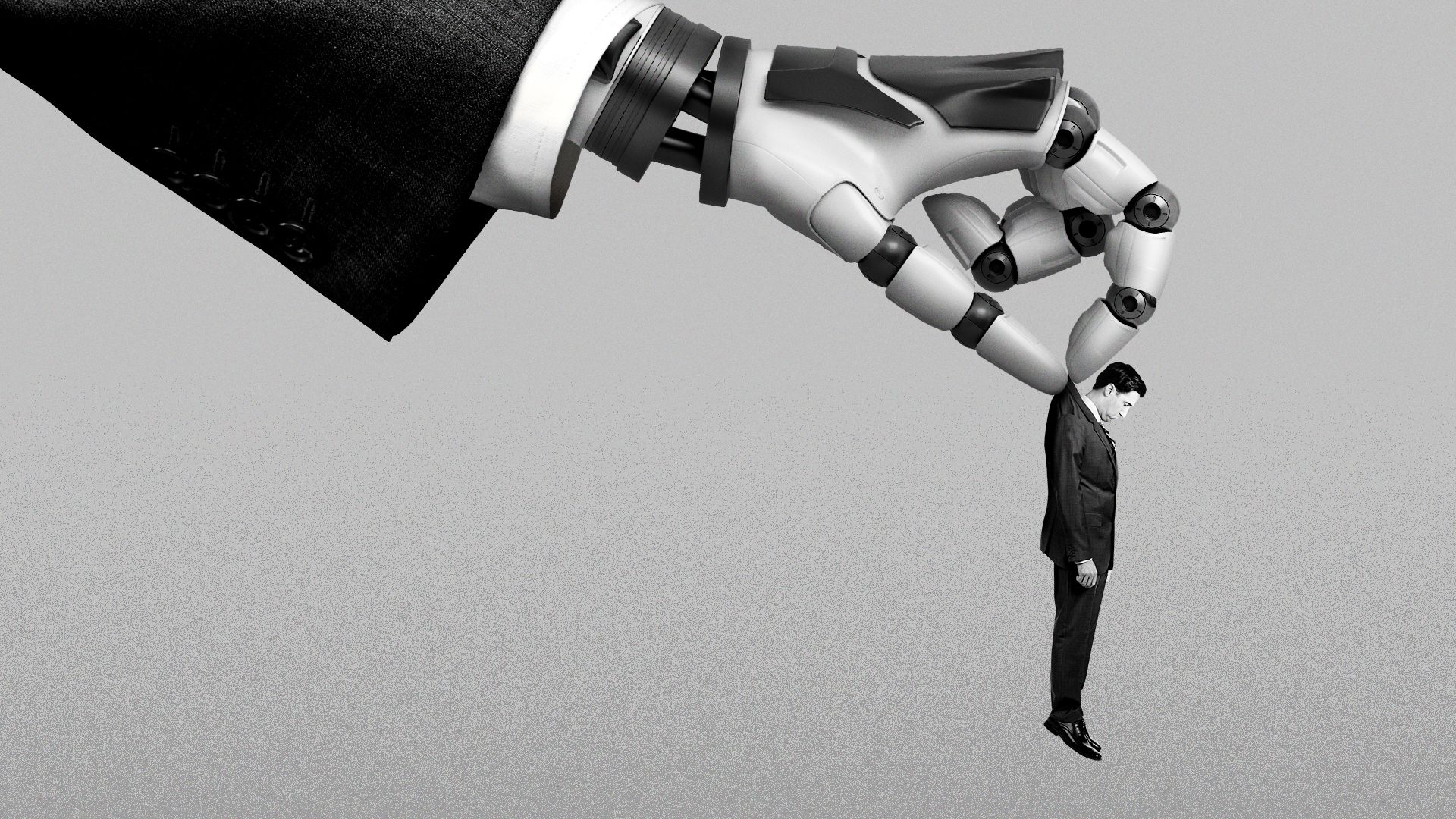
There's little evidence AI is destroying large numbers of white-collar jobs today. But five developments show the potential for massive future job and workplace disruption, Jim VandeHei and Mike Allen write in a "Behind the Curtain" column:
- A new report from Goldman Sachs Research warns: "AI can potentially automate tasks that account for 25% of all work hours in the U.S. This significant exposure has raised concerns around widespread and permanent job loss, sparking fears of a 'job apocalypse' or 'humans going the way of horses.'"
- Anthropic revealed this week that one of its AI tools, Claude Code, built a new product, Cowork, which allows others to use AI for workplace tasks normally done by humans — creating presentations, summarizing meetings, consolidating research. You read that right: AI built AI that will displace human work with AI. Use that for a glimpse of what's coming.
- Some top tech leaders are talking privately about losing interest in H-1B visas — the ones tech companies use to hire top overseas talent. The reason: They now assume AI will do the work.
- The Wall Street Journal reports that a hot new San Francisco startup, Mercor, has hired more than 30,000 contractors to recruit specialists, from psychologists to dermatologists, to train AI to do their jobs. The company got a $10 billion valuation for a reason.
- Elon Musk, in a new "Moonshots" podcast episode, says AI is good enough today to replace half of white-collar jobs. He also argues it's "pointless" to go to medical school except for "social reasons." Robots, he says, will be doing surgery at scale within three years.
Why it matters: Nothing will determine the future of AI, politics and employment more than if — and how fast — the new technology destroys good-paying jobs.
🖼️ The big picture: So far, the job market is pretty good by historical standards, with unemployment at 4.4%.
- But it's been slowing. Many CEOs will tell you privately they plan to run their companies with far fewer people in the years ahead. They're slower to fill open jobs and quicker to determine what roles AI will soon displace.
Most new technologies create more jobs than they destroy over time. But there's often pain in between.
- Both major parties are oddly silent about what to do about the possible jobs inferno that seems to be coming. Among the reasons they express privately: Policy experts are at a loss ... It's not here yet ... Politicians are reluctant to poke the bear on a subject that makes people queasy.
- You could sit in a room and make a huge dent in many problems if you were willing to make hard enough choices. Not this one.
President Trump thinks the problem is the opposite. He told The New York Times last week that we'll need robots just to meet labor demands.
- "I think just the opposite," he said when told many Americans are concerned that AI will take their jobs. "I think AI is going to be a tremendous job producer. I think that we have so many jobs. My biggest problem isn't taking the jobs. It's that we don't have enough people to fill the jobs, and that's where robots come in."
Put that one in a time capsule: Trump will either look clairvoyant — or careless.
2. 🤖 AI's job evolution
Our column shows what's barreling at us. New data this morning from Anthropic, creator of Claude, gives us a snapshot of this moment:
- Right now, instead of putting people out of work, AI is mostly helping them do their jobs, Axios' Emily Peck writes from a new edition of the Anthropic Economic Index.
🔬 Zoom in: Today's AI is reshaping how people work, not whether people work. Put another way: AI takes over parts of people's jobs.
- 49% of jobs can now use AI in at least a quarter of the tasks involved — up from 36% three months ago, Anthropic found.
🎨 The big picture: The way AI changes your job depends a lot on what kind of work you do.
- Deskilling: AI takes on large portions of many roles, from data entry to IT, putting more work at risk of automation and extending trends decades in the making.
- Upskilling: AI takes over rote work, giving professionals like radiologists and therapists more time for interacting with clients.
💥 Friction point: The study finds that AI delivers the biggest productivity gains on complex work — the same work that most requires human oversight.
- It can take Claude minutes to pull together a broad overview of research, says Peter McCrory, Anthropic's head of economics. But whether or not that actually generates any real value hinges on your expertise in evaluating that work.
Full report ... More data on how people use Claude ... Share this story.
3. ⛏️ Scoop: Strategic reserve for critical minerals

A bipartisan group of lawmakers will introduce legislation today to create a $2.5 billion strategic stockpile of critical minerals, Axios' Hans Nichols has learned.
- Why it matters: President Trump is bringing his prospector's pick to nearly every corner of the globe — including Ukraine, Venezuela and Greenland — in a push to boost the U.S. supply of minerals that are critical to the tech industry's growth.
Now Congress wants to join the minerals rush by helping to secure — and stabilize — the domestic market for rare-earth and critical materials.
- Sens. Jeanne Shaheen (D-N.H.) and Todd Young (R-Ind.) — along with Reps. John Moolenaar (R-Mich.) and Rob Wittman (R-Va.) — will introduce the SECURE Minerals Act this morning.
🔭 Zoom in: Most of the world's supply is controlled by China, leaving the U.S. vulnerable to price swings and supply-chain disruptions for minerals needed to make advanced semiconductor chips and EV batteries.
- The goal is to create something akin to the Strategic Petroleum Reserve, which was established in 1975 in response to the Arab oil embargo.
4. 💵 Exclusive: America's economic "hinge point"

The U.S. faces a fork in the road: Embrace dynamic capitalism or tolerate stagnation, the leader of America's biggest business group will say today in a major speech.
- Why it matters: American business leaders see strains of thought in both major parties that they believe threaten the nation's economic vibrancy as the U.S. approaches its 250th birthday, Axios' Neil Irwin writes.
Suzanne P. Clark, president of the U.S. Chamber of Commerce, will make a full-throated case for embracing the power of markets at the group's "State of American Business" event this afternoon, according to a prepared text seen first by Axios.
- "Not only is this America's 250th year, but it is a year when competing visions for America's economic future are coming to a head," Clark will say, describing it as a "hinge point."
- Voters are frustrated about affordability and job opportunities, and a growing number "are willing to throw out capitalism and try something different," she warns.
🔬 Between the lines: The speech, which will be delivered before some of America's most prominent CEOs, doesn't mention any elected officials by name. But it doesn't take much imagination to discern the political trends Clark sees as contrary to the cause of American prosperity.
- Some Democrats openly embrace socialism, and corporate leaders widely believe the Biden years featured a damaging anti-business regulatory overreach.
- President Trump has implemented the highest tariffs in nearly a century and sought to micromanage companies' decision-making from the Oval Office.
📊 Gallup polling released yesterday found a near-record share of Americans see big business as the biggest threat to the country's future — behind big government.
5. 👀 Trump's mass deportation trouble

Support for President Trump's immigration crackdown is unraveling quickly and reviving Democratic opposition on an issue that helped decide the last election, Axios' Brittany Gibson writes.
- Why it matters: Border chaos under former President Biden helped return Trump to power. Now, it's chaos from ICE and other Trump immigration enforcers that's turning off the public, one viral video at a time.
Just weeks after Trump was sworn in, ICE had a +16 positive favorability rating, according to a YouGov/Economist poll.
- Majorities now disapprove of ICE raids and how the agency is handling its job. Americans are now statistically split on whether to abolish ICE altogether, according to one poll.
- If that anger carries into the midterms, a Democratic House majority could cut off ICE funding, subpoena DHS and even impeach Homeland Security Secretary Kristi Noem.
6. 💰 Stat du jour: America's largest landowner

Stan Kroenke — the billionaire owner of the L.A. Rams and Denver Nuggets — became the largest private landowner in America last month, according to The Land Report.
- His purchase of 937,000 acres of ranchland in New Mexico brings Kroenke's total holdings to 2.7 million acres across the West.
Go deeper (N.Y. Times gift link) ... Top 100 landowners.
7. 📺 Exclusive: New streaming record

Christmas Day shattered historic streaming records, according to new Nielsen data shared exclusively with Axios' Sara Fischer.
- Why it matters: Streaming accounted for more than half (54%) of all TV viewing in the U.S. on Christmas, marking only the second time in history that streaming has surpassed 50% total viewership in a single day.
The NFL's slate of Christmas games, combined with Netflix's release of three new "Stranger Things" season five episodes, helped push streaming to new heights over the holiday.
8. 🌴 1 fun thing: Olympic ticket marathon

The scramble to buy tickets for the 2028 Los Angeles Olympics officially began yesterday — 2½ years before the opening ceremony, Axios' Kate Murphy writes.
- Organizers opened a lottery for time slots to buy tickets when sales begin in April. Registration runs through March 18.
LA28 is expected to release a record 14 million tickets for the Olympics and Paralympics.
📬 Thanks for reading! Please invite your friends to join AM.
Sign up for Axios AM