Axios AM

June 20, 2025

๐ Happy Friday, and welcome to summer! Today's the summer solstice โ the longest day of the year.
โ๏ธ In what President Trump hailed as a "BIG WIN," a 9th U.S. Circuit Court of Appeals panel last night allowed him to keep control of California National Guard troops he deployed to LA. Get the latest ... Read the ruling.
๐ต SoftBank founder Masayoshi Son wants to team up with Taiwan Semiconductor Manufacturing Co. to build a trillion-dollar AI-and-robotics manufacturing hub in Arizona, Bloomberg reports ($).
- SoftBank officials have talked with state and Trump administration officials about tax breaks for companies investing in the industrial park, Bloomberg says.
Smart Brevityโข count: 1,545 words ... 6 mins. Thanks to Noah Bressner for orchestrating. Copy edited by Bryan McBournie.
1 big thing: CEOs try fright
Chief executives are giving employees an AI fright โ warning them the new technology could make many workers obsolete, while urging them to start using it right away, Axios' Emily Peck writes.
- Why it matters: Workers are being inundated with a constant barrage of surveys and warnings about AI taking jobs.
In a post earlier this week, Amazon CEO Andy Jassy offered his thoughts on generative AI. In paragraph 15, he gets to the tough part:
- The transformation will likely "reduce our total corporate workforce."
- Jassy is echoing the message of many other leaders. JPMorgan's consumer chief recently told investors AI would allow for a 10% headcount reduction. Other companies have already blamed AI for layoffs.
Zoom in: Here are a few explanations for the wave of hard-nosed AI messaging:
๐ Genuine belief: Executives are concerned about AI's impact. They believe employees aren't taking it seriously enough, says Brian Elliott, a leadership consultant.
- Some lean toward "a more balanced message," he says. They suggest they'll be slowing or stopping hiring, while imploring workers to adapt.
- Shopify CEO Tobi Lutke did this in an email to employees. Rather than threaten layoffs, he says using AI is now a "baseline expectation" at the company. Before any new hiring, managers would have to demonstrate that AI couldn't fill the role.
๐ Setting expectations: It's a way to make CEOs look more transparent, and could make way for future layoffs without shocking employees, says Jeffrey Sonnenfeld, a professor at Yale School of Management.
- All this talk has an "inoculation effect," he says โ a "warning with an anticipatory alert that preempts later trauma going viral."
๐ Appealing to investors: The tough talk is for Wall Street, a signal that a company is on trend.
๐ Talking their book: AI companies โ and the firms making massive investments in the tech โ want to communicate how valuable it is.
Friction point: Managing through fear has a bad track record, decades of research shows.
- Scaring employees could inspire them to action. But there are "toxic effects over the long run," as Wharton professor Andrew Carton has put it.
- It can stifle creativity, inhibit collaboration and lead to burnout, he said.
2. โ Trump's Iran diplomacy timeline

Citing the "chance for substantial negotiations" with Iran, President Trump is leaving the door open to a diplomatic solution in the coming days that could avert a major escalation in the Middle East, Axios' Barak Ravid writes.
- Why it matters: White House press secretary Karoline Leavitt told reporters Trump would make a decision on an Iran attack "within two weeks" (a favorite Trump time horizon).
๐ Behind the scenes: As Trump has deliberated in recent days over whether to join Israel's war, special envoy Steve Witkoff has maintained direct communication with Iranian Foreign Minister Abbas Araghchi.
- Trump said Wednesday that Iran still wants to negotiate with the U.S. and has even proposed sending a delegation to the White House.
- He cautioned, however, that it was getting "very late" for talks and he may soon authorize strikes on Iran's nuclear program.
U.K. Foreign Secretary David Lammy met with Witkoff and Secretary of State Marco Rubio at the White House yesterday, and posted on X that a "window now exists within the next two weeks to achieve a diplomatic solution."

๐ Between the lines: Trump's extended timeline "also opens a host of new military and covert options," The New York Times' David E. Sanger and Tyler Pager note. (Gift link)
- "Assuming he makes full use of it, Mr. Trump will now have time to determine whether six days of relentless bombing and killing by Israeli forces" have changed minds in Tehran.
- But it's also possible that Trump's announcement yesterday "was an effort to deceive the Iranians and get them to let their guard down."
3. ๐ Poll: Americans want presidential health records
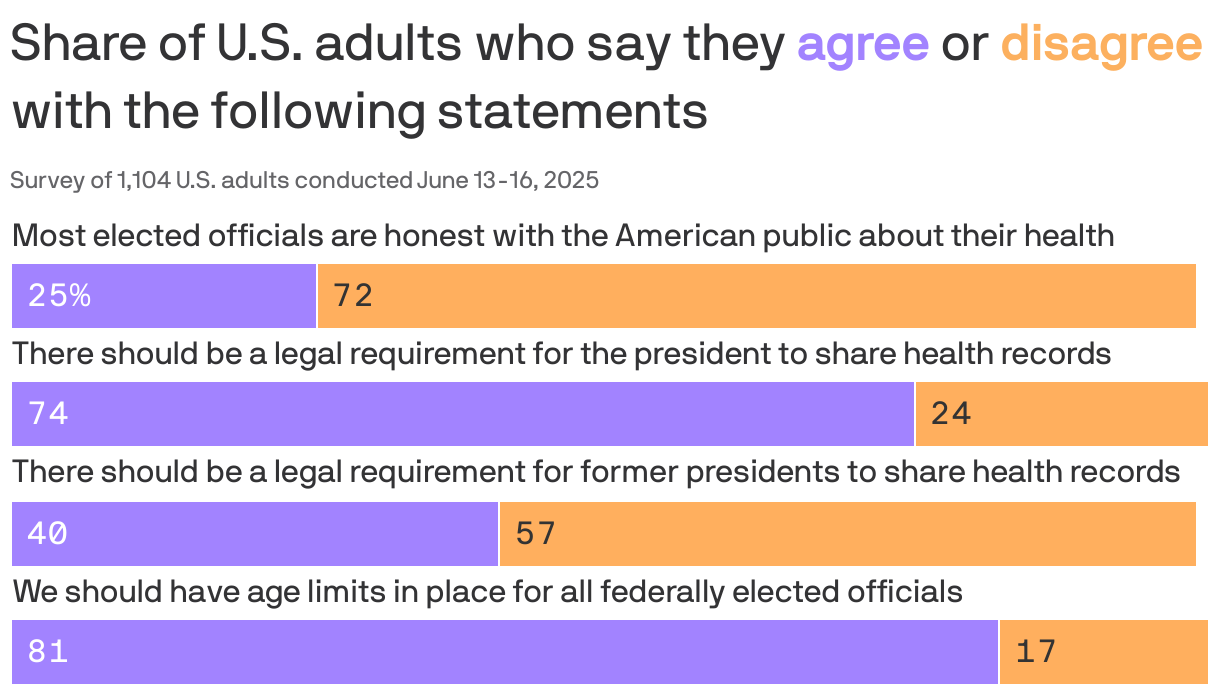
Eight in 10 Americans want legally required and publicly released cognitive tests and disease screenings for U.S. presidents โ and age limits on the presidency, according to the latest Axios-Ipsos American Health Index.
- About 3 in 4 say politicians aren't honest about their health, and that presidents should be legally required to share their medical records with the public, Axios' Adriel Bettelheim and Margaret Talev write.
Why it matters: The issue of presidents' health has become particularly poignant in light of the decline of Joe Biden, who was 82 when he left office, and the return of Donald Trump, who's now 79 and was the oldest president to be inaugurated in U.S. history.
- Trump rarely has offered glimpses into his health records. His team released a memo after his physical in April that pronounced him in "excellent health," but political foes such as California Gov. Gavin Newsom have questioned Trump's mental fitness and whether he's up to the job.
๐ผ๏ธ The big picture: The balance between public officials' medical privacy and the public's right to know has swung sharply toward more disclosure, the poll showed.
- It found strong bipartisan appetite for increased transparency about public officials' health, and for a maximum age at which officeholders and Supreme Court justices can serve.
4. ๐ฅ Trump's Juneteenth jab

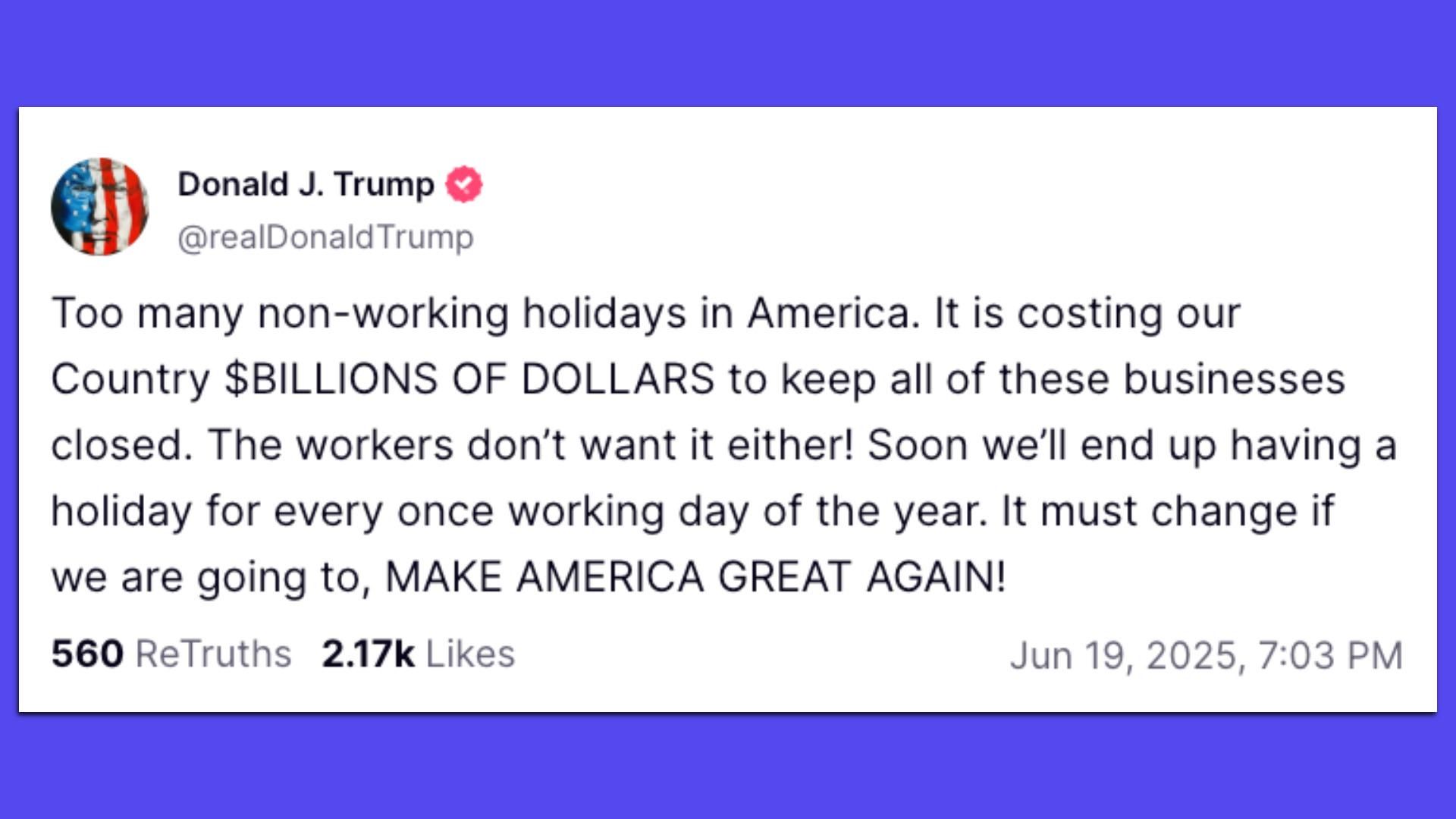
On Juneteenth, a federal holiday marking the end of slavery, President Trump declared on Truth Social that there are "[t]oo many non-working holidays in America."
- "Soon we'll end up having a holiday for every once working day of the year."
Go deeper: No White House proclamation for Juneteenth, which became a federal holiday under then-President Biden in 2021.
5. ๐๏ธ Exclusive: Google rolls out AI city playbook

Google is releasing a playbook today to help mayors across the country adopt city-wide AI strategies, Axios Pro Tech Policy's Ashley Gold writes.
- Why it matters: Cities are approaching the technology wildly differently and with varying levels of resources, interest and need.
"Building Your City's AI Strategy," released in partnership with the United States Conference of Mayors, is meant to serve as a framework for mayors and other municipal leaders to assess and implement AI.
- The guide states that AI offers cities "significant advantages" and "can automate certain tasks while freeing up city staff for complex, human-centric work."
๐งฎ By the numbers: 96% of 100 mayors across the globe surveyed by Bloomberg Philanthropies in 2023 said they were interested in using generative AI, but only 2% surveyed were actively implementing it and 69% said they were exploring it.
- Read the guide ... Get Axios Tech Policy: Quick intel on federal tech policy for your job.
6. ๐ค AI's small biz slow start
Small business leaders are beginning to embrace generative AI, but not enough to pay much for it, Axios' Scott Rosenberg writes from a new survey of 1,000 businesses by U.S. Bank.
- 36% of these small business owners say they're already using generative AI, and another 21% say they expect to start doing so over the coming year.
Most of the use by small businesses is in the free or low-cost entry-level tiers. So AI giants can't expect a wave of revenue growth from this market.
- 68% of small business owners surveyed who are using generative AI say they're spending less than $50 a month for AI services.
- The survey defined a small business as having up to $25 million in annual revenue, with 99 or fewer employees.
๐ญ Zoom out: The tech industry has been using a "hook them on free samples" tactic since the 1990s advent of the web.
- AI makers are betting that today's free-tier user will graduate to higher-priced levels.
7. ๐ Waymo's Manhattan detour
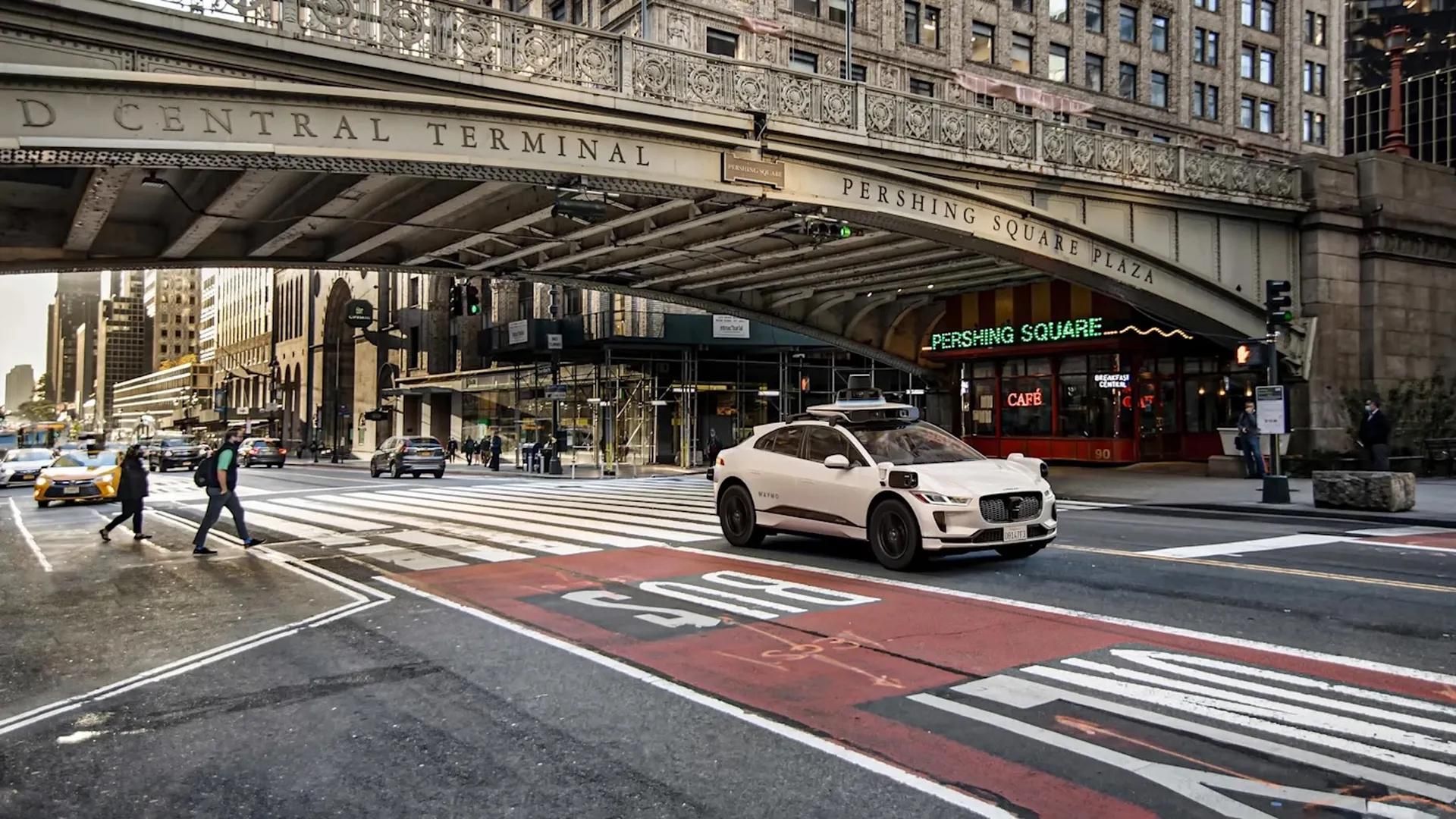
Waymo is bringing its robotaxis to New York next month with a goal of launching a full-fledged driverless rideshare service in the future, Axios Future of Mobility author Joann Muller writes.
Why it matters: Waymo is the autonomous vehicle industry leader, with a fleet of 1,500 robotaxis in multiple U.S. cities, including San Francisco, Los Angeles and Phoenix.
- Cracking New York, America's most crowded city, would be a huge feat.
The catch: New York state law prohibits vehicles from operating without a driver behind the wheel.
- Waymo has applied to the city's Department of Transportation for a permit to test autonomous vehicles with a safety driver in Manhattan.
- If approved, it would be the first testing deployment of robot-driven cars in New York.
8. ๐ฝ๏ธ 1 fun thing: World's best restaurant

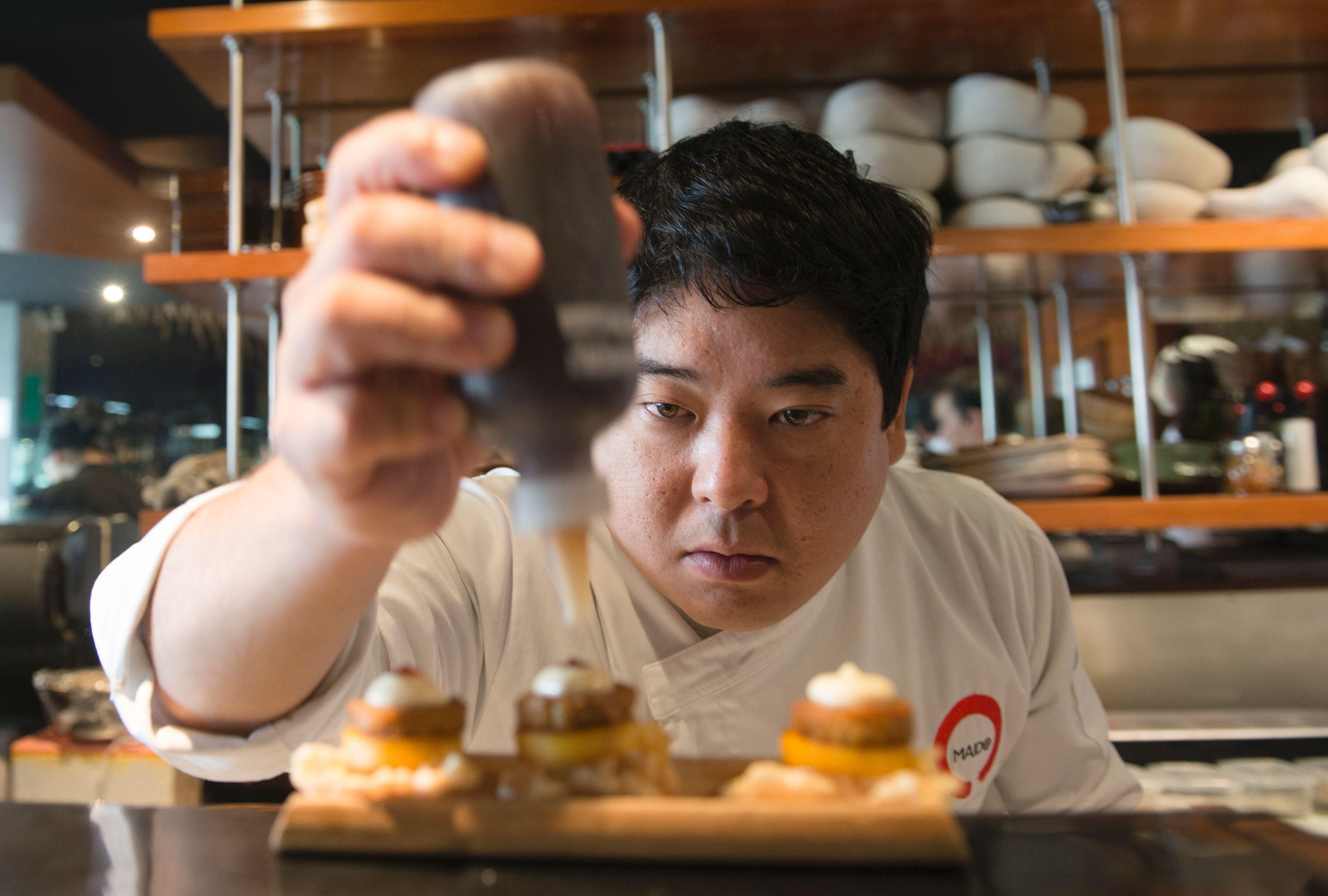
Maido โ a Peruvian-Japanese restaurant in Lima, Peru โ took the top prize on the influential World's 50 Best Restaurants list.
- Only one U.S. restaurant made this year's ranking: At No. 12, Atomix ("Elevated Korean counter dining in Manhattan"), which also won a James Beard Award this week.
๐ฌ Thanks for reading! Please invite your friends to join AM.
Sign up for Axios AM