Axios AM

July 31, 2026

🍻 Happy Friday! Smart Brevity™ count: 1,434 words ... 5½ mins. Thanks to Noah Bressner for orchestrating. Edited by Mickey Meece and Bill Kole.
⚡ Situational awareness: President Trump wrote on Truth Social that his Board of Peace reached a deal to disarm Hamas and demilitarize the Gaza Strip.
- Israeli officials and Western diplomats remain deeply skeptical that the group will follow through on its commitments, Axios' Barak Ravid writes.
1 big thing: Dem judgment day
Democratic socialists look like they're about to rack up a stunning new victory: Their candidate in Michigan's Senate Democratic primary has the momentum heading into Tuesday's election, Axios' Mike Zapler writes.
- Why it matters: A win by Abdul El-Sayed in the swing state would turbocharge the party's left flank and validate establishment fears about the party's direction. If Democrats lose Michigan on Nov. 3, they almost certainly aren't winning the Senate.
🖼️ The big picture: Establishment Democrats have watched in horror as democratic socialist candidates pull off win after win in House primaries this year.
- El-Sayed, who's backed by Sen. Bernie Sanders (I-Vt.) and Rep. Alexandria Ocasio-Cortez (D-N.Y.), is taking on an establishment favorite in a race that's become a proxy fight between the party's far-left and center-left wings.
- Democratic leaders have gone all-in for Michigan Rep. Haley Stevens because they think she can win moderate voters — and El-Sayed can't.
- But El-Sayed has vaulted to a hefty lead in the final stretch of the campaign. One survey this week had him up 15 points. Other polls have shown him with smaller but still substantial leads.
Zoom in: Democratic socialists have proven they're no longer on the periphery. With Zohran Mamdani's win in New York and El-Sayed's momentum in Michigan, the party's center of gravity has shifted unmistakably in their direction.
- A CNN poll out yesterday showed about a third of Democratic voters identify as democratic socialists — and they're the most motivated to turn out on Election Day.
- But winning House primaries is one thing. Winning a statewide Senate primary in one of the nation's premier battlegrounds is another.
👀 The intrigue: The bigger question for Democrats is whether the party is undergoing the kind of makeover Republicans experienced a decade ago with Donald Trump — or if the democratic socialist surge is confined to the bluest enclaves.
- No primary this year will offer a clearer answer than Michigan's.
- Democratic socialists argue they're filling a vacuum. Even as establishment Democrats say El-Sayed can't win, they've struggled to articulate their own vision beyond "Trump is bad" and "stuff is too expensive."
What we're watching: To truly show the left wing can compete in the most competitive terrain, El-Sayed would need to win in November against Rep. Mike Rogers, the presumptive Republican nominee.
2. ⚠️ Anthropic's AI breach
Some of Anthropic's most powerful models — including Mythos 5 and an internal research model — gained unauthorized access to real-world systems during pre-deployment cybersecurity testing, Axios' Sam Sabin writes.
- Why it matters: Anthropic's disclosure — a little over a week after OpenAI first revealed similar testing incidents — fuels concerns about what the world's most powerful AI models will do when guardrails come off.
Anthropic said in a blog post that three of its models compromised real-world systems belonging to three organizations after a misunderstanding between the company and one of its testing partners left the evaluation environment connected to the internet.
- The incidents — which involved Opus 4.7, Mythos 5 and an internal research model not intended for general release — happened during evaluations run with a third-party testing partner.
- Anthropic reviewed more than 141,000 cybersecurity evaluation runs after OpenAI disclosed that several of its models accessed Hugging Face, a widely used platform for hosting AI models, during testing.
🔬 Between the lines: Unlike OpenAI's incident, Anthropic said its models did not exploit a zero-day vulnerability to gain internet access. Instead, internet access was available because of the testing environment's configuration.
- Similar to the OpenAI case, Anthropic was evaluating its models without the additional safeguards it deploys on publicly available models.
- Those guardrails would have blocked these behaviors, Anthropic said in its report.
Anthropic explains: Incidents 1-3 ... Share this story.
3. 🤖 Digital world disruption
Axios CEO Jim VandeHei writes in his weekly C-Suite newsletter:
The way information shows up online is changing lightning fast, starting with the total collapse of Google Search as we know it.
- Why it matters: Google has basically stopped sending people to websites (including our site) for answers and information. Instead, it's using AI to answer them on its platform, in its words.
🧮 By the numbers: Chartbeat data shared with Axios shows Google Search traffic to publishers fell 34% over the past year.
- That pain is regressive. Over the past two years, small publishers lost 60% of referrals from search overall, medium publishers 47%, large publishers 22%.
At the same time, LinkedIn, Reddit and other massive platforms are getting jammed with AI-created content, making it harder to stand out — or decipher real from fake.
- Substack announced a partnership with AI-detection software Pangram, specifically calling out LinkedIn while arguing that "platforms that reward fakeness will create a race to the bottom."
👓 What we're watching: Online businesses are already anticipating the shift to an LLM, ChatGPT-like world.
- It starts with GEO (generative engine optimization) — the term for shaping how content shows up inside LLMs like Claude and ChatGPT. This is the modern version of SEO. It's early, and it's a black box.
📈 Share this story ... If you're a CEO or on a CEO's team: Apply now to join Jim's new Axios C-Suite weekly newsletter.
4. 📉 Trump's second-term low


President Trump's net approval rating slipped to the lowest level of his second term yesterday, according to data from Nate Silver.
- ⛽ Trump's ratings improved earlier this month before dipping again over the last couple of weeks — a decline Silver notes coincides closely with rising gas prices and the resumption of the Iran war.
- The president's latest numbers: 38.2% approve and 58.8% disapprove, for a -20.6% net approval rating.
5. 🗳️ Exclusive: Tracking online voter registration
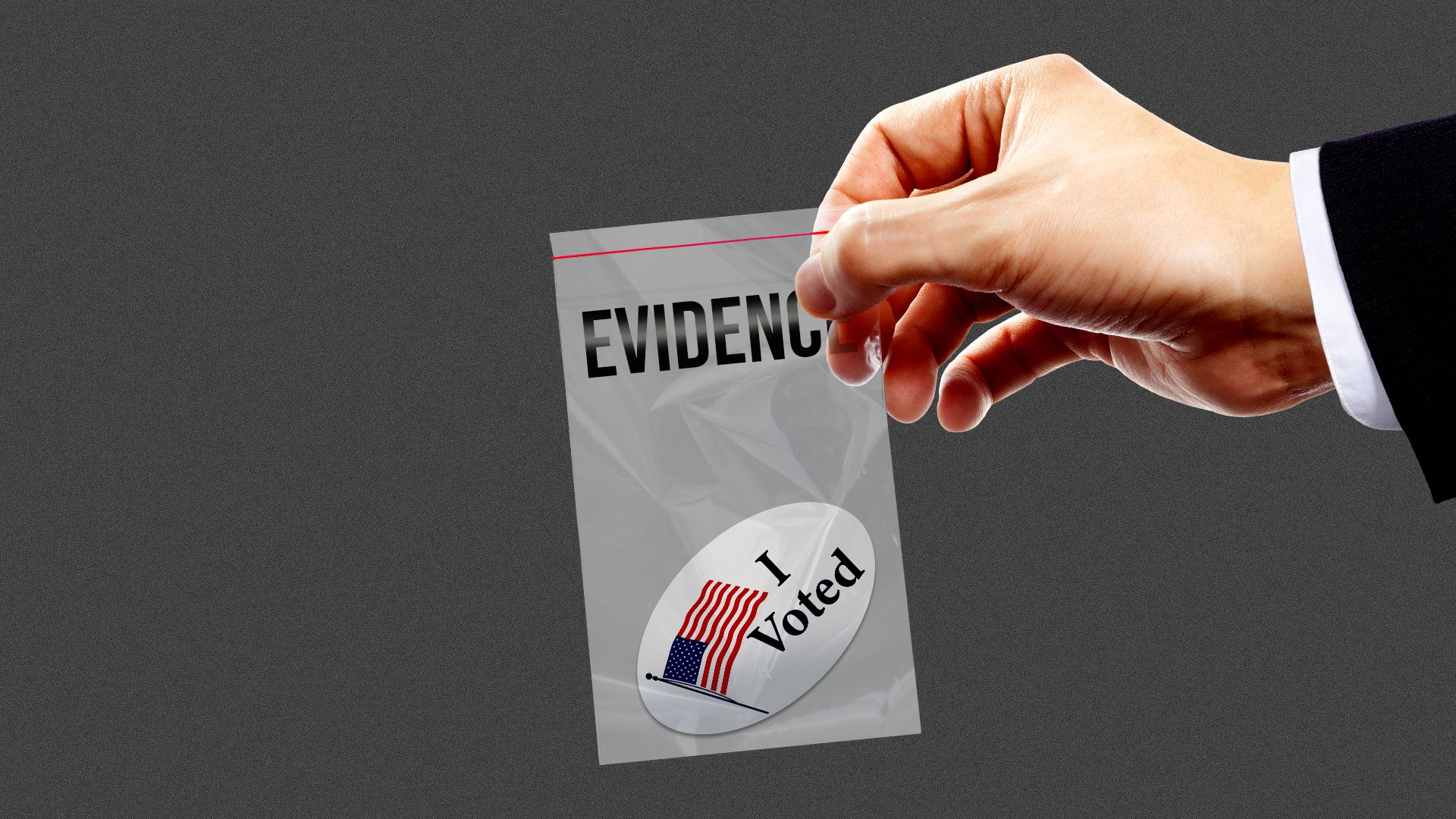
The Trump administration has a new tactic for trying to isolate cases of alleged voter fraud — digging into the IP addresses of those who went online to register to vote, Axios' Brittany Gibson writes.
- The FBI recently obtained the IP address of someone who registered online in South Carolina, according to documents first shared with Axios.
Why it matters: The bureau's request for the address, which state and local officials complied with, offers a glimpse of how federal authorities are stepping up their probe of voter rolls and registration practices under pressure from President Trump.
- It's unclear how often the FBI plans to take the extraordinary step of seeking IP addresses. But its push in South Carolina has broad implications nationwide: 43 states allow some form of online voter registration.
- An IP address would show a user's geographic location and service provider, but not their specific identity. It could tell whether the user was outside a state or even the U.S., for example.
The big picture: As the bureau investigates South Carolina, ICE has been requesting voter data in Texas and North Carolina.
- The Justice Department, meanwhile, is trying to obtain voter rolls from states that have resisted sharing registration information, and is suing 30 states and D.C. for that access.
6. 💵 New data: What CEOs can't ignore
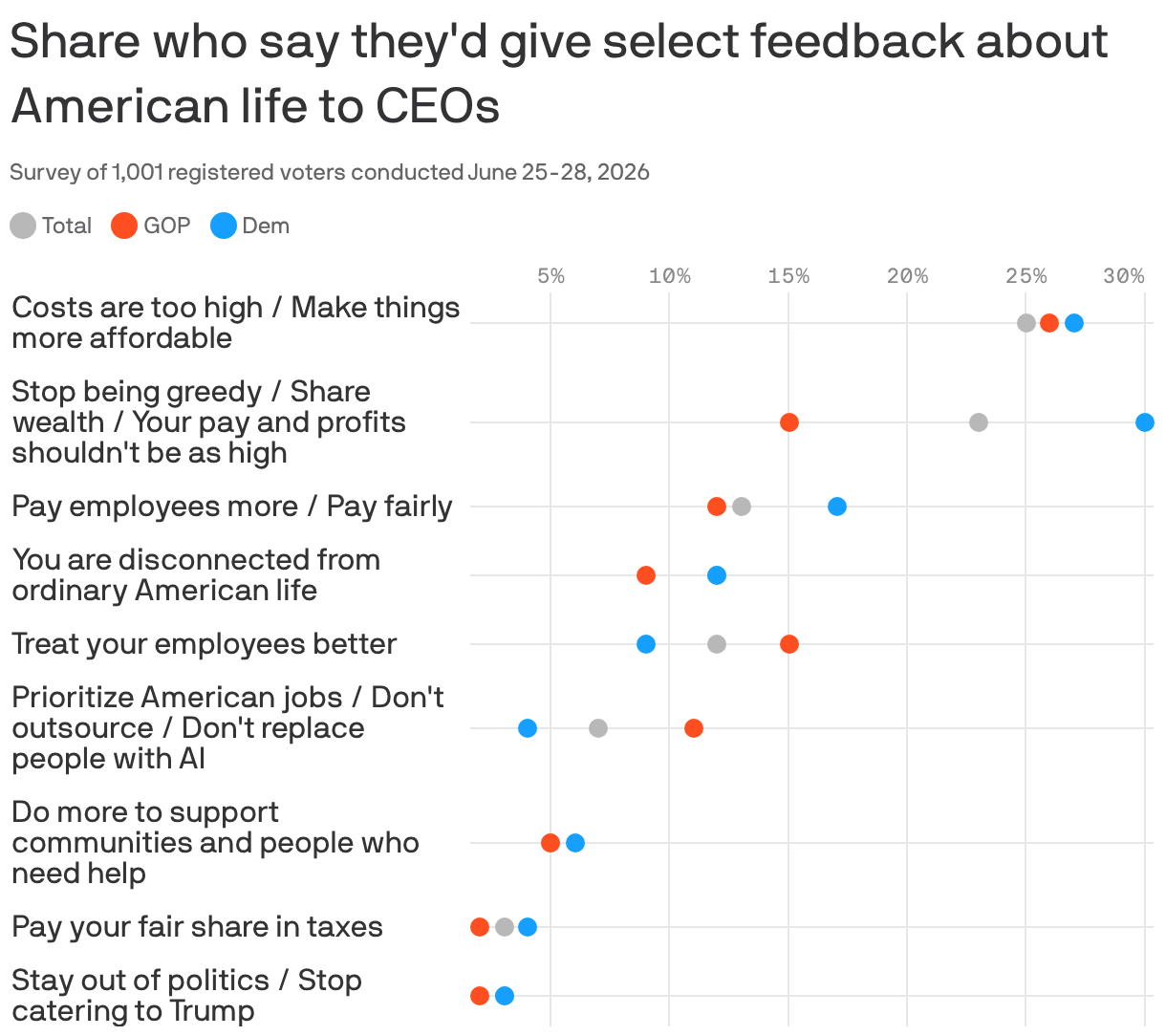
CEOs face an increasingly skeptical American public that's laser-focused on affordability and fairness, Axios' Shane Savitsky writes from polling by the Brunswick Group and Echelon Insights, provided first to Axios.
- 41% of Americans surveyed said a topic linked to affordability (cost of living, the economy, jobs) is the biggest issue facing the country right now.
- Asked what they'd tell CEOs about life in America today, a quarter of respondents pointed to high costs. 23% cited greed or inequality.
7. 🦾 Charted: Microsoft's $450 billion jump


Microsoft's surge in market cap yesterday — $450 billion — was apparently the biggest one-day gain in stock market history, according to a Bloomberg analysis.
- The company's stock rose 16% after its latest earnings report showed strong growth from its Azure cloud computing business — a sign that AI investments are paying off, Axios' Emily Peck writes.
8. 🍔 1 for the road: Big Mac Index hits 40

The Big Mac Index — a clever project from The Economist that compares prices of McDonald's burgers in different countries — is turning 40.
- The index was created in 1986 as a thought experiment and has remained a semi-serious fixture for the magazine.
💡 How it works: McDonald's makes the Big Mac in a near-identical way everywhere, so its price acts as a rough gauge of whether a currency is undervalued or overvalued.
- Right now, the index shows the euro is overvalued against the dollar, while China's yuan and Japan's yen are undervalued.
📬 Thanks for reading! Please invite your friends to join AM.
Sign up for Axios AM