Axios AM

February 16, 2026

๐บ๐ธ Hello, Presidents' Day! Smart Brevityโข count: 1,466 words ... 5ยฝ mins. Thanks to Andrew Childers for editing.
๐งงโ๏ธ Tomorrow brings a global celebratory double-header: Lunar New Year and Mardi Gras!
- It'll be the year of the Fire Horse. "Hundreds of millions of people crisscross China during [the 40-day] Lunar New Year holidays ... to reunite with families in their hometowns or for sightseeing in an extended festive period, making it the world's largest annual human migration." โReuters
1 big thing โ Exclusive: Pentagon threatens Anthropic punishment

Defense Secretary Pete Hegseth is "close" to cutting business ties with Anthropic and designating the AI company a "supply chain risk" โ meaning anyone who wants to do business with the U.S. military has to cut ties with the company, Mike, Dave Lawler and Maria Curi report.
- A senior Pentagon official said: "It will be an enormous pain in the ass to disentangle, and we are going to make sure they pay a price for forcing our hand like this."
Why it matters: That kind of penalty is usually reserved for foreign adversaries.
Chief Pentagon spokesman Sean Parnell told Axios: "The Department of War's relationship with Anthropic is being reviewed. Our nation requires that our partners be willing to help our warfighters win in any fight. Ultimately, this is about our troops and the safety of the American people."
๐ฆพ The big picture: Anthropic's Claude is the only AI model currently available in the military's classified systems, and is the world leader for many business applications. Pentagon officials heartily praise Claude's capabilities.
- As a sign of how embedded the software already is within the military, Claude was used during the Maduro raid in January, as Axios reported on Friday.
Breaking it down: Anthropic and the Pentagon have held months of contentious negotiations over the terms under which the military can use Claude.
- Anthropic CEO Dario Amodei takes these issues very seriously but is a pragmatist. Anthropic is prepared to loosen its current terms of use but wants to ensure its tools aren't used to spy on Americans en masse, or to develop weapons that fire with no human involvement.
- Pentagon officials are insisting in negotiations with Anthropic and three other big AI labs โ OpenAI, Google and xAI โ that the military be able to use their tools for "all lawful purposes."
An Anthropic spokesperson said: "We are having productive conversations, in good faith, with DoW on how to continue that work and get these new and complex issues right."
- The spokesperson reiterated the company's commitment to using frontier AI for national security, noting Claude was the first to be used on classified networks.
Another Anthropic official told us: "There are laws against domestic mass surveillance, but they have not in any way caught up to what AI can do."
- For instance, the official said, "AI can be used to analyze any and all publicly available information at scale. DoW is legally permitted to collect publicly available information โ so-called 'open source intelligence' โ including everything posted on social media, public forums and online news. That's always been true, but the scale was limited by human capacity."
The stakes: Designating Anthropic a supply chain risk would require the plethora of companies that do business with the Pentagon to certify that they don't use Claude in their own workflows.
- A senior administration official said that competing models "are just behind" when it comes to specialized government applications, complicating an abrupt switch.
๐ฅ The intrigue: The Pentagon's hardball with Anthropic sets the tone for its negotiations with OpenAI, Google and xAI. All have agreed to remove their safeguards for use in the military's unclassified systems, but are not yet used for more sensitive classified work.
2. ๐ซจ Megacap sell-off amid AI jitters

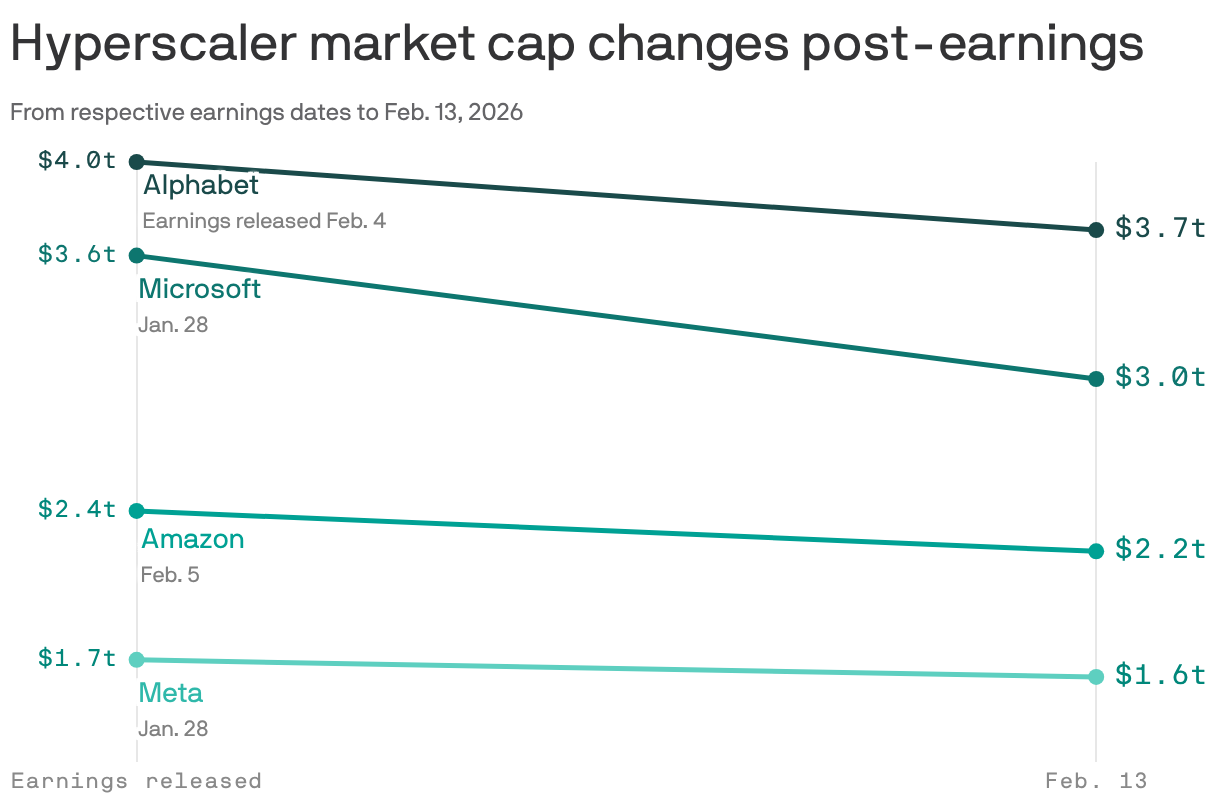
The four biggest hyperscalers (Alphabet, Microsoft, Amazon and Meta) have lost a combined $1 trillion in market capitalization since their latest quarterly earnings releases, Axios AI+ co-author Madison Mills reports.
- Why it matters: Investors are rotating out of tech stocks, as rising AI spending fuels fears these companies are building too much, too fast.
Go deeper: "From software to real estate, U.S. sectors under the grip of AI scare trade" (Reuters)
3. ๐ช Paying $1M to be a lab rat
Bryan Johnson โ the famous L.A.-based biohacker โ says 1,500+ people applied in the first 30 hours of his Immortals program. Three people will be allowed to pay $1 million for access to elaborate longevity protocols the wealthy entrepreneur has followed for the past five years.
- Why it matters: Johnson, 48, contends that conquering death "will be humanity's greatest achievement," and is optimistic that we'll be "the first generation who won't die." The "Age of Immortals is here," he says.
Johnson, a longtime Axios reader, tells me the applicants are diverse, including entrepreneurs, athletes, politicians, actors and artists. They're young and old, male and female.
- Interviews to pick the three winners will begin in the next few weeks.
Immortals includes "a dedicated concierge team, BryanAI 24/7, extensive testing, millions of biological data points, continuous tracking, best skin and hair protocols, and access to the best therapies on market."
- "The long-term goal is universal access: the same standard of care, regardless of income or willpower," Johnson says. "As these systems mature and scale, cost declines."
4. ๐ Older Americans power gray economy


Older Americans are powering the economy: The changing demographics in the U.S. โ more old people, fewer young ones โ are reshaping jobs and spending in all kinds of ways, Axios' Emily Peck reports.
- ๐ Nearly all of January's job growth came from the health care and social assistance sectors. Health care employment also drove much of the labor market growth last year.
"As the population ages, you need more doctors and nurses, but you also need more health aides," says Daniel Zhao, chief economist at Glassdoor. "You need more nursing home staff."
- As people have fewer children, fewer younger Americans are available to care for their elders.
๐ฐ The twist: The senior population is getting bigger as a share of the overall population. They're also getting richer.
- More than 70% of all wealth in the country is held by those over 55.
๐ฎ Between the lines: The changing demographics help explain all kinds of new businesses and marketing trends, including longevity startups and the boom in menopause companies.
5. ๐ Laid-off Posties lace up for Olympics
Two laid-off writers are among the four Washington Post journalists covering the Winter Olympics, AP reports from Cortina d'Ampezzo, Italy.
- The Post announced two days before the Olympics opened that it'll eliminate the sports section and lay off a third of its staff. The paper originally planned to send 14 staffers.
- Plane tickets, hotels and workspace had already been paid for.
Sports columnist Barry Svrluga, one of the two laid-off Posties, is at his 12th Games: "They can take away our section but in a way, they can't take away our spirit. ... I wanted to be occupied. I love covering the Olympics."
- At Svrluga's first Olympics, the 2004 Athens Summer Games, he was struck by the way Post colleagues collaborated at a big event.
- "It felt like a team sport for us and that benefited the section and the paper," Svrluga said. "What we're trying to do here is remind people โ readers and decision-makers โ that these are a lot of committed people who were doing things for the right reasons."
Les Carpenter โ the paper's Olympics reporter, who's covering his eighth Games โ was already in Milan when he found out he was losing his job.
- "The Post sports department always had such a great connection with its readers. I felt I had to stay to tell the story of this Olympics for them," Carpenter said. "It's what I'd want as a reader. If this is the end for Post sports, let's give our most loyal readers our best."
๐๏ธ I'm told that laid-off Post employees will be paid through April 10, and will receive six months of continued health insurance. Guild bargaining on severance packages continues through Friday.
- Go deeper: WashPost sports legends.
6. ๐ฅ 1 for the road: AI's Olympic gold

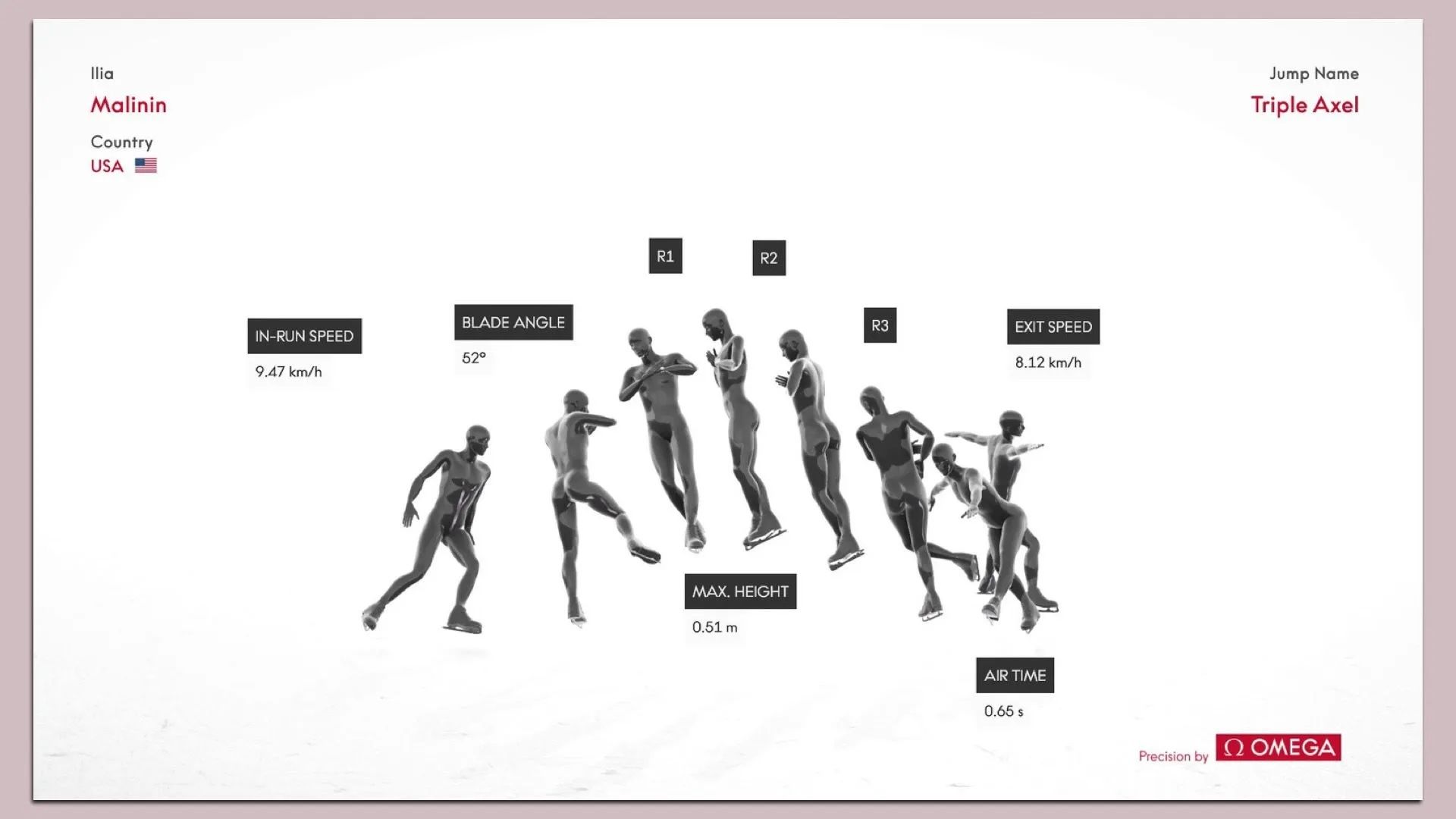
MILAN, Italy โ AI's next big innovation, making its debut at these Winter Olympics, could help figure skating judges determine whether an athlete landed a fast-twirling move successfully, Axios' Ina Fried reports.
How it works: Omega, the official Olympic timing and measurement provider, has installed an array of 14 cameras to track athletes in motion.
- ๐๏ธ From that data, it can create a heat map of where skaters are concentrating their moves, as well as the jump height, jump length and rotation of each jump.
- ๐ "We're down to millimeters in the detection of the blade," said Alain Zobrist, CEO of Omega's timing unit. AI can detect movements that "couldn't be seen with the naked eye," he added.
๐ฎ What's next: For now, Omega is providing this to broadcasters. But the expectation is that judges at international competitions could have access to the technology later this year.
- ๐ฅ Talker: Curling controversy widens as Britain is accused of same violation as Canada ... Medal count.
๐ฌ Thanks for reading! Please invite your friends to join AM.
Sign up for Axios AM