"Split" jobs report shows the labor market is stabilizing (for now)


Add Axios as your preferred source to
see more of our stories on Google.
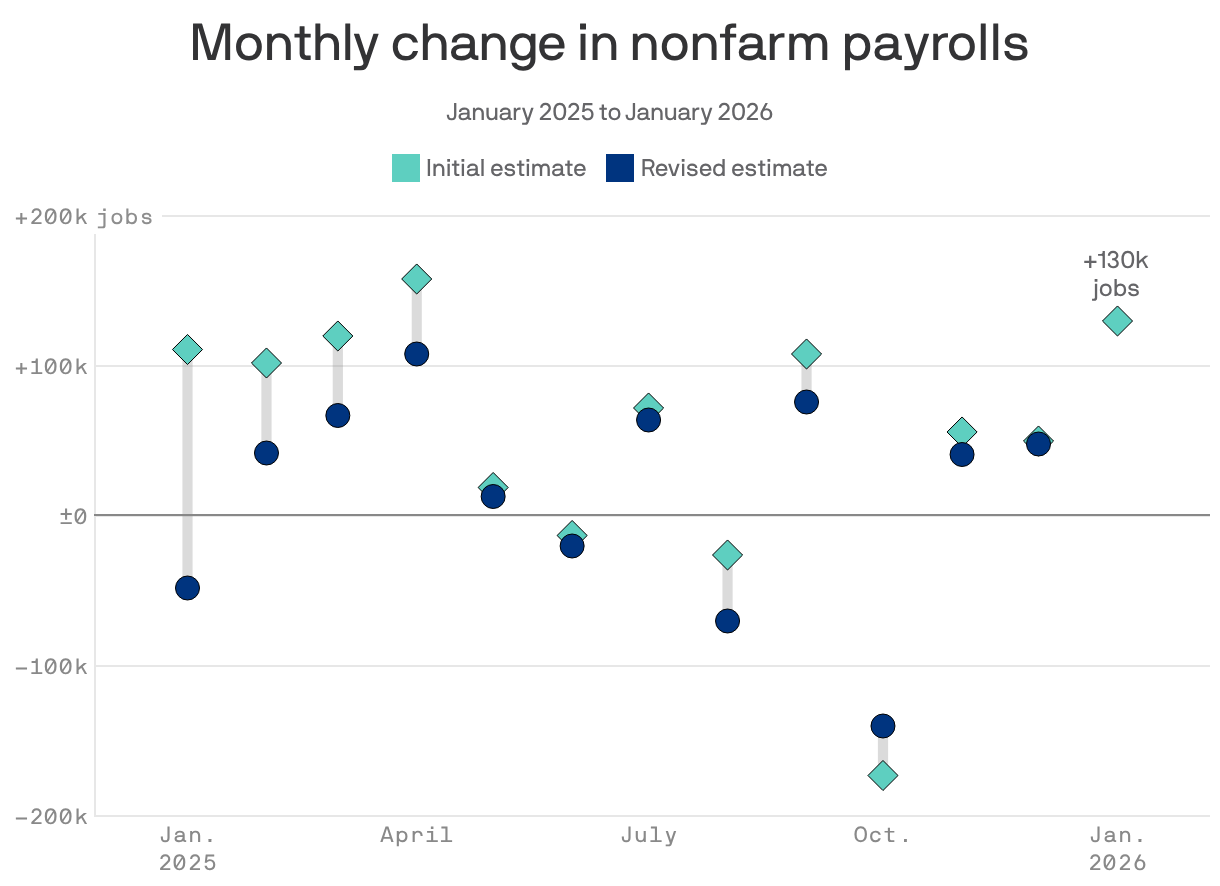
The labor market kicked off 2026 with a bang: Job creation surged, and joblessness ticked down. But 2025 was slower than we thought.
Why it matters: It points to the possibility that 2025 was the low point for job creation and that a more stable environment in January could signal stabilization or even a hiring pickup in the months ahead.
- Still, you would be forgiven for having economic whiplash, after some downbeat indicators leading up to Wednesday's report — including plunging job openings in December and sharply negative polling on Americans' perceptions of the job market.
What they're saying: "January's jobs report reads like a race split in two," Glassdoor chief economist Daniel Zhao wrote in a note, noting 2025 revisions that show "a slower jog than we first thought."
- "After a slow start in the first leg, the labor market may be finding its footing now."
The intrigue: The sense of mixed signals was evident in the report itself, with news that employment rose by 130,000 — the biggest monthly gain since December 2024 — coming alongside deep revisions to job growth last year.
- The Bureau of Labor Statistics' annual benchmark revisions, based on more complete tax records, showed that the economy added just 181,000 jobs in 2025, far fewer than the 584,000 initially reported.
- With those revisions, the labor market added a mere 15,000 jobs per month, on average, last year — down from the 49,000 previously estimated.
- In a country with 160 million jobs, that's essentially a halt in net job creation.
Yes, but: Those revisions were well-telegraphed, with top Federal Reserve officials anticipating that last year's growth in jobs was overstated.
- Now the question becomes whether January's job surge was a one-off or is ultimately revised lower — or a sign of a turning point after tariff effects and economic uncertainty held back employers last year.
- That both surveys making up the report — one of households and the other of businesses — point in the direction of stabilization bolsters the case for the latter.
Zoom in: Fed chair Jerome Powell told reporters last month that the unemployment rate "has shown some signs of stabilization," even as his colleague Fed governor Christopher Waller sounded more apocalyptic about the state of the labor market.
- Powell looks right, at least as of last month: The jobless rate ticked down again to 4.3% after recently peaking at 4.5% in November.
- Roughly 81% of prime-age workers — those between 25 and 54 — were employed in January, returning to the peak seen this economic cycle.
The other side: The bigger job gains were concentrated in just a few sectors, a sign that the labor market still hasn't shaken the concerning trend of historically narrow jobs growth.
- In recent years, workers looking for jobs in health care or social assistance have likely had their pick of gigs. Most of the economy's other sectors are barely adding workers at all (and some are shedding them).
- That continued last month: Health care (+82,000) and social assistance (+42,000) accounted for the bulk of last month's gains. The construction sector also added 33,000 jobs.
- Gains elsewhere were muted. Finance, insurance and real estate firms shed 22,000 workers. The federal government shed another 34,000 jobs as workers who accepted resignation offers fell off payrolls.
The bottom line: Narratives about the labor market have rarely been more split, with Wednesday's report conflicting with other data that shows hiring trends have remained sluggish, if not worsened.
