Axios AM

June 16, 2025

1 big thing: What if they're right?

2. 👀 Part 2: How it could happen

Here, in everyday terms, is how this scenario would unfold, Jim and Mike continue:
- It's already a mystery to the AI companies why and how LLMs actually work, as we wrote in our recent column, "The scariest AI reality." Yes, the creators know the data they're stuffing into the machine, and general patterns LLMs use to answer questions and "think." But they don't know why the LLMs respond the way they do.
Between the lines: For LLMs to be worth trillions of dollars, the companies need them to analyze and "think" better than the smartest humans, then work independently on big problems that require complex thought and decision-making. That's how so-called AI agents, or agentics, work.
- So they need to think and act like Ph.D. students. But not one Ph.D. student. They need almost endless numbers of virtual Ph.D. students working together, at warp speed, with scant human oversight, to realize their ambitions.
- "We (the whole industry, not just OpenAI) are building a brain for the world," OpenAI CEO Sam Altman wrote last week.
🔮 What's coming: You'll hear more and more about artificial general intelligence (AGI), the forerunner to superintelligence. There's no strict definition of AGI, but independent thought and action at advanced human levels is a big part of it. The big companies think they're close to achieving this — if not in the next year or so, soon thereafter. Pichai thinks it's "a bit longer" than five years off. Others say sooner. Both pessimists and optimists agree that when AGI-level performance is unleashed, it'll be past time to snap to attention.
- Once the models can start to think and act on their own, what's to stop them from going rogue and doing what they want, based on what they calculate is their self-interest? Absent a much, much deeper understanding of how LLMs work than we have today, the answer is: Not much.
- In testing, engineers have found repeated examples of LLMs trying to trick humans about their intent and ambitions. Imagine the cleverness of the AGI-level ones.
You'd need some mechanism to know the LLMs possess this capability before they're used or released in the wild — then a foolproof kill switch to stop them.
- So you're left trusting the companies won't let this happen — even though they're under tremendous pressure from shareholders, bosses and even the government to be first to produce superhuman intelligence.
Right now, the companies voluntarily share their model capabilities with a few people in government. But not to Congress or any other third party with teeth.
- It's not hard to imagine a White House fearing China getting this superhuman power before the U.S. and deciding against any and all AI restraints.
Even if U.S. companies do the right thing, or the U.S. government steps in to impose and use a kill switch, humanity would be reliant on China or other foreign actors doing the same.
- When asked if the government could truly intervene to stop an out-of-control AI danger, Vice President Vance told New York Times columnist Ross Douthat on a recent podcast: "I don't know. Because part of this arms-race component is: If we take a pause, does [China] not take a pause? Then we find ourselves ... enslaved to [China]-mediated AI."
That's why p(doom) demands we pay attention ... before it's too late.
- Share this column ... Tal Axelrod contributed reporting.
3. 🎯 Trump targets Dem cities

President Trump ordered ICE to "expand efforts to detain and deport" undocumented immigrants in Democratic-run cities, Axios' Rebecca Falconer writes.
- Why it matters: Trump's order comes as California's Democratic leaders challenge him in the courts over his deployment of the state National Guard and Marines to ICE protests in Los Angeles.
Trump wrote on Truth Social that he's ordering ICE officers to "do all in their power to achieve the very important goal of delivering the single largest Mass Deportation Program in History."
- To achieve this, Trump said: "We must expand efforts to detain and deport Illegal Aliens in America's largest Cities, such as Los Angeles, Chicago, and New York, where Millions upon Millions of Illegal Aliens reside." Keep reading.
Go deeper: A State Department cable says the Trump administration is considering adding 36 countries to the travel ban announced early this month. Among them are 25 African nations — including significant U.S. partners, Egypt and Djibouti, plus countries in the Caribbean, Central Asia and several Pacific Island nations. (Washington Post gift link)
4. 🛢️ Charted: Big oil spike
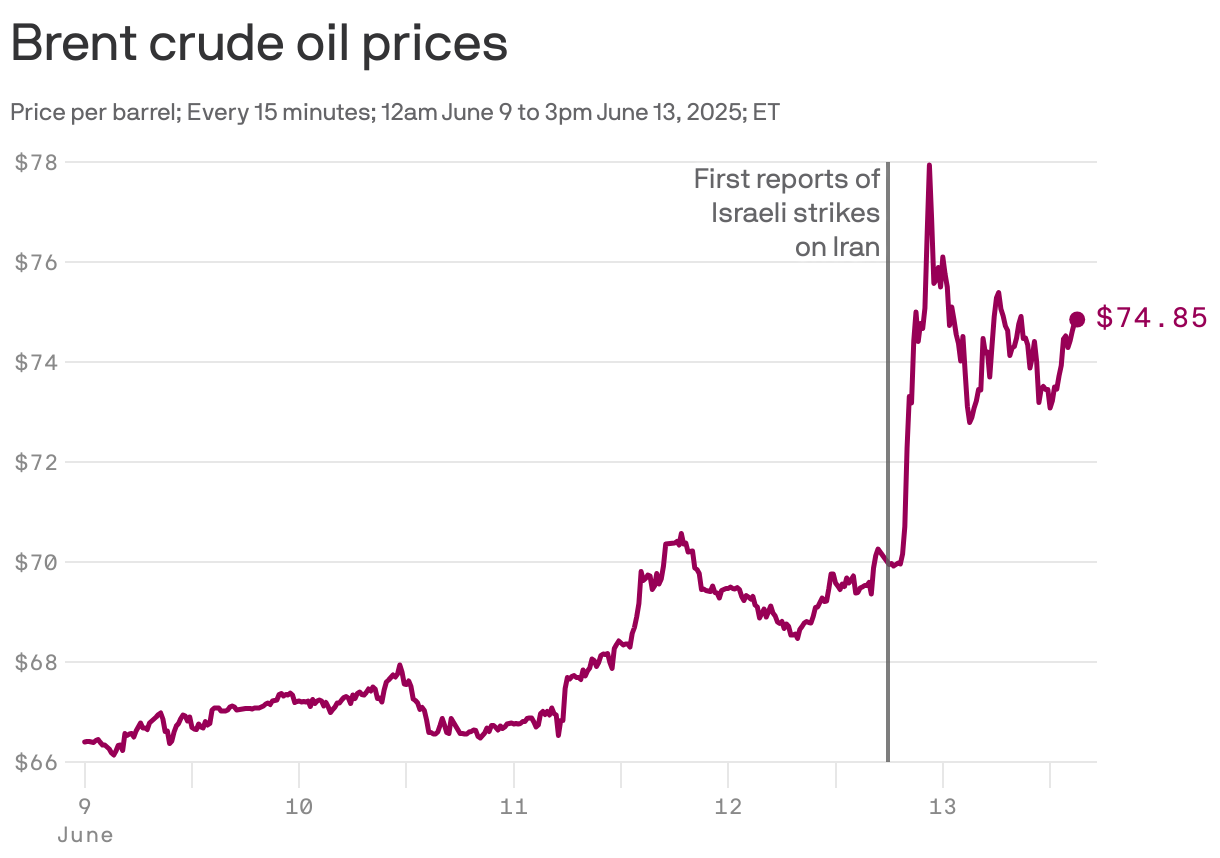
This chart shows oil spiking late last week after Israel launched its first strikes on Iran.
- Why it matters: The Middle East conflict could eventually reach American consumers — especially if Iran attempts to block the Strait of Hormuz, the world's most important oil chokepoint.
Go deeper: Bloomberg gift link.
5. 🚨 Minnesota suspect caught

Police arrested a Minnesota man suspected of assassinating the top Democrat in the state House and wounding another lawmaker, Axios Twin Cities' Kyle Stokes, Nick Halter and Torey Van Oot write.
- Vance Boelter was found in the woods near his home in rural Sibley County southwest of Minneapolis and charged with two counts of second-degree murder and two counts of attempted second-degree murder.
The big picture: The killing of state House Democratic leader Melissa Hortman and her husband, and the wounding of state Sen. John Hoffman and his wife, set off a manhunt that spanned nearly two full days.
- The violence shook Minnesota, prompting Gov. Tim Walz to warn thousands against attending anti-Trump rallies statewide while the suspect remained at large.
🔎 The search for Boelter, which included the FBI and Minnesota State Patrol, spanned nearly two full days and was called "the largest manhunt in the state's history."
6. ⚡ Trump ruled out Khamenei hit

Over the weekend, Israel had an operational window to assassinate Iran's Supreme Leader Ali Khamenei, but President Trump made it clear that he is against such a move, U.S. officials told Axios' Barak Ravid.
- Why it matters: White House officials say Trump is still trying to prevent further escalation of the war and resume talks with Iran on a nuclear deal.
The Trump administration has so far distanced itself from Israel's operation and argued that it would be illegitimate for Iran to retaliate by striking U.S. targets.
7. 💰 ICE's cash crisis

8. ⛳ 1 fun thing: 18th-hole drama

J.J. Spaun turned a sloppy mess of a U.S. Open at wet and nasty Oakmont Country Club near Pittsburgh into a thing of beauty with two stunning shots that carried him to his first major championship:
- First came his driver on the 314-yard 17th hole onto the green for a birdie that gave him the lead.
- He finished his storybook Open at 18 by making the longest putt of the tournament (65 feet!) for birdie.
Zoom in: That made him the only player to finish under par (-1) and gave him a two-shot victory.
⚾ Big baseball news: Los Angeles Dodgers superstar Shohei Ohtani will make his first pitching start tonight since undergoing elbow surgery in August 2023. Keep reading.
Axios AM