Axios AI+

October 22, 2026

Ina here, after a rough night for the Valks, but more on them in + This. Today's AI+ is 1,209 words, a 4.5-minute read.
1 big thing: Scoop: AI agents slip into bank accounts

Major U.S. banks are detecting unauthorized third-party AI agents operating inside customer accounts, with some agents attempting to take actions that appear to be independent of user instructions, sources tell Axios.
Why it matters: AI agents are becoming a nightmare for America's banks, making their way into banking systems faster than financial institutions can respond.
- The difficulty in distinguishing between a human and an unauthorized bot is forcing banks to block the technology and rapidly rewrite their terms of service.
Driving the news: Banks including Morgan Stanley, Bank of America, JPMorgan, Wells Fargo and others are racing to contain agent risks. Some are aware of unauthorized access, people familiar with the issue said.
- These are generally situations when an agent or AI assistant accesses a human's account with the user's permission and login credentials. Even if permitted by the user, this goes against the guidelines of most banks requiring that humans log in to their own accounts.
- This presents significant security risks: Banking executives fear the steps agents with login access might take, especially if a user has granted purchase authority or the ability to shift funds.
- In other instances, some banks have tracked activity when agents β programmed to fulfill requests or complete tasks on a user's behalf β contact call centers or appear to take actions independent of user instructions, the people said.
State of play: The concerns are at the root of the decision by several banks to restrict third-party AI agent access, the people said.
- Morgan Stanley has begun blocking third-party agents from accessing its platforms, sources familiar with the decision said.
- JPMorgan, Bank of America and Citi are also restricting agents.
- A Chase spokesperson said customers should not give their usernames and passwords to anyone. A Morgan Stanley spokesperson said the bank hasn't observed instances of "rogue AI agents accessing our platforms."
Zoom out: Most banks have authorized or are moving in the direction of allowing read-only access, which should allow agents to see customer financial information without taking action.
Threat level: Many banks are broadly not able to parse whether agent account activity is user-directed, sources said.
What we're watching: Banks are investing in preventing worst-case scenarios, but they are also preparing in case they do happen, including with "day after" scenario planning that would allow them to quickly secure or restore customer access, sources said.
The bottom line: The rapid pace of AI advancement is becoming a security nightmare for America's financial institutions.
2. AI finds big flaw in web's foundational code
Security officials are sounding the alarm over two critical vulnerabilities in a programming language used to run millions of websites, marking one of the most consequential cybersecurity discoveries yet made with AI.
Why it matters: The bugs, which researchers found partly with an OpenAI model, proves AI can uncover critical flaws humans missed for decades β raising the stakes for defenders racing to fix vulnerabilities before attackers can exploit them at machine speed.
Driving the news: There are two problems hackers could easily exploit in an open-source programming language known as PHP that's used on nearly 70% of all websites.
- Government officials from the U.S. to Japan are warning companies to apply a patch to fix the bugs, or consider taking down their sites to avoid an attack.
Between the lines: Security researchers have been skeptical of AI-generated vulnerability reports, many of which have turned out to be minor bugs or false alarms.
- But the PHP discovery could force the cybersecurity community to reckon with the reality of AI threats.
Threat level: If exploited, the PHP flaws would allow malicious hackers to take control of vulnerable web servers without needing a password or other credentials.
- "These findings rank among the most severe vulnerabilities discovered in PHP, and arguably in software history," researchers at Wiz wrote in a post.
The big picture: AI-driven bug discoveries are shining a light on the fragility of the modern internet, which is heavily reliant on a slew of open-source software powered by volunteers.
3. The AI boom's new complication: falling prices

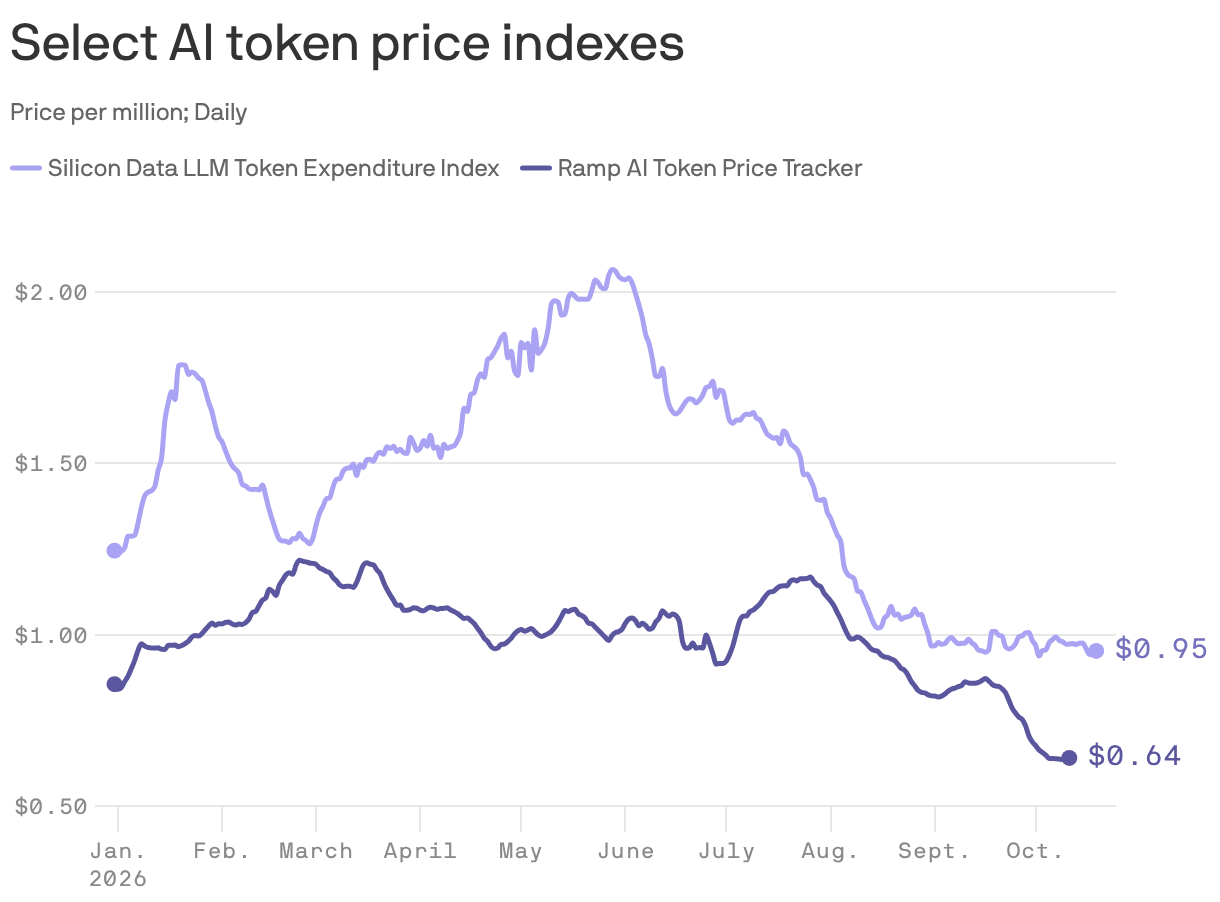
Prices for tokens β a measure of AI usage β have tumbled in recent months.
Why it matters: The price drop raises questions about the strength of an AI boom fueled by supposedly bottomless demand for computing power.
The latest: There's no token price that captures all activity, but several available public indexes show similar declines.
- Silicon Data's LLM Token Expenditure Index β a volume-weighted benchmark of AI token prices that captures a shifting mix toward lower-priced models β has broken the buck in recent days, falling below $1 per million tokens.
- It's down 54% from its peak of $2.07 per million tokens in late May.
What they're saying: The collapse in token prices reflects both the impact of corporate customers switching to cheaper, open-weight models and the price cuts that OpenAI and Anthropic have made.
Increasing use of agents for longer AI interactions is also contributing to the decline in prices, says Chris Clark, co-founder and chief operating officer of OpenRouter, a software platform that lets developers use a range of AI models.
- That's because large chunks of these longer interactions are saved, or cached, rather than being rerun through the models. Tokens representing cached inputs are typically much cheaper than other tokens, Clark says.
The big picture: Whatever the reason, declining prices could prompt a recalculation of one of the largest investment booms in U.S. history.
- The largest U.S. hyperscalers alone are on track to spend $800 billion on capital expenditures this year and are forecast to spend another $1.1 trillion in 2027, according to Goldman Sachs.
Yes, but: The price drop has been largely shrugged off with frequent references to the so-called Jevons paradox, an economic phenomenon in which technological improvement causes prices to drop, stimulating more economic activity at those lower prices.
- And that has been true, as far as it goes: AI usage, as measured in tokens, continues to rise incredibly quickly.
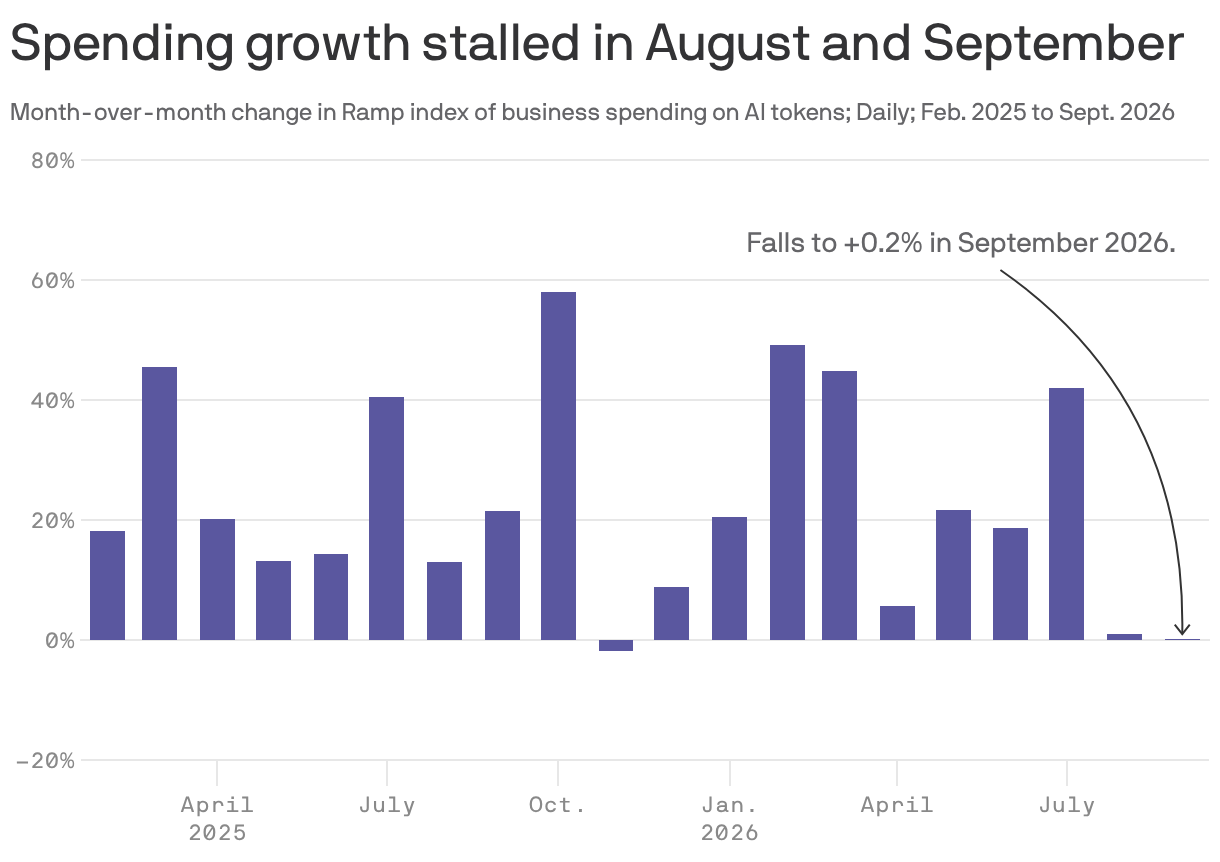
Friction point: By Ramp's accounting, however, token spending by businesses β as opposed to token usage β has been strangely flat for two consecutive months, even as businesses continue to burn compute.
- "For the first time, we're seeing token usage go up and token spend hold flat," says Ara Kharazian, lead economist at Ramp. "And it's now occurred for two months straight."
The bottom line: Token spending by businesses is closely related to revenue for AI model makers.
- If spending is in fact beginning to flatline, that would be a big problem for the expected IPOs of AI companies like Anthropic β and for the AI trade that continues to be the engine driving the markets and economy.
4. Training data
- A New Mexico judge ordered Meta to pay $25 billion in penalties after a jury found that the social media giant misled users about data privacy. (Axios)
- Following a record Q3, Meta is issuing new nonvoting stock to fund AI development while preserving Mark Zuckerberg's voting control. (WSJ)
5. + This
The WNBA cards that Dots and Muse helped me procure arrived. And I got a bunch of my favorites, including Kaitlyn Chen and Gabby Williams. Here's Gabby's card, alongside a picture I took of Gabby during warmups for Game 2.
Thanks to Bradley Olson for editing this newsletter and Matt Piper for copy editing.
Sign up for Axios AI+

Scoops on the AI revolution and transformative tech, from Ina Fried, Madison Mills, Ashley Gold and Maria Curi.