Axios AI+
May 30, 2024

Good morning — and how is it almost June already? Today's AI+ is 1,139 words, a 4-minute read.
1 big thing: Washington's chief AI officers sound off



Across the federal government, agencies now have chief AI officers to help deploy the technology responsibly.
Why it matters: AI officers are helping agencies fulfill new tasks from President Biden's expansive AI executive order.
Driving the news: Officers for 24 agencies were appointed by Monday's deadline, with several named well in advance.
- We spoke with a few of them to check in on the progress made and challenges ahead.
CAIO Dorothy Aronson, who's focused on internal operations at the National Science Foundation, says in an interview that the biggest challenge so far has been finding the right people with the skills and expertise needed in areas of data, privacy, law and technology.
The Department of Homeland Security's Eric Hysen has served as DHS CIO since the start of the Biden administration, and as its chief AI officer since September. Hysen says he's spending more than half his time on AI-related work.
- DHS has been using predictive AI and machine learning for many years, and is now accelerating some major efforts, he says.
- Generative AI pilots at DHS include one with FEMA on resilience plans, one with USCIS on training officers and one with Homeland Security Investigations on connecting details from case files, he says.
- Hysen says balancing people's civil liberties with homeland security initiatives is a priority. If DHS employs AI in any way that sparks concerns among the public, "we [may] lose our permission to be able to use those technologies."
Between the lines: Before government agencies started naming chief AI officers, the tech industry was hiring chief privacy officers — and the latter can inform the work of the former, Future of Privacy Forum CEO Jules Polonetsky tells Axios.
- Both privacy and AI officers are responsible for raising issues through the proper channels and mitigating new risks. AI issues directly relate to data use, decisions, transparency and other privacy concerns.
- "It's critical to ensure these roles are set up in ways where they're actually empowered. Otherwise, they can just be for show," Polonetsky says.
- That means giving the CAIOs proper tools, staff and authority to integrate policies and ensure compliance.
- The AI Safety Institute could help set standards for government agencies to follow, but it needs proper funding to be effective.
What's next: Deadlines from Biden's AI order kick in next month for a Commerce Department report on authenticating content and detecting fakes.
- On July 26, the Patent and Trademark Office will recommend executive actions on AI and copyright, and the Energy Department must file a plan for analyzing the "nuclear, nonproliferation, biological, chemical, critical infrastructure, and energy-security threats or hazards" posed by AI models.
A version of this story was published first on Axios Pro. Unlock more news like this by talking to our sales team.
2. AI unmasks the secret life of plants

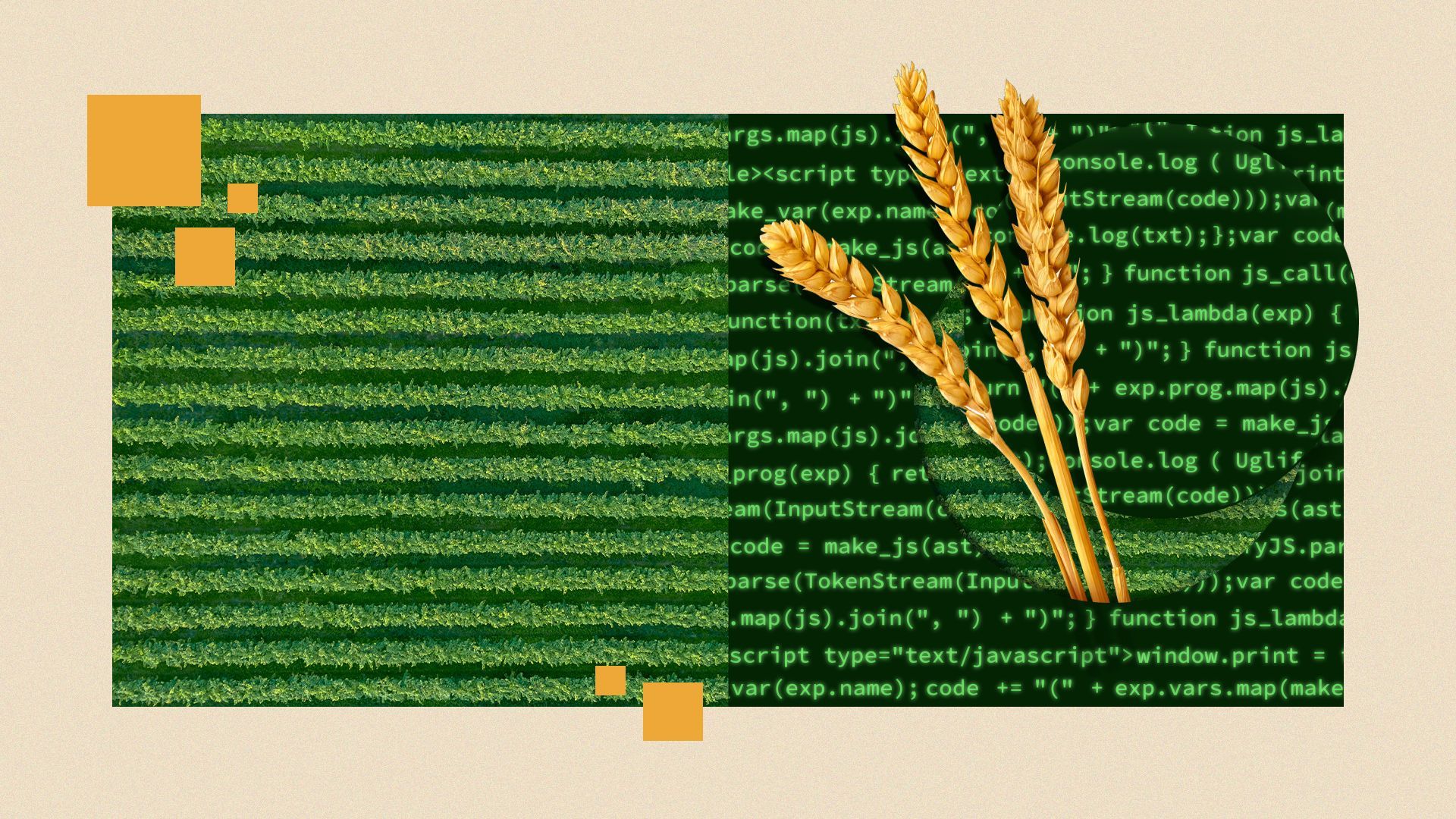
The latest AI tools and computing advances are providing a more detailed view of plants and their interactions with the world, which could help breeders develop more resilient crops and farmers plan for a far different future.
Why it matters: A growing global population needs to be fed using less land — all under the pressures of degrading soil, pests, disease and climate change.
- "These are huge challenges, and we're trying to address them on many different scales — from the epidemiological to the molecular," says Jake Harris, a professor of plant biology at the University of Cambridge.
- "AI is going to help across the board," he says.
State of play: AI algorithms aren't new to plant science. Robots roam fields taking photos of plants and, using AI deep learning methods, detect disease and analyze different attributes of plants in an effort to bring precise, consistent data collection to agriculture.
- Machine learning algorithms analyze plant traits and predict which genetic combinations will produce a plant with the desired traits — often aiming for a resilience to drought or disease that doesn't slash a crop's yield.
But new AI-based tools are allowing researchers to unravel the inner workings of plant biology that were previously hidden in a complex web of molecular interactions.
- "It wasn't economically feasible to do plant structural biology at scale," says Google DeepMind researcher John Jumper, who leads the team behind AI-powered protein structure predictor AlphaFold.
- One paper found the structures of less than 2% of the proteins in plant biology's model species, Arabidopsis thaliana, were known, compared with about 10 times as many for human proteins. AlphaFold bumped that coverage of the plant's proteins to more than 60%, though with varying degrees of quality.
- Harris is using AlphaFold to try to understand the chemical modifications that are made to plant DNA when they are exposed to pathogens, drought and other stresses. Those modifications store information for the plant to respond the next time it is stressed — but how the cell does that was "previously invisible" information, Harris says.
Yes, but: AI's integration into plant biology faces hurdles, particularly around the data that is available and its quality.
- It's also difficult to both find scientists who understand biology and computer science and attract them to plant science, which often doesn't offer salaries and funding at the level of medical research, says Carlos Rodriguez Lopez, a professor of horticulture at the University of Kentucky.
What to watch: LLMs that power chatbots and other AI tools that people increasingly interact with are being developed to decipher the language of DNA and proteins.
- That could allow scientists to identify how different regions of a genome interact with one another and control different traits of a plant — the way different sentences in a chapter string together a story, says Mohsen Yoosefzadeh Najafabadi, a research associate at the University of Guelph.
- It would "save so much time and resources because there is no need to grow plants in the field and select them. We can take DNA from a seed and see if a sentence is available and select the best seed."
3. Training data
- The Atlantic and Vox Media struck a deal with OpenAI to license content, as Axios' Sara Fischer first reported. (Axios)
- Google confirmed the authenticity of thousands of publicly posted leaked documents detailing some of the search giant's data collection practices. (The Verge)
- A bipartisan pair of senators has urged the Pentagon to find other vendors beyond Microsoft given the software giant's recent security woes. (Axios)
- Anthropic has added Confluent CEO Jay Kreps to its board of directors. (Anthropic)
- OpenAI says free users now have access to the GPT store, file uploads, vision and other features that previously required a subscription. (X)
- Mistral released Codestral, its first AI model focused on generating computer code. (VentureBeat)
4. + This
I knew how much better organized the metric system is than the one the U.S. uses, known as the imperial system — but I just learned how much more logical the European system of paper sizes is, too, compared to our "letter" and "legal" labels.
Thanks to Megan Morrone and Scott Rosenberg for editing this newsletter and to Caitlin Wolper for copy editing it.
Sign up for Axios AI+
