Axios AI+

November 15, 2024

TGIF. Seriously. Today's AI+ is 1,170 words, a 4.5-minute read.
1 big thing: Apple Intelligence's personalized yet impersonal pics
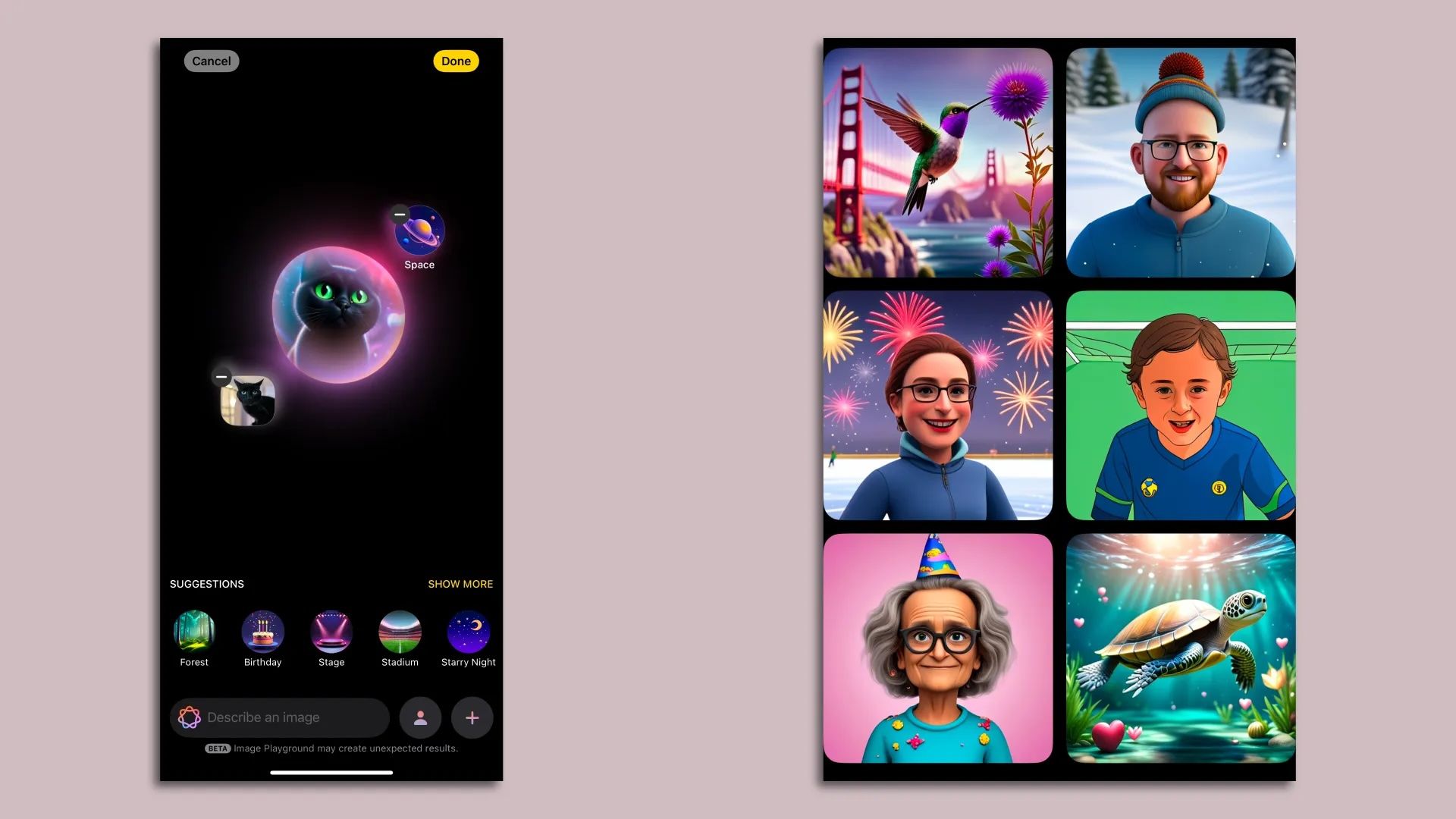
The latest crop of Apple Intelligence features, included in the public beta of iOS 18.2, offer those new to AI image generation a safe — and, yes, a bit sterile — opportunity to try out the technology.
Why it matters: Apple may be slower to market than its AI rivals, but its devices tend to be where new technologies move beyond the early adopter crowd into everyone else's lives.
Driving the news: The free update to the iPhone operating system, due for broad release next month, brings a second wave of Apple Intelligence tools, including ChatGPT integration.
In this review, I'm focusing on Apple's approach to image generation, present in a trio of features that were announced in June:
- Genmoji allows people to describe the emoji they want and even personalize it to look like themselves or someone in their photo library. It's available wherever the keyboard pops up.
- Image Playground lets users experiment more broadly. You can select someone from your photo library to be the subject and then choose to write a text prompt and/or select various suggestions of objects, backgrounds or themes to incorporate into the AI image.
- Magic Wand transforms sketches into more polished illustrations in apps such as Notes. Users can also add text to help customize the image — or just circle a blank space and Apple Intelligence will attempt to use the context to create a relevant image.
Zoom in: After downloading the public beta version of iOS 18.2 and getting off a waitlist, I have spent the last few days creating various images using both Genmoji and Image Playground.
- As with other elements of Apple Intelligence, the strength of these features is that they draw on personal data — in this case, letting me easily incorporate my actual friends and family into the creations.
Sending our cat into space or putting a party hat on my mother-in-law was as simple as opening Image Playground and dragging together a couple of icons. There's also a text option to describe what you'd like to see.
- However, Apple's results often suffer from some of the same flaws as other early AI image-creation tools: Its output feels shallow and soulless.
- It doesn't help that Apple offers only two styles in Image Playground, one that resembles a cartoon and another that is more like a professional illustration.
It's hard to get very personal here.
- Genmoji did a good job of creating an owl playing basketball and a penguin playing soccer. But it struggled when I asked it to show me with a sad face.
Zoom out: Apple is taking a different approach than rivals both with its interface and with what it allows and forbids.
- For example, Image Playground and Genmoji allows you to create images based on people you know — including kids. Other tech companies have blocked the ability to generate images of specific people, especially kids, as part of their safety measures. Apple has taken a different approach to limiting harm, detailed below.
- The result is that Apple's images are more personalized: It's really focused on creating images of your friends, family and pets.
- Apple's interface for both Image Playground and Genmoji is also unique. Rather than starting from a single text prompt or image, Apple allows users to easily mix people, themes and settings, providing for an easy and fun way to mash together a handful of concepts.
Between the lines: Apple has cleverly managed to sidestep many of the pitfalls of image generation.
- Image Playground only supports cartoon and illustration styles that eliminate the risk of creating authentic-looking deepfakes, making it less vulnerable to being misused.
- The images are also largely limited to people's faces. The narrower frame means fewer chances to produce images that reflect bias or that can raise safety concerns.
The big picture: For many, Apple Intelligence will be their first experience with AI-based image generation, and Apple's choice of the "playground" label is apt — this feels like a safe and safely bounded space to try out new things.
My thought bubble: Apple has often added features to the iPhone that, while initially popular, end up as rarely used party tricks.
- One that comes to mind is Memoji. Introduced with iOS 12 in 2018, this feature allowed people to create a cartoonish digital likeness of their face and hair that could be used as part of FaceTime calls.
- Before that there were Animoji, which let people appear as animated versions of other creatures — such as robots, dinosaurs and monkeys — whose mouths and facial expressions mimicked the caller's.
Yes, but: More than the new Apple Intelligence features, those previous efforts left room for the human user to participate in the creative act, since you were controlling the figure's actions and expressions.
What we're watching: It can't be long before this personalized AI imagery gets blended with branded content that brings you into specific universes, like "Star Trek" or "The Simpsons," rather than the generic ones present in Apple Intelligence.
Go deeper: Apple has a style problem
2. OpenAI, Google expand AI app options

Google released a Gemini app for the iPhone yesterday, while OpenAI updated ChatGPT for the Mac with a feature allowing the chatbot to interact directly with coding programs.
Why it matters: Having native programs allows AI chatbots to interact more directly with both the operating system and other apps.
Driving the news: ChatGPT for the Mac can now interact with apps like terminal and Xcode directly, reducing the need for developers to copy and paste data back and forth.
- The feature is available immediately for paid individual and team users, and coming soon for enterprises and eventually for free users.
- OpenAI also broadly released its ChatGPT app for Windows yesterday. An earlier preview version of the Windows program was limited to paid users.
- Google, meanwhile, released a standalone Gemini app for iOS. The company already had a Gemini app for Android, while Gemini features for iOS had been part of the broader Google app.
Yes, but: Gemini, like other chatbots, is still prone to hallucinations and erratic behavior — as highlighted by this discussion thread shared publicly on X, in which Gemini, seemingly out of nowhere, tells a user that they are "not special" and should die.
- "Large language models can sometimes respond with nonsensical responses, and this is an example of that," a Google representative said in a statement to Axios. "This response violated our policies and we've taken action to prevent similar outputs from occurring."
3. Training data
- Facebook alum Matt Perault is joining Andreessen Horowitz as head of AI policy, based at its D.C. office. Perault was most recently director of the Center on Technology Policy at UNC-Chapel Hill. (X)
- The Federal Trade Commission is preparing an inquiry into antitrust issues related to Microsoft's Azure cloud business. (Financial Times)
4. + This
OK, I'm a bit stuck on hockey. But how cool is it that the San Jose Sharks — who were sharing a practice facility in New York with amateur players — allowed a 65-year old rec league goalie to face some shots.
Thanks to Megan Morrone and Scott Rosenberg for editing this newsletter and to Anjelica Tan for copy editing it.
Sign up for Axios AI+
