Axios AI+

December 20, 2024

It's hard to believe but this is our last newsletter for 2024. We will be back in your inbox on Jan. 2 and, till then, be sure to check out axios.com/technology for breaking tech news. Wishing you all a very happy holidays!
Today's AI+ is 1,010 words, a 4-minute read.
1 big thing: Dollars flood into data centers


Big Tech is spending at a rate that's never been seen, sparking boom times for companies scrambling to facilitate the AI build-out.
Why it matters: AI is changing the economy, but not in the way most people assume.
- AI needs facilities and machines and power, and all of that has, in turn, fueled its own new spending involving real estate, building materials, semiconductors and energy.
- Energy providers have seen a huge boost in particular, because data centers require as much power as a small city.
- "Some of the greatest shifts in history are happening in certain industries," Stephan Feldgoise, co-head of M&A for Goldman Sachs, tells Axios. "You have this whole convergence of tech, semiconductors, data centers, hyperscalers, and power producers."
Zoom out: Companies that are seeking fast growth into a nascent market typically spend on acquisitions.
- Tech companies are competing for high-paid staff and spending freely on research.
- But the key growth ingredient in the AI arms race so far is capital expenditure, or "capex."
Capital expenditure is an old-school accounting term for what a company spends on physical assets such as factories and equipment.
- In the AI era, capex has come to signify what a company spends on data centers and the components they require.
- The biggest tech players have increased their capex by tens of billions of dollars this year, and they show no signs of pulling back in 2025.
The capex bonanza for data center growth is separate from the R&D that companies spend on chips and new AI technology.
- "R&D expenses are funding expanded investments in AI integration as well as the rising costs of training AI models," says Eric Hanselman, a chief analyst at S&P Global Market Intelligence.
- As for capex, "spending on the equipment needed to fill data centers has accelerated dramatically," he says.
Our thought bubble: The fortunes being spent today on data centers for AI are jaw-dropping, but tech leaders are actually worrying about spending too little.
- "When you go through a curve like this, the risk of underinvesting is dramatically greater than the risk of overinvesting for us here," Google CEO Sundar Pichai told analysts in August.
The bottom line: Tech CEOs view their investments in data centers as all-purpose bets on the future.
- If the AI bubble pops, a data center can easily be put to work fueling whatever the next big wave in tech turns out to be.
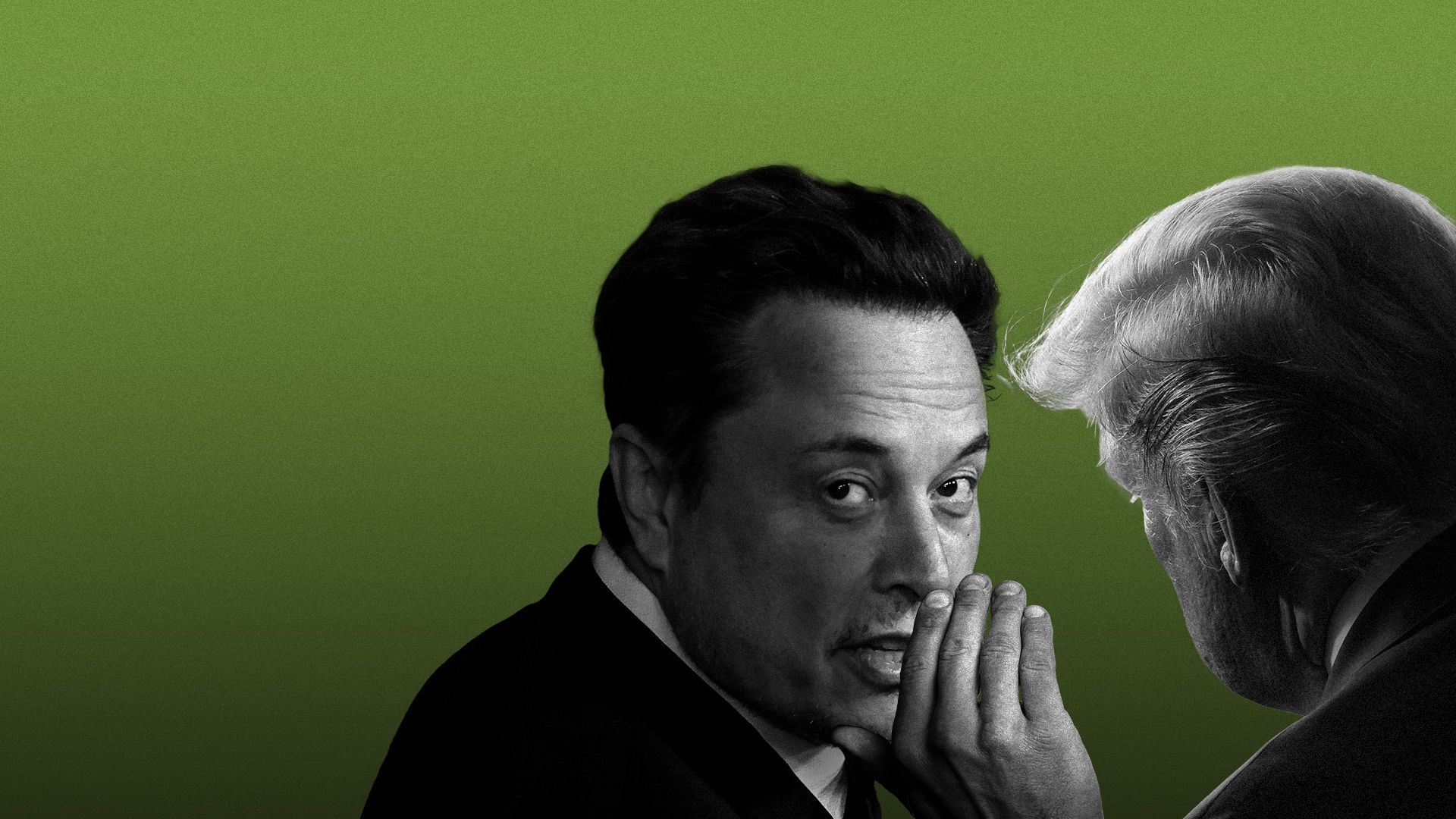
2. Musk's maxed-out megaphone

Wednesday's extraordinary display of Elon Musk's social media power saw the world's richest man funnel the anger of his hundreds of millions of online followers to kill a bipartisan compromise funding bill.
Yes, but: Last night, a revised bill, this one backed by both Musk and President-elect Trump, went down in flames, too, ditched not only by nearly all House Democrats but also by 38 Republicans.
Why it matters: Musk's arresting demonstration of government-by-tweet left Washington reeling — but the magic trick is harder to repeat.
The big picture: Shooting down a spending bill is a lot easier than passing one. Stopping government in its tracks is much easier than making it work.
- Starting Jan. 20, Republicans will essentially control all three branches of government, and making it work will be their job.
How it works: Musk's X has become a partisan megaphone fine-tuned to promote its owner's own messages to a user base of MAGA supporters, libertarians, crypto enthusiasts, and fans of Musk himself.
- Its influence is strongest with Republican House members because its base overlaps with theirs.
- The other half of America has been voting with its feet, with many Democrats and progressives abandoning X in favor of a variety of online alternatives.
Between the lines: Musk's call to arms on Wednesday took place at his point of maximum power.
- The legislators he wanted to pressure answer to the votes of the people who listen to him.
Zoom in: Republicans' control of Congress beginning in January will be precarious.
- The GOP has a margin of only a couple of votes in the House, and the new Senate majority will often hang on a handful of Republican moderates.
When it comes time to build any kind of coalition to pass a new law or a spending measure, Musk's megaphone is likely to prove a clumsy tool.
- If the Musk-led "Department of Government Efficiency" recommends cuts to Social Security or health care, mustering the same kind of support could be a lot harder — and, historically, opponents of such measures have found effective ways to exert their own "vox populi."
Right now, Trump and Musk seem to be on the same page. But that could change any time.
- Trump-watchers suggest the president-elect's jealousy reflex could already have been triggered by Musk's high-profile power flex.
What to watch: If Musk can manage to repeat the trick, he will have ushered us into a new era of social-media-driven legislating.
- Then we'll have to decide whether what's happening is really direct democracy, or rule by unelected billionaire.
3. Training data
- Google released a new model called Gemini 2.0 Flash Thinking Experimental, meant to rival the "thinking" and "reasoning" capabilities of models recently released by OpenAI and Anthropic. (TechCrunch)
- Google is also readying an AI-powered search that will let users "switch to an AI Mode that looks nearly identical to its Gemini AI chatbot." (The Information)
- Researcher Alec Radford is leaving OpenAI. Radford joined OpenAI early, in 2016, and was the lead author of the company's original paper on GPTs. (The Information)
- Sunairio, an AI-driven weather and climate modeling software firm aimed at boosting energy grid reliability, raised $6.2 million. (Axios)
- Emmett Shear, the former Twitch CEO who briefly served as OpenAI's interim CEO last year, is launching a new AI startup called Stem AI, with backing from Andreessen Horowitz. (TechCrunch)
- Next year Instagram plans to roll out an AI editing feature that will allow users to "change nearly any aspect" of their videos. (The Verge)
- OpenAI and Anthropic are aiming to bring on policy staffers with ties to the incoming Trump administration. (The Information)
4. + This
It looks like Santa upgraded his handwritten nice/naughty list to a database.
Thanks to Megan Morrone and Scott Rosenberg for editing this newsletter and Anjelica Tan for copy editing it.
Sign up for Axios AI+