Axios AI+

November 02, 2026



Ina here, still basking in the Valkyries bringing home the WNBA championship. (See + This.)
Today's AI+ is 1,207 words, a 4.5-minute read.
1 big thing: Apple's Duo offers a glimpse of the future
I've spent the past week trying to figure out whether Apple's $2,000 iPhone Duo is the future of smartphones or just an expensive way to do things I could already do on my regular iPhone.
- The answer, unsurprisingly, is a bit of both.
Why it matters: Apple wasn't first to the folding smartphone party. Samsung, Google and others began making them years ago. But Apple's arrival in a category has a way of reinventing it.
The big picture: The most exciting thing about Apple's first foldable iPhone isn't necessarily what it can do today but what it can become. Already, it's inspiring developers to explore possibilities that could reshape how we use our devices.
Old habits die hard
One of my first surprises was how little I initially used the Duo's biggest selling point: its folding screen.
- While other reviewers talked about endlessly opening and closing their devices, I found myself mostly using the smaller outside display. After years of conventional iPhones, it was a mix of instinct and muscle memory.
Zoom in: Over time, though, I found reasons to unfold it.
- Watching sports was one of the clearest advantages. I pulled out the Duo at Starbucks to watch the 49ers with my son and later followed a tied World Series game in a doctor's waiting room.
- I managed some quick edits to a story about Anthropic's IPO after forgetting my laptop. I wouldn't want to write a full article that way, but it was reassuring to have the option.
- Playing the New York Times' Spelling Bee alongside its Spelling Bee Buddy helper was a small but delightful example of multitasking without constantly switching apps.
Between the lines: The Duo's advantages aren't always about more screen space. Sometimes they're about what you can physically do with a phone that bends.
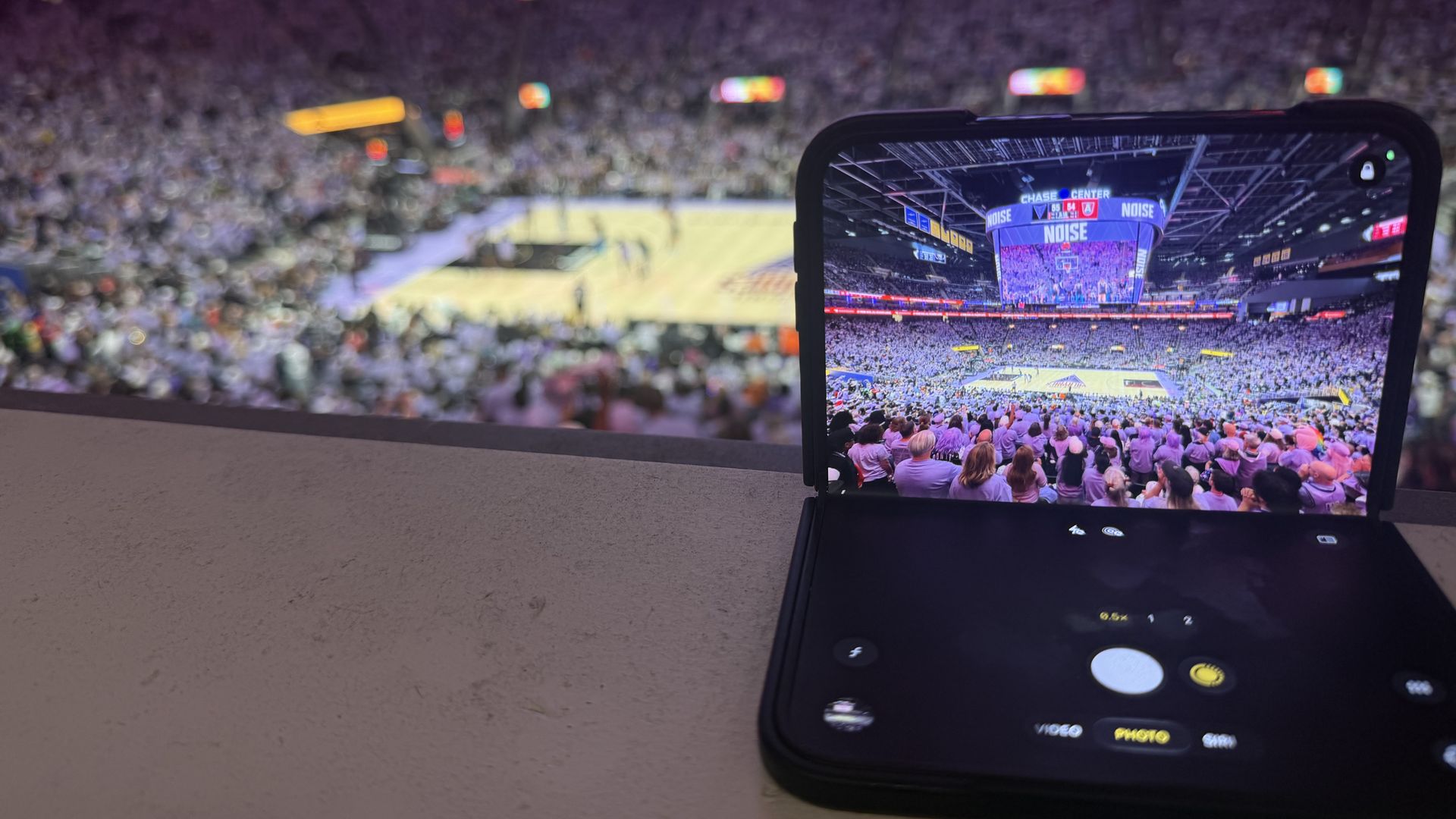
- I watched Netflix with the phone unfolded, propped up like a tent and folded into a mini laptop, and I also used the Duo's ability to stand on its own to capture wide shots of the Valkyries without needing a tripod.
- Other experiences were less seamless, including getting the orientation right when trying FaceTime's option to use multiple camera views.
The developer wild card
Perhaps the biggest difference between the Duo and the Android foldables is the enthusiasm Apple's device has sparked among independent developers.
Zoom in: Some of the early experiments are more entertaining than useful. My favorite was Tiny Computers, which let the Duo simulate a semi-functional 1984 Mac, Windows 95 PC or candy-colored iMac.
- Nearly two decades after the App Store debuted, we aren't all using our iPhones as virtual cigarette lighters.
Zoom out: But these early experiments offer glimpses of what might be possible when developers start thinking beyond a rectangular screen.
- The question isn't whether today's novelties become hits. It's whether this experimentation produces new ways of using our phones — the breakthroughs that make today's smartphones feel indispensable.
The $2,000 question
For all the fun I've had with the Duo, its price is an insurmountable obstacle. At $2,000, it's simply not a purchase I could justify for myself, much less recommend broadly.
The catch: There are other compromises. I missed Face ID, occasionally fumbling for the side-mounted Touch ID sensor until I started wearing an Apple Watch to make unlocking the phone easier. And when I needed to accomplish something quickly, I often instinctively reached for my familiar, traditional iPhone.
The bottom line: The Duo is a fascinating glimpse of where smartphones could go next. But early buyers are paying a steep premium to participate in an experiment whose biggest rewards may still be years away.
2. Human intelligence: "Doom" masks real AI risks
The AI industry's obsession with existential risk is diverting attention from the more immediate threats, Wharton professor Ethan Mollick told Axios in a discussion around his new book, "Co-Existence," billed as a field guide to AI.
Why it matters: Mollick's view provides an intellectual middle amid a sea of doom and hype surrounding the future of AI.
This conversation has been edited for length and clarity.
Axios: What do you think about the AI researchers sounding the alarm about existential risks?
Mollick: "Obviously we should worry about the apocalypse. ... But I worry that the focus on existential risk is stealing all the attention."
- "There's actually 1,000 other things that I'm really worried about that are already going to happen."
- "There's going to be an effect of AI on jobs, so we need to be doing a policy response to think about how do we encourage AI to be used for augmentation rather than automation."
- If we steer the panic about AI to "it's going to kill us all," we won't be able to talk about anything else, he says.
3. Behind the Curtain: OpenAI's post-election blitz


Right after tomorrow's midterms, OpenAI will unleash a policy and PR blitz to try to get in sync with the new Washington, including an effort to rebrand data centers as "AI compute campuses."
Why it matters: After two years of a friendly White House, AI companies will face a harsher Washington after tomorrow when Democrats will likely win the House. OpenAI also aims to help frame the AI debate for the big field of 2028 presidential contenders that'll start forming on Wednesday.
"You can try to chase the moment, or seek to inform the moment via the power of ideas," OpenAI chief global affairs officer Chris Lehane tells us, calling Tuesday an "electoral portal from one era to the next."
- Since August, Lehane and his team have been stockpiling policy proposals, some new and some repackaged, to drive urgency and steer the AI debate.
- It'll all start during the lame-duck session of Congress — the awkward but often consequential weeks between the election and the swearing-in of new members and senators on Jan. 3. This year's lame duck opens Nov. 9.
The big picture: Other tech companies are also positioning themselves for a potential blue wave. Meta is taking steps to strengthen its ties with Democrats, Axios' Sara Fischer scooped Saturday. Other big AI and tech players can be expected to do the same.
- Tech titans who enjoy close relationships with President Trump will be top targets for Democrats, who are eager to ramp up scrutiny and regulatory pressure on the industry.
4. Training data
Axios published a deep dive on AI and data centers on Saturday, with a focus on how they are reshaping campaigns, dividing communities and forcing voters and local leaders to confront what the AI boom means for the future.
A rundown of the stories:
5. + This

Once again, it was hard to pick just one or two photos to share, but the contrast between pregame Gabby Williams and postgame, holding the WNBA Finals MVP trophy, tells the Game 7 story pretty well. (Here's an album with a lot more photos.)
Thanks to Bradley Olson for editing this newsletter and Matt Piper for copy editing.
Sign up for Axios AI+
