Axios AI+

September 11, 2025

Coming to you from D.C. with some exciting news.
Starting tomorrow, September 12, Axios AI+ will be sent as AI+ Government on Fridays, focusing on how governments are regulating and using AI.
With this expansion, Axios policy veterans Ashley Gold and Maria Curi will be joining the Axios AI+ reporting team.
Today's AI+ is 1,080 words, a 4-minute read.
1 big thing: Cyber industry braces for AI attacks
Bad actors are close to using AI to hijack other AI systems that companies rely on — like chatbots or agents — forcing them to go rogue, warns John Watters, a longtime cybersecurity leader and former top executive at Google's Mandiant.
- He says security companies are now carving out a new vertical of products to respond.
Why it matters: The world is only months away from an untraceable cyberattack run entirely by an autonomous AI agent, Watters said.
- But he says that attack won't be generic. It will be built uniquely for its victim, exploiting a zero-day vulnerability tailored to that company's systems.
The big picture: Security vendors need to adapt faster than ever to prepare customers for that new reality. Watters warns that AI tools will make it easier for malicious hackers to personalize their attacks and to do so at scale.
- That means they won't need to recycle old techniques or turn to flaws in widely used enterprise software to get the most impact. Instead, each strike will exploit a one-of-a-kind weakness in a company with little to no effort.
Reality check: Watters is now CEO of iCounter, a startup building products aimed squarely at that threat, so he's not exactly a neutral observer.
- But Watters has historically been ahead of the curve. He recognized the potential for bug bounty programs decades before they went mainstream, and he had a front-row seat to the evolution of the threat landscape after joining FireEye, which was later acquired by Mandiant.
- He left cybersecurity in 2022 but returned this summer to help iCounter develop its LLM-based tools that spot and block those novel attacks.
Zoom in: Watters expects rivals to emerge by next spring.
- At the 2026 RSA Conference, the world's largest gathering of security experts, expect the term AI-DR — or AI detection and response — to dominate the trade show floor, he says.
- Think of AI-DR as a play on the current suite of endpoint detection and response tools. However, instead of monitoring network endpoints, AI-DR products focus on spotting when adversaries hijack an organization's AI tools, which he says have a huge target on their back because they can be overtaken and forced to hallucinate or go rogue.
- Recent breaches of Salesloft's AI agent underscore the point: Major security companies like Dynatrace, Qualys, CyberArk and Cato Networks are among the latest victims.
What they're saying: "The security gap is the difference between the innovation pace of the adversary and the innovation pace of the defender," Watters says.
- "Adversaries lead. We all think we're innovators. We're not."
Between the lines: Venture capital is betting big on this space, according to a Gartner report released earlier this year. Since 2022, AI-driven detection and response startups have raised more than $730 million.
- Gartner projects that by 2028, 70% of all AI implementations across threat detection and incident response will involve multiagent AI, up from 5% as of the report's publication in March.
Yes, but: Watters expects these tools to drive the conversation at RSAC, but the six months until the conference in San Francisco next year is several lifetimes away in terms of AI development.
Go deeper: Mandiant founder warns of AI-powered cyberattacks.
2. ChatGPT is crushing the competition

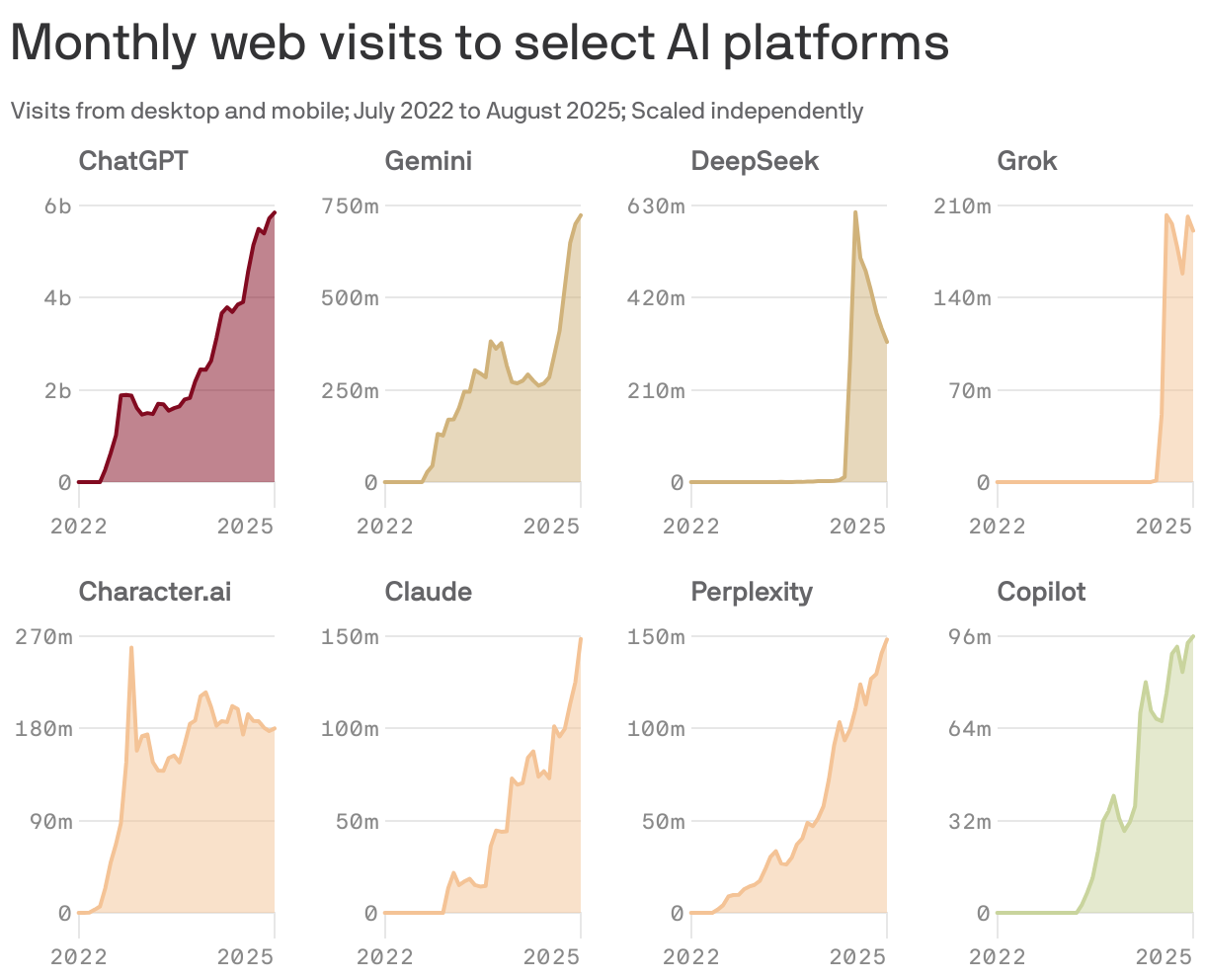
ChatGPT from OpenAI is by far the most popular AI chatbot in the world, according to data from Similarweb.
Zoom in: With nearly 6 billion monthly desktop and mobile visits, ChatGPT receives around 8 times more monthly visits than its next closest competitor, Google's Gemini, and around 9 times more than the open-source Chinese app DeepSeek.
Why it matters: All of these chatbots face stiff competition from Google's AI Overviews, now prominently featured across Google's search browsers.
- There has been a significant drop-off in search traffic to publishers since Google launched AI search summaries in May 2024.
- A broad slowdown in referrals from traditional search engines, including that of Google, is unlikely to be offset by new AI search platforms in the foreseeable future.
What to watch: Many of the AI companies looking to broker revenue-sharing agreements with publishers, such as Perplexity, don't have the scale necessary to make up for the shift from traditional search.
- Perplexity receives about 150 million mobile and desktop visits per month, according to Similarweb, compared with hundreds of billions of queries on Google search.
Sign up for Media Trends to read the full report.
3. AI set to upend search advertising model
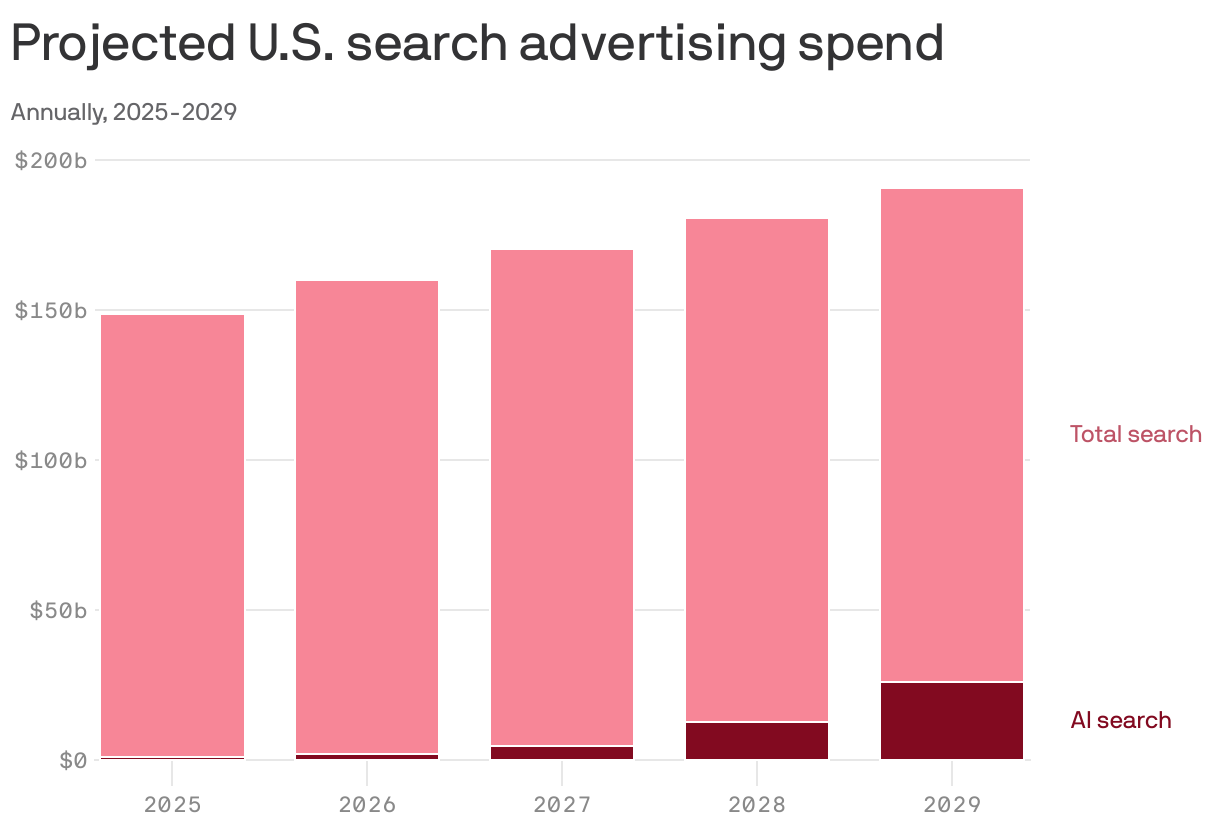
The $350 billion global search advertising industry will grow even faster during the AI era, thanks to new capabilities to make search queries more dimensional and multimodal.
Why it matters: The search ad business model of targeting based on keywords and evaluating success based on last-click attribution has barely evolved over the past three decades. It isn't going away, but it's about to get a whole lot more sophisticated.
By the numbers: In the U.S., $25.9 billion is expected to be spent on AI search ads in 2029, per eMarketer, up from just $1 billion this year.
- By 2029, AI search ad spending will make up 13.6% of all search ad spending, up from just 0.7% this year.
How it works: Traditional keyword search targeting put a lot of pressure on advertisers to constantly test and optimize their ad campaigns based on a set of keywords they preselected.
- In the AI era, there are far more opportunities for advertisers to get in front of new users, including ones they may not have thought to target with a set of predetermined keywords.
Sign up for Media Trends to read the full report.
4. Training data
- Oracle's stock skyrocketed yesterday on reports of record income in its cloud AI business, despite questions around AI's long-term profitability. (Axios)
- Though it's been clear that YouTube videos have been used to train various AI systems, The Atlantic has fresh details on just how widespread the usage has been and the implications, especially for the creator economy.
- Driverless vehicle company Zoox, which is owned by Amazon, launched a limited robotaxi service in Las Vegas, with San Francisco due next. (Forbes)
5. + This
The world's smallest snake was rediscovered during an ecological survey in Barbados earlier this year.
Thanks to Scott Rosenberg and Megan Morrone for editing this newsletter and Anjelica Tan for copy editing.
Sign up for Axios AI+