Axios AI+

July 28, 2025

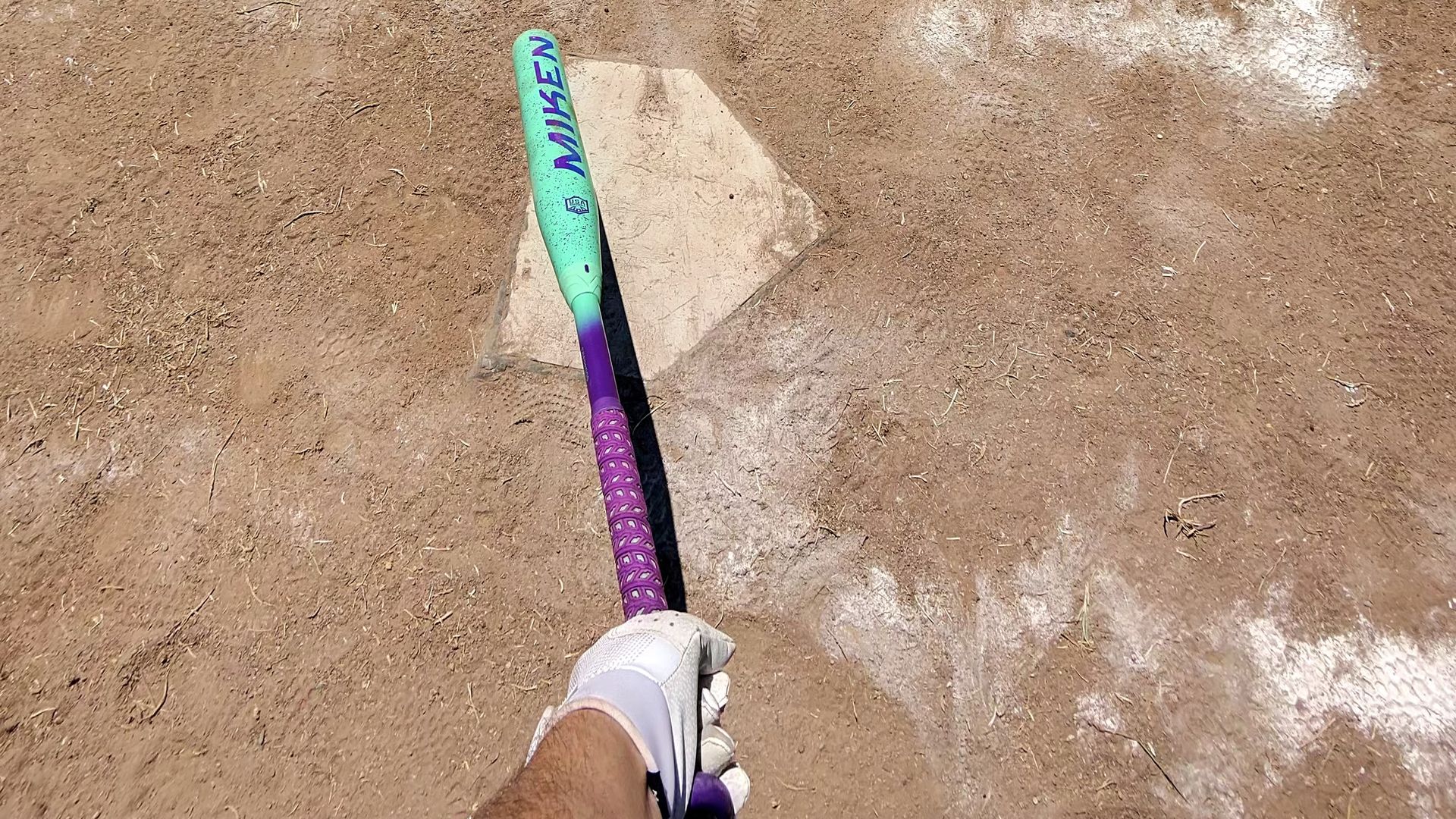
I had a blast playing softball all weekend at a tournament — and capturing my pitcher's-eye view via Ray-Ban Meta smart glasses. Today's AI+ is 1,184 words, a 4.5-minute read.
1 big thing: AI's global race in the dark
The U.S.'s great AI race with China, now freshly embraced by President Trump, is a competition in the dark with no clear prize or finish line.
Why it matters: Similar "races" of the past — like the nuclear arms race and the space race — have sparked innovation, but victories haven't lasted long or meant much.
The big picture: Both Silicon Valley and the U.S. government now agree that we must invest untold billions to build supporting infrastructure for an error-prone, energy-hungry technology with an unproven business model and an unpredictable impact on the economy and jobs.
What they're saying: "America is the country that started the AI race. And as president of the United States, I'm here today to declare that America is going to win it," Trump said at an event last week titled "Winning the AI Race."
- Policy experts and industry leaders who promote the "race" idea argue that the U.S. and China are in a head-to-head competition to win the future of AI by achieving research breakthroughs, establishing the technology's standards and breaking the AGI or "superintelligence" barrier.
- They suggest that the world faces a binary choice between free, U.S.-developed AI imbued with democratic values or a Chinese alternative that's under the thumb of the Communist Party.
Flashback: The last time a scientific race had truly world-shaping consequences was during the Second World War, as the Manhattan Project beat the Nazis to the atomic bomb.
- But Germany surrendered well before the U.S. had revealed or made use of its discovery.
- The nuclear arms race with the Soviet Union that followed was a decades-long stalemate that cost fortunes and more than once left the planet teetering on an apocalyptic brink.
The 1960s space race was similarly inconclusive.
- Russia got humanity into space ahead of the U.S., but the U.S. made it to the moon first.
- Once that leg of the race was over, both countries retreated from further human exploration of space for decades.
State of play: With AI, U.S. leaders are once again saying the race is on — but this time the scorecard is even murkier.
- "Build a bomb before Hitler" or "Put a man on the moon" are comprehensible objectives, but no one is providing similar clarity for the AI competition.
- The best the industry can say is that we are racing toward AI that's smarter than people. But no two companies or experts have the same definition of "smart" — for humans or AI models.
- We can't even say with confidence which of any two AI models is "smarter" right now, because we lack good measures and we don't always know or agree on what we want the technology to do.
Between the lines: The "beat China" drumbeat is coming largely from inside the industry, which now has a direct line to the White House via Trump's AI adviser, David Sacks.
- "Whoever ends up winning ends up building the AI rails for the world," OpenAI chief global affairs officer Chris Lehane said at an Axios event in March.
- Arguing for controls on U.S. chip exports to China earlier this year, Anthropic CEO Dario Amodei described competitor DeepSeek as "beholden to an authoritarian government that has committed human rights violations, has behaved aggressively on the world stage, and will be far more unfettered in these actions if they're able to match the U.S. in AI."
Yes, but: In the era of the second Trump administration, many Americans view their own government as increasingly authoritarian.
- With Trump himself getting into the business of dictating the political slant of AI products, it's harder for America's champions to sell U.S. alternatives as more "free."
China has been catching up to the U.S. in AI research and development, most tech experts agree. They see the U.S. maintaining a shrinking lead of at most a couple of years and perhaps as little as months.
- But this edge is largely meaningless, since innovations propagate broadly and quickly in the AI industry.
- And cultural and language differences mean that the U.S. and its allies will never just switch over to Chinese suppliers even if their AI outruns the U.S. competition.
- In this, AI is more like social media than like steel, solar panels or other fungible goods.
The bottom line: The U.S. and China are both going to have increasingly advanced AI in coming years. The race between them is more a convenient fiction that marshals money and minds than a real conflict with an outcome that matters.
2. Zuckerberg details superintelligence plans
Shengjia Zhao — formerly of OpenAI — is the new chief scientist at Meta's Superintelligence Lab, Mark Zuckerberg announced Friday on Threads.
Why it matters: The company is spending billions of dollars to hire key employees as it looks to jumpstart its effort and compete with Google, OpenAI and others.
What they're saying: "In this role, Shengjia will set the research agenda and scientific direction for our new lab working directly with me and Alex," Zuckerberg wrote on Threads, meaning former Scale CEO Alexandr Wang.
Catch up quick: In addition to pay packages reportedly worth up to hundreds of millions of dollars per person in some cases, the company is investing $14.3 billion to take a 49% stake in Scale AI and hire Wang.
- The company has been poaching talent from across the industry, nabbing key folks from Apple, OpenAI and Ilya Sutskever's Safe Superintelligence.
- From Apple, Meta grabbed AI experts Mark Lee and Tom Gunter, after hiring their boss, Ruoming Pang, former head of Apple's LLM team, Bloomberg reported.
- Meta also hired Tianhe Yu, Cosmo Du and Weiyue Wang, three of the engineers that worked on the Gemini model that achieved gold medal performance at last week's International Mathematical Olympiad, right after the results were announced, per The Information.
Between the lines: Hiring talent is just one part of the equation, of course.
- "We're also going to invest hundreds of billions of dollars into compute to build superintelligence," Zuckerberg said in a July 14 Threads post. "We have the capital from our business to do this."
3. What news sources AI chatbots read

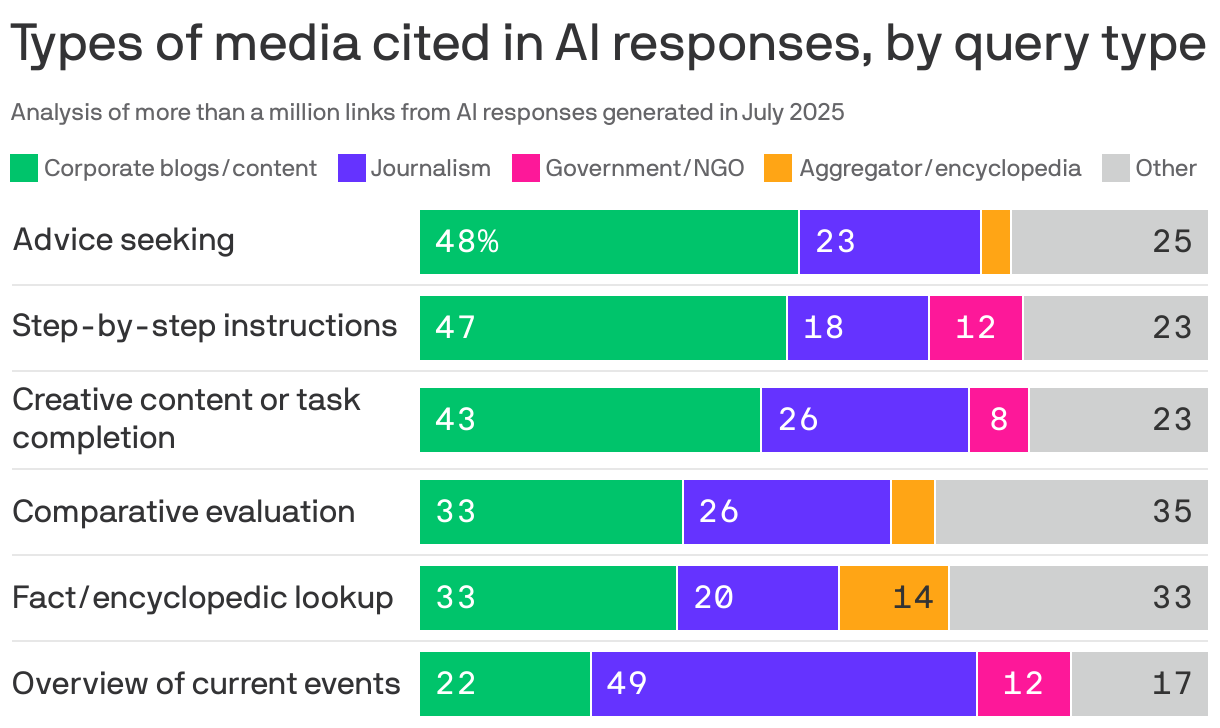
News stories or content generated by external sources like journalists, influencers, customers, or the general public are the top sources for AI bots like ChatGPT, Claude and Gemini, a new Muck Rack report finds.
Why it matters: AI is increasingly being used for search, and how a brand, company or public figure shows up in AI-generated responses could impact their ability to attract customers, investors and talent.
By the numbers: Muck Rack input more than 1 million realistic user prompts into ChatGPT, Gemini and Claude and analyzed the citations.
Between the lines: A key difference between AI-generated search results and traditional SEO is that paid marketing and sponsored links rarely populate AI results.
4. Training data
- Venture investment in AI agents — especially in the enterprise — is soaring in 2025. (Axios)
- IBM CEO Arvind Krishna says companies will need more people, not less, as AI increases productivity. (Axios)
- Austin's exclusive AI private school — known as Alpha School — will spread to a dozen additional cities this fall. (New York Times)
5. + This
Here's just one of the hundreds of photos and videos I took from the glasses during five games of softball.
Thanks to Scott Rosenberg and Megan Morrone for editing this newsletter and Matt Piper for copy editing.
Sign up for Axios AI+